

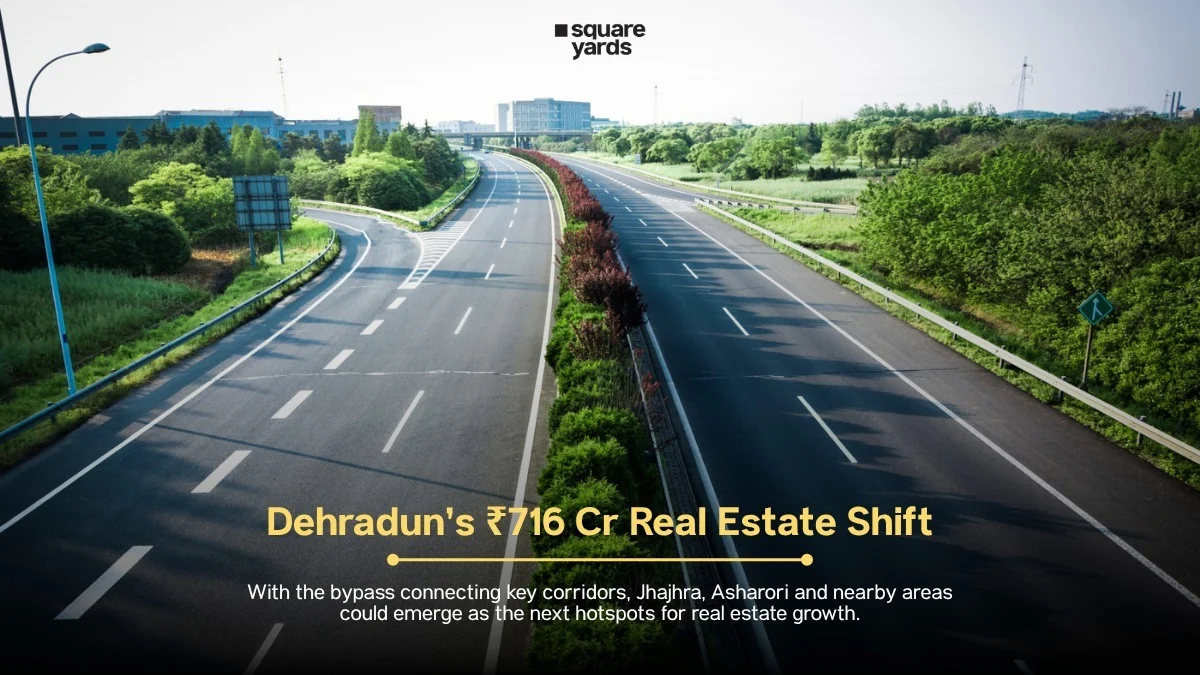
Dehradun | September 3, 2026 — The landscape of the Doon Valley is undergoing a profound structural transformation. Long celebrated as a quiet "retirement paradise" and a gateway to the Himalayas, Dehradun is now transitioning into a high-velocity urban hub. At the heart of this evolution is the ₹716 crore Dehradun Bypass, a project that—when coupled with the massive Delhi-Dehradun Economic Corridor—is poised to fundamentally recalibrate the region’s real estate market, logistics potential, and urban blueprint.
As the city grapples with the pressures of rapid urbanization, this 12-kilometer infrastructure marvel represents more than just asphalt and concrete; it is the catalyst for a new "peripheral economy" that promises to shift the center of gravity away from the congested city core toward emerging suburban frontiers.
1. Main Facts: The Blueprint of Connectivity
The Dehradun Bypass is a 12-kilometer, four-lane, access-controlled expressway designed to serve as a critical artery for the state of Uttarakhand. Developed with an investment of approximately ₹716 crore, the project is strategically engineered to bypass the dense urban traffic of Dehradun, providing a seamless transition for long-distance commuters and freight.
Key Technical Specifications:
- Route: The bypass originates at Jhajhra and terminates at the Asharori check post.
- Interconnectivity: It serves as the vital link between the Delhi-Dehradun Economic Corridor and the Paonta Sahib-Ballupur section of NH-7.
- Design: It is an access-controlled corridor, meaning limited entry and exit points to ensure high-speed traffic flow and minimal local interference.
- Objective: The primary goal is to divert heavy transit traffic traveling between Delhi, Western Uttar Pradesh, Himachal Pradesh, Punjab, and Haryana, preventing these vehicles from entering Dehradun’s city center.
By streamlining the flow of goods and people, the bypass is expected to reduce travel time across the valley by 30-40 minutes during peak hours, significantly lowering the carbon footprint of idling vehicles in the city’s bottleneck areas like Saharanpur Road and Rajpur Road.
2. Chronology: From Vision to Execution
The journey toward this infrastructure milestone has been a multi-year effort, reflecting a broader national push to integrate Tier-2 cities into the primary economic grid.
- December 2021: The foundation stone for the Delhi-Dehradun Economic Corridor was laid by Prime Minister Narendra Modi. This ₹12,000+ crore project set the stage for ancillary infrastructure, including the Dehradun Bypass.
- 2022-2023: Land acquisition and environmental clearances for the Jhajhra-Asharori stretch were prioritized. The project was fast-tracked as part of the Bharatmala Pariyojana phase.
- 2024-2025: Construction commenced in phases. Engineering challenges, including the rugged terrain of the Shivalik foothills and the need for wildlife-sensitive construction near the Asharori forest range, were addressed.
- Current Status (September 2026): The project is in an advanced stage of construction. Paving and bridge-work on major intersections are nearing completion.
- Target Completion: The Ministry of Road Transport and Highways (MoRTH) has set a firm deadline of April 2027 for the bypass to be fully operational.
This timeline illustrates a rapid transition from planning to execution, a pace that has caught the attention of institutional investors and real estate developers who typically look for such "hard" infrastructure markers before committing capital.
3. Supporting Data: The Real Estate Ripple Effect
The impact of the bypass is already being reflected in property inquiries and land valuation across the Doon Valley. Market data suggests a clear "anticipatory rise" in prices along the project’s influence zone.
Real Estate Valuation Trends
According to recent data from Square Yards and local market analysts, the pricing spectrum in Dehradun is shifting:
- Sahastradhara Road: Currently hovering between ₹2,500 and ₹3,500 per sq. ft. While not directly on the bypass, this area is seeing increased interest as the bypass promises to decongest the city roads leading to it.
- Jhajhra and Premnagar: Historically considered the outskirts, these areas have seen a 15-20% year-on-year increase in land queries.
- The "Corridor Effect": The Delhi-Dehradun Economic Corridor has already slashed travel time from 6 hours to roughly 2.5 hours. This 58% reduction in travel time has made Dehradun a viable "weekend home" or "satellite office" location for the Delhi-NCR elite.
Logistics and Warehousing
The Asharori-Doiwala belt is emerging as a "Logistics Goldmine." With the bypass connecting to the Delhi corridor, the demand for warehousing space has surged. Estimates suggest a 30% increase in demand for Grade-A warehousing facilities in the next 24 months, driven by e-commerce players looking for a base to serve Uttarakhand and Himachal Pradesh.
4. Official Responses and Expert Insights
Government officials and industry experts view the bypass as the "missing piece" in Dehradun’s master plan.
From the NHAI (National Highways Authority of India):
A senior official involved in the project noted, "The Dehradun Bypass is not just a road; it is a decompression chamber for the city. By the time we reach the April 2027 completion date, we expect to have diverted nearly 40% of the commercial traffic that currently chokes the Rajpur and Saharanpur arteries."
The Developer’s Perspective:
Local real estate consultants argue that the bypass is creating a "New Dehradun." "We are seeing a shift from vertical congestion in the city center to horizontal expansion in the periphery," says a lead analyst at a regional property firm. "Investors are no longer looking at the Mall Road; they are looking at Jhajhra for residential townships and Asharori for commercial hubs."
Civic Authorities:
The Dehradun Mussoorie Development Authority (DMDA) has signaled that future zoning laws may be adjusted to accommodate the growth along these corridors, focusing on "Transit-Oriented Development" (TOD) to ensure that the growth is organized rather than sporadic.
5. Implications: The Future of the Doon Valley
The long-term implications of the ₹716 crore bypass extend far beyond traffic management. They touch upon the socio-economic fabric of the region.
A. The Decentralization of Dehradun
For decades, Dehradun’s growth was concentrated in a few pockets. The bypass forces a decentralization.
- Jhajhra: This area is likely to transform into an educational and residential hub, given its proximity to existing institutions and the new ease of access to the NH-7.
- Asharori: As the gateway to the Delhi-Dehradun Economic Corridor, Asharori is destined to become the commercial face of the city, potentially hosting business parks and hospitality projects.
- Doiwala: Improved regional connectivity will likely turn Doiwala into a premium residential zone for those who want to stay connected to the airport and the capital simultaneously.
B. The Rental Market and Liveability
While land prices are rising, the rental market is expected to follow a more "measured" trajectory. Rental yields will only spike once the commercial infrastructure—offices, malls, and schools—catches up with the road connectivity. For the average resident, the biggest implication is "liveability." Reduced traffic in the city core means less noise, lower pollution levels, and a return to the "garden city" charm that Dehradun was once famous for.
C. Risks and Environmental Considerations
However, this growth is not without its perils.
- Land Speculation: Artificial price bloating could make housing unaffordable for the local population.
- Infrastructure Lag: While the roads are being built, civic amenities like water supply, sewage systems, and waste management in peripheral areas must keep pace.
- Environmental Impact: The Doon Valley is ecologically sensitive. The construction near forest zones (like Asharori) requires strict adherence to environmental safeguards to prevent human-wildlife conflict and maintain the valley’s biodiversity.
D. The Economic Multiplier
The bypass acts as a multiplier for the state’s GDP. By facilitating faster movement of agricultural produce from the hills to the plains and industrial goods from the plains to the hills, it reduces logistics costs, making Uttarakhand more competitive for manufacturing and trade.
Conclusion: A Strategic Pivot
The Dehradun Bypass, though only 12 kilometers in length, carries the weight of the city’s future. It is the final link in a chain that connects the quiet hills of Uttarakhand to the economic powerhouse of the National Capital Region.
For the real estate sector, the message is clear: the periphery is the new center. For the resident, the promise is one of reduced congestion and restored serenity. As the April 2027 deadline approaches, the Doon Valley stands at a crossroads—moving away from its identity as a sleepy hill station and toward its destiny as a modern, connected, and economically vibrant urban ecosystem. Success, however, will depend on whether the city’s civic infrastructure can match the high-speed pace set by its new expressways.
