

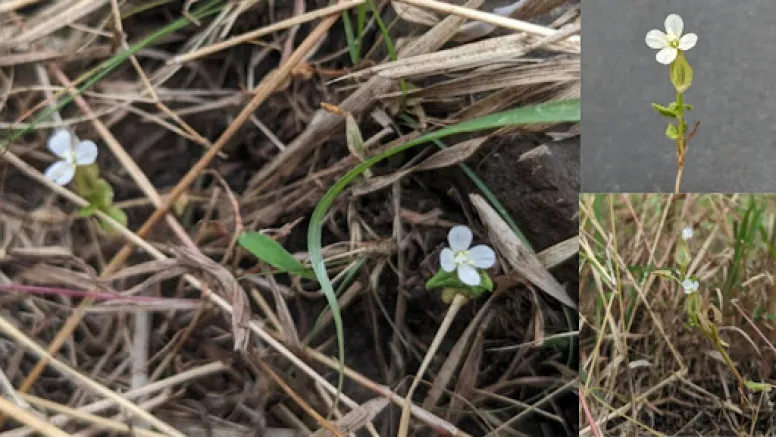
PUNE — In the rugged, sun-drenched landscapes of the Deccan Plateau, where the wind sweeps across grassy hills and seasonal fires blacken the earth, a tiny botanical marvel has emerged to challenge long-standing environmental narratives. Researchers from the Indian Institute of Science Education and Research (IISER) Pune and the Savanna Science Foundation have announced the discovery of a new plant species, Canscora agni, a find that does more than just add a name to the global register of flora—it provides a critical window into the misunderstood beauty and ecological necessity of India’s savanna ecosystems.
The discovery, made on the outskirts of Pune at Sus Hill, serves as a stark reminder of the hidden biodiversity thriving in what are often dismissed as "wastelands." Named after the Sanskrit and Marathi word for fire, Canscora agni is a testament to the resilience of species that have evolved to coexist with, and even depend upon, the very flames that modern conservation often seeks to extinguish.
Main Facts: A Discovery a Decade in the Making
The discovery of Canscora agni was not an overnight success but the culmination of a decade of meticulous fieldwork and comparative analysis. Led by researchers Ashish N. Nerlekar and Sharad Suresh Kambale, the team first encountered the plant during routine vegetation surveys of the old-growth savannas in Maharashtra.
The plant belongs to the family Gentianaceae, a group known for its diverse and often striking floral displays. However, Canscora agni is notable for its diminutive stature. While its closest relative, Canscora alata, can reach heights of 60 centimeters, this new species is a "dwarf herb," rarely exceeding 10 centimeters. This physical adaptation is common among plants in high-stress environments where staying low to the ground provides protection from wind and allows for rapid life cycles between fire intervals.

The researchers have proposed that the species be classified as "Critically Endangered" under the International Union for Conservation of Nature (IUCN) criteria. This recommendation stems from the fact that the plant has currently been documented in only one highly localized area—Sus Hill—which is under immediate threat from urban expansion and misguided environmental policies.
Chronology: From Misidentification to New Species
The journey to identifying Canscora agni began over ten years ago when Nerlekar and Kambale first spotted the small herb with white petals and peculiarly winged stems. At the time, the specimens were tentatively identified as Canscora alata, a well-documented species found across various parts of India.
However, the researchers noted subtle discrepancies that did not align with existing botanical literature. Over the subsequent decade, the team engaged in a rigorous process of verification:
- Field Observation (2014–2024): The researchers monitored the population at Sus Hill across multiple seasons to understand its growth patterns, flowering cycles, and response to environmental triggers like the monsoon and fire.
- Herbarium Comparison: The team consulted historical plant records and global catalogs, including Kew’s Herbarium and the Botanical Survey of India. They compared their live specimens with the original "type" specimens of C. alata—the physical plant used to originally describe the species centuries ago.
- Morphological Analysis: Using high-resolution microscopy and detailed measurements, the team identified unique physical traits—such as glandular hairs and specific vein patterns—that were entirely absent in C. alata.
- Formal Publication (2026): After confirming that the plant was genetically and morphologically distinct, the findings were published, officially introducing Canscora agni to the scientific community.
Supporting Data: Morphological Distinctions
The scientific validity of Canscora agni rests on several distinct morphological features that differentiate it from its taller cousin, C. alata. These differences are not merely aesthetic; they represent evolutionary adaptations to the specific micro-climate of the Pune savannas.

- Stature and Foliage: C. agni is a dwarf herb (max 10 cm) compared to C. alata (up to 60 cm). Its leaves are significantly smaller, measuring a maximum of 11 millimeters in length, and are fewer in number.
- The "Wings": Both species feature "winged" stems—longitudinal protrusions that run along the stalk. However, in C. agni, these wings are unevenly distributed, appearing wider just below the flowers and narrowing significantly toward the base of the stem.
- Microscopic Details: A defining characteristic of the new species is the presence of minute glandular hairs on the leaf surfaces. These hairs often serve to deter insects or prevent water loss. Furthermore, the calyx (the base of the flower) in C. agni displays distinct reticulate (web-like) veins on its wide wings, a trait missing in C. alata.
- Reproductive Organs: The ovary of C. agni is shorter than that of its relatives, suggesting a specialized reproductive strategy suited for its short life cycle.
Official Responses and Ecological Context
The naming of the plant—agni—is a deliberate political and scientific statement. In India, fire is frequently viewed by forest departments and the public as a purely destructive force. However, savanna ecologists argue that fire is a "natural herbivore" that maintains the health of these ecosystems.
"The name was chosen to challenge the popular belief that all fires are destructive," the researchers noted in their study. In the ancient savannas of the Deccan, natural or controlled fires prevent woody encroachment—the process where trees and thick shrubs take over grassy areas, shading out the sun-loving herbs and grasses that define the savanna.
The Savanna Science Foundation has raised concerns regarding India’s current land-management policies. Programs like the "Green India Mission," which promote large-scale tree planting (afforestation), often target savannas because they are classified as "wastelands" in government records. By planting trees in these naturally open spaces, the government inadvertently destroys the habitat of specialized species like Canscora agni.
"We are essentially suffocating these ecosystems in the name of ‘greening’ the planet," says an ecological consultant familiar with the study. "A savanna is not a degraded forest; it is a complex, ancient biome that requires light and occasional fire to survive."

Implications: The Future of Savanna Conservation
The discovery of Canscora agni has profound implications for how India manages its non-forest biomes. As the species is currently known only from Sus Hill, its survival is precariously tied to the fate of a single geographic feature.
1. Redefining "Wastelands"
For decades, the Revenue Department of India has classified rocky outcrops and grassy hills as "wastelands." This classification makes them prime targets for industrial development, urban sprawl, or "compensatory afforestation." The presence of a Critically Endangered species like C. agni provides legal and scientific leverage to argue for the protection of these lands as high-value biodiversity zones.
2. Policy Shift in Fire Management
The discovery underscores the need for a nuanced fire policy. Rather than a "zero-fire" approach, which leads to the accumulation of dry fuel and eventually more catastrophic, uncontrolled wildfires, researchers advocate for "prescribed burning." This traditional management technique mimics natural fire cycles, ensuring that species like C. agni can continue their life cycles without being overtaken by invasive woody plants.
3. The Threat of Misguided Afforestation
The researchers highlight a paradoxical threat: the push for carbon sequestration through tree planting. When trees are planted in savannas, they alter the soil chemistry, deplete groundwater, and eliminate the open-canopy environment required by dwarf herbs. For Canscora agni, a "Green India" could mean extinction.

4. Urban Biodiversity Awareness
Located in Pune, one of India’s fastest-growing metropolitan hubs, Sus Hill is a microcosm of the conflict between development and nature. The discovery of a new species in such close proximity to an urban center suggests that there may be many more undiscovered species waiting to be found in India’s "backyard" ecosystems—provided they aren’t paved over first.
Conclusion
Canscora agni is more than just a tiny herb with white flowers; it is a biological messenger. It tells a story of adaptation, of the ancient relationship between flora and flame, and of the urgent need to look closer at the landscapes we often ignore. As the scientific community rallies to protect this "Critically Endangered" treasure, the message to policymakers is clear: conservation cannot be a one-size-fits-all approach. To save the agni (fire) plant, we must first learn to respect the fire that sustains it.
The researchers from IISER Pune and the Savanna Science Foundation continue their work, hoping that the recognition of Canscora agni will lead to the formal protection of Sus Hill and a broader appreciation for the golden, fire-forged savannas of the Indian subcontinent.
