

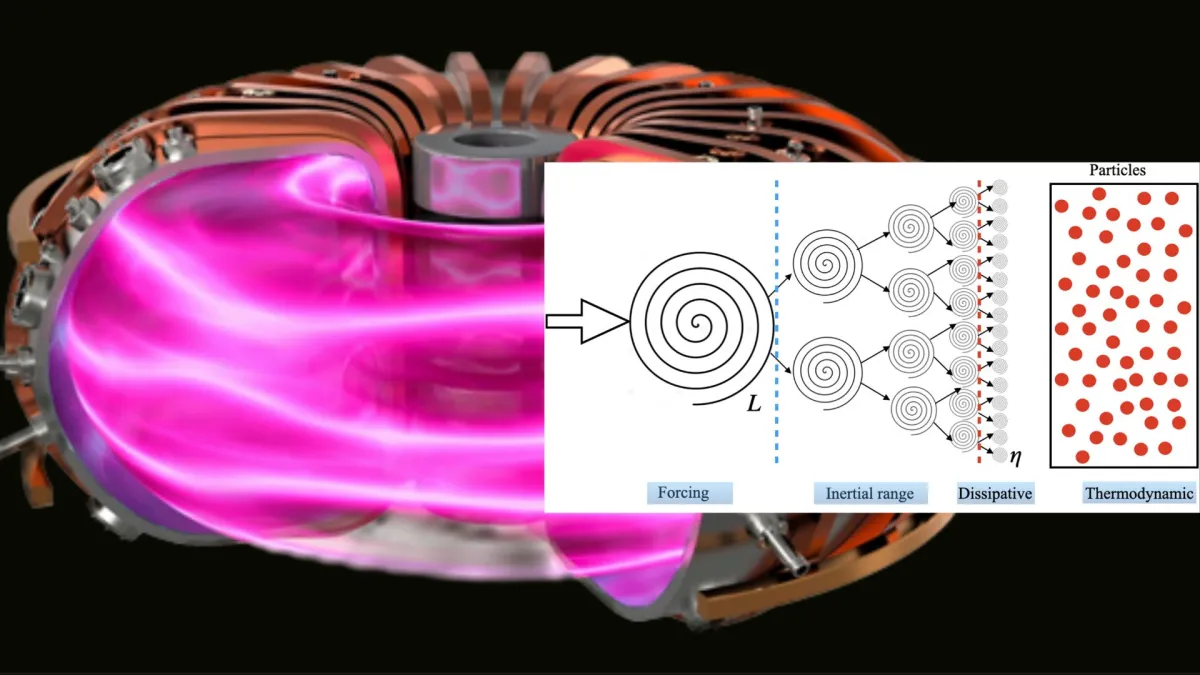
In the vast, churning expanse of the cosmos—from the majestic rings of Saturn to the searing heart of a supernova—and within the high-tech confines of experimental fusion reactors, a common enemy persists: turbulence. For decades, the chaotic motion of fluids and gases has remained one of the most significant unsolved problems in classical physics. However, a groundbreaking study led by researchers from the Indian Institute of Technology (IIT) Jammu and IIT Kanpur has recently peeled back the veil on this mystery.
By tracking the individual trajectories of millions of microscopic particles in a specialized state of matter known as "dusty plasma," the team has provided a revolutionary bottom-up view of how chaos begins, evolves, and eventually dissipates into heat. This research does more than just solve a physics puzzle; it provides a roadmap for the future of clean energy and our understanding of the universe’s most violent events.
Main Facts: A Breakthrough in Molecular Dynamics
The research, published recently by a collaborative team from IIT Jammu and IIT Kanpur, utilizes massive supercomputer simulations to observe the "roots" of turbulence. Unlike traditional studies that view fluids as a continuous, smooth substance, this study utilized a particle-resolved approach.
The Fourth State of Matter with a Twist
To understand the breakthrough, one must first understand the medium: plasma. Often called the fourth state of matter, plasma is created when atoms are stripped of their electrons, resulting in a soup of ions and free-moving electrons. When microscopic solid dust grains are introduced into this environment, they become "dusty plasmas." These grains pick up high negative charges, creating a complex system where the dust particles interact through powerful electrical forces.
Key Discoveries
The researchers focused on two primary types of fluid instability: the Kelvin-Helmholtz instability (which occurs when layers of fluid slide past each other) and the Rayleigh-Taylor instability (which occurs when a heavy fluid sits atop a lighter one).

The study’s most significant findings include:
- Viscoelasticity: Strongly coupled dusty plasmas do not behave like simple gases; they act like "viscoelastic" materials, possessing the ability to flow like liquids but also to stretch and snap back like elastic rubber.
- Thermalization Delay: The stronger the electrical interaction between particles, the slower the process of "thermalization"—the point where large-scale swirling energy turns into microscopic heat.
- The Bridge to Continuum: The team successfully demonstrated that the smooth, macroscopic flow we see in nature can be accurately reconstructed by simulating the chaotic movements of billions of individual atoms and molecules.
Chronology: The Evolution of Turbulence Theory
The journey to this discovery is rooted in over a century of fluid dynamics research. Traditionally, scientists have relied on the Navier-Stokes equations to predict how fluids move. These equations treat water, air, or plasma as a "continuum"—a smooth, unbroken substance.
The Limits of the Continuum (19th Century – Present)
While Navier-Stokes equations are remarkably accurate for predicting weather or designing aircraft wings, they begin to break down at the microscopic scale. They cannot account for the "graininess" of matter. When energy flows from a large vortex down to the smallest scales, these traditional equations struggle to explain exactly how that energy vanishes.
The Rise of Molecular Dynamics (Late 20th Century)
With the advent of high-performance computing, scientists began using Molecular Dynamics (MD) simulations. Instead of solving general equations for a whole fluid, MD tracks every single particle. However, for decades, the computational power required to simulate enough particles to represent a real-world fluid was unavailable.
The Current Breakthrough (2024-2026)
Leveraging the Large-scale Atomic/Molecular Massively Parallel Simulator (LAMMPS), the researchers at IIT Jammu and IIT Kanpur achieved what was once impossible. By simulating up to a billion particles simultaneously on high-performance computing clusters, they were able to bridge the gap between the microscopic jiggling of atoms and the macroscopic swirling of a storm. This marked the transition from theoretical "toy models" to high-fidelity simulations that mirror the physical reality of dusty plasmas.

Supporting Data: Simulating the Architecture of Chaos
The technical core of the study lies in the team’s ability to map the "energy spectrum" of the plasma flow. In physics, the energy spectrum acts as a fingerprint, showing how kinetic energy is distributed across different scales—from massive, slow-moving eddies to tiny, rapid ripples.
Modeling Instabilities
The team used the LAMMPS tool to recreate two iconic scenarios:
- The Kelvin-Helmholtz (KH) Simulation: Replicating the effect of wind over water, the team simulated two layers of plasma moving in opposite directions. They observed the formation of "billow" clouds—vortices that eventually break down into smaller and smaller structures.
- The Rayleigh-Taylor (RT) Simulation: Replicating the effect of oil on water, they placed a dense layer of plasma over a less dense one. Gravity causes "fingers" of the heavy fluid to sink while bubbles of the light fluid rise.
The Role of Electrical Coupling
A critical data point in the study was the "coupling parameter." When the electrical forces between dust grains are weak, the plasma behaves like a gas. However, as the coupling grows stronger, the particles become "locked" in a dance with their neighbors.
- Data Finding: In strongly coupled states, the energy spectrum showed a significant delay in the decay of vortices. The "elasticity" of the plasma acted as a buffer, preventing the energy from dissipating quickly into heat. This phenomenon is known as elastic turbulence, a state typically reserved for complex polymers like melted plastics.
2D vs. 3D Dynamics
While the current study focused primarily on 2D simulations (representing flat layers of plasma often found in laboratory settings), the team analyzed the mathematical differences. In 2D, energy often moves from small scales to large scales (an inverse cascade), whereas in 3D, it moves from large to small. The researchers noted that while 3D simulations are the "holy grail," the 2D results provided the first-ever particle-resolved evidence of how these instabilities reach thermal equilibrium.
Official Responses and Research Context
The research community has hailed this as a "bridge-building" study. While official statements from the institutes emphasize the collaborative nature of the work, the lead researchers point to the importance of the "bottom-up" approach.

According to the study’s framework, the goal was never just to watch particles move, but to prove that the Navier-Stokes behavior (smooth flow) emerges naturally from Newtonian behavior (individual particle collisions). By using the LAMMPS simulator, the team demonstrated that if you have enough particles and enough computing power, the "graininess" of the universe eventually smooths out into the fluids we recognize.
The researchers from IIT Jammu and IIT Kanpur noted that this method allows scientists to study "exotic flows"—environments where standard fluid descriptions simply do not exist, such as the edges of black holes or the ultra-dense matter inside a fusion core.
Implications: From Clean Energy to the Cosmos
The ramifications of this study extend far beyond the laboratory, offering potential solutions to some of the most pressing challenges in science and engineering.
1. The Quest for Nuclear Fusion
Nuclear fusion—the process of fusing hydrogen atoms to create helium—holds the promise of near-limitless clean energy. However, sustaining a fusion reaction requires keeping plasma at millions of degrees Celsius. Turbulence is the primary reason heat "leaks" out of the magnetic bottles (tokamaks) used to hold the plasma. By understanding the microscopic roots of how plasma turns motion into heat, engineers can develop more stable containment fields, bringing us closer to a viable fusion power plant.
2. Astrophysical Insights
The Rayleigh-Taylor instability is a driving force in the death of stars. When a star goes supernova, layers of different densities push against each other, creating the massive, turbulent clouds of gas we see through telescopes like the James Webb. This research provides astrophysicists with a more granular model to predict how energy and elements are distributed across the galaxy during these cataclysmic events.

3. Planetary Science and Geology
Dusty plasmas are not just laboratory curiosities; they exist in the rings of Saturn and in the plumes of volcanic eruptions. In a volcano, ash particles become highly charged, creating a dusty plasma environment. Understanding the "elastic" nature of these mixtures can help geologists better predict the flow of pyroclastic surges and the distribution of volcanic ash in the atmosphere.
4. Advanced Manufacturing
The study’s findings on "elastic turbulence" have direct applications in the manufacturing of complex fluids. From the production of liquid plastics to the development of new pharmaceuticals, understanding how microscopic particles influence the macroscopic flow of a substance allows for more precise control over chemical reactions and material strength.
Conclusion: A New Lens on the Universe
The work of the IIT Jammu and IIT Kanpur teams represents a paradigm shift in how we view chaos. By proving that the chaotic movement of billions of individual particles can be mapped and understood, they have provided a new lens through which to view the universe. Turbulence is no longer just a "mess" to be avoided; it is a complex, structured process that can be decoded grain by grain. As supercomputing power continues to grow, the ability to simulate the world from the bottom up will undoubtedly unlock further secrets of the fourth state of matter and the fundamental forces that shape our reality.
