

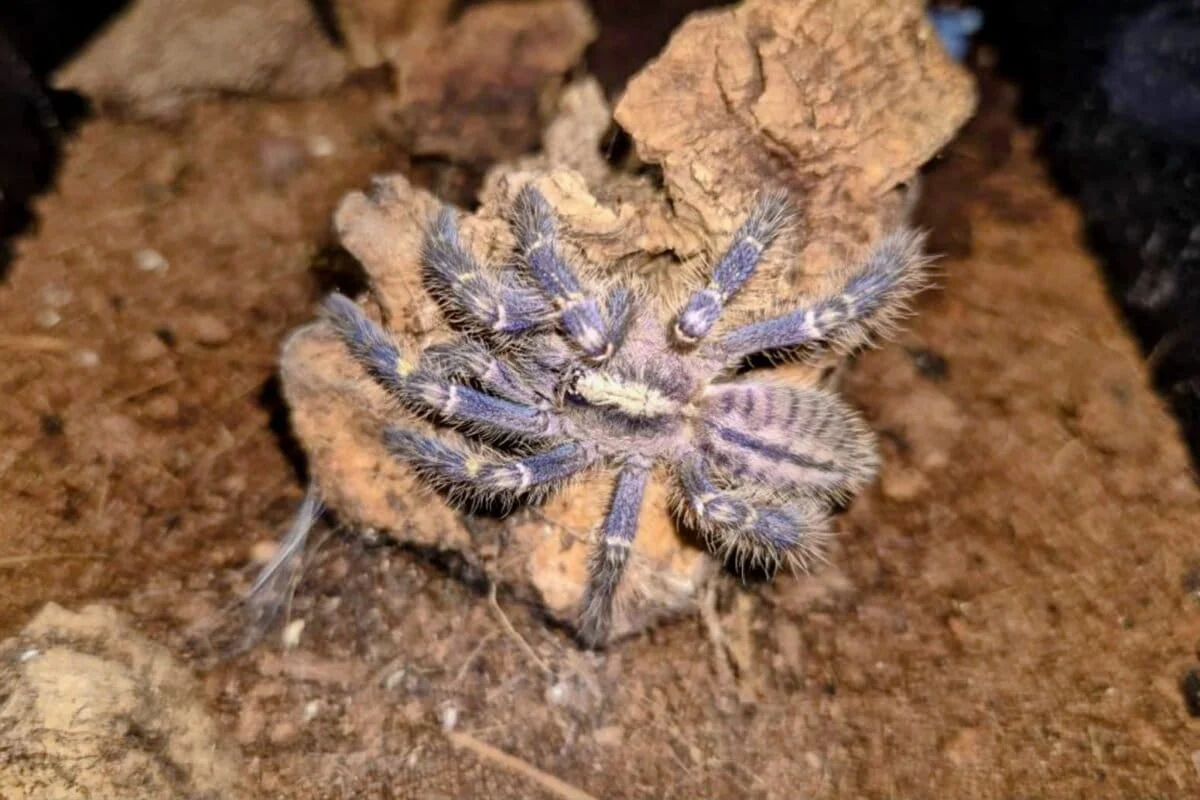
SRISAILAM, ANDHRA PRADESH – In the dappled sunlight of the dry deciduous forests of the Eastern Ghats, a biological treasure—often overlooked by the casual observer—clings to the hollows of ancient trees. The Peacock Tarantula (Poecilotheria metallica), a creature of startling iridescent beauty, is currently the focus of a landmark conservation initiative. The Andhra Pradesh Forest Department, in a strategic partnership with the non-profit Eastern Ghats Wildlife Society (EGWS), has officially launched an intensive conservation survey within the Nagarjunasagar-Srisailam Tiger Reserve (NSTR) and its surrounding forest divisions.
This ambitious project aims to pull the "Gooty Sapphire" back from the brink of extinction, addressing the dual threats of habitat degradation and a voracious international illegal pet trade. As one of the most striking arachnids on the planet, the Peacock Tarantula serves as a flagship species for the often-neglected invertebrate biodiversity of the Eastern Ghats.
Main Facts: The "Sapphire" of the Arachnid World
The Peacock Tarantula is not merely another spider; it is a biological marvel. First described by British arachnologist Reginald Innes Pocock in 1899, the species is renowned for its vibrant metallic blue coloration, accented with intricate patterns of lemon yellow and stark white on its legs and abdomen. It remains the only species within the Poecilotheria genus to exhibit this specific shade of sapphire blue.
Conservation Status and Range
Despite its visual splendor, the species is currently classified as Critically Endangered on the International Union for Conservation of Nature (IUCN) Red List. This designation indicates that the species faces an extremely high risk of extinction in the wild. Its distribution is remarkably narrow, being endemic to a small fraction of the Eastern Ghats in Andhra Pradesh. While historically associated with Gooty—where the type specimen was collected at a railway station—its true primary habitats are the Nandyal and Giddalur forest divisions, as well as the rugged terrain of the Seshachalam hills.
Biological Profile
The Peacock Tarantula is a purely arboreal (tree-dwelling) species. Unlike many other tarantulas that burrow into the earth, P. metallica seeks sanctuary in the natural hollows, crevices, and peeling bark of old-growth trees. They are nocturnal predators, playing a vital role in the ecosystem by controlling insect populations. However, their specialized microhabitat requirements make them exceptionally vulnerable to environmental changes.
Chronology: From Discovery to Modern Conservation
The history of the Peacock Tarantula is a saga of long absences and sudden rediscoveries, highlighting how little is known about India’s invertebrate wonders.
- 1899: The species is first recorded by R.I. Pocock. The specimen was found in Gooty, Andhra Pradesh, which led to its common name, the "Gooty Sapphire." Interestingly, it is believed the specimen may have been transported to the Gooty rail station via timber logs from the nearby hills, as the immediate vicinity of Gooty does not match its natural habitat.
- 1900s – 2000: For over a century, the species remained largely elusive to the scientific community, with very few documented sightings in the wild, leading to fears that it might have already vanished.
- 2001: The species was "rediscovered" in the wild after 102 years, sparking renewed interest from both conservationists and, unfortunately, illegal collectors.
- 2014: The Eastern Ghats Wildlife Society (EGWS) was established, focusing on the conservation of lesser-known species in the region, including reptiles and arachnids.
- 2023: Recognizing the lack of updated population data, the EGWS approached the Andhra Pradesh Chief Wildlife Warden to propose a comprehensive, multi-divisional survey.
- Last Month (2024): Baseline surveys officially commenced in the Nagarjunasagar-Srisailam Tiger Reserve and surrounding divisions after all necessary permits were secured.
- Projected 2025: The completion of the one-year study, intended to provide a roadmap for long-term habitat management and protection strategies.
Supporting Data: Threats and Ecological Vulnerability
The survival of the Peacock Tarantula is currently compromised by a combination of anthropogenic pressures. Data gathered by researchers suggests that the species’ niche habitat is shrinking at an alarming rate.
Habitat Fragmentation and Logging
The dry deciduous forests of Andhra Pradesh are under constant pressure from logging, forest fires, and encroachment. Because these tarantulas require mature, large-diameter trees with natural cavities, the removal of "old-growth" timber is catastrophic. When a single primary tree is felled, an entire colony of tarantulas may be displaced or destroyed. The EGWS notes that the species’ preference for specific hill slopes and valleys suggests that only certain "micro-climes" within the Eastern Ghats can support them.
The Illegal Pet Trade
Perhaps the most direct threat to the species is its popularity in the exotic pet market. Due to its stunning blue color, P. metallica is considered the "Holy Grail" for arachnid collectors worldwide. Despite being protected under Indian law and listed on CITES Appendix II (which regulates international trade), a thriving black market exists. Poachers often target the Nandyal and Giddalur regions, removing breeding adults from the wild to satisfy demand in Europe, North America, and East Asia.
Methodology of the Current Study
To combat these threats, the ongoing survey utilizes a multi-pronged scientific approach:

- Transect Walks: Researchers conduct nocturnal surveys to spot the tarantulas when they are most active.
- Community Interviews: Engaging with local indigenous communities and forest guards to document historical sightings and identify areas of high activity.
- Habitat Suitability Modeling: Using GIS (Geographic Information Systems) to map forest density, tree species composition, and elevation to predict where undiscovered populations might exist.
- Threat Assessment: Identifying specific areas prone to poaching or habitat loss to prioritize enforcement.
Official Responses: A Collaborative Front
The initiative represents a unique synergy between government bodies, local NGOs, and international scientific institutions.
Murthy Kantimahanti, CEO of the Eastern Ghats Wildlife Society and a leading voice in the project, emphasizes the ecological importance of the species. "These tarantulas are purely arboreal, living in tree holes and crevices. They are found across hill slopes, valleys, and plains along this landscape, suggesting that these forest patches together create the ecological conditions that have made the species endemic to the region," Kantimahanti stated. He further noted that the baseline surveys are crucial for moving beyond anecdotal evidence toward data-driven conservation.
The Andhra Pradesh Forest Department has been instrumental in facilitating the study. By granting access to the Nagarjunasagar-Srisailam Tiger Reserve—the largest tiger reserve in India—officials are acknowledging that conservation must extend beyond "charismatic megafauna" like tigers and leopards to include the smaller, equally vital components of the ecosystem.
International support is being provided by Wingham Wildlife Park, a UK-based institution. As a scientific and advisory partner, the park provides technical expertise and shares data from captive European populations. This "ex-situ" (off-site) knowledge helps researchers understand the growth rates, breeding cycles, and longevity of the species, which can then be applied to "in-situ" (on-site) conservation efforts in India.
Implications: Setting a Precedent for Invertebrate Conservation
The implications of this survey extend far beyond the protection of a single spider species. It represents a paradigm shift in how biodiversity is managed in India.
Biodiversity Indicators
Arachnids like the Peacock Tarantula are excellent bio-indicators. Their presence—or absence—reflects the health of the forest. A thriving population of P. metallica indicates a robust ecosystem with old-growth trees and a healthy insect population. Conversely, their decline serves as an early warning system for ecological degradation that could eventually affect larger animals and human communities.
Policy and Protection
The findings of this one-year study are expected to lead to the development of a Species Recovery Plan. This could include:
- Zoning: Declaring specific pockets of the Nandyal and Giddalur divisions as "Invertebrate Conservation Zones" where logging is strictly prohibited.
- Enhanced Surveillance: Increasing forest patrols in known tarantula hotspots to deter poachers.
- Community Stewardship: Training local communities to act as "Guardians of the Sapphire," turning potential poachers into conservationists through eco-tourism or education initiatives.
Elevating the Eastern Ghats
For decades, the Western Ghats have received the lion’s share of conservation funding and media attention in India. This study helps pivot the spotlight toward the Eastern Ghats, a region that is equally rich in endemic species but significantly more fragmented and under-researched. By championing the Peacock Tarantula, the Andhra Pradesh Forest Department and the EGWS are making a case for the global importance of this mountain range.
As the survey continues through the coming seasons, the hope is that the metallic blue flash of the Poecilotheria metallica will remain a permanent fixture of the Indian wilderness—not just a preserved specimen in a collector’s glass box, but a living, breathing testament to the hidden wonders of the Eastern Ghats.
