

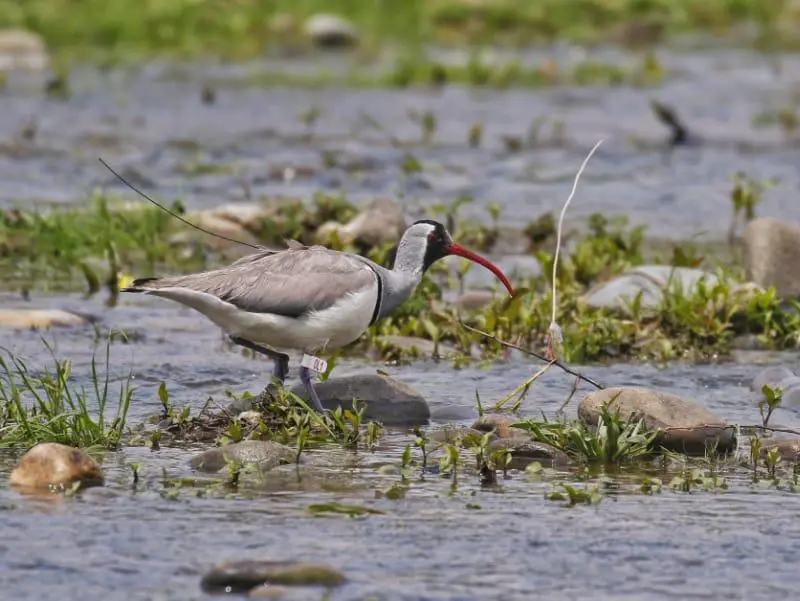
In the high-altitude, boulder-strewn corridors of the North-Western Himalayas, the Ibisbill remains a ghost-like presence. A landmark study now reveals how rising temperatures and human encroachment are reshaping the destiny of this unique avian specialist.
The Ibisbill (Ibidorhyncha struthersii), a bird so distinct that it occupies its own taxonomic family, has long been a mystery to the scientific community. Residing in the treacherous, fast-flowing braided rivers of the Himalayas and the Tibetan Plateau, it is a master of camouflage and a specialist of a very specific niche: the gravel bar. However, as the "Third Pole" warms and human industrial activities like boulder mining penetrate deeper into mountain valleys, the Ibisbill’s future is being recalibrated.
A new comprehensive assessment, the first of its kind focusing on the North-Western Himalayas, has utilized advanced climate modeling to map the bird’s current range and project its survival through the end of the century. The findings, while suggesting a potential expansion of climatically suitable areas, serve as a stark warning: a suitable climate does not guarantee a habitable home if the rivers themselves are being dismantled by man.
Main Facts: A Monotypic Wonder Under Pressure
The Ibisbill is a biological anomaly. It is "monotypic," meaning it is the sole representative of the family Ibidorhynchidae. Evolutionarily isolated, it has no close living relatives, making its conservation a high priority for global biodiversity. Standing on long, grayish-purple legs with a distinctive downward-curved crimson bill, the bird is perfectly adapted to the high-altitude rivers of Asia, ranging from 1,700 to 4,400 meters above sea level.

Key Highlights of the Recent Findings:
- Temperature as a Driver: Mean annual temperature accounts for approximately 60% of the influence on the Ibisbill’s distribution.
- Geographic Focus: The study specifically analyzed the Kashmir and Ladakh regions, identifying the Sindh and Lidder rivers as critical strongholds.
- The Paradox of Expansion: While climate models suggest the bird’s "climatic envelope" might expand into mid-elevation corridors as the region warms, the physical habitat (gravel bars and braided channels) is rapidly disappearing due to mining and infrastructure development.
- Anthropogenic Threats: Beyond climate change, the bird faces immediate pressure from boulder mining, plastic pollution, and increased predation from domestic dogs and opportunistic scavengers like crows and kites.
Chronology: From Elusive Resident to Subject of Satellite Surveillance
For decades, the Ibisbill was documented only through sporadic sightings by intrepid ornithologists and local birdwatchers. Its preference for uninhabited, remote, and often politically sensitive border regions made systematic study nearly impossible.
The Early 2000s: Baseline Ecology
Initial studies focused on the time-activity budgets of the bird in the Kashmir Himalaya. Researchers began to understand its seasonal movements—altitudinal migration where the bird moves to lower elevations during the harsh winter months when high-altitude rivers freeze.
2015–2020: The Introduction of Telemetry
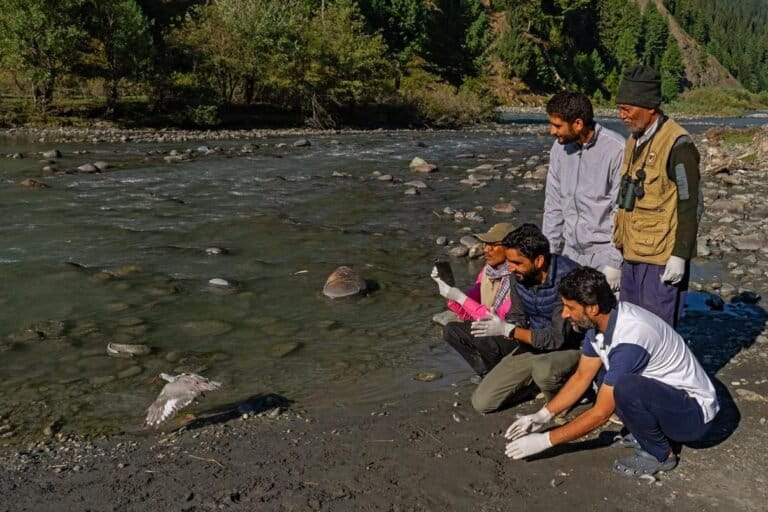
The Division of Wildlife Sciences at the Sher-e-Kashmir University of Agricultural Sciences and Technology (SKUAST-Kashmir) began pioneering satellite telemetry studies. By fitting birds with Platform Transmitter Terminals (PTT), scientists were able to track their precise movements for the first time. This period confirmed the species’ remarkable "nest-site fidelity," where individuals return to the exact same gravel bars year after year to breed.
2023–2024: The Climate Modeling Breakthrough
The most recent phase of research, supported by the Science and Engineering Research Board (SERB), Government of India, moved from observing individual birds to modeling the entire population’s future. Using Species Distribution Modelling (SDM), researchers integrated decades of sighting data with complex bioclimatic variables to predict how the species will react to the warming trends of 2050 and 2080.

Supporting Data: Modeling the "Climatic Envelope"
The study, recently published in the Journal for Nature Conservation, employed an "ensemble approach." This method is more robust than single-algorithm models because it runs multiple statistical simulations—such as Random Forest, Generalized Additive Models, and MaxEnt—to reach a consensus on where a species can survive.
Bioclimatic Variables
The researchers fed the models six primary variables. While precipitation patterns and temperature seasonality played minor roles, the Mean Annual Temperature was the undisputed king of predictors. The Ibisbill requires a specific thermal range to maintain its metabolic rate and to ensure that the aquatic invertebrates it feeds upon—larvae and insects hidden under river stones—remain available.
The Findings on Range Shift
The models indicate a "net expansion" in climatically suitable areas. As higher altitudes become slightly warmer, the Ibisbill may find new areas hospitable. However, the researchers emphasize a critical distinction: Climatic Suitability vs. Habitat Suitability.
- Climatic Suitability: The air and water temperature are within the bird’s tolerance.
- Habitat Suitability: The presence of braided river channels, unpolluted water, and, crucially, the large boulders and gravel bars needed for nesting.
Data from the Sindh River in the Ganderbal district shows that even in areas where the climate is perfect, the habitat is "severely degraded." Mining for sand and boulders—the very materials the bird uses to camouflage its nests—has rendered large stretches of the river unusable for breeding.
Official Responses: Experts Weigh In on the Crisis
The research has sparked a dialogue among India’s leading conservationists, who warn that the Ibisbill is an "indicator species"—a canary in the coal mine for the health of Himalayan river systems.
Ankita Sinha, Wildlife Biologist (Senckenberg Biodiversity and Climate Research Center):
"Because of their limited sightings and ranges restricted to remote areas, knowledge on their ecology is limited. As umbrella species, protecting the Ibisbill could benefit entire riverine ecosystems. They are indicators of ecosystem health; if the Ibisbill is disappearing, the river is dying."
Dr. Khursheed Ahmad, Senior Scientist (SKUAST-Kashmir):
"Our satellite telemetry has shown pioneering insights into their movement, but it has also documented severe degradation. We are seeing extensive sand and boulder mining in Central Kashmir. This poses a significant threat to reproductive success. We need to legally protect these key nesting sites from further anthropogenic disturbance."
Asad Rahmani, Ornithologist and Former Director of BNHS:
"The habitat is also occupied by people. As boulders are required for houses and roads, extensive mining takes place. This disturbs the bird and brings in crows, kites, and dogs. If the situation is not changed, I am afraid the Ibisbill will disappear from many parts of the Sindh river and its nallahs (streams)."

Rohan Menzies, Ornithologist (Nature Conservation Foundation):
"The study provides the climatic preferences, but climate is only one requirement. Habitat-specialist river birds tend to avoid stretches of river that have been altered drastically. We see similar pressures in the Eastern Himalaya, where mining and dams are transforming riverscapes."
Implications: The Destabilization of the Third Pole
The plight of the Ibisbill is inextricably linked to the broader geological and environmental shifts occurring in the Himalayas. The implications of this research extend far beyond a single bird species.
1. The Changing Geomorphology of Rivers
Climate change is accelerating glacier melt. In the short term, this increases river discharge, which might seem beneficial. However, this surge in water destabilizes riverbanks and increases sediment loads. Remote sensing data shows that Himalayan rivers are changing their routes faster than ever before, forming "cut-offs" and shifting from braided patterns (which the Ibisbill loves) to meandering patterns (which it avoids).
2. The Impact of Infrastructure
The push for hydroelectric power and improved road connectivity in border regions has led to an explosion in dam construction and channel engineering. These projects narrow active channels and destroy the "riparian vegetation" and gravel beds that support the Ibisbill’s food source.

3. The Pollution Factor
The increase in tourism and urbanization in valleys like Gurez and Ganderbal has introduced plastic pollution and garbage into high-altitude streams. This not only affects the birds directly but also attracts predators. Domestic dogs, supported by human food waste, are now a primary threat to Ibisbill chicks, which are ground-nesters and highly vulnerable.
4. A Gap in Monitoring
Despite Asia being home to nearly half of the world’s specialist river birds, they are rarely included in routine environmental impact assessments for river projects. The study highlights a desperate need to integrate avian monitoring into river management policies.
Conclusion: A Call for Legal Protection
The Ibisbill is more than just a bird; it is a relic of an ancient evolutionary lineage and a sentinel for the world’s most important water towers. The research concludes that while the bird might find new places to live in a warming world, it will have nowhere to go if we continue to strip the rivers of their stones.
Conservationists are now calling for the designation of "Ibisbill Conservation Zones" along the Sindh and Lidder rivers—protected areas where boulder mining is strictly prohibited and human interference is minimized during the critical breeding season. Without such measures, the "Ghost of the Himalayas" may truly become a spirit of the past.
