

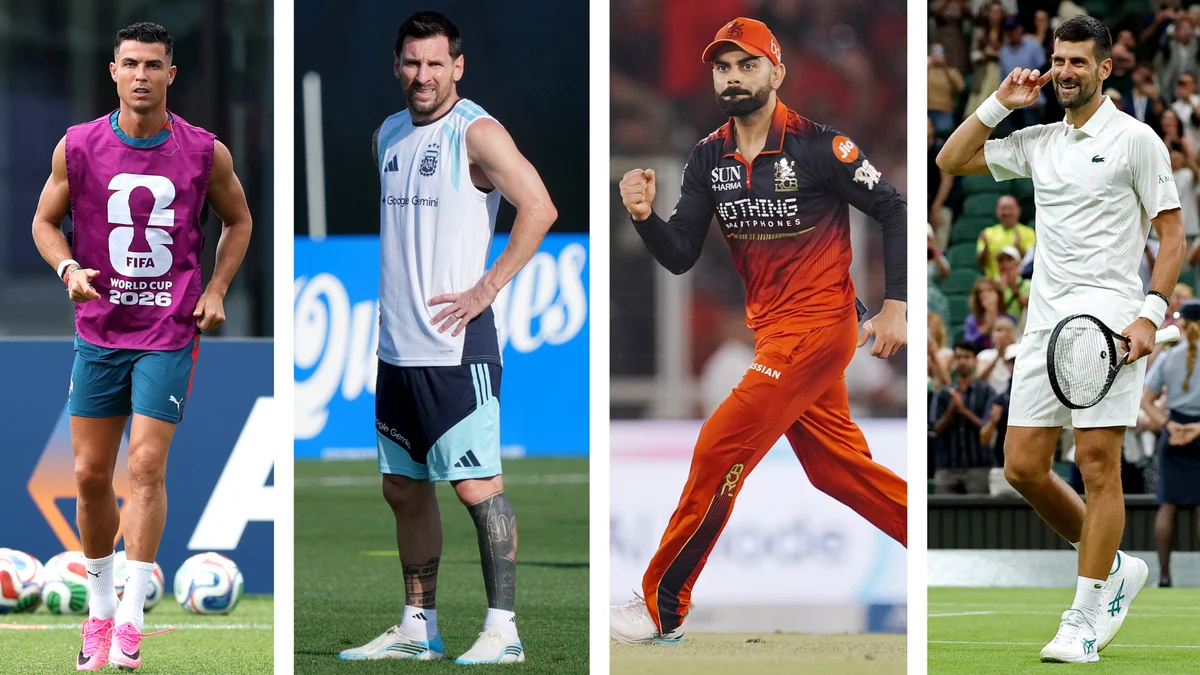
The sports world stands at a profound crossroads, witnessing the simultaneous twilight of an era defined by unparalleled individual brilliance. Four titans – Cristiano Ronaldo, Lionel Messi, Novak Djokovic, and Virat Kohli – who have dominated their respective arenas for nearly two decades, are entering the final chapters of their storied careers. Their impending departures are not just personal milestones but seismic shifts signaling a fundamental transformation in the landscape of global sport.
The Unprecedented Cohort: A Symphony of Longevity and Dominance
For an astonishing span of time, the sporting universe has been captivated by the sustained excellence of a unique quartet. Cristiano Ronaldo, at 41, is preparing for his final FIFA World Cup, a testament to a career defined by relentless ambition and a refusal to bow to the inevitable march of time. Alongside him, Lionel Messi, 39, is also likely participating in his last World Cup, having already defied expectations by achieving his lifelong dream of lifting the coveted trophy.
Across the globe, in the hallowed grounds of tennis, Novak Djokovic, 39, continues his pursuit of history, aiming for an unprecedented 25th Grand Slam title. His journey has been one of extraordinary resilience, marked by comebacks from injuries and controversies, solidifying his status as statistically the greatest male tennis player of all time. And in the vibrant world of cricket, Virat Kohli, 38, embodies the same unwavering dedication and insatiable hunger for success, often described as cricket’s answer to the football and tennis legends.

These athletes are not merely participants; they have been the architects of their eras, consistently pushing the boundaries of human performance. Their enduring presence has normalized the extraordinary, allowing fans to witness and even take for granted a level of sustained excellence that may never be replicated. They have, in essence, acted as temporal anomalies, momentarily delaying our collective confrontation with the realities of aging and the cyclical nature of sporting dominance.
A Chronicle of Unrivaled Achievement: Defining an Epoch
The narrative of these four athletes is deeply intertwined with the evolution of their respective sports. Novak Djokovic, for instance, emerged from the shadow of tennis’s iconic "Big Three" – Roger Federer and Rafael Nadal – to carve out a legacy that is, by the numbers, unparalleled. His statistical dominance, while sometimes overshadowing his universal fan appeal, has irrevocably altered the conversation around the greatest of all time (GOAT). This phenomenon, where statistical supremacy doesn’t always equate to the most beloved figure, speaks to a deeper human appreciation for narrative and perceived flaws, a trait often found in literary heroes as well.
Cristiano Ronaldo’s career is a saga of relentless self-improvement and an almost defiant negotiation with his own biology. Even in his advanced years, his scoring prowess remains a potent force, fueled by an unyielding determination. Lionel Messi, after years of near misses and mounting pressure, finally claimed the World Cup, a crowning achievement that silenced many doubters and reaffirmed his enduring brilliance. His continued presence on the field, displaying that same hunger, is a powerful statement. Virat Kohli, meanwhile, has transcended the sport of cricket, becoming a cultural icon whose performances continue to inspire millions, his intensity only amplifying with age.

The Shifting Sands of Sport: Systems Over Soul?
The impending departure of these icons coincides with a profound transformation within their sports. Football, for example, is increasingly characterized by data-driven strategies, intricate pressing structures, and a shift towards systemic efficiency. The "geometry of straight lines" – the precision of formations and tactical execution – appears to be superseding the "poetry of curves" – the spontaneous brilliance of individual artistry. While the artist still exists, their value is increasingly measured by quantifiable metrics like sprint distances and defensive recoveries, rather than the intangible magic they once conjured.
Tennis, too, has evolved into a high-octane contest of raw physical power, with competitors adhering to the elevated standards of performance that Djokovic himself helped to establish. Ironically, the very champions who defined an era have inadvertently shaped the competitive landscape that will ultimately make their sustained dominance more challenging. This evolution raises questions about the future of individual flair in sports increasingly driven by analytics and athleticism.
Historically, athletes like Diego Maradona, whose "feet painted some of the most colorful canvases in the game," or a slightly less self-destructive Messi, represented a different era. Their genius was often more intuitively understood, less dissected by algorithms. The current era, it seems, is moving towards a phase potentially dictated by artificial intelligence, where the emergence of a truly unique hero might be a reaction against, rather than a continuation of, established patterns. The likes of Carlos Alcaraz and Jannik Sinner in tennis, or emerging talents in other sports, are seen as harbingers of this new wave. They represent a break from the past, perhaps even visitors from a future where individual brilliance will manifest not as part of a continuum, but in direct opposition to it.

The Evolving Role of National Identity: Club vs. Country in a Globalized World
Beyond the technical and tactical shifts, the very fabric of how fans consume and engage with sport is undergoing a fundamental change. The author’s personal reflection on the diminished emphasis on national representation is particularly poignant. The once-sacrosanct belief in the ultimate glory of representing one’s country at the highest level is being challenged. This shift is evident in the expansion of tournaments like the FIFA World Cup to include a larger number of teams, some of whom might struggle against established club sides, and in unexpected results like India’s T20 series loss to Ireland. The definition of the "highest level" is becoming more fluid, and national allegiances are not always the ultimate benchmark of sporting achievement.
This evolution, however, might not be entirely detrimental. It offers the potential to temper the often-toxic nationalism that can pervade major international tournaments. While watching Messi lead Argentina is undeniably compelling, witnessing the fluid, uninhibited brilliance of Messi, Neymar Jr., and Kylian Mbappé playing together for Paris Saint-Germain can be an equally, if not more, thrilling spectacle. This club-centric model offers a glimpse of sport played with a certain "purity," where the best players showcase their talents irrespective of national affiliations.
The age-old debate of club versus country continues. While the World Cup provides crucial exposure for players from less prominent nations, fostering the growth of the sport globally, a complete club monopoly could lead to a commercialization that alienates the average fan. The moral argument for national representation is strong, but sport, as history has shown, does not always evolve morally. Factors such as money, convenience, politics, and media influence often dictate its trajectory.

Implications for the Future: A New Paradigm of Athleticism and Fandom
The departure of these legends leaves a void, but also an opportunity. The sports they have graced are undergoing a metamorphosis, driven by technology, data analytics, and a shifting fan base. The "customer" of sport is increasingly sophisticated, demanding more than just individual heroics. The future might belong to athletes who can blend exceptional physical capabilities with a deep understanding of tactical systems, or perhaps to those who emerge as entirely new archetypes, defying existing classifications.
The concept of "individual brilliance" might also be redefined. Instead of a linear progression from past champions, future stars might emerge as disruptors, forging their own paths in opposition to established norms. This could lead to an era of unexpected heroes, individuals whose impact cannot be easily predicted or explained by past performance or current trends.
The legacy of Ronaldo, Messi, Djokovic, and Kohli is not just in the trophies they have won or the records they have broken. It lies in the impossible standards they have set, the enduring inspiration they have provided, and the profound way they have shaped our understanding of what is humanly possible in sport. Their goodbyes are poignant reminders of our own mortality, yet they also serve as a powerful testament to the enduring spirit of competition and the ceaseless evolution of athletic endeavor. As these titans gracefully exit the stage, the world watches with anticipation, eager to see who will rise to define the next captivating chapter in the grand narrative of sport.
