

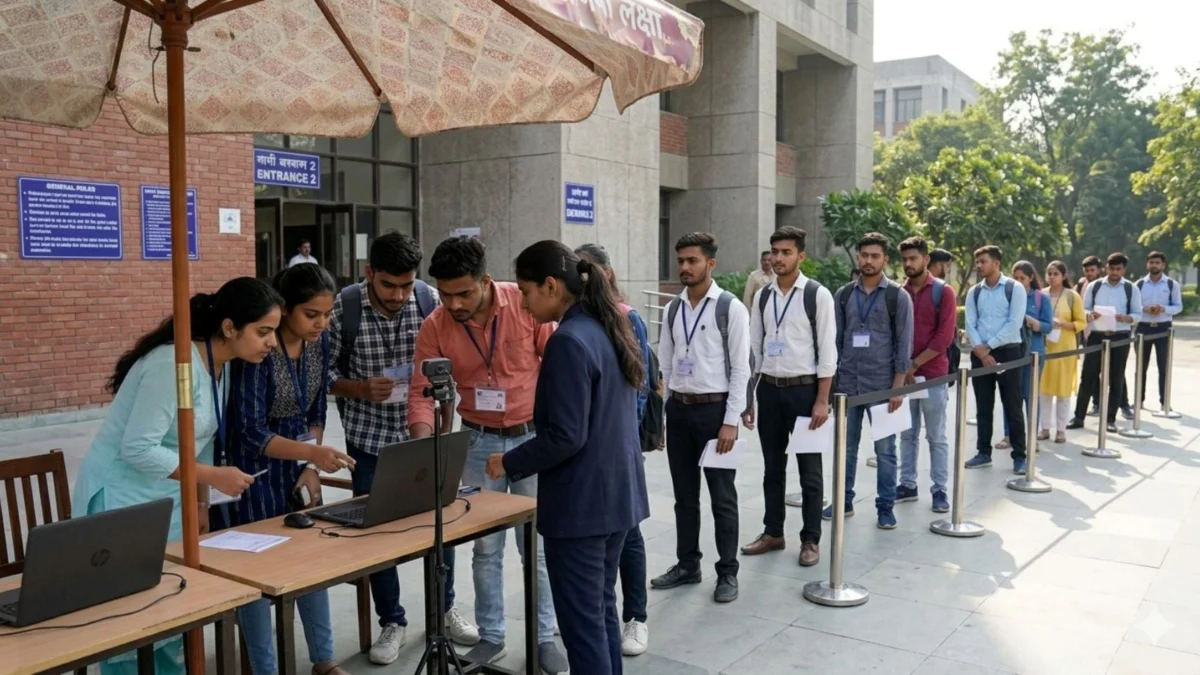
New Delhi – June 4, 2026 – In a significant leap forward for examination security and transparency, the Union Public Service Commission (UPSC) has successfully implemented a sophisticated, real-time facial authentication system across its highly competitive Civil Services (Preliminary) Examination 2026. This groundbreaking technology, deployed across a vast network of 2,072 examination venues nationwide, marked a pivotal moment in the UPSC’s ongoing commitment to upholding the integrity of one of India’s most crucial recruitment processes.
The newly introduced system was instrumental in verifying the identity of over 5.5 lakh candidates, ensuring that each individual appearing for the examination was indeed the person who had submitted their photograph during the application process. This strategic deployment aims to decisively combat impersonation and other fraudulent practices, thereby reinforcing the fairness and credibility of the Civil Services examination. The successful rollout, involving over 7,000 invigilators simultaneously utilizing the system, underscores a new paradigm in examination administration, promising a more secure and efficient future for aspiring civil servants.
The Dawn of a New Security Protocol: Main Facts of the Facial Authentication System
The Union Public Service Commission’s (UPSC) announcement on Thursday highlighted the comprehensive and successful deployment of its innovative face-authentication system during the Civil Services (Preliminary) Examination 2026. This technological advancement was not merely an experiment; it was a full-scale implementation designed to address long-standing concerns regarding impersonation in high-stakes examinations.
At the heart of this initiative lies a robust Android-based mobile application, meticulously developed by the UPSC with crucial technical support from the National e-Governance Division (NeGD), an arm of the Ministry of Electronics and Information Technology. This application empowers invigilators to conduct real-time facial verification of candidates before granting them entry into the examination hall. The process is designed to be swift and seamless, ensuring that the candidate’s live image is meticulously compared against the photograph uploaded during their application submission. Only upon a confirmed match is the candidate permitted to proceed, thereby creating a formidable barrier against any attempts at identity fraud.
The scale of this operation was unprecedented. Over 7,000 invigilators, spread across the length and breadth of the country, were equipped with this technology and operated it simultaneously. This vast network of trained personnel worked in tandem to verify approximately 5.5 lakh candidates appearing at over 2,000 examination venues. The efficiency of the system was a key consideration. The UPSC reported that the authentication process for each candidate took approximately six to eight seconds, a remarkably short duration that significantly minimized delays and prevented the formation of lengthy queues at examination centers, particularly during the peak entry periods. During these crucial times, the application demonstrated its capacity to process an impressive nearly 12,000 authentications every minute, a testament to its scalability and robust performance under pressure.
The core objective of this initiative, as articulated by the UPSC, is to create an "impersonation-free examination environment." The system’s design facilitates live, real-time authentication, making it exceedingly difficult for individuals to substitute themselves for the actual candidates. This proactive approach to security is expected to bolster confidence in the examination process among all stakeholders, including aspirants, educational institutions, and the public at large. The successful implementation of this technology signifies a major stride in the UPSC’s continuous efforts to enhance the credibility and transparency of its examinations, which serve as the gateway to prestigious positions within the Indian administrative services.
A Journey Towards Technological Integration: Chronology of Implementation
The successful deployment of the face-authentication system did not happen overnight. It represents a culmination of meticulous planning, development, and extensive preparatory measures. While the precise timeline for the initial conceptualization remains proprietary, the operational readiness and final rollout for the Civil Services (Preliminary) Examination 2026 indicate a focused and accelerated development phase.
The journey likely began with the UPSC identifying the persistent challenge of impersonation and the need for a more advanced, technologically driven solution. This would have led to a thorough assessment of existing facial recognition technologies and their applicability to the unique demands of a nationwide examination. The collaboration with the National e-Governance Division (NeGD) was a critical early step, leveraging their expertise in developing and implementing e-governance solutions.
Following the conceptualization and partnership, the development of the proprietary Android-based mobile application would have commenced. This phase would have involved extensive research and development, focusing on creating an algorithm capable of high accuracy and speed, even under varying lighting conditions and with different facial features. Simultaneously, the UPSC would have been formulating a comprehensive Standard Operating Procedure (SOP). This SOP, a detailed guide for the seamless execution of the authentication process, was crucial for ensuring uniformity and clarity across all examination centers.
A significant preparatory phase involved the meticulous planning of the nationwide rollout. This would have included identifying the technical infrastructure requirements, the procurement or standardization of compatible devices (in this case, standard Android smartphones), and the logistical arrangements for disseminating the application and training materials.
The crucial step of training the invigilation workforce was undertaken with utmost seriousness. The UPSC organized multiple rounds of training sessions for the more than 7,000 invigilators who would be directly involved in operating the system. This training would have covered not only the technical aspects of using the mobile application but also the nuances of the SOP, troubleshooting common issues, and handling any discrepancies that might arise during the verification process. The emphasis on training ensured that the invigilators were confident and competent in their roles, which is paramount for the success of such a large-scale technological deployment.
The final phase, leading up to the Civil Services (Preliminary) Examination 2026, involved rigorous testing and pilot programs. While not explicitly detailed in the initial report, it is highly probable that the UPSC conducted smaller-scale trials to identify and rectify any potential bugs or operational challenges before the full-scale launch. This iterative process of development, training, and testing would have culminated in the successful and seamless implementation of the face-authentication system on examination day, marking a significant milestone in the UPSC’s technological evolution.
Quantifying Success: Supporting Data and Operational Metrics
The success of the UPSC’s face-authentication system is not just a qualitative claim; it is substantiated by impressive quantitative data that underscores the efficiency and effectiveness of the technology. These metrics provide a clear picture of the scale of operations and the system’s performance under real-world conditions.
Scale of Deployment:
- Examination Venues: The system was deployed across a staggering 2,072 examination venues nationwide. This vast geographical spread highlights the logistical prowess involved in its implementation.
- Candidates Verified: Approximately 5.5 lakh candidates underwent the face-authentication process. This figure represents a significant portion of the total number of aspirants appearing for the Civil Services (Preliminary) Examination.
- Invigilators Utilized: Over 7,000 invigilators were actively engaged in operating the system simultaneously across the country. This large workforce was essential for managing the verification process at numerous locations.
Operational Efficiency:
- Verification Time per Candidate: The face-authentication process for each candidate was remarkably swift, taking an average of six to eight seconds. This efficiency was crucial in preventing bottlenecks and ensuring a smooth flow of candidates.
- Peak Processing Capacity: During the busiest periods of candidate entry, the application demonstrated an impressive processing capability, handling nearly 12,000 authentications per minute. This showcases the system’s ability to manage high volumes of data and operations concurrently.
Technological Backbone:
- Device Compatibility: A key factor in the widespread adoption was the system’s compatibility with standard Android smartphones. This eliminated the need for specialized, expensive hardware, making the deployment more cost-effective and logistically simpler. The application worked on readily available devices, allowing invigilators to use their own or institution-provided smartphones.
These figures collectively paint a picture of a highly successful and efficient technological integration. The ability to verify such a large number of candidates quickly and accurately across numerous locations, with minimal reliance on specialized infrastructure, is a testament to the robust design and effective execution of the UPSC’s face-authentication system. This data-driven success story sets a new benchmark for the implementation of advanced technologies in large-scale public examinations.
Voices of Authority: Official Responses and Statements
The successful implementation of the face-authentication system has garnered significant attention and praise from the highest levels of the Union Public Service Commission. The officials have expressed their satisfaction and highlighted the strategic importance of this technological leap.
Dr. Ajay Kumar, the Chairman of the UPSC, was a prominent voice in articulating the vision and objectives behind this initiative. He emphasized that the primary goal was to "ensure impersonation-free examinations." Dr. Kumar acknowledged the collaborative effort involved, stating that while the technology was developed "in-house with support from NeGD," the "larger challenge was deploying it at scale, training the invigilation workforce and implementing it nationwide within a short timeframe." This statement underscores the multifaceted nature of the project, extending beyond mere technological development to encompass extensive operational planning and human resource management.
The UPSC itself issued a formal statement detailing the successful deployment. The statement highlighted that the "newly introduced face-authentication system was successfully used during the Civil Services (Preliminary) Examination 2026, verifying candidates in real time across 2,072 examination venues nationwide." It reiterated the system’s purpose: "to prevent impersonation and ensure that the candidate appearing for the examination matched the photograph submitted during the application process."
The Commission also provided specific operational details in its statement, noting that "every candidate was required to undergo face authentication before being allowed entry into the examination hall." The details regarding the Android-based mobile application, developed with technical support from NeGD, were also provided. The statement further elaborated on the efficiency of the process, mentioning that it "took around six to eight seconds per candidate, helping avoid delays and long queues." The impressive processing capacity of "nearly 12,000 authentications every minute" during peak entry periods was also highlighted.
The UPSC concluded by asserting that the "successful implementation of real-time face authentication marks a significant step towards strengthening examination integrity and improving transparency in one of the country’s largest recruitment examinations." This overarching statement encapsulates the profound impact of the initiative on the credibility and public perception of the UPSC’s examination processes. The official responses collectively convey a sense of accomplishment and a firm commitment to leveraging technology for the betterment of public service examinations.
Beyond Verification: Implications for Future Examinations and Beyond
The successful integration of real-time facial authentication by the UPSC is more than just a procedural upgrade; it signifies a paradigm shift with far-reaching implications for the future of examinations and potentially other high-stakes verification processes in India.
Enhanced Examination Integrity: The most immediate and profound implication is the significant enhancement of examination integrity. By creating a robust barrier against impersonation, the UPSC is reinforcing the principle of meritocracy, ensuring that only genuine candidates are awarded opportunities based on their abilities. This will likely lead to increased trust and confidence in the selection process among aspirants and the general public.
Deterrence of Malpractices: The visible and effective implementation of such a technology acts as a powerful deterrent against a range of malpractices, including impersonation, proxy attendance, and the use of forged documents. This proactive approach to security can significantly reduce the incidence of such fraudulent activities, saving valuable time and resources for the examination conducting bodies and the justice system.
Technological Advancement in Public Services: The UPSC’s initiative serves as a beacon for other government agencies and public sector undertakings. It demonstrates the feasibility and effectiveness of adopting advanced technologies like facial recognition for critical administrative functions. This success can pave the way for similar implementations in areas such as identity verification for government benefits, access control to sensitive facilities, and streamlined citizen services.
Scalability and Cost-Effectiveness: The fact that the system works on standard Android smartphones, rather than requiring specialized hardware, is a critical takeaway. This highlights the potential for implementing advanced technological solutions in a cost-effective and scalable manner, even in resource-constrained environments. This model can be replicated across various government departments and programs.
Streamlined Examination Processes: Beyond security, the efficiency gains observed in reduced queues and faster entry times suggest that technology can also be leveraged to improve the overall candidate experience during examinations. Future implementations could explore further integration of technology for features like digital hall tickets, real-time updates, and simplified administrative procedures.
Data Security and Privacy Considerations: While celebrating the success of the technology, it is crucial to acknowledge the importance of data security and privacy. The UPSC’s development of a robust SOP and its collaboration with NeGD suggest a focus on these aspects. As such systems become more widespread, robust frameworks for data protection, consent management, and ethical usage of biometric data will become increasingly vital. The UPSC’s approach sets a positive precedent for responsible technological implementation.
In conclusion, the UPSC’s foray into real-time facial authentication is a landmark achievement. It not only strengthens the credibility of the Civil Services examination but also offers a compelling blueprint for technological adoption across various sectors, promising a more secure, efficient, and transparent future for governance and public service delivery in India.
