

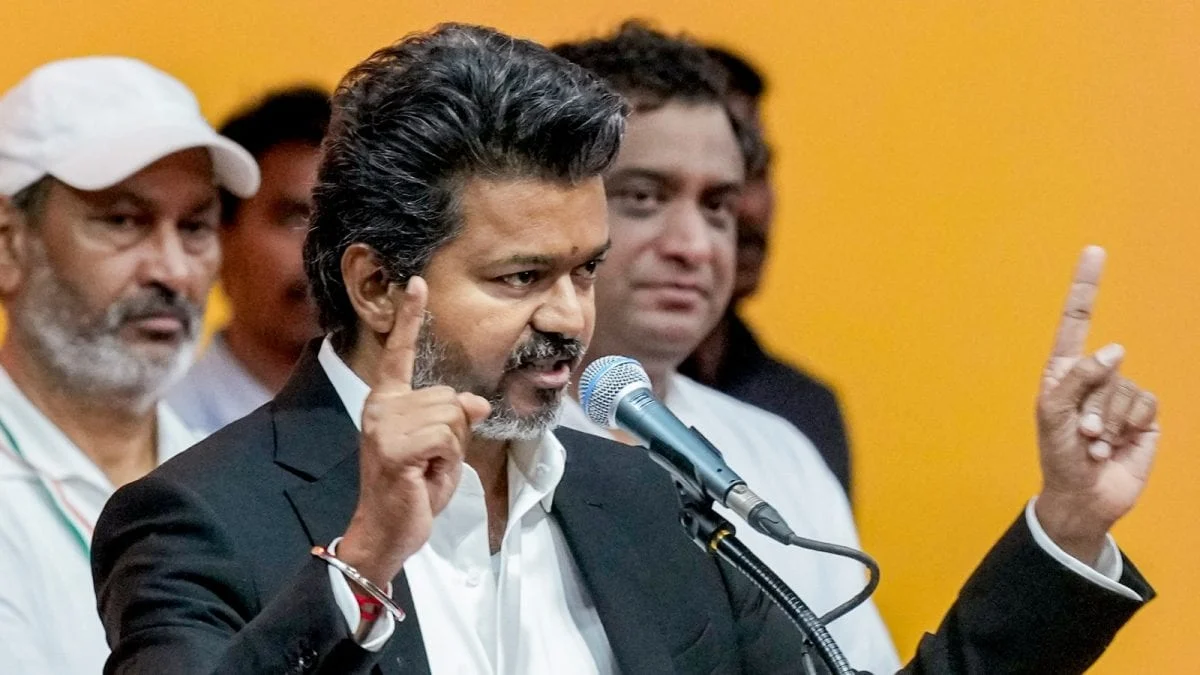
CHENNAI, India – May 13, 2026 – In a political earthquake that has irrevocably altered the landscape of Tamil Nadu, actor-turned-politician Vijay’s newly formed Tamilaga Vettri Kazhagam (TVK) made a stunning electoral debut, securing 108 seats in the 234-member legislative assembly. While falling just 10 seats shy of the coveted 118-seat simple majority, an in-depth analysis of the results reveals a tantalizingly close call: a mere 4,649 additional votes, strategically distributed across 10 critical constituencies, would have propelled TVK to an unprecedented solo majority, cementing Vijay’s status as a political titan on his very first attempt.
This remarkable performance has not only positioned TVK as a formidable new force but has also fundamentally broken the decades-long duopoly of the Dravida Munnetra Kazhagam (DMK) and the All India Anna Dravida Munnetra Kazhagam (AIADMK), which have historically dominated the state’s political narrative. Even without an absolute majority, Vijay’s maiden electoral venture has transformed Tamil Nadu politics, forcing a coalition government and ushering in an era of multi-party governance.
The Historic Debut: A Political Earthquake Shakes Tamil Nadu
The 2026 Tamil Nadu Assembly elections will undoubtedly be remembered as a watershed moment. For generations, the state’s political discourse has been a battleground primarily between two Dravidian behemoths: the DMK, founded by the charismatic C.N. Annadurai and later helmed by M. Karunanidhi and M.K. Stalin, and the AIADMK, established by the iconic M.G. Ramachandran and subsequently led by J. Jayalalithaa. Their alternating reigns had become an almost immutable feature of Tamil Nadu’s political fabric, leaving little room for new entrants to genuinely challenge their dominance.
It is against this entrenched backdrop that Vijay, a superstar of Tamil cinema with a colossal fan following, chose to launch his political vehicle, the Tamilaga Vettri Kazhagam. His entry was met with a mix of excitement, skepticism, and anticipation. Many analysts questioned whether his cinematic charisma could translate into tangible political capital, given the historical struggles of other film personalities to replicate their screen success in the electoral arena. However, Vijay’s campaign proved to be a masterclass in grassroots mobilisation combined with a potent message of change, anti-corruption, and youth empowerment.
From the moment he officially announced his party’s formation and its intention to contest, the buzz around TVK was palpable. Vijay’s public persona, often perceived as accessible and grounded, resonated deeply with a populace yearning for fresh leadership. His carefully crafted speeches, delivered in his characteristic understated yet impactful style, focused on systemic issues, governance reforms, and a vision for a progressive Tamil Nadu free from the perceived dynastic and corrupt practices of the established parties. The sheer scale of his rallies, drawing massive crowds, served as an early indicator of the groundswell of support he was generating, particularly among younger voters and first-time electors who felt disenfranchised by traditional political narratives.
The TVK’s campaign machinery, though nascent compared to the decades-old networks of the DMK and AIADMK, demonstrated remarkable efficiency and enthusiasm. Volunteers, many drawn from Vijay’s extensive fan clubs, worked tirelessly to spread the party’s message, reaching into the remotest corners of the state. Social media played a crucial role, amplifying Vijay’s message and connecting directly with a tech-savvy demographic. The party’s manifesto, reportedly focusing on education, healthcare, employment generation, and environmental protection, offered a distinct alternative to the welfare schemes and identity politics often championed by the older parties. This comprehensive approach, combined with Vijay’s undeniable star power, allowed TVK to pierce through the traditional vote banks and establish a significant foothold.
The Mathematics of a Near Miss: A Mere 4,649 Votes Separated TVK from Solo Power
The final seat tally of 108 for TVK is undeniably impressive for a debutant party. However, the true drama lies in the razor-thin margins that separated Vijay from achieving an outright majority. To form a government independently in the 234-member assembly, a party needs 118 seats. TVK fell short by a mere 10 seats, a gap that statistical analysis reveals could have been bridged by a remarkably small number of votes.
A meticulous examination of the results shows that had TVK secured just 4,649 additional votes, strategically distributed across 10 specific constituencies where they faced their narrowest defeats, the entire electoral outcome would have been different. In a first-past-the-post system, the concept of "swing votes" is critical. If TVK had managed to flip just enough votes in these specific seats – effectively, securing one vote more than half of the winning margin in each of these closely contested battles – they would have clinched an additional 10 seats, pushing their total to 118 and granting them a clear majority.
The 10 constituencies that proved to be the theatre of these agonizingly close contests, along with the minuscule margins of defeat, are as follows:
- Tirukkoyilur: TVK lost by a mere 285 votes.
- Kulithalai: TVK lost by 579 votes.
- Palani: TVK lost by 693 votes.
- Kovilpatti: TVK lost by 843 votes.
- Vikravandi: TVK lost by 910 votes.
- Udhagamandalam: TVK lost by 976 votes.
- Papanasam: TVK lost by 1,065 votes.
- Dindigul: TVK lost by 1,131 votes.
- Killiyoor: TVK lost by 1,311 votes.
- Thirumayam: TVK lost by 1,492 votes.
A simple sum of these margins highlights the incredible proximity to a solo majority. The aggregate of these 10 narrowest defeats totals 9,285 votes. Therefore, exactly 4,649 swing votes (half of the total margin plus one vote in each constituency) would have been sufficient to convert these 10 losses into wins for TVK. This statistical reality underscores the intense competition and the wafer-thin difference that often determines electoral fates. For a party making its debut, coming this close to an absolute majority is not just historic; it’s almost unprecedented in the annals of Indian electoral politics.
These crucial 10 constituencies were not won by a single dominant force, further illustrating the fragmented nature of the electoral battle and TVK’s broad appeal. The seats were claimed by a mix of rivals and current allies: DMK secured four of these seats, AIADMK won two, the Bharatiya Janata Party (BJP) took one, the Indian National Congress (INC) won one, the Indian Union Muslim League (IUML) secured one, and the Pattali Makkal Katchi (PMK) claimed one. This distribution suggests that TVK was not merely eating into one party’s vote share but was drawing support from a diverse cross-section of the electorate, challenging incumbents from across the political spectrum. The fact that a single seat was won by an ally (IUML) and another by a coalition partner (INC) also indicates that a slightly different pre-poll alliance strategy could have potentially altered these outcomes.
Chronology of an Electoral Phenomenon
The journey of Tamilaga Vettri Kazhagam, from its inception to its groundbreaking electoral performance, is a testament to the power of a popular leader and a compelling narrative.
Early 2023: Whispers of Vijay’s political ambitions begin to solidify as his fan clubs, traditionally engaged in social welfare activities, become more organised and politically oriented. He holds private meetings with key advisors and political strategists.
February 2024: Vijay officially announces the formation of the Tamilaga Vettri Kazhagam (TVK), declaring his intent to contest the upcoming assembly elections. He clarifies that his entry into politics is driven by a desire for "corruption-free governance" and "people-centric policies," and he commits to leaving his film career to dedicate himself fully to public service. This announcement sends shockwaves across Tamil Nadu’s political establishment.
Mid-2024: TVK begins its organizational buildup. Vijay embarks on a series of public interactions, avoiding large-scale rallies initially, to gauge public sentiment and articulate his vision. The party enrolls members, establishes district-level committees, and begins drafting its manifesto, focusing on issues like quality education, affordable healthcare, rural development, and environmental sustainability.
Late 2024 – Early 2025: The party launches its official campaign. Vijay crisscrosses the state, addressing massive gatherings that often outnumber those of established parties. His rallies become spectacles, drawing unprecedented crowds, especially among the youth. He employs a distinctive campaign style, often engaging in direct conversations with citizens, listening to their grievances, and promising concrete solutions. The party’s symbol, a simple yet powerful representation, quickly gains recognition.
Late 2025: As the election draws closer, TVK emerges as a legitimate third alternative, challenging the conventional wisdom that Tamil Nadu politics is a two-horse race. Pre-election surveys, initially cautious, begin to show a significant swing towards TVK, particularly in urban and semi-urban areas. The DMK and AIADMK, initially dismissive, are forced to recalibrate their strategies, acknowledging the potent threat posed by Vijay. Negotiations for alliances begin, with TVK maintaining a stance of going it alone unless a strong, ideologically aligned coalition emerges.
January 2026: Election dates are announced. TVK finalizes its candidate list, fielding a mix of young professionals, social activists, and experienced individuals from various walks of life, emphasizing a break from traditional political families. Vijay personally campaigns extensively for each candidate, leveraging his star power to boost their visibility.
April 2026: The final phase of campaigning sees a fierce battle between all major parties. Vijay intensifies his efforts, holding multiple rallies a day, often speaking for hours. His focus remains steadfast on good governance and a transparent administration, avoiding personal attacks and divisive rhetoric.
May 2026 – Election Day: Polling is conducted peacefully across the state. Voter turnout is high, indicating significant public engagement. Exit polls offer varied predictions, with some hinting at a hung assembly and a strong showing for TVK, while others remain cautious.
May 12, 2026 – Counting Day: The results begin to trickle in. Early trends show TVK performing strongly, leading in numerous constituencies. As the day progresses, it becomes clear that TVK has surpassed all expectations, winning 108 seats. The state watches in awe as the decades-old political structure crumbles. However, the final tally reveals the party is 10 seats short of a majority.
May 13, 2026 – Post-Election Negotiations: With a hung assembly, intensive negotiations begin. TVK, as the single largest party, takes the lead. After rounds of discussions, a coalition government is formed with the crucial support of the Indian National Congress (INC) and the Makkal Needhi Maiam (MNM), alongside outside backing from the Communist Party of India (Marxist) (CPI(M)), the Communist Party of India (CPI), the Viduthalai Chiruthaigal Katchi (VCK), and the Indian Union Muslim League (IUML). Vijay is poised to be sworn in as the Chief Minister, marking a new chapter in Tamil Nadu’s political history.
Supporting Data and Broader Context: A New Political Axis
TVK’s electoral performance is not merely about seat count; it signifies a profound shift in voter sentiment and the potential for a new political axis in Tamil Nadu. While the exact statewide vote share for TVK is still being meticulously calculated, its ability to win 108 seats and come within touching distance of a majority suggests a substantial chunk of the electorate, likely exceeding 30-35%, cast their vote for the new party. This is a remarkable achievement for a debutant, often requiring years for new parties to build such a base.
The success of TVK also points to several demographic shifts and evolving voter priorities. A significant portion of Vijay’s support base appears to be drawn from the youth and first-time voters, who are increasingly disillusioned with traditional politics and are seeking fresh, unencumbered leadership. His message of transparency and development resonated strongly with this segment, as well as with urban and semi-urban populations who are more exposed to national political trends and less tied to rigid caste or community-based loyalties that often define regional politics. While the DMK and AIADMK continue to command significant rural support and traditional vote banks, TVK’s inroads demonstrate a weakening of these historical allegiances.
Comparing TVK’s debut to other instances of new parties making a splash in Indian state politics, its performance stands out. The Aam Aadmi Party (AAP) in Delhi, for example, took two elections to secure a clear majority, albeit after a strong initial showing. TVK’s immediate leap to being the single largest party, even without an absolute majority, underscores the unique confluence of a popular leader, a compelling narrative, and a receptive electorate. It suggests that Tamil Nadu, long considered a bastion of Dravidian ideology, is open to new political experiments and leaders who can articulate a vision beyond conventional identity politics.
For the DMK and AIADMK, the results are a stark wake-up call. The DMK, having been the ruling party, will now find itself in opposition, contemplating the reasons behind the erosion of its support. The AIADMK, already in opposition, faces the challenge of rebuilding its cadre and re-establishing its relevance in a newly fragmented political landscape. The BJP, despite winning a seat in a closely contested battle, still struggles to make significant inroads in Tamil Nadu, remaining largely a peripheral player in state politics. The INC, by aligning with TVK, has secured a position in the new government, offering it a renewed lease on life in a state where its presence has been historically limited.
Official Responses and Expert Commentary: Navigating a New Era
Following the declaration of results and the subsequent coalition formation, reactions from various political quarters have been swift and telling.
Vijay, the Chief Minister-designate, in his first public address after securing the coalition, expressed gratitude to the people of Tamil Nadu. "This mandate is a clear call for change, for transparent governance, and for a future where every citizen’s voice is heard," he stated. "While we came incredibly close to a solo majority, the formation of this coalition government is a testament to our shared commitment to the state’s progress. We will work tirelessly with our allies to deliver on the promises we have made and to build a ‘Tamil Nadu Vettri Kazhagam’ – a victorious Tamil Nadu for all." He also subtly acknowledged the narrow margins, implying lessons learned for future electoral battles.
Leaders of the coalition partners, including the INC and MNM, welcomed the formation of the new government. A senior INC leader remarked, "We believe in the vision presented by Thiru Vijay and the TVK. This alliance is not merely about power-sharing but about a common agenda to address the pressing needs of Tamil Nadu. We are committed to providing a stable and progressive government." MNM leader, Kamal Haasan, lauded Vijay’s debut as "a significant step towards a more inclusive and dynamic political future for Tamil Nadu," emphasizing the importance of working together for the state’s welfare.
From the opposition benches, the DMK leadership issued a statement acknowledging the public’s verdict. "We respect the democratic process and the decision of the people," said a DMK spokesperson. "We will analyze these results thoroughly, introspect, and continue to serve as a responsible opposition, holding the new government accountable and raising the issues that matter to the people." Similarly, the AIADMK leadership conveyed their commitment to strengthening the party and working to regain public trust.
Political analysts have offered varied perspectives on the implications of TVK’s debut. Dr. Revathi Krishnan, a Chennai-based political scientist, commented, "This election marks the end of an era. The DMK-AIADMK duopoly, which defined Tamil Nadu politics for over half a century, has been shattered. Vijay’s TVK has not just entered the political arena; it has fundamentally reshaped it. The near miss of a solo majority, by just 4,649 votes, will be a historical footnote, but the immediate impact is a coalition government, which brings both opportunities and challenges for stability and policy implementation."
Another analyst, Mr. Prakash Rajan, highlighted the significance of the youth vote. "Vijay’s appeal to the younger generation, coupled with a genuine desire for clean politics, proved to be a potent combination. The traditional parties need to seriously reconsider their strategies to engage with this demographic, or they risk further marginalization."
Implications and Future Outlook: A New Political Dawn
The formation of the TVK-led coalition government heralds a new, potentially volatile, but also promising, political era for Tamil Nadu. The immediate challenge for Vijay and his allies will be to ensure the stability of the coalition. Managing diverse political interests, forging consensus on key policy decisions, and navigating potential internal disagreements will require astute leadership and continuous negotiation. The constituent parties, while united by a common goal of governance, each have their own ideologies and voter bases to cater to.
For TVK, the path forward involves consolidating its gains and establishing a robust organizational structure beyond the charisma of its leader. While Vijay’s personal appeal was instrumental in this debut, sustainable political success requires strong local leadership, effective cadre building, and a consistent delivery on promises. The next five years will be crucial for TVK to prove its governance capabilities and to transform its electoral momentum into a durable political force. The party will undoubtedly be looking back at those 4,649 votes, strategizing how to convert such narrow defeats into victories in future elections.
The impact on Tamil Nadu’s political future is profound. This election has potentially created a multi-polar contest, where future elections might involve three or more significant players, making outcomes less predictable and alliances more fluid. This fragmentation could lead to more dynamic politics, but also potentially to more unstable governments if coalitions become the norm. The DMK and AIADMK will be forced to reinvent themselves, possibly by forging new alliances, adopting fresh narratives, or identifying new leaders to challenge TVK’s ascendancy.
For Vijay, the journey from cinematic superstar to the helm of a state government, albeit in a coalition, marks a remarkable political evolution. He now faces the monumental task of translating his popular mandate into effective governance. The expectations from the public, particularly those who voted for change, will be immense. His ability to deliver on promises, maintain coalition harmony, and navigate the complex administrative machinery will define his political legacy. The 4,649 votes that separated him from an absolute majority will forever serve as a reminder of how close he came to complete political control on debut, a testament to a historic election that has undeniably rewritten the rules of engagement in Tamil Nadu politics. The stage is set for an intriguing and transformative chapter in the state’s history.
