

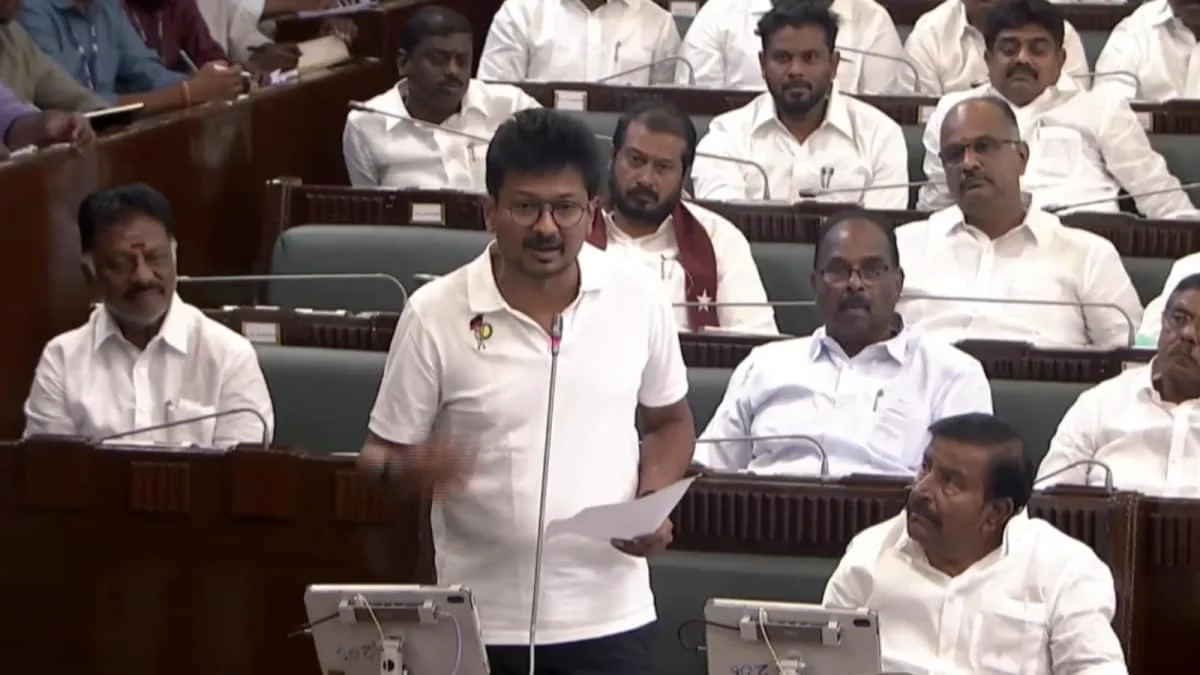
The political theatre unfolded in the assembly as CM Vijay sought to affirm his majority, a mere week after assuming office. The DMK’s decision to boycott the confidence vote, rather than actively vote against it, signifies a strategic withdrawal, aimed at delegitimizing the process and highlighting their profound skepticism about the government’s longevity and mandate. Udhayanidhi Stalin, in a blistering address, articulated the DMK’s deep concerns, accusing the TVK of lacking public trust and warning that the electorate already regretted their choice.
A Stinging Rebuke from the Opposition
Addressing the assembly with palpable intensity, Leader of Opposition Udhayanidhi Stalin delivered a scathing critique of the TVK government. He questioned the very foundation of its mandate, asserting that a significant portion of the electorate felt a "grave error" had been committed by voting for the new ruling party. "The very people who voted for you have begun to feel that they have committed a grave error," Stalin declared, his words reverberating through the assembly hall. This sentiment, he argued, was not merely anecdotal but widespread, reflecting a fundamental disconnect between the government and the aspirations of the state’s citizens.
Stalin further intensified his attack by claiming that nearly 65% of Tamil Nadu’s voters had actively rejected Chief Minister Vijay and the TVK during the recent elections. This statistic, while not immediately verifiable in the context of a multi-party election, underscored the DMK’s narrative that the TVK’s victory was a narrow, perhaps even accidental, outcome that did not reflect the broader will of the people. He demanded that the government, despite its electoral success, "carry out its work in a manner that earns the trust of the people." This implied a direct challenge to the TVK to govern inclusively and transparently, moving beyond the political machinations that led to its formation.
A core tenet of the DMK’s opposition was the call for a "secular government" in Tamil Nadu. While not explicitly detailing what aspects of the TVK government he considered non-secular, Stalin’s emphasis on this principle hinted at concerns over potential ideological leanings or a perceived lack of representation for certain communities. This point was further amplified by DMK ally MMK (Manithaneya Makkal Katchi) leader Jawahirullah, who explicitly raised the issue of inadequate Muslim representation in the state Cabinet, thereby adding a specific grievance to the broader secularism argument. Another ally, Manithaneya Jananayaga Katchi (MJK), also registered its protest by voting against the confidence motion, signaling a united front among key opposition partners on this critical issue.
Beyond ideological and representational concerns, Stalin also focused on the practical aspects of governance, urging CM Vijay’s administration not to "make people wait for months" for the fulfillment of election promises. This directly challenged the TVK to demonstrate immediate action and delivery, tapping into the common voter frustration with political rhetoric versus tangible outcomes. The DMK’s walkout, therefore, was not just a symbolic gesture but a comprehensive rejection of the TVK’s legitimacy, stability, and perceived commitment to inclusive governance and public welfare.
Chronology of a Delicate Mandate: From Election to Floor Test
The path to today’s floor test has been a winding one, beginning with the fiercely contested Assembly elections that delivered a fractured mandate. The Tamilaga Vettri Kazhagam (TVK), a relatively new entrant on the state’s political landscape, emerged as the single largest party, securing 108 seats in the 234-member House. While a significant achievement for the party, this figure fell short of the crucial majority mark of 118 by a margin of 10 seats. Adding to the numerical challenge, Chief Minister Joseph Vijay, having contested and won from two constituencies, subsequently resigned from one, effectively increasing the shortfall to 11 seats required to command a clear majority.
The electoral outcome plunged Tamil Nadu into a period of intense political negotiations and coalition-building. With no single party crossing the majority threshold, the focus immediately shifted to post-election alliances. CM Vijay, demonstrating political acumen and strategic foresight, embarked on a series of discussions to garner the necessary support. His efforts bore fruit as the TVK successfully stitched together a coalition, bringing together diverse political entities.
The Congress party, with its 5 MLAs, extended its support, providing a crucial bloc of votes. The Indian Union Muslim League (IUML), securing 2 seats, also pledged its backing, aligning with the TVK. Further bolstering the coalition were the Communist Party of India (CPI) and the Communist Party of India (Marxist) (CPI(M)), each contributing 2 MLAs. The Viduthalai Chiruthaigal Katchi (VCK), a party with a strong Dalit support base, also joined the alliance with its 2 representatives. These alliances collectively brought the ruling coalition’s strength to a comfortable 120 seats (108 TVK + 5 Congress + 2 IUML + 2 CPI + 2 CPI(M) + 2 VCK), surpassing the 118-seat majority mark by two.
With this numerical advantage, Chief Minister Joseph Vijay was able to stake his claim to form the government last week, culminating in his swearing-in ceremony. However, the constitutional requirement of proving the majority on the floor of the House remained. Today’s confidence vote was the inevitable next step, a formal procedure to validate the new government’s command over the assembly. The DMK’s walkout, while not directly impacting the numbers of the TVK-led coalition, nevertheless added a layer of political uncertainty and underscored the contentious nature of the government’s formation.
The Calculus of Support: Who Backs TVK and Why?
Despite the vociferous opposition from the DMK and its allies, Chief Minister Vijay’s TVK government successfully garnered support from a diverse array of parties and individuals, showcasing the intricate web of alliances that characterize Indian state politics. The backing received from these entities was crucial for the government to confidently face the floor test and signals a pragmatic approach to power-sharing and strategic alignment.
The Congress, with its 5 MLAs, emerged as a significant partner. Historically, the Congress has often played the role of a kingmaker or junior partner in various state coalitions. Their decision to support the TVK likely stems from a combination of factors: a desire to remain relevant in state politics, a potential alignment on certain policy issues, and a strategic move to counter the dominant DMK-AIADMK narrative in Tamil Nadu. By aligning with TVK, Congress ensures its presence in the ruling dispensation and potentially gains leverage for future electoral contests.
The Communist Party of India (Marxist) (CPI(M)) and the Viduthalai Chiruthaigal Katchi (VCK), each contributing 2 MLAs, also extended their support. The CPI(M), a Left-wing party, often aligns with secular and progressive forces. Their support for TVK could be indicative of a shared platform on social justice or anti-communalism, or simply a strategic decision to prevent the DMK from dominating the opposition space entirely. The VCK, a prominent Dalit political party, often prioritizes issues of social equality and representation. Their backing suggests that the TVK might have offered assurances on these critical fronts, or that the VCK sees a more conducive environment for its agenda within the TVK-led coalition compared to the alternatives.
The Indian Union Muslim League (IUML), with its 2 MLAs, is another crucial partner. The IUML traditionally represents Muslim interests and often aligns with parties that champion secular values and minority rights. Their support for the TVK government likely implies that CM Vijay’s party has provided satisfactory assurances regarding minority welfare and representation, directly contrasting the DMK ally MMK’s criticism on the lack of Muslim representation in the cabinet. This internal contradiction within the broader political landscape highlights the complex and often localized nature of coalition politics.
Adding an intriguing dimension to the support base was Kamaraj, an expelled MLA from the Amma Makkal Munnettra Kazagam (AMMK). His individual declaration of support for the TVK government was particularly emphatic. "I supported the Tamilaga Vettri Kazhagam government yesterday, I support it today, and I will continue to support it for the next five years," Kamaraj asserted, publicly expressing his confidence in CM Vijay. His personal loyalty and belief that "CM Vijay is protecting the entire state" and would "protect and save me too" underscores the role of individual political maneuvering and personal allegiances in shaping government stability, especially in a closely contested assembly. Kamaraj’s support, though numerically small, carries symbolic weight, demonstrating the TVK’s ability to attract cross-party support, even from estranged elements of rival factions.
These alliances, collectively, provided CM Vijay with the numerical strength to overcome the initial deficit and secure the confidence of the House, at least on paper. However, the diverse ideological backgrounds and potentially competing interests within this coalition suggest that governance will require careful negotiation and consensus-building to maintain stability over the long term.
The Floor Test: A Constitutional Imperative and Political Crucible
A floor test is a critical constitutional mechanism in parliamentary democracies like India, designed to ascertain whether a chief minister or a government enjoys the confidence of the legislative assembly. It becomes particularly imperative when a new government is formed, especially in cases of hung assemblies or when there are doubts about the ruling party’s majority. The primary purpose of a floor test is to ensure that the executive government is accountable to the legislature and truly represents the will of the elected representatives.
In Tamil Nadu, with a 234-member assembly, the majority mark stands at 118. For Chief Minister Joseph Vijay’s TVK-led coalition, securing at least 118 votes in favor of the confidence motion was non-negotiable. The process typically involves a motion of confidence moved by the Chief Minister, followed by a debate where members can express their views, question the government’s legitimacy, or declare their support. This debate provides a crucial platform for both the ruling and opposition parties to articulate their positions, influence public opinion, and demonstrate their strength.
The DMK’s decision to stage a walkout, rather than casting votes against the motion, is a nuanced political tactic. While a direct ‘no’ vote would have been a clear numerical opposition, a walkout serves a different purpose. It allows the opposition to protest the very legitimacy of the proceedings or the government itself, without formally participating in a vote that they believe is flawed or pre-determined. By walking out, the DMK aimed to delegitimize the outcome, suggesting that the government’s victory in the confidence vote was hollow or achieved under questionable circumstances. It also ensures that the DMK’s numerical strength is not even implicitly counted in the final tally of those who participated, thereby underscoring their complete disassociation from the TVK’s claim of confidence.
Historically, floor tests in India have often been fraught with drama, defections, and intense political maneuvering. They are not merely procedural formalities but often serve as crucibles that test the loyalty of MLAs, the cohesion of coalitions, and the strategic prowess of party leaderships. For the TVK, securing this vote, despite the DMK’s boycott, signifies a crucial first step in solidifying its hold on power. However, the manner in which it was achieved – with a significant opposition walkout – ensures that the narrative of instability will continue to dog the government in the public discourse.
Implications for Tamil Nadu Politics: A Rocky Road Ahead
The outcome of today’s floor test, particularly the DMK’s strong stance and walkout, has significant implications for the political landscape of Tamil Nadu, signaling a period of intense parliamentary battles and potential governmental instability.
For Chief Minister Joseph Vijay and the TVK government, securing the confidence vote is a vital constitutional victory. It officially legitimizes their administration and allows them to proceed with governance. However, the manner of this victory—with the principal opposition party boycotting the vote and questioning its very legitimacy—means that the TVK will likely face an uphill battle in establishing unquestioned authority and public trust. The coalition, forged out of necessity, will need careful management. The diverse interests of Congress, CPI(M), VCK, and IUML will require constant negotiation and compromise, potentially slowing down policy implementation or leading to internal disagreements. CM Vijay’s leadership will be tested not just by the opposition, but by the need to maintain cohesion within his own ranks. The DMK’s narrative of a "grave error" by voters will continue to be a potent weapon, forcing the TVK to deliver tangible results quickly to counter this perception.
For the DMK, the walkout marks a clear and aggressive strategy to position itself as a formidable opposition from day one. By boycotting the vote, Udhayanidhi Stalin has drawn a sharp line in the sand, refusing to lend any legitimacy to the TVK government. This strategy carries both risks and rewards. On one hand, it allows the DMK to maintain its critical stance without being implicated in any perceived failures of the government. On the other hand, it also means they miss an opportunity to actively vote down the government, should the numbers have allowed it. Their challenge will be to translate their strong rhetoric and public disapproval into effective parliamentary opposition and sustained public pressure. The DMK will likely scrutinize every government decision, mobilize public opinion, and highlight any perceived shortcomings or unfulfilled promises, aiming to reinforce their narrative of instability and voter regret.
For Tamil Nadu as a whole, the political atmosphere is set to remain charged. The state, traditionally dominated by two Dravidian majors, is now witnessing the rise of a new political force in TVK, operating with a delicate coalition and a vocal opposition. This could lead to a more dynamic, albeit potentially fractious, legislative environment. Governance might be characterized by heightened scrutiny, frequent debates, and a constant struggle for political one-upmanship. Crucial policy decisions, especially those requiring cross-party consensus, could face delays or significant challenges. The focus on fulfilling election promises, particularly those related to welfare and economic development, will be paramount for the TVK to solidify its base and counter the DMK’s criticisms.
Looking ahead, the longevity of the TVK government will depend heavily on its ability to manage internal coalition dynamics, deliver on its promises, and effectively counter the DMK’s relentless opposition. The next five years in Tamil Nadu are poised to be a period of intense political maneuvering, where every policy decision and legislative debate will be viewed through the prism of governmental stability and public mandate. The floor test was just the first hurdle; the real challenge of governing and proving its worth to the people of Tamil Nadu now truly begins for Chief Minister Joseph Vijay and the Tamilaga Vettri Kazhagam.
