

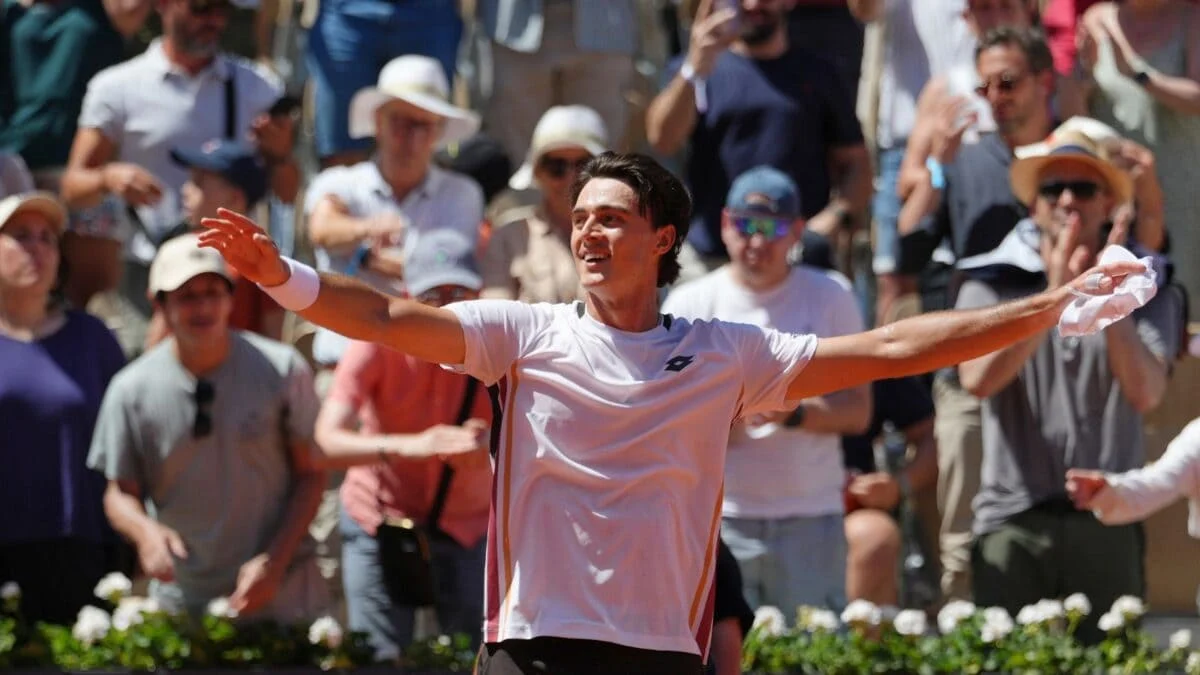
PARIS, France – May 26, 2026 – The hallowed red clay of Roland Garros witnessed a seismic upset on Monday as Australian wildcard Adam Walton, ranked 97th in the world, delivered a career-defining performance to dethrone the sixth-seeded Daniil Medvedev in a gripping five-set thriller. The 27-year-old Queenslander’s victory, marked by resilience and audacious play, not only secured his first-ever win against a Top 10 opponent but also propelled him into the second round of the French Open, where he is set to face American challenger Zachary Svajda.
The monumental 6-2, 1-6, 6-1, 1-6, 6-4 triumph unfolded over three hours and 38 minutes on Court Suzanne-Lenglen, captivating spectators with its wild swings of momentum. Walton, displaying nerves of steel, rallied from a perilous 2-4 deficit in the decisive fifth set, breaking Medvedev twice consecutively to seal the most significant victory of his burgeoning professional career. This stunning result sends shockwaves through the men’s draw, underscoring the unpredictable magic inherent in Grand Slam tennis and establishing Walton as a legitimate dark horse.
Main Facts
Adam Walton, a 27-year-old Australian wildcard ranked 97th globally, orchestrated a monumental upset at Roland Garros on Monday, May 26, 2026, defeating the tournament’s sixth seed, Daniil Medvedev, in a grueling five-set match. The final scoreline of 6-2, 1-6, 6-1, 1-6, 6-4 reflects a rollercoaster encounter that saw both players dominate in phases. This victory marks Walton’s maiden win over a Top 10 ranked opponent and secures his passage to the second round of a Grand Slam for the first time in his career. His remarkable comeback from 2-4 down in the deciding fifth set showcased exceptional mental fortitude and tactical prowess. The win sets up a second-round clash against American Zachary Svajda, offering Walton a tangible opportunity to further advance in the tournament. This unexpected result is a significant highlight of the early stages of the French Open, affirming the depth of talent within the men’s professional tour and challenging the established hierarchy.
Chronology of a Classic Upset
The highly anticipated first-round clash between the seasoned Grand Slam champion Daniil Medvedev and the determined underdog Adam Walton began under a cloudless Parisian sky, promising an intriguing battle of contrasting styles. From the outset, it was clear this would be no ordinary encounter.
Set 1: Walton’s Early Statement (6-2)
Walton, typically known for his tenacious baseline game and solid serve, started with an aggressive intensity that seemed to catch Medvedev off guard. The Australian broke the Russian’s serve early, showcasing a fearless approach with deep returns and well-placed groundstrokes. Medvedev, known for his methodical approach, appeared slightly sluggish, perhaps still adjusting to the clay court conditions that have historically been less favorable to his game. Walton capitalized on this, maintaining a high first-serve percentage and defending his own service games with remarkable composure, ultimately taking the first set comfortably at 6-2. The crowd, initially buzzing with curiosity, now sensed a potential upset brewing.
Set 2: Medvedev’s Resurgence (1-6)
True to his reputation as a Grand Slam winner and former World No. 1, Medvedev responded with a brutal efficiency in the second set. He elevated his intensity, finding his rhythm on his serve and deploying his signature flat, penetrating groundstrokes with greater precision. Walton, perhaps momentarily overwhelmed by the sudden shift in Medvedev’s level, struggled to maintain the same aggression, committing a few unforced errors. The Russian swiftly broke Walton’s serve multiple times, dismantling his opponent’s game to claim the second set with a dominant 6-1, restoring parity to the match and seemingly reaffirming the expected order.
Set 3: Australian Resilience (6-1)
Just as Medvedev appeared to be seizing control, Walton demonstrated his remarkable resilience. Shaking off the disappointment of the previous set, he rediscovered his aggressive form, pushing Medvedev around the court and forcing errors. The Australian’s forehand began to find its mark with greater consistency, and his serve, backed by an impressive ability to save break points, became a formidable weapon once more. Medvedev, on the other hand, seemed to lose his focus, perhaps frustrated by Walton’s renewed tenacity. Unforced errors crept back into his game, and Walton capitalized decisively, breaking the Russian multiple times to clinch the third set 6-1, once again turning the tide of the match.
Set 4: The Medvedev Response (1-6)
The seesaw nature of the match continued into the fourth set. Medvedev, refusing to yield, mounted another powerful comeback. He rediscovered his defensive prowess, absorbing Walton’s power and turning it into offensive opportunities. His movement improved, allowing him to cover the court with greater efficiency, and his ability to construct points meticulously began to wear down the Australian. Walton, despite his best efforts, found himself increasingly on the back foot, unable to consistently breach Medvedev’s formidable defense. The Russian dominated the set 6-1, setting the stage for a dramatic decider.
Set 5: The Decisive Comeback (6-4)
With the match poised at two sets all, the tension on Court Suzanne-Lenglen was palpable. The fifth set began with both players holding serve, a testament to their improved focus and determination. However, Medvedev struck first, securing a crucial break to take a 4-2 lead. At this juncture, many would have expected the experienced Medvedev to close out the match. But Walton, displaying an extraordinary refusal to lose, dug deep. He found an extra gear, unleashing powerful forehands and executing daring winners. He broke Medvedev back immediately, leveling the score at 4-4, sending a jolt of energy through the crowd.
The crucial ninth game saw Walton hold serve under immense pressure, pushing him to a 5-4 lead. The momentum had decisively swung. Serving to stay in the match, Medvedev faced a relentless Walton, who pressed hard for the final break. After a series of thrilling rallies and deuces, Walton seized his opportunity, breaking Medvedev’s serve for the second consecutive time to seal the set 6-4 and claim the biggest victory of his career. The celebration was one of pure elation and disbelief, a fitting end to an unforgettable five-set epic.
Supporting Data
The narrative of Adam Walton’s upset over Daniil Medvedev is not merely a tale of a single match; it’s a culmination of a dedicated journey, a testament to specific strengths, and an indictment of a particular weakness. Delving into the backgrounds of both players and the statistical nuances of their encounter provides crucial context for this monumental victory.
Adam Walton’s Ascent: A Profile in Perseverance
Born and raised in the rural town of Home Hill in North Queensland, Adam Walton’s path to the upper echelons of professional tennis has been anything but conventional. He began playing tennis at the tender age of five, nurturing a passion that would eventually lead him far from his humble beginnings. At 14, recognizing his potential, Walton made the significant move to Brisbane, where he secured a coveted tennis scholarship to attend the prestigious Anglican Church Grammar School. This move also allowed him to train at the National Academy located at the Queensland Tennis Centre, providing him with access to elite coaching and facilities.
Walton then embarked on a successful college tennis career at the University of Tennessee, a common pathway for many Australian players seeking to hone their skills while pursuing an education. It was here that he truly distinguished himself, capturing the highly regarded 2021 NCAA doubles title alongside his partner Pat Harper. This collegiate success provided a solid foundation for his transition to the professional tour, instilling in him a competitive spirit and an understanding of high-stakes environments.
His professional breakthrough began on the Challenger circuit, where he gradually built his ranking and confidence. He claimed his maiden ATP Challenger doubles title at the San Luis Open Challenger, partnering with Colin Sinclair. This was soon followed by his first Challenger singles title in August 2023 at the Atlantic Tire Championships in Cary, North Carolina, signaling his readiness to compete at a higher level.
Walton’s Grand Slam main-draw debut came via a wildcard at the 2024 Australian Open, where he faced a tough challenge against Matteo Arnaldi, ultimately falling in the opening round. He received another wildcard for the 2024 French Open, where he again lost in the first round, this time to Arthur Rinderknech. However, his maiden ATP main-draw victory came at the Mallorca Championships, beating Yannick Hanfmann before exiting in the second round to Paul Jubb. Crucially, he also recorded a significant win over 22nd seed Ugo Humbert in the opening round of last year’s US Open, demonstrating his capability to perform against seeded opponents on the big stage. The most prescient detail, however, is his prior stunning victory over then-World No. 15 Daniil Medvedev at the Cincinnati Open just last year, proving that this upset was not a complete anomaly but rather a repeat performance against a familiar, high-profile foe.
Walton’s game is characterized by a strong work ethic, a powerful forehand, and an impressive ability to grind out points. His defensive skills, combined with moments of aggressive brilliance, make him a difficult opponent, particularly when he finds his rhythm.
Daniil Medvedev’s Clay Conundrum
Daniil Medvedev, a former World No. 1 and a Grand Slam champion (2021 US Open), is widely recognized as one of the most intelligent and effective players on hard courts. His unique, flat hitting style, exceptional defensive skills, and tactical acumen have brought him immense success on faster surfaces. However, clay has historically been his least favored surface. While he has made efforts to adapt his game and has shown improvements in recent seasons, including a Masters 1000 title on clay, Roland Garros remains his toughest Grand Slam challenge.
Medvedev’s flat groundstrokes, which skitter off hard courts, tend to lose some of their potency on the slower, higher-bouncing clay. His movement, while excellent on hard courts, can sometimes appear less fluid on clay, which demands more sliding and different footwork patterns. Despite being the sixth seed, a significant portion of the tennis world always eyes Medvedev’s clay court performance with a degree of skepticism. His prior loss to Walton at Cincinnati, albeit on a hard court, suggests that Walton’s game style might pose particular challenges for Medvedev, regardless of the surface.
Match Statistics: The Numbers Behind the Drama
The statistical breakdown of the five-set epic between Walton and Medvedev reveals key insights into the match’s dynamics:
- Break Points Saved: A standout statistic for Walton was his incredible ability to save break points. He fended off 16 out of 21 break points faced, a testament to his composure under pressure and clutch serving in critical moments. This significantly blunted Medvedev’s opportunities to establish sustained dominance.
- Match Duration: The match lasted three hours and 38 minutes, indicating a physically demanding encounter that tested the endurance of both players. Walton’s ability to maintain his intensity, particularly in the fifth set, speaks volumes about his fitness levels.
- Winners and Unforced Errors (Inferred): While specific figures are not available, the fluctuating scoreline suggests that both players experienced periods of high-risk, high-reward play. Walton likely hit a higher percentage of winners during his dominant sets, particularly with his forehand, while Medvedev’s unforced error count would have spiked during the sets he lost convincingly. In the fifth set, Walton’s ability to maintain a lower error count while increasing his aggression was crucial.
- Serve Performance: The alternating nature of the sets often correlated with the players’ first-serve percentages and their effectiveness on second serves. When Walton’s first serve was firing, he was tough to break; when Medvedev’s serve wavered, Walton capitalized aggressively.
- Rally Tolerance: On clay, rally tolerance is paramount. While Medvedev is a master of extended rallies, Walton demonstrated an impressive ability to stay in points, absorb pace, and then turn defense into offense, particularly in the later stages of the match.
These statistics paint a picture of a match where Walton not only executed his game plan effectively but also demonstrated superior mental resilience and tactical adaptability, especially in the face of Medvedev’s known clay court struggles and his own ability to perform under Grand Slam pressure.
Official Responses
The immediate aftermath of such a significant upset inevitably brings a mix of euphoria, disappointment, and analytical reflection from the players and observers.
Adam Walton’s Elation
Emerging from the court, visibly emotional yet beaming, Adam Walton’s post-match comments reflected a profound sense of accomplishment and a touch of disbelief. "Honestly, it’s surreal," Walton reportedly stated, wiping sweat from his brow. "To beat a player of Daniil’s caliber, especially at a Grand Slam, it’s what you dream of. The crowd was amazing, really kept me going in that fifth set when things looked tough."
When asked about his comeback from 2-4 down in the decider, he emphasized mental fortitude. "I just told myself to keep fighting, one point at a time. I’ve been working so hard for moments like these, and to execute under that kind of pressure… it’s just an incredible feeling. I knew I had beaten him before, and that gave me a little bit of belief, even when I was down. I just tried to stick to my game, play aggressive when I could, and stay solid." He concluded by expressing his excitement for the next challenge. "I’ll enjoy this for a bit, but then it’s back to work. Zachary [Svajda] is a tough opponent, and I’m looking forward to the next round."
Daniil Medvedev’s Disappointment
Daniil Medvedev, typically candid in his post-match assessments, acknowledged his opponent’s superior performance and expressed his own frustrations with the result. "Adam played a very good match, especially in the important moments," Medvedev conceded in his press conference, his voice tinged with disappointment. "He was fighting, he was hitting his forehand well. For me, it was a very strange match, up and down, up and down."
Reflecting on his recurring challenges on clay, he added, "Clay is always tough for me, even though I try to improve every year. Today, I just couldn’t find my best level consistently. When I had the lead in the fifth set, I felt like I had the momentum, but he played some really strong points to break me back. Credit to him, he deserved to win today." Medvedev also alluded to the specific tactical difficulties Walton presented. "He serves well, he moves well, and he has a good return game. Sometimes I felt like I was playing well, and then suddenly the set was gone. It’s frustrating, but this is tennis."
Expert Commentary
Tennis pundits and former players were quick to laud Walton’s performance and analyze the implications of the upset. Legendary commentator Mats Wilander, speaking on Eurosport, remarked, "This is why we love Roland Garros! Adam Walton showed incredible heart. To come back from 2-4 down in the fifth against a player like Medvedev, who is a fighter himself, tells you everything you need to know about Walton’s character. He’s been building towards this, and he seized his moment."
Analyst Laura Robson highlighted Medvedev’s clay-court struggles: "Daniil has made strides on clay, but this match really exposed some of the inherent difficulties his game faces on this surface. Walton exploited those weaknesses perfectly, combining aggression with relentless defense. This is a huge, huge win for the Australian, and it opens up that section of the draw significantly." The consensus among experts was that Walton’s win was not merely a fluke but a testament to sustained effort and a well-executed game plan against a vulnerable top seed.
Implications
Adam Walton’s stunning victory over Daniil Medvedev is far more than just a first-round upset; it carries significant implications for both players, the ongoing French Open, and the broader narrative of professional tennis.
For Adam Walton’s Career: A Watershed Moment
This win represents a definitive watershed moment for Adam Walton.
- Confidence and Validation: Defeating a Top 10 player, especially a Grand Slam champion like Medvedev, provides an unparalleled boost in confidence. It validates years of hard work, sacrifices, and belief in his own abilities, confirming that he belongs on the biggest stages.
- Ranking and Financial Reward: While his current ranking of 97th is respectable, this victory will significantly contribute to his ATP points tally, pushing him closer to, or potentially into, the Top 80, securing direct entry into more ATP Tour events and Grand Slams without needing wildcards or qualifying. The prize money for reaching the second round of Roland Garros is also substantial, offering crucial financial support for his continued professional journey.
- Increased Profile and Opportunities: The global exposure gained from such a high-profile upset will undoubtedly lead to increased media attention, potential sponsorship opportunities, and greater recognition within the tennis world. He transitions from a relatively unknown wildcard to a player who has proven he can beat the best.
- Path Forward in the Tournament: Facing Zachary Svajda in the second round presents a significant, yet winnable, opportunity. While Svajda is a talented opponent, Walton will enter the match with immense momentum and self-belief. A deep run at a Grand Slam can be career-altering, and this victory has opened that door for him.
For Daniil Medvedev: A Disappointing Early Exit
For Daniil Medvedev, this early exit from Roland Garros is a considerable setback.
- Grand Slam Performance: As a six-time Grand Slam finalist and one-time champion, Medvedev holds himself to a high standard. A first-round exit, especially against a player ranked outside the Top 90, is a major disappointment and a blow to his Grand Slam aspirations for the year.
- Clay Court Narrative: Despite his efforts to improve his clay-court game, this loss reinforces the persistent narrative that clay remains his Achilles’ heel. It will inevitably lead to renewed questions about his ability to consistently contend for titles on the surface, potentially affecting his confidence heading into the grass and hard court seasons.
- Ranking Points and Season Goals: An early exit means a significant loss of potential ranking points, which could impact his standing and qualification for the ATP Finals later in the year. He will need to quickly regroup and perform exceptionally well in upcoming tournaments to mitigate the damage.
- Mental Reset: Medvedev will need to perform a swift mental reset, analyzing what went wrong and refocusing on his strengths as he transitions to the grass-court season, where he is typically far more comfortable and dangerous.
Wider Tournament Impact: Shaking Up the Draw
The implications for the 2026 French Open itself are also noteworthy:
- Open Section of the Draw: Medvedev’s departure as the sixth seed immediately opens up his quarter of the draw. This creates an unexpected opportunity for other players in that section, who might now face a potentially easier path to the later stages of the tournament, enhancing the chances for a surprise semi-finalist.
- Unpredictability and Excitement: Upsets like this inject immense excitement and unpredictability into Grand Slams. They remind fans that no match is a foregone conclusion, and that the depth of talent on tour means anyone can be beaten on any given day. This fuels interest and anticipation for the remainder of the tournament.
- Narrative of the Underdog: Walton’s story adds to the rich tapestry of underdog narratives that often define Grand Slams, inspiring aspiring players and captivating audiences with tales of perseverance and unexpected triumph.
The "Giant Killer" Narrative
Walton’s victory over Medvedev also solidifies his growing reputation as a "giant killer," particularly against the Russian. Having previously stunned Medvedev at the Cincinnati Open, this repeat performance suggests a specific matchup advantage or a mental edge Walton holds over the former World No. 1. This developing narrative could make future encounters between the two even more compelling and raises Walton’s stock as a player capable of producing major upsets, making him a dangerous opponent for any top seed.
In conclusion, Adam Walton’s monumental win at Roland Garros is a powerful reminder of the captivating drama and inherent unpredictability of professional tennis. It is a moment that will undoubtedly reshape his career trajectory, while simultaneously forcing a re-evaluation of Daniil Medvedev’s clay-court capabilities and adding another thrilling chapter to the storied history of the French Open.
