

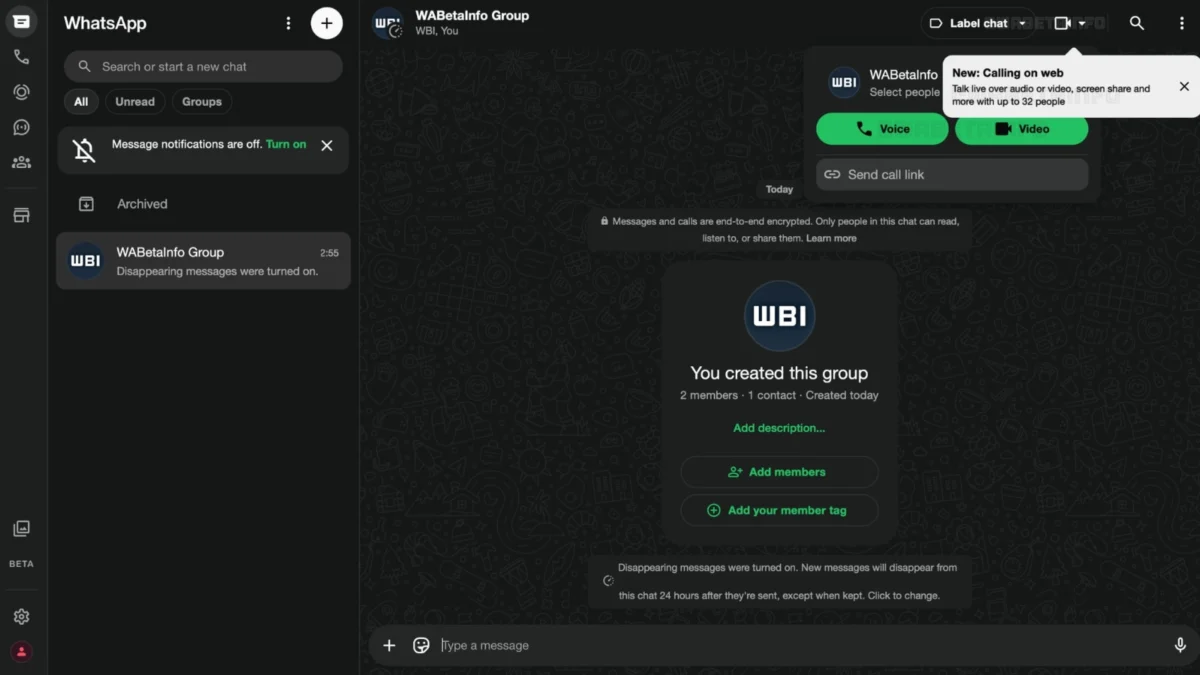
New Delhi, India – June 15, 2026 – WhatsApp, the ubiquitous messaging platform owned by Meta, is significantly enhancing its web-based offering by rolling out support for group voice and video calls directly from web browsers. This pivotal update, initially accessible to a select cohort of beta testers, marks a crucial step in bridging the functionality gap between WhatsApp’s mobile and desktop applications and its widely used web interface. The feature, which began its phased deployment earlier in June 2026, is anticipated to reach a broader user base in the coming weeks, promising a more integrated and versatile communication experience for millions worldwide.
For years, WhatsApp Web has served as a convenient extension of the mobile app, primarily facilitating text-based conversations and one-on-one calls. The introduction of group calling capabilities represents a strategic evolution, transforming the web client into a more robust tool for collaborative communication, rivaling dedicated conferencing platforms in its accessibility and ease of use.
A New Era for WhatsApp Web: Expanding Collaborative Communication
The ability to initiate and participate in group voice and video calls directly from a web browser signifies a substantial upgrade to the WhatsApp Web experience. Until this rollout, users requiring multi-participant communication were compelled to switch to their mobile devices or the dedicated desktop application. This update eliminates that friction, allowing for seamless transitions between messaging and real-time group conversations within the browser environment. The move underscores Meta’s commitment to fostering a unified and feature-rich experience across all WhatsApp platforms, catering to the diverse needs of its global user base, from casual conversations to professional engagements.
Bridging the Feature Gap with Enhanced Usability
The core of this update lies in its capacity to bring the full spectrum of group communication to the web. Historically, WhatsApp Web’s calling functionalities were confined to individual voice and video calls, a limitation that often necessitated a device switch for users engaging in group interactions. With the new implementation, users will discover a prominent call button strategically positioned at the top of a group chat window on WhatsApp Web. Upon selection, a clear prompt will allow users to choose between initiating a voice or video call. Crucially, the system offers flexibility, enabling users to either include all participants in the group or meticulously select specific individuals, providing a layer of control vital for focused discussions or smaller huddles within larger groups.
This development is particularly impactful for users who primarily operate from their computers, integrating WhatsApp more deeply into their workflow. It aligns the web client’s capabilities more closely with the mobile and desktop apps, ensuring a consistent user experience regardless of the access point.
Key Features and Enhanced User Control
The newly introduced group calling feature on WhatsApp Web comes laden with a suite of functionalities designed to enhance both usability and security:
- Participant Capacity: The system supports up to 32 participants for both group voice and video calls. This capacity mirrors the limits already established on WhatsApp’s mobile and desktop versions, reflecting a deliberate effort by the company to maintain consistency across its ecosystem. A 32-person limit positions WhatsApp competitively against other mainstream communication platforms for small to medium-sized group interactions, making it suitable for team meetings, family gatherings, or study groups.
- End-to-End Encryption (E2EE): A cornerstone of WhatsApp’s security architecture, end-to-end encryption, based on the robust Signal protocol, extends to group calls on the web version. This means that all communications, including audio and video streams, are encrypted from the sender’s device to the recipient’s device. Neither WhatsApp nor its parent company, Meta, can access the content of these calls, ensuring an unparalleled level of privacy and security for users.
- Call Links: The update introduces support for call links, a highly convenient feature enabling users to generate and share unique invitation URLs for group calls. These links simplify the process of inviting participants, particularly those not already in the group chat or external contacts. The links are designed with security in mind, automatically expiring after 30 days of inactivity, minimizing potential unauthorized access to old call sessions.
- Waiting Room Functionality: For enhanced control over who joins a call, WhatsApp Web now includes a waiting room feature. This allows the call host to vet participants before granting them access, adding an extra layer of security and privacy, especially useful for formal meetings or sensitive discussions.
- Screen Sharing: Addressing a critical need for collaborative environments, WhatsApp Web’s video calls now support screen sharing. This functionality empowers participants to present documents, slides, applications, or other content directly from their browser, facilitating more engaging and productive virtual meetings. It’s important to note, however, that this feature is exclusively available during video calls and does not extend to voice-only sessions, a common distinction in most conferencing tools.
Chronology of Web-Based Communication Evolution
The journey of WhatsApp Web from a nascent messaging extension to a comprehensive communication hub has been incremental, marked by strategic feature rollouts designed to enhance user engagement and platform versatility.
From Text to Individual Calls: The Early Stages
When WhatsApp Web first launched in 2015, its primary utility was to mirror mobile conversations onto a larger screen, offering the convenience of typing with a physical keyboard. For years, its capabilities were largely confined to text, media sharing, and basic document exchange. The idea of real-time voice or video communication, especially for groups, seemed a distant prospect given the technical complexities of browser-based real-time communication.
The first significant leap in calling functionality arrived in 2026, when WhatsApp began rolling out one-to-one voice and video calling support for its web version. This initial integration was a crucial precursor, laying the technical groundwork and testing the infrastructure required for real-time, browser-based communication. It addressed a longstanding user demand, allowing individuals to make private calls without having to pick up their phone, a feature that resonated strongly with users who spend extended periods working on their computers. This 2026 rollout served as a pilot, allowing WhatsApp to refine its WebRTC (Web Real-Time Communication) implementation and ensure stability before tackling the more complex challenge of group calls.
The Leap to Group Connectivity: Consolidating the Experience
The current rollout of group voice and video calls in June 2026 represents the culmination of this evolutionary trajectory. It’s not merely an addition of a new feature but a consolidation of the communication experience, bringing the web version significantly closer to the full-fledged capabilities of its mobile and desktop counterparts. This expansion signifies WhatsApp’s maturity as a communication platform that transcends basic messaging, positioning it as a viable contender in the broader landscape of unified communication tools. The timing of this rollout also reflects the sustained global demand for robust remote collaboration tools, a trend that has accelerated significantly in recent years.
Supporting Data and Technical Underpinnings
The successful implementation of group calls on a web browser relies on sophisticated technical architecture and adherence to stringent security protocols. The insights into this rollout, primarily sourced from WABetaInfo, a reliable independent portal tracking WhatsApp developments, provide a glimpse into these foundational elements.
The Power of End-to-End Encryption via Signal Protocol
The commitment to end-to-end encryption for web-based group calls is paramount. WhatsApp explicitly stating its protection by the Signal protocol is a significant reassurance for users. The Signal Protocol, developed by Signal Foundation, is widely regarded as the gold standard for secure messaging and calling. It ensures that communication content is encrypted on the sender’s device and decrypted only on the recipient’s device. This means that intermediate servers, including those operated by WhatsApp or Meta, cannot read or listen to the content.
For group calls, this involves complex cryptographic key exchanges among all participants, ensuring that each segment of the conversation remains private. The integrity of this encryption is crucial, especially in an era of heightened data privacy concerns and cyber threats. It distinguishes WhatsApp from platforms that may offer encryption only in transit or lack E2EE by default, positioning it as a secure choice for sensitive group discussions. The application of E2EE across all platforms—mobile, desktop, and now web—reinforces WhatsApp’s unwavering commitment to user privacy, a core tenet of its global appeal.
Performance and Accessibility Considerations
Implementing real-time group communication in a browser environment presents unique technical challenges related to performance and compatibility. WhatsApp’s choice to roll out this feature incrementally to beta testers is a standard practice for ironing out bugs and optimizing performance across various browsers (Chrome, Firefox, Edge, Safari) and operating systems.
- Browser and System Requirements: While specific technical requirements haven’t been detailed, modern browsers with robust WebRTC support are essential. Users with older or less powerful machines might experience performance variations, though WhatsApp typically optimizes for a wide range of hardware.
- Network Bandwidth: Group video calls, especially with screen sharing, are bandwidth-intensive. The platform will likely employ adaptive bitrate technologies to adjust call quality based on available network speed, minimizing disruptions. However, a stable and reasonably fast internet connection will be crucial for optimal performance.
- Accessibility for Diverse Operating Systems: The update is particularly beneficial for Linux users. Unlike Windows and macOS, for which WhatsApp offers dedicated desktop applications, Linux users have historically relied solely on WhatsApp Web. The absence of a native desktop app meant that Linux users were completely excluded from the convenience of desktop-based group calls. This update levels the playing field, making robust WhatsApp communication accessible directly from their preferred browser, filling a critical gap in the platform’s multi-OS strategy.
- Call Links and Waiting Room as Control Mechanisms: The provision of call links not only simplifies invitations but also reduces the overhead of managing group memberships for spontaneous calls. Coupled with the waiting room feature, hosts gain granular control over who can join a call, preventing unwanted interruptions and ensuring that only intended participants are present. This dual functionality offers a balance between ease of access and necessary security.
Official Responses and Strategic Vision
While the initial news of this rollout stems from observations within the beta program, WhatsApp’s actions and previous statements provide clear insights into its overarching strategic vision.
Meta’s Unified Platform Strategy
The introduction of group calls on WhatsApp Web is a direct reflection of Meta’s broader strategy to create a seamless, interoperable ecosystem across its family of applications. Meta has long pursued the vision of unifying communication experiences across WhatsApp, Instagram, and Facebook Messenger, even if full cross-platform messaging remains a long-term goal. For WhatsApp specifically, the objective is to ensure feature parity across mobile, desktop, and web clients. This not only enhances user convenience but also solidifies WhatsApp’s position as a comprehensive communication solution capable of handling diverse use cases, from personal chats to professional collaborations.
By strengthening WhatsApp Web, Meta aims to capture a larger share of the desktop-centric communication market. Businesses and professionals increasingly rely on browser-based tools, and a fully functional WhatsApp Web allows them to integrate the platform more deeply into their daily workflows without the need to constantly switch devices. This strategy is critical in an intensely competitive landscape where rivals like Telegram, Signal, Microsoft Teams, and Google Meet offer robust web clients and multi-device support.
The Beta Program and Future Rollout Timeline
WhatsApp’s typical development cycle involves rigorous beta testing before a wide-scale public release. The current availability to "limited number of users enrolled in the WhatsApp Web beta programme" is a standard practice. This phased rollout allows WhatsApp to gather crucial feedback, identify and rectify bugs, and optimize performance in a controlled environment. Beta testers play a vital role in stress-testing new features under real-world conditions, ensuring stability and a smooth user experience for the general public.
While WhatsApp has not shared a specific timeline for a wider rollout, industry patterns suggest that if the beta phase progresses smoothly, the feature could become generally available within weeks to a few months. Users who do not yet see the group call option are advised to keep their WhatsApp Web client updated and monitor for future announcements, as access will likely be granted through subsequent software updates. The iterative nature of software deployment means that even after a general rollout, further refinements and enhancements can be expected.
Implications and Future Outlook
The expansion of group calling to WhatsApp Web carries significant implications for user experience, the competitive landscape, and the future trajectory of the platform.
Enhancing Productivity and Collaboration
For individual users, the convenience factor is immense. Remote workers, students, and professionals can now conduct quick group discussions, share screens during presentations, or simply connect with family and friends without interrupting their workflow on their computer. This fosters greater productivity by minimizing device switching and centralizing communication within a single, accessible interface. The ability to generate call links and utilize a waiting room further streamlines the process of organizing and managing group interactions, whether for impromptu discussions or scheduled meetings. The inclusion of screen sharing is particularly transformative for collaborative tasks, enabling real-time feedback and shared viewing of documents, presentations, or creative projects.
Reshaping the Communication Ecosystem
The update significantly bolsters WhatsApp’s competitive stance against dedicated video conferencing tools and other messaging apps that have long offered robust desktop and web-based group calling. While platforms like Zoom, Google Meet, and Microsoft Teams remain dominant for large-scale enterprise meetings, WhatsApp’s strength lies in its massive user base and its seamless integration with personal and small-group messaging. By enhancing its web client, WhatsApp positions itself as a strong contender for informal team huddles, family calls, and small business interactions, leveraging its existing network effect.
This move could potentially disrupt the market for casual group calling, as users might opt for the familiarity and convenience of WhatsApp over downloading separate applications or navigating different interfaces. The emphasis on end-to-end encryption also provides a distinct advantage in an era where privacy is a major differentiator, attracting users who prioritize secure communications.
The Road Ahead for WhatsApp Web
This rollout is likely part of a broader strategy to continue enhancing WhatsApp Web’s capabilities. Future developments could include:
- Expanded Participant Limits: While 32 is substantial for many, larger groups might eventually be accommodated, or tiered options introduced.
- Enhanced Moderation Tools: For larger group calls, more sophisticated moderation features (e.g., muting all, hand-raising, breakout rooms) could be integrated.
- Integration with Other Meta Services: While privacy protocols are strict, subtle integrations with other Meta business tools or even Instagram/Facebook Messenger could be explored for specific use cases.
- Persistent Call Rooms: The ability to create "rooms" that users can join and leave at will, similar to some other platforms, could be a future enhancement.
- Community Features: As WhatsApp expands its "Communities" feature, robust web-based group calling will be crucial for larger organizational communication.
In conclusion, the introduction of group voice and video calls on WhatsApp Web marks a pivotal moment for the platform. It not only addresses a critical feature gap but also reaffirms WhatsApp’s commitment to providing a unified, secure, and highly functional communication experience across all devices. As the feature rolls out more widely, it is poised to significantly impact how millions of users interact, collaborate, and connect in the digital realm.
(This article has been curated by Shivani P Menon, who is an intern with The Indian Express)
