

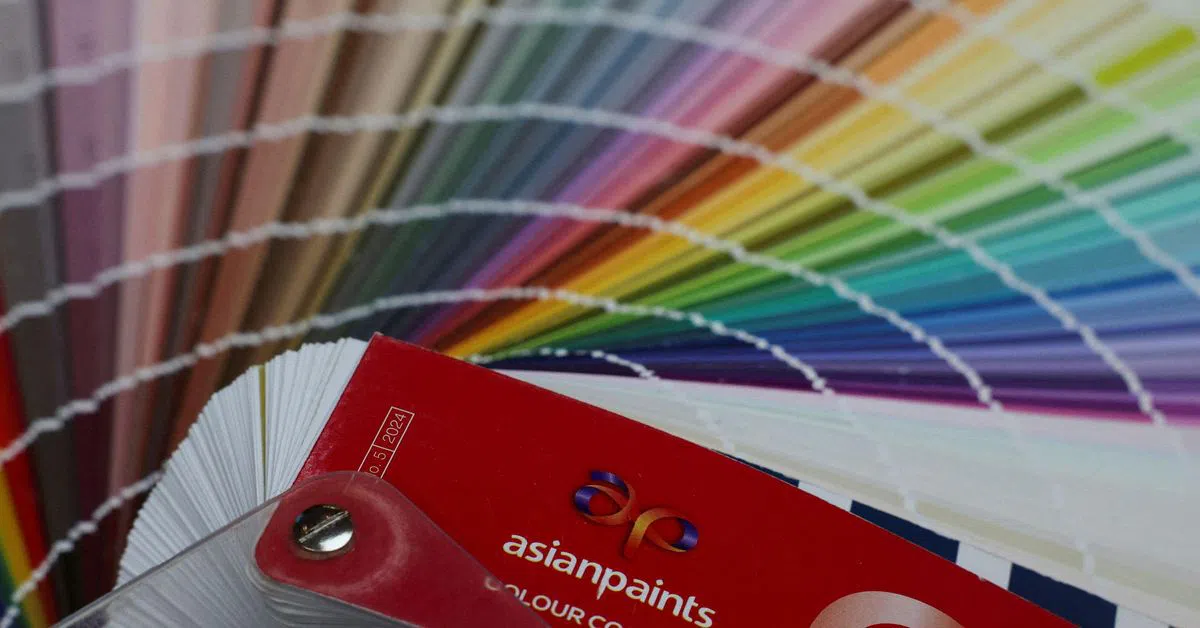
MUMBAI – Asian Paints, the undisputed titan of the Indian coatings industry, has once again demonstrated its market resilience. In its latest financial disclosure for the quarter ending March 31, the company reported a robust performance that surpassed analyst expectations, driven primarily by a surge in domestic volumes and strategic pricing maneuvers. As the company navigates a landscape marred by volatile crude prices and geopolitical instability in the Middle East, its ability to maintain double-digit growth signals a strong consumer appetite for home improvement in the Indian subcontinent.
Main Facts: A Stellar Performance Against Market Odds
Asian Paints’ consolidated net profit for the fourth quarter witnessed a staggering 69 percent year-on-year increase, reaching ₹1,172 crore ($123.1 million). This figure comfortably outpaced the average estimate of ₹1,116 crore projected by analysts polled by LSEG. The company’s revenue from sales followed a similar upward trajectory, growing by nearly 11 percent to settle at ₹9,229 crore.
The primary engine of this growth remains the company’s core decorative paints segment, which accounts for approximately 90 percent of its total revenue. In a market where consumer sentiment has been cautious due to inflationary pressures, Asian Paints managed a domestic decorative volume growth of 12.4 percent. While volume growth was high, value growth stood at 10.2 percent, indicating a slight gap that reflects the company’s efforts to balance market share with price adjustments.
Following the announcement, the stock market reacted positively. Shares of Asian Paints rose by 1.7 percent to ₹2,718, reflecting investor confidence in the company’s ability to protect its margins despite rising input costs.
Chronology: Navigating a Turbulent Fiscal Year
The journey to these fourth-quarter results has been defined by a series of strategic pivots and external challenges.
The Pricing Cycle
Throughout the early months of the calendar year, Indian paint makers, led by Asian Paints, have been forced to recalibrate their pricing strategies. In late 2023 and early 2024, the industry faced significant pressure from rising petrochemical costs. According to dealer checks by Macquarie, Asian Paints implemented a price hike of approximately 3 percent to 5 percent effective this May. This followed an even more aggressive hike of 6 percent to 8 percent earlier in the year.
While the company has not officially confirmed the exact percentages of these May hikes, the market consensus suggests that these moves were essential to offset the rising cost of crude-linked raw materials.
The Earnings Sequence
Asian Paints was the final major player in the Indian paint sector to report its earnings for the fiscal year. Its performance follows a trend set by its smaller rivals—Berger Paints, Kansai Nerolac, and JSW Dulux—all of which reported improved profitability earlier this month. However, the scale of Asian Paints’ profit jump (69%) significantly outperformed the percentage increases seen by its competitors, reinforcing its dominant position in the "organized" segment of the market.
The Geopolitical Context
The latter half of the quarter was overshadowed by escalating tensions in West Asia. The conflict in the Middle East has had a twofold impact on the industry: first, by causing volatility in crude oil prices (a key component for paint solvents and resins), and second, by disrupting global supply chains for essential petrochemicals.
Supporting Data: Dissecting the Financial Health
A closer look at the balance sheet reveals the operational efficiencies that contributed to this quarter’s success.
Margin Expansion
One of the most significant highlights of the report was the improvement in the PBDIT (Profit Before Depreciation, Interest, Tax, Other Income, and Exceptional Items) margin. The margin expanded to 19.4 percent, up from 17.2 percent in the same quarter of the previous year. This 220-basis point improvement is particularly noteworthy given the inflationary environment. It suggests that the company’s premiumization strategy—pushing higher-end, high-margin products—is yielding results.
Segmental Performance
- Domestic Decorative Business: Volume growth of 12.4% vs. Value growth of 10.2%. This discrepancy suggests that while more paint is being sold, the product mix or recent discounts to capture market share have slightly tempered the total value growth.
- Industrial Segment: While the report focused heavily on decorative paints, the industrial and automotive coatings segments also showed steady progress, benefiting from the broader recovery in the Indian automotive sector.
- International Business: Though a smaller portion of the pie, the international business faced headwinds due to currency devaluation in certain African and South Asian markets, though it remained stable overall.
Comparative Landscape
Compared to its peers, Asian Paints maintains a superior distribution network of over 150,000 dealers across India. This infrastructure allowed the company to capitalize on the "wedding season" and "pre-monsoon" demand cycles more effectively than JSW Dulux or Kansai Nerolac, which are still expanding their retail footprints.
Official Responses: Leadership Caution and Strategic Outlook
The leadership at Asian Paints remains cautiously optimistic, acknowledging that while the internal numbers are strong, the external environment is fraught with unpredictability.
Amit Syngle, MD and CEO, Asian Paints
In an official statement, Amit Syngle highlighted the duality of the current market. "The external environment remains fluid, with the West Asia conflict contributing to near-term uncertainty in demand," Syngle remarked. He emphasized that while domestic demand remains resilient, the company must stay agile to navigate the "near-term uncertainty" caused by global geopolitical shifts.
Industry Peers
The sentiment of caution was echoed by competitors earlier this month. Rajiv Rajgopal, CEO of JSW Dulux, warned of a "possible near-term softness in demand." JSW Dulux has been pivotally targeting the mass-urban consumer and expanding its mid-market presence to hedge against the volatility. Rajgopal noted that the uncertainty linked to the Middle East conflict makes long-term forecasting difficult for the fiscal year ahead.
Implications: What Lies Ahead for the Paint Industry?
The results from Asian Paints provide a barometer for the health of the Indian consumer economy, but they also raise questions about the sustainability of current growth rates.
The Raw Material Shadow
Analysts are closely monitoring the "lag effect" of raw material inflation. While Asian Paints managed to expand margins this quarter, the sharp rise in crude prices seen in March and April 2024 is expected to hit the books in the first quarter of the next fiscal year. There is a prevailing concern among market analysts that if crude remains above $85-$90 per barrel, industry margins could come under severe pressure by mid-2024.
Competitive Intensity
The Indian paint sector is no longer a "quiet" oligopoly. The entry of deep-pocketed players like Grasim (with its ‘Birla Opus’ brand) has intensified the battle for shelf space. To maintain its 12.4 percent volume growth, Asian Paints may need to increase its spending on marketing and dealer incentives, which could eat into the very margins it worked so hard to expand this quarter.
The Urban-Rural Divide
The data suggests a shift in demand patterns. While mass-urban consumers are showing signs of "softness" in demand (as noted by JSW Dulux), the premium segment in Tier-1 and Tier-2 cities continues to perform well. Asian Paints’ focus on "Home Decor" services—moving beyond just selling cans of paint to offering full-scale interior design—is a strategic move to capture more value from the affluent urban demographic.
Long-term Outlook
Looking toward the future, the industry faces a balancing act. On one hand, the government’s push for infrastructure and the "Housing for All" initiative provide a structural tailwind for paint demand. On the other hand, the "petrochemical dependency" of the industry makes it a hostage to global oil politics.
For Asian Paints, the challenge will be to sustain its 69 percent profit growth trajectory in an environment where price hikes may eventually hit a ceiling of consumer resistance. If the Middle East conflict stabilizes, the company could see a "goldilocks" period of lower input costs and high demand. However, should tensions escalate, the company’s supply chain resilience and pricing power will be put to their ultimate test.
In conclusion, while Asian Paints has delivered a masterclass in operational excellence this quarter, the road ahead is painted with shades of uncertainty. Investors and consumers alike will be watching closely to see if the leader of the Indian paint market can continue to turn geopolitical "grey" into financial "gold."
