

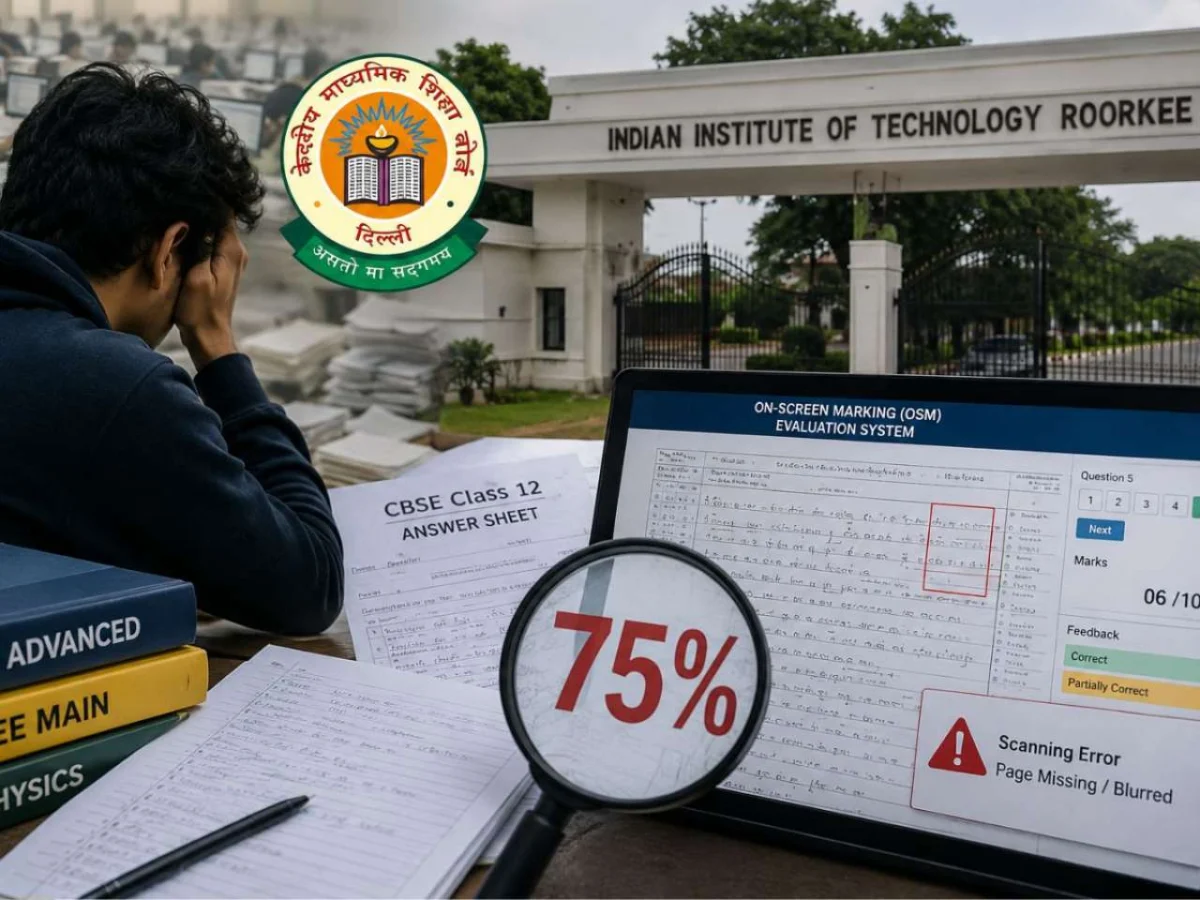
New Delhi, India – In a significant development that has dashed the hopes of countless aspiring engineers, IIT Roorkee has unequivocally rejected calls for any relaxation of the stringent 75% Class 12 eligibility criterion for admission to the prestigious IITs, NITs, and IIITs. This firm stance comes as a major setback for students and parents who have been vociferously demanding either the removal or a substantial reduction of this benchmark, particularly in light of the ongoing controversy surrounding the Central Board of Secondary Education’s (CBSE) On-Screen Marking (OSM) evaluation system. The decision has ignited further debate about fairness and accessibility in the highly competitive engineering entrance landscape.
The 75% rule, a long-standing prerequisite for candidates seeking admission to premier engineering institutes through the Joint Entrance Examination (JEE) Main and JEE Advanced, mandates that students achieve at least 75% aggregate marks in their Class 12 examinations or rank within the top 20 percentile of their respective boards. While this criterion has been in place for several years, the current academic session has seen it come under intense scrutiny, fueled by widespread allegations of errors and inconsistencies in the CBSE’s recent Class 12 examination results.
)
The Unwavering Stance of IIT Roorkee
Responding to queries from ANI regarding the possibility of a one-time relaxation or removal of the 75% eligibility criterion amidst the CBSE marks row, IIT Roorkee issued a clear and concise statement that leaves little room for interpretation. "No relaxing in marks as candidates from 36 different boards are participating. We published this criterion almost in December and last year there were candidates who lost IIT/NIT seats mainly due to percentages. Hence, lowering is not possible; however, we are in close touch with CBSE and will try to resolve this for all those affected candidates on priority," the statement read.

This response highlights several key justifications for IIT Roorkee’s resolute position. Firstly, the institution emphasizes the diverse academic backgrounds of the applicant pool, with students hailing from 36 different examination boards. Maintaining a uniform eligibility criterion across such a varied system, they argue, is crucial for ensuring a level playing field. Secondly, the institute points to the early dissemination of this criterion in December, implying that students and their guardians were aware of the requirements well in advance of the examinations. The mention of past instances where students narrowly missed admission due to percentage discrepancies further underscores their commitment to upholding the established benchmark.
)
However, the statement also offers a glimmer of hope, albeit a cautious one. IIT Roorkee’s assurance of being in "close touch with CBSE" and their commitment to "resolve this for all those affected candidates on priority" suggests a potential avenue for addressing individual cases of genuine hardship caused by the evaluation anomalies. The exact nature and extent of this resolution remain to be seen, but it indicates a willingness to engage with the issue on a case-by-case basis, rather than a blanket waiver.
)
Understanding the 75% Eligibility Criterion
The 75% eligibility criterion, formally known as the Joint Entrance Examination (JEE) Main and JEE Advanced eligibility criteria, has been a significant hurdle for many aspiring engineers. For admission to the National Institutes of Technology (NITs), Indian Institutes of Information Technology (IIITs), and other centrally funded technical institutions (CFTIs) through the JEE Main counselling process, students from the general category are required to secure at least 75% marks in their Class 12 examinations. Alternatively, they can qualify if they fall within the top 20 percentile of their respective board examinations. This rule has been consistently applied for admissions, including those for the 2026 academic year, underscoring its established importance in the admission process.
)
The Genesis of the Current Controversy: CBSE’s On-Screen Marking (OSM) System
The current uproar surrounding the 75% criterion is intrinsically linked to the recent challenges faced by the CBSE in its evaluation process. The Board implemented the On-Screen Marking (OSM) system, a digital platform designed to evaluate answer sheets scanned and uploaded onto secure servers. The stated objectives behind this transition were to enhance transparency, expedite the declaration of results, and minimize the potential for human error inherent in traditional manual evaluation.
)
However, the rollout of the OSM system has been far from smooth, marred by a cascade of complaints from students and parents alleging "unexpectedly low marks" and significant discrepancies in the evaluation. Many students have come forward with claims that the OSM system failed to adequately account for step-marking, diagram evaluations, or the nuances of long-answer questions, which are crucial for a comprehensive assessment, particularly in science subjects. This perceived deficiency in the evaluation methodology has led to a substantial number of students falling short of the 75% threshold, thereby jeopardizing their eligibility for JEE admissions.
)
The demand for a free manual re-evaluation of answer sheets by students and parents stems directly from these concerns. They argue that the digital nature of OSM, while aiming for efficiency, may have inadvertently led to a more rigid and less forgiving marking scheme, penalizing students who might have otherwise performed well under traditional evaluation methods. The loss of confidence in the administration, exacerbated by reported instances of answer sheet mismatches and technical glitches, has further amplified the calls for a review and potential revision of the eligibility criteria.
)
A Chronology of Discontent and Demands
The current discontent can be traced back to the declaration of CBSE Class 12 results on May 13, 2024. Almost immediately, a significant number of students began reporting unusually low marks, particularly in subjects like Physics, Chemistry, and Mathematics. This anomaly prompted many to seek scanned copies of their answer sheets to understand the grading.
)
- May 13, 2024 onwards: CBSE Class 12 results declared, with numerous students reporting unexpectedly low marks.
- Following Result Declaration: Students begin requesting scanned copies of their answer sheets, leading to a surge in applications for re-evaluation. The numbers speak for themselves:
- 4,04,319 students applied for scanned copies of their answer sheets.
- 17,68,968 candidates sought scanned answer sheets in total.
- 11 lakh answer scripts were requested for re-evaluation.
- Emergence of Technical Glitches: As students attempted to access scanned copies and initiate re-evaluation requests, the CBSE portal reportedly experienced significant technical issues. These included blurred scans of answer sheets, missing pages, and system crashes, further fueling frustration and suspicion.
- Security Concerns Raised: The integrity of the OSM system was called into question when ethical hacker Nisarga Adhikary reportedly exposed vulnerabilities, including the potential for unauthorized access to student answer sheets by identifying passwords and security loopholes.
- Procurement Allegations: Reports surfaced regarding the tendering process for the OSM services, with allegations that the contract was awarded to a vendor, Coempt Eduteck, despite modifications to eligibility criteria and concerns about prior blacklisting clauses.
- Student and Parent Protests: Faced with these mounting issues, students and parents organized protests and launched online campaigns, urging the CBSE and relevant authorities, including the Ministry of Education and the Joint Entrance Examination (JEE) Apex Board, to address their grievances. The central demand was for a manual re-evaluation and a temporary suspension or relaxation of the 75% eligibility criterion for JEE admissions.
- IIT Roorkee’s Refusal: Despite widespread appeals, IIT Roorkee, acting as the organizing institute for JEE (Advanced), has maintained its stance, refusing any relaxation of the 75% eligibility criterion.
Supporting Data and Expert Opinions
The debate is not merely anecdotal. Counsellors and education experts have weighed in on the potential impact of the 75% rule in the current context. Many have highlighted the plight of students who, despite demonstrating strong performance in the JEE Main and JEE Advanced exams, might be disqualified due to a marginal shortfall in their Class 12 board marks.
)
"It’s a deeply unfortunate situation," comments Dr. Anjali Sharma, an educational consultant specializing in engineering admissions. "We have students who have diligently prepared for JEE and scored exceptionally well, only to be potentially barred from entry because their Class 12 marks, affected by a flawed evaluation system, fall just short of 75%. This is a systemic issue that requires a systemic solution, not a rigid adherence to a rule that might be inadvertently penalizing deserving candidates."
)
According to counsellors, students who have lost eligibility by a mere two or three percentage points could be severely affected. This is particularly true for those who might have faced genuine issues with the OSM system, such as incorrect scanning or misinterpretation of their answers, leading to a lower-than-expected score.
)
Official Responses and Implications
While IIT Roorkee has been firm in its decision, the Ministry of Education and the CBSE have acknowledged the concerns raised by students and parents. The CBSE has stated that it is investigating the complaints and reviewing the OSM system’s performance. However, no concrete steps have been announced to address the immediate eligibility crisis for JEE admissions.
)
The implications of IIT Roorkee’s steadfastness are far-reaching:
)
- Disappointment for Aspirants: Thousands of students who were hoping for a reprieve now face the grim reality of being ineligible for admission to top engineering colleges, despite their strong performance in the entrance examinations. This could lead to significant mental distress and career uncertainty.
- Questioning of Fairness: The decision to uphold the 75% criterion without any modification, despite the acknowledged issues with CBSE’s evaluation, raises questions about the fairness and sensitivity of the admission process. It could be perceived as prioritizing administrative rigidity over student welfare.
- Impact on Diversity: While IIT Roorkee cited the diversity of boards as a reason for the uniform criterion, the current situation might disproportionately affect students from boards that faced greater evaluation challenges or those who were particularly impacted by the OSM system’s shortcomings.
- Future of Evaluation Systems: The ongoing controversy is likely to prompt a thorough review of digital evaluation systems in education. The emphasis will be on ensuring robust technological infrastructure, foolproof error detection mechanisms, and transparent grievance redressal processes.
- Increased Pressure on Alternative Pathways: With admission to IITs, NITs, and IIITs becoming more challenging due to this criterion, students might increasingly look towards private universities or other educational avenues, potentially altering the landscape of engineering education in India.
The current impasse underscores a critical disconnect between the administrative imperatives of maintaining standards and the practical realities faced by students grappling with systemic evaluation challenges. As the academic year progresses, the focus will remain on how the CBSE and the Joint Entrance Examination (JEE) Apex Board will navigate this complex situation and whether any further interventions will be considered to ensure a more equitable admission process for aspiring engineers. The refusal of IIT Roorkee to budge on the 75% rule, while understandable from an institutional perspective, has undoubtedly cast a long shadow of uncertainty over the dreams of many bright young minds.
