

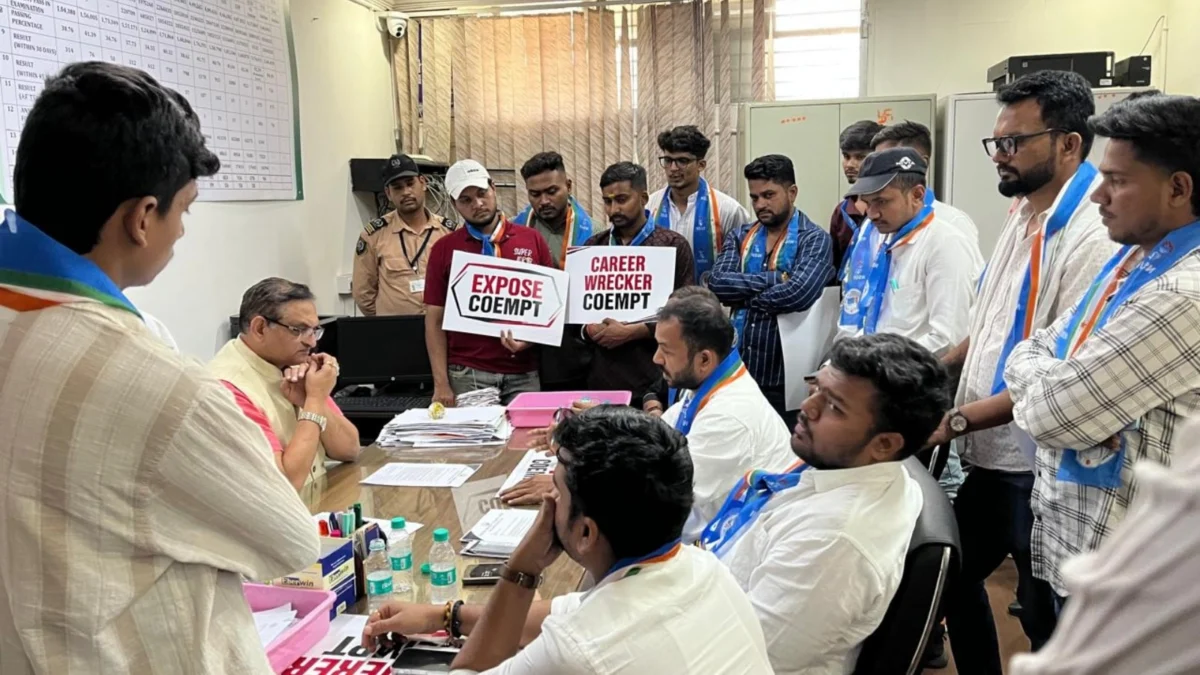
Nagpur, India – A cloud of discontent and uncertainty hangs heavy over Rashtrasant Tukadoji Maharaj Nagpur University (RTMNU) as students from across various disciplines continue to voice serious concerns over the accuracy and integrity of their examination results declared since February. At the epicenter of this growing controversy is Coempt Eduteck Pvt Ltd, a company that has found itself embroiled in national outrage and facing a probe over alleged systemic glitches that have marred the CBSE Class 12 results. The unfolding situation at Nagpur University mirrors these wider concerns, raising questions about the company’s competence and the transparency of the procurement processes involved.
Unraveling the Crisis: A Cascade of Errors and Student Distress
The issues plaguing Nagpur University students are multifaceted and deeply concerning. From the alleged omission of crucial internal assessment marks to the issuance of factually incorrect marksheets and widespread errors in the overall result processing, the repercussions for thousands of students have been significant. These problems have primarily surfaced following the declaration of results for the "Winter Exams 2025," a critical examination cycle that saw an overwhelming 3,17,540 students appear for 1,261 examinations conducted by the university.
The fallout has been palpable, with students experiencing anxiety, academic disruption, and a profound sense of injustice. The delay in rectifying these errors has further exacerbated the distress, forcing students to navigate a labyrinth of administrative procedures while simultaneously grappling with their ongoing academic commitments.
A Chronology of Concerns: From Missing Marks to Questionable Tenders
The genesis of the current crisis can be traced back to the declaration of results for the Winter Exams 2025. Students began reporting anomalies shortly after the results were made accessible, initially through informal channels and later via the university portal.
November 2025 (Post-Exams): The Winter Exams for 2025 are conducted by Nagpur University.
February 2026 Onwards: Results for the Winter Exams 2025 begin to be declared. Students start reporting a series of issues, including:
- Missing Internal Assessment Marks: Numerous students discovered that their internal assessment marks, a crucial component of their overall grades, were not reflected in their marksheets, often appearing as blank entries.
- Incorrect Marksheets: Several students received marksheets containing factual errors, ranging from incorrect subject names to erroneous marks awarded.
- Errors in Result Processing: The underlying systems managing the results appear to have malfunctioned, leading to incorrect calculations and an overall flawed outcome.
April 2, 2026: The National Students’ Union of India (NSUI) formally lodges a complaint with the university, bringing the widespread grievances to the attention of the administration.
April 2026: In response to the escalating complaints, Vice-Chancellor Dr. Manali Kshirsagar takes a decisive step by establishing a three-member inquiry committee. This committee, tasked with a comprehensive investigation, is headed by Manmohan Bajpai, an advocate and a respected Senate member of the university. The committee’s mandate is to scrutinize allegations related to contradictions in the examination process, eligibility issues, and the transparency of the tender awarded to Coempt Eduteck.
May 29, 2026: Summer Exams commence for the current academic year, adding further pressure on students already dealing with the fallout from the Winter Exam results.
June 1, 2026: In a case highlighted by student Rahul Satdeve, a first-year B.Sc. (Computer Science) student, his missing internal assessment marks are finally corrected, and a revised marksheet is issued after persistent follow-ups with college and university authorities.
June 5, 2026: Formal hearings are scheduled to commence for the inquiry committee, marking a significant step in the investigation into the examination system and Coempt Eduteck’s role.
Voices from the Ground: Student Testimonies Paint a Grim Picture
The distress of the students is palpable and eloquently articulated through their personal accounts. These narratives underscore the systemic failures and the personal toll these errors are taking.
Rahul Satdeve, a first-year B.Sc. (Computer Science) student, shared his ordeal of discovering blank entries for his internal assessment marks. "That part was blank," he recounted. "I repeatedly followed up the matter with the college and university authorities. The correction was finally made only on June 1, and a revised marksheet issued." This highlights the arduous and time-consuming process students have to endure to get basic errors rectified.
Another student from the same course, who preferred to remain anonymous, expressed her shock at receiving a zero in a Vedic Mathematics theory paper despite having completed the entire paper and receiving internal assessment marks. "I had attempted the complete paper and also received internal assessment marks. A 0 makes no sense," she stated, highlighting the inexplicable nature of some of the errors. As a precautionary measure, she has applied for both re-evaluation and a supplementary examination. "Whoever is responsible, the loss is mine," she lamented, trying to focus on her ongoing Summer Exams.
Ayush Lingayat, another student, pointed out that the problems began immediately after the results for the last semester were declared. "The marksheets were initially not visible on the university portal. Teachers started sharing the results, and that is when students noticed that internal assessment marks were missing. The marksheets were sent back for corrections by college authorities," he explained. Lingayat further elaborated on the persistent discrepancies, stating, "The marks for our programme should be calculated out of 1100, but the portal shows it is out of 1000. How can the total itself be wrong?" This indicates fundamental errors in the result aggregation and presentation mechanisms.
The university calendar itself reveals a pattern of delays. Winter Exams in 2025, scheduled to commence on October 3, were delayed. Similarly, Summer Exams for the current year, slated for March 9, have also faced delays, with ongoing examinations extending beyond the usual vacation period. The declaration of Winter Exam results also deviated significantly from the stipulated 30-45-day timeframe, with a substantial number of results taking over 45 days for declaration. According to a university press release, results for 744 out of the 1,261 exams were declared after the 45-day mark, underscoring a systemic slowdown in the evaluation and declaration process.
Supporting Data: Scale of the Problem and Examination Delays
The sheer scale of the problem at Nagpur University is staggering. The "Winter Exams 2025" involved a colossal 3,17,540 students participating in 1,261 examinations. The subsequent declaration of results has been plagued by issues, impacting a significant portion of this student population.
The delays in examination schedules and result declarations are also noteworthy:
- Winter Exams 2025: Scheduled for October 3, 2025, but commenced later.
- Summer Exams 2026: Scheduled for March 9, 2026, and ongoing beyond the expected vacation period.
- Result Declaration Timeline:
- 356 exams declared within 30 days.
- 161 exams declared between 31 and 45 days.
- 744 exams declared after 45 days.
This data strongly suggests a systemic inefficiency or breakdown in the examination and evaluation process, directly impacting student timelines and academic progression.
Official Responses and the Inquiry Committee’s Mandate
In the face of mounting pressure, Nagpur University has initiated an official inquiry. Vice-Chancellor Dr. Manali Kshirsagar’s decision to form a three-member committee headed by Manmohan Bajpai reflects the seriousness with which the university is now approaching the crisis. The committee’s mandate is comprehensive, aiming to dissect the allegations from multiple angles:
- Examination Process Contradictions: Investigating any inconsistencies or discrepancies in how examinations were conducted and evaluated.
- Eligibility Issues: Examining the criteria and processes related to student eligibility for examinations and subsequent result processing.
- Transparency of the Tender Awarded to Coempt Eduteck: A crucial aspect of the inquiry, focusing on the procurement process and the rationale behind awarding the contract to Coempt.
The committee comprises Bajpai as chairman, alongside Dr. Nitin Chintaman Kongre from Jawaharlal Nehru College of Arts, Commerce and Science, Wadi, and Dr. Nishikant Raut, Professor in the Department of Pharmaceutical Sciences at Nagpur University.
Manmohan Bajpai, in his interaction with The Indian Express, stated that the committee is yet to reach any preliminary conclusions. However, he offered a candid assessment of the company’s performance: "what we have observed so far is that the company’s work here has been unsatisfactory." The committee is actively verifying Coempt’s track record at other institutions where it has previously operated.
Bajpai also revealed that Coempt Eduteck has attributed the glitches to receiving examination data from the university in an incorrect format. "If this was so, we need to examine the extent to which that contributed to the problems," Bajpai noted, emphasizing the need to ascertain the degree of responsibility. The committee will also consider any similar issues that arise during the ongoing examinations.
The inquiry is also delving into allegations that the tender conditions for the contract were allegedly modified to "favour Coempt." This mirrors similar accusations leveled in the allocation of the CBSE contract to the Hyderabad-based company. Bajpai confirmed, "We are looking into whether there was a genuine need to revise eligibility conditions, such as the turnover requirement."
The Shadow of the Tender Process: Promarc’s Allegations and Court Rulings
The tender process itself has become a focal point of contention, with allegations of irregularities and favoritism. Promarc Software Private Limited, the long-standing manager of Nagpur University’s examination system from 2005 to 2024, has alleged that it was unfairly denied the contract. Promarc moved the Nagpur Bench of the Bombay High Court, claiming the university set "arbitrary" financial requirements, particularly concerning annual turnover.
Promarc contends that an earlier tender floated in December 2024, which appeared to favor another bidder and attracted only two participants, was subsequently cancelled. A new tender was issued on August 7, 2025, and awarded to Coempt Eduteck.
Vice-Chancellor Manali Kshirsagar, however, countered these claims by alleging that Promarc failed to transfer examination data after its tenure ended and withheld its payments.
The Bombay High Court ultimately ruled in favor of the university. The court acknowledged that the scope of work had significantly expanded due to the shift of infrastructural and operational responsibilities to the vendor, thus justifying more stringent financial benchmarks. The court dismissed Promarc’s petition, affirming the authorities’ discretion in setting qualifications to assess a contractor’s capability.
Despite the court’s ruling, a senior Promarc official reiterated their charges. They pointed to specific changes in the bidding process, such as the increase in the minimum turnover requirement from Rs 5 crore to Rs 25 crore, a reduction in the experience criterion from handling three lakh students annually to two lakh, and a dilution of the requirement for prior experience in establishing digital valuation centers. The official also denied the university’s allegations regarding data transfer, stating, "Our bills were cleared only after the data was submitted. If the data had not been handed over, examinations could not have continued." They further asserted that payments were withheld only after Promarc challenged the tender process in court.
Implications and the Road Ahead
The ongoing crisis at Nagpur University has far-reaching implications, extending beyond the immediate academic concerns of the students.
- Erosion of Trust: The repeated errors and the prolonged period of uncertainty have significantly eroded the trust students and parents place in the university’s examination and evaluation system. This trust is fundamental to the credibility of any educational institution.
- Academic and Career Setbacks: For students, incorrect marksheets and delayed results can lead to missed opportunities for higher education admissions, scholarships, and job placements. The anxiety and stress associated with these issues can also impact their performance in subsequent examinations.
- Reputational Damage: The controversy, amplified by Coempt Eduteck’s involvement in similar national issues, casts a shadow over Nagpur University’s reputation. This could have long-term consequences for its standing among academic circles and prospective students.
- Scrutiny of Procurement Processes: The allegations surrounding the tender process necessitate a thorough review of how such contracts are awarded in public educational institutions. Ensuring transparency, fairness, and robust due diligence is paramount to prevent future recurrences.
- Accountability and Redressal: The inquiry committee’s findings will be crucial in determining accountability and establishing a clear path for redressal for the affected students. The university must demonstrate its commitment to rectifying errors and implementing measures to prevent them in the future.
As the inquiry committee begins its formal hearings, the Nagpur University community awaits a resolution that addresses the immediate grievances and instills confidence in the integrity of its academic processes. The lessons learned from this crisis must pave the way for a more robust, transparent, and student-centric examination system.
