

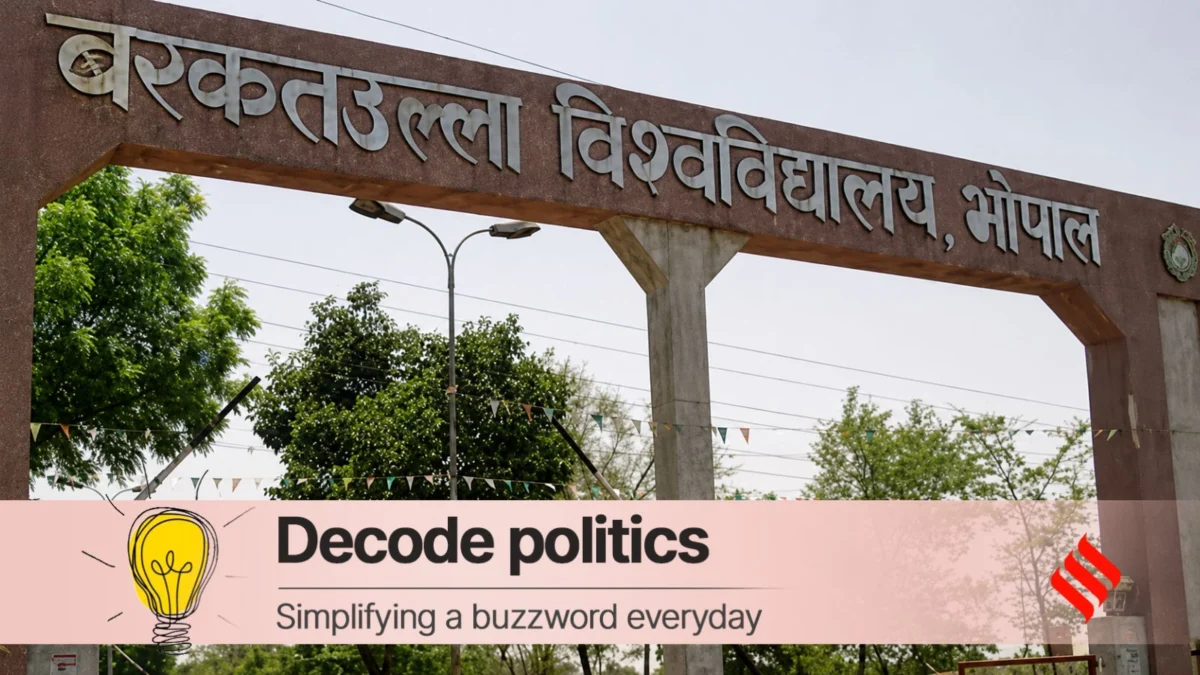
Bhopal, India – A significant cultural and political debate has erupted in Madhya Pradesh following a proposal by the Executive Council of Bhopal-based Barkatullah University to rename the 55-year-old institution. Days after the historically contested Bhojshala complex was formally declared a Hindu site, leading to widespread calls for the re-installation of a ‘Vagdevi’ idol, the university’s governing body has moved to replace its current name, which honours the renowned freedom fighter Maulana Barkatullah, with ‘Vagdevi Bhojpal University.’
The proposal, now forwarded to Governor and Chancellor Mangubhai Patel, seeks to imbue the university with a name reflecting a distinct historical and cultural lineage. ‘Vagdevi,’ the Sanskrit appellation for Saraswati, the revered Hindu Goddess of Learning, holds deep associations with the Bhojshala complex, traditionally believed to have been a centre for Saraswati worship and learning. ‘Bhojpal,’ meanwhile, is widely regarded as the ancient name for Bhopal, directly referencing Raja Bhoj, the medieval king whose legacy is central to the renaming discourse. This proposed change is not merely an administrative tweak; it signifies a deeper re-evaluation of historical narratives and identities in the public sphere, aligning with a broader trend of renaming initiatives across India.
Main Facts: A Proposal Rooted in Cultural Reassertion
The Executive Council of Barkatullah University, a prominent educational institution in Madhya Pradesh, formally passed a resolution to rename itself ‘Vagdevi Bhojpal University.’ This decision, which garnered majority support within the council, was confirmed by Vice-Chancellor Professor S.K. Jain. The rationale behind the proposed change is multi-faceted: it aims to honour Goddess Vagdevi, the patron deity of knowledge and arts, and to invoke the historical figure of Raja Bhoj, considered by many to be the founder of Bhopal (then Bhojpal).
This move is directly contextualized by recent developments concerning the Bhojshala complex in Dhar, Madhya Pradesh. Long a site of contention, with Hindus claiming it as a Saraswati temple and Muslims as the Kamal Maula Mosque, the Archaeological Survey of India (ASI) recently concluded a survey that led to its declaration as a Hindu site. This declaration reignited fervent demands for the re-establishment of a Vagdevi idol, believed to have been originally housed there. The university’s proposal, therefore, is seen by many as a direct echo of this cultural reassertion, seeking to cement a particular historical and religious identity within the state’s educational landscape.
The current name, Barkatullah University, commemorates Maulana Barkatullah Bhopali, a towering figure in India’s independence movement who hailed from Bhopal. The university was renamed in his honour by the state Congress government in 1988, having previously been known as Bhopal University. The proposed shift thus represents a departure from a legacy tied to a global revolutionary and a embrace of figures and symbols deeply embedded in local, and increasingly Hindu, cultural narratives.
Chronology: A Trajectory of Renaming and Reclaiming History
The journey leading to the current proposal is marked by a series of historical events and political currents, reflecting a broader trend in Indian public life.
- 1964: The university is established as Bhopal University, serving as a key educational hub for the region.
- 1988: The state Congress government renames Bhopal University to Barkatullah University, honouring Maulana Barkatullah Bhopali, a significant, albeit lesser-known, freedom fighter with strong local ties. This act sought to embed the legacy of an anti-colonial revolutionary into the city’s academic identity.
- November 2021: The renaming of Habibganj Railway Station in Bhopal to Rani Kamlapati Railway Station significantly boosts momentum for similar renaming initiatives. This change, honouring a Gond queen, was championed by the BJP government as a recognition of tribal heritage and local heroes, setting a precedent for revisiting existing names.
- Early 2024: The Archaeological Survey of India (ASI) concludes its survey of the Bhojshala complex in Dhar. The findings and subsequent declaration reinforce the Hindu claim over the site, intensifying calls for the re-installation of the Vagdevi idol. This event becomes a critical trigger, providing a fresh impetus for cultural reassertion across the state.
- April 2024: Amidst the heightened cultural discourse following the Bhojshala declaration, the Executive Council of Barkatullah University formally passes the resolution to rename the institution ‘Vagdevi Bhojpal University.’ The proposal is subsequently sent to the Governor and Chancellor for approval. This action directly links the university’s identity to the recent developments at Bhojshala and the historical narrative surrounding Raja Bhoj.
This chronological progression highlights how a series of seemingly disparate events – from historical commemorations to contemporary archaeological surveys and political rebranding – have converged to precipitate the current controversy, underscoring the deep interplay between history, politics, and cultural identity in modern India.
Supporting Data: Unpacking the Legacies of Barkatullah, Bhoj, and Vagdevi
The proposed renaming necessitates a deeper understanding of the figures and concepts it seeks to replace and enshrine. The debate is fundamentally about whose history is commemorated and how public institutions reflect collective memory.
Who Was Maulana Barkatullah? A Global Revolutionary’s Legacy
Maulana Mohamed Barkatullah Bhopali, born in Bhopal in 1854, was arguably one of India’s most international and radical freedom fighters. His life was a testament to unwavering dedication to India’s independence, spent largely abroad, forging alliances and inspiring revolutionary fervour across continents.
After early education in Bhopal, Barkatullah embarked on an extraordinary journey that saw him traverse the globe. He lived in London, where he connected with Indian nationalist circles, before moving to the United States. In Japan, he became a professor of Hindustani at the University of Tokyo, a position he skillfully leveraged to build anti-colonial networks among Indian expatriates and sympathetic Japanese intellectuals. His activities in Japan were pivotal, establishing the country as a crucial hub for Indian revolutionary movements long before the advent of Subhas Chandra Bose. He edited the Islamic Fraternity journal, which championed pan-Islamism and anti-British sentiments, often clashing with British diplomatic efforts.
Barkatullah’s most significant contributions include his role as a co-founder of the Ghadar Party in San Francisco in 1913. This radical organization, composed primarily of Sikh immigrants from Punjab, advocated for armed rebellion against British rule in India and sought to incite mutiny among Indian soldiers serving the colonial empire. His vision extended beyond mere independence; he envisioned a truly free India, often aligning with socialist and anti-imperialist ideals.
In a remarkable political achievement, Barkatullah helped establish the Provisional Government of India in Kabul in December 1915. Alongside Raja Mahendra Pratap, who served as President, Barkatullah assumed the crucial role of Prime Minister. This government-in-exile, though lacking territorial control, was a profound symbolic gesture, attempting to secure international recognition and support for Indian independence from powers like Germany, Turkey, and later, Soviet Russia. It represented one of the earliest concerted efforts to establish an independent Indian administration outside British dominion.
His revolutionary zeal also led him to Germany, where he collaborated with the Berlin Committee (later Indian Independence Committee), and later to Soviet Russia after the 1917 Revolution. He met with Lenin and other Bolshevik leaders, seeking support for the Indian cause, showcasing his adaptability and willingness to engage with diverse ideological fronts in pursuit of freedom.
Maulana Barkatullah died in San Francisco in 1927, two decades before India achieved independence. His life epitomized the struggle against colonial oppression, transcending geographical and ideological boundaries. Renaming a university bearing his name, critics argue, risks erasing the memory of a pivotal figure whose global contributions to India’s freedom struggle are unique and profound.
Who Was Raja Bhoj? King, Scholar, and Legend
Raja Bhoj, a Paramara ruler of the Malwa region, reigned approximately between 1010 and 1055 CE. His era is documented through a wealth of contemporary inscriptions and copper plate grants, testifying to his historical existence and significant impact. His reputation is multi-faceted, encompassing military prowess, astute governance, and an exceptional commitment to scholarship and the arts.
Bhoj’s military campaigns saw him expand his kingdom, engaging with powerful contemporary dynasties such as the Chalukyas and the Chandelas. He was a capable administrator, credited with numerous public works and reforms that fostered prosperity in his realm. However, it is his intellectual legacy that truly sets him apart. Raja Bhoj was not merely a patron of learning but a prolific scholar himself, with numerous works on diverse subjects attributed to him.
Among his most celebrated works are:
- Samarangana Sutradhara: A monumental treatise on architecture, urban planning, and iconography, providing detailed instructions on constructing temples, palaces, and towns.
- Yukti Kalpataru: A comprehensive work covering statecraft, shipbuilding, lexicography, and other practical sciences.
- Saraswati Kanthabharana: A treatise on poetics and literary criticism.
- He is also credited with works on medicine (e.g., Rajamartanda on Ayurveda), philosophy (e.g., Yoga Sutra Vritti), astronomy, grammar, and dharma.
Folklore and popular tradition further attribute to Raja Bhoj the founding of the city of Bhopal (as Bhojpal) and the construction of the magnificent Upper Lake (Bhojtal) through a colossal dam project. The Bhojshala complex in Dhar is also popularly believed to have been a Saraswati temple and a centre of learning established by him.
However, historians caution that while Raja Bhoj was undeniably a significant figure, much of what is popularly believed about him, particularly concerning his direct involvement in founding Bhopal or building the Bhojshala, derives from texts written centuries after his death. As is often the case with ancient rulers, legend and historical fact have become deeply intertwined in his narrative. Archaeological evidence regarding his direct presence or construction activities in the precise location of modern Bhopal remains a subject of academic debate. The proposed name, ‘Vagdevi Bhojpal University,’ seeks to solidify these popular narratives into institutional identity.
Vagdevi: The Goddess of Learning
Vagdevi, a Sanskrit term meaning ‘Goddess of Speech’ or ‘Goddess of Eloquence,’ is another name for Saraswati, the Hindu Goddess of knowledge, music, art, speech, wisdom, and learning. She is often depicted holding a veena (a musical instrument), a book (representing knowledge), and a rosary (symbolizing meditation and spirituality). As the patron deity of education, arts, and sciences, her association with a university is symbolically potent and inherently logical within a Hindu cultural framework. The call for her idol’s re-installation at Bhojshala, a site historically linked to a Saraswati temple, underscores her significance in the current cultural discourse. Linking the university’s name to Vagdevi explicitly invokes this powerful symbol of intellectual pursuit and cultural heritage.
Official Responses: Diverse Voices in a Contentious Debate
The proposal has elicited a range of reactions from political figures, academics, and historians, highlighting the contentious nature of such renaming initiatives.
Vice-Chancellor Professor S.K. Jain stated to The Indian Express that the proposal "received majority support in the Executive Council," indicating internal consensus for the change within the university’s governing body. This suggests a deliberate move rather than an impulsive decision.
BJP spokesperson Hitesh Bajpai expressed strong support for the initiative: "The proposal will now be sent to the government for further consideration. Once it reaches the government, an appropriate decision will be taken. At this stage, I believe it is a positive step." Bajpai’s remarks signal the BJP’s likely endorsement of the renaming, aligning with the party’s broader ideological agenda of reasserting what it perceives as indigenous historical and cultural identities.
However, the proposal has drawn sharp criticism from historians and opposition leaders. Historian Shahnawaz Khan, who has extensively researched Bhopal’s history and the freedom movement, questioned the fundamental rationale behind replacing Barkatullah’s name. "Barkatullah University is among the most recognised educational institutions in Madhya Pradesh. Maulana Barkatullah was not merely a resident of Bhopal, he was a major freedom fighter who also served as Prime Minister of the Provisional Government of India established in Kabul in 1915," Khan emphasized to The Indian Express. He further challenged the historical basis for the new name, stating, "On the other hand, there is little evidence of Raja Bhoj ever building anything in Bhopal, or even having stayed here." Khan’s comments underscore the academic skepticism regarding the historical accuracy of the proposed name’s foundational claims, contrasting it with the well-documented contributions of Maulana Barkatullah.
Congress MLA Arif Masood echoed this sentiment, lamenting the potential erasure of a significant historical figure. "Changing the name of a historic institution is unfortunate," Masood remarked, highlighting that Barkatullah’s place in India’s freedom movement is undeniable. He suggested an alternative approach: "The state could honour Raja Bhoj or Vagdevi through a new institution," arguing against the removal of an existing, historically significant name. Masood’s concern that "People are now asking who Barkatullah was" points to the potential for such renaming drives to diminish the memory of figures not conforming to a particular cultural narrative.
These diverse responses illustrate the core tension: between an impulse to reconnect with ancient, often Hindu-centric, historical figures and the imperative to preserve the legacies of more recent national heroes, especially those who contributed to a pluralistic freedom struggle.
Implications: The Politics of Renaming and India’s Contested Histories
The proposal to rename Barkatullah University is far more than a simple administrative decision; it is deeply embedded in the complex and often contentious politics of renaming that have characterized India’s public sphere for decades, particularly under BJP governments. This move carries significant historical, cultural, and political implications.
The BJP’s Renaming Agenda
Under successive BJP governments, from Shivraj Singh Chouhan to the current Chief Minister Mohan Yadav, Madhya Pradesh, like several other BJP-ruled states, has pursued a sustained programme of renaming cities, railway stations, schools, institutions, and public places. This agenda is articulated as an effort to "restore historical, cultural, and civilisational identities" and to "honour local heroes, freedom fighters, and tribal icons." Examples abound across the country, from Allahabad becoming Prayagraj, Faizabad becoming Ayodhya, and Mughalsarai Junction becoming Deen Dayal Upadhyaya Nagar, to Rani Kamlapati Railway Station in Bhopal. Proponents argue that these changes correct historical injustices and reclaim a heritage obscured by colonial or medieval Islamic names.
In this context, renaming Barkatullah University to ‘Vagdevi Bhojpal University’ fits seamlessly into this broader narrative. It seeks to replace a name associated with a Muslim freedom fighter with one that invokes a Hindu goddess of learning and a revered Hindu king, thereby strengthening a specific cultural and religious identity within the state’s premier educational institution. This is seen as a crucial step in aligning public institutions with a Hindu majoritarian view of history and heritage.
Critics’ Concerns: Erasure and Rewriting History
Critics, however, view these renaming exercises as selective attempts to diminish Muslim-associated names and legacies from public life, rather than a holistic restoration of history. They argue that such moves contribute to a deliberate rewriting of history, where complex, pluralistic pasts are replaced by a simplified, often ideologically driven narrative. The erasure of figures like Maulana Barkatullah, who represent a syncretic and diverse freedom struggle, is particularly concerning to them.
Bhopal, the city itself, serves as a poignant example of a rich, multi-layered history. While its pre-Islamic heritage is visible in sites like Bhojpur and traditions linked to Raja Bhoj, its history was also profoundly shaped by Pashtun Dost Mohammad Khan, who established the Bhopal State in the early 18th century, and by a remarkable succession of four Begums who ruled between 1819 and 1926. These female rulers — Qudsia Begum, Sikandar Begum, Shahjehan Begum, and Sultan Jahan Begum — were progressive administrators who left an indelible mark on the city through their architectural patronage, promotion of education (especially for women), and modernizing reforms. Bhopal, therefore, boasts a rich culture of Urdu literature, Islamic scholarship, and Indo-Islamic architectural marvels, elements that would be diminished by a singular focus on a perceived "ancient" identity.
Congress MLA Arif Masood’s concern that "People are now asking who Barkatullah was" underscores a fear that such renaming initiatives, by removing names from public visibility, can actively contribute to the forgetting of historical figures who do not fit the dominant narrative. This leads to a fragmented understanding of India’s past, where certain contributions are celebrated while others are deliberately marginalized.
Procedural Hurdles and Future Outlook
While the Executive Council has passed the proposal, several procedural hurdles remain. The most immediate is the requirement for approval from the Governor, who also serves as the Chancellor of the university. Beyond this, any change to the university’s official name would likely necessitate amendments to the legislation governing the institution. This legislative process could involve debates in the state assembly, further bringing the controversy into the public and political spotlight.
The renaming of Barkatullah University, if approved, will not only alter the identity of a significant educational institution but will also serve as another powerful symbol in the ongoing national debate about history, heritage, and identity. It reflects a deeper ideological struggle over how India chooses to remember and present its past, and what values it seeks to enshrine in its public institutions. The outcome will be closely watched as an indicator of the direction of cultural and historical politics in the country.
