

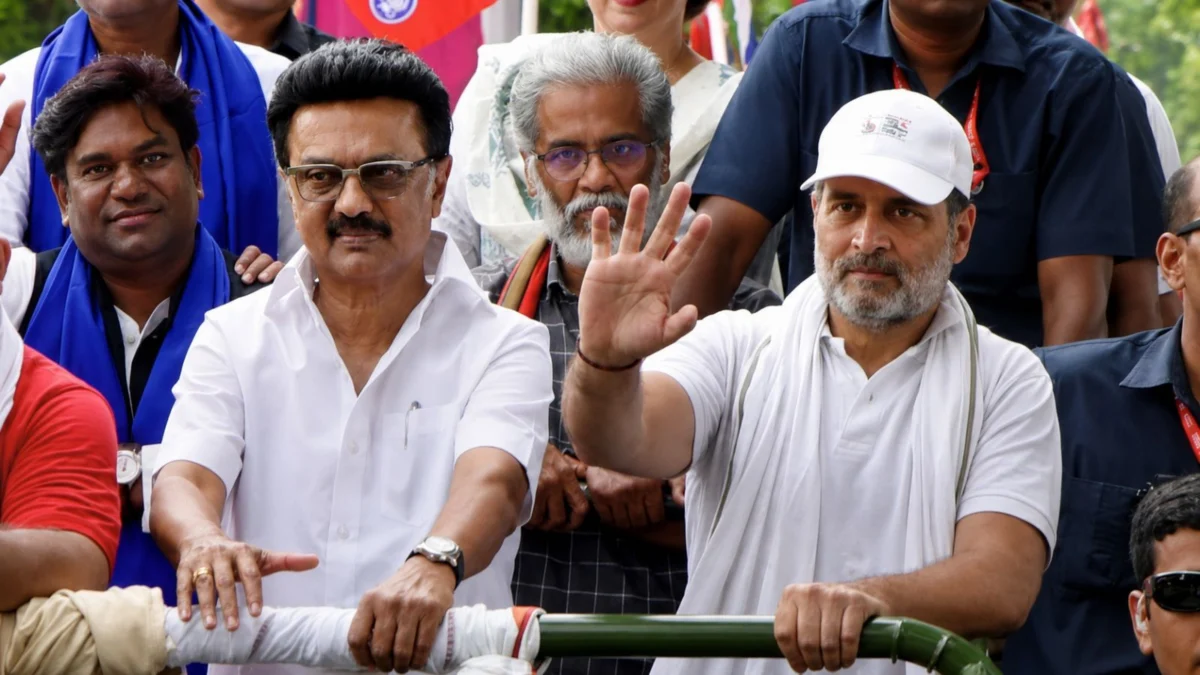
Chennai/New Delhi, June 4, 2026 – The nascent INDIA (Indian National Developmental Inclusive Alliance) bloc, formed with the ambitious goal of challenging the incumbent Bharatiya Janata Party (BJP) in the upcoming national elections, finds itself teetering on the brink of an unprecedented crisis. In a stunning development that has sent shockwaves through India’s political landscape, the Dravida Munnetra Kazhagam (DMK), a pivotal southern ally and a founding member of the INDIA bloc, has announced its decision to skip the crucial June 8 alliance meeting. This bombshell comes in direct response to the Congress party’s audacious move to extend unconditional support to actor-turned-politician Vijay’s Thamizhaga Vetri Kazhagam (TVK) for the formation of the new government in Tamil Nadu, effectively sidelining its long-standing partner, the DMK.
The Congress’s strategic pivot in Tamil Nadu, which explicitly outlines a commitment to ally with TVK not just for the state government but also for future local body, Lok Sabha, and Rajya Sabha elections, has been widely interpreted as a direct affront to the DMK. While the DMK maintains it will continue to stand with like-minded parties on "issues concerning the nation," its absence from the imminent INDIA bloc assembly speaks volumes about the deep fissures now threatening the opposition’s fragile unity. This development raises profound questions about the bloc’s cohesion, its ability to present a united front, and the very viability of its national aspirations.
A Fracture in the Alliance: Main Facts
The political earthquake originated in Tamil Nadu, a state known for its unique Dravidian political dynamics. Following the recently concluded 2026 Tamil Nadu Assembly Elections, which reportedly resulted in a hung assembly, the newly formed Thamizhaga Vetri Kazhagam (TVK) emerged as a significant force, holding the balance of power. In a move that blindsided its traditional ally, the Congress party swiftly declared its support for TVK to form the next state government. This endorsement was not merely transactional for immediate power-sharing; the Congress explicitly stated its intention to forge a lasting alliance with TVK for all future electoral contests, from local bodies to parliamentary elections.
This declaration immediately triggered a furious reaction within the DMK. Accustomed to leading the alliance in Tamil Nadu with Congress as a junior partner for decades, the DMK views this as a blatant act of betrayal and a direct challenge to its dominance in the state. The party’s high command, after an emergency session, decided to boycott the upcoming INDIA bloc meeting scheduled for June 8 in New Delhi. While attempting to soften the blow by reiterating its commitment to national issues, the DMK’s physical absence from a critical gathering of the anti-BJP front underscores the severity of the internal crisis. Political analysts are quick to point out that this is not merely a state-level dispute but a national-level embarrassment for the INDIA bloc, exposing its inherent vulnerabilities and the difficulty of reconciling conflicting regional ambitions with a unified national agenda.
A Deepening Rift: Chronology of Events
The current crisis is the culmination of several developments, tracing back to the very formation of the INDIA bloc and the evolving political landscape of Tamil Nadu.
July 2023: Birth of the INDIA Bloc: The INDIA bloc was conceptualized as a grand coalition of disparate opposition parties, united by a common goal to unseat the BJP-led NDA government. The DMK, under Chief Minister M.K. Stalin, was an enthusiastic and prominent founding member, hosting early meetings and championing the cause of federalism and secularism. The Congress, as the largest national opposition party, was positioned as a central pillar of this alliance.
Decades of DMK-Congress Alliance in Tamil Nadu: The alliance between the DMK and Congress in Tamil Nadu has been one of India’s most enduring political partnerships, spanning several decades with intermittent breaks. Rooted in shared secular ideologies and a common opposition to right-wing politics, this alliance has been electorally successful, particularly in Lok Sabha elections, where their combined strength often proved formidable against the AIADMK or other third fronts. The Congress traditionally played a junior, supportive role, benefiting from the DMK’s extensive grassroots network and charismatic leadership.
Late 2025: Vijay’s Political Entry and TVK’s Formation: Actor Vijay, a superstar with a massive fan following in Tamil Nadu, officially announced his entry into politics, forming the Thamizhaga Vetri Kazhagam (TVK). His entry immediately injected an unpredictable element into the state’s bipolar political landscape, traditionally dominated by the DMK and AIADMK. Initial surveys and public rallies indicated significant youth appeal and a potential to disrupt traditional vote banks.
March-April 2026: The 2026 Tamil Nadu Assembly Elections: The state went to polls amidst heightened anticipation. TVK, despite being a debutant, launched an aggressive campaign, promising clean governance, anti-corruption measures, and a fresh alternative to the established Dravidian parties. Exit polls hinted at a fractured mandate, with no single party or pre-poll alliance achieving a clear majority.
May 2026: Hung Assembly and TVK as Kingmaker: The election results confirmed a hung assembly. The DMK-led alliance, while emerging as the largest bloc, fell short of the magic number. The AIADMK-led front also failed to secure a majority. Crucially, TVK, in its maiden electoral outing, secured an impressive 42 seats in the 234-member assembly, positioning itself as the undisputed kingmaker. Both the DMK and AIADMK reportedly initiated back-channel talks with TVK.
June 3, 2026: Congress’s Shocking Announcement: In a dramatic turn of events, the Tamil Nadu Pradesh Congress Committee (TNPCC), following directives from the party high command in Delhi, announced its unequivocal support for TVK to form the government. The official statement from TNPCC President K.S. Alagiri not only pledged immediate support but went a step further, declaring a long-term alliance with TVK for all future elections, including local bodies, Lok Sabha, and Rajya Sabha. This public declaration effectively severed the long-standing electoral ties with the DMK, at least for the foreseeable future.
June 4, 2026: DMK’s Retaliation and INDIA Bloc Snub: The DMK leadership, led by Chief Minister M.K. Stalin, held an emergency meeting. The consensus was clear: the Congress’s move was an act of political betrayal. While acknowledging the need for national unity against the BJP, the DMK decided that attending the INDIA bloc meeting with the very party that had undermined its state-level interests was untenable. A spokesperson for the DMK officially announced the party’s decision to skip the June 8 meeting, stating, "While our commitment to national issues and like-minded parties remains, the recent developments in our home state cannot be ignored. Our focus is on the welfare of Tamil Nadu and upholding political decorum."
June 8, 2026: The Impending INDIA Bloc Meeting: The absence of a key member like the DMK will undoubtedly cast a long shadow over the proceedings of the INDIA bloc meeting. The agenda, which was expected to focus on seat-sharing strategies for upcoming parliamentary elections and a unified narrative against the central government, will now likely be dominated by discussions on internal strife and the bloc’s very survival.
Cracks in the Foundation: Supporting Data and Analysis
The current imbroglio in the INDIA bloc is not an isolated incident but rather a dramatic manifestation of the inherent challenges faced by any multi-party alliance in India.
Fragility of Coalition Politics: Indian political history is replete with examples of alliances formed and broken based on regional compulsions and power dynamics. The United Front governments of the 1990s and the complexities of the UPA and NDA eras highlight the constant tension between national objectives and state-level political realities. The Congress’s decision, while seemingly a pragmatic move to gain a foothold in Tamil Nadu through TVK, risks alienating a crucial and reliable national partner in the DMK.
The Rise of Regional Parties and Personalities: Vijay’s TVK exemplifies the enduring power of celebrity and regional sentiment in Indian politics. Unlike traditional parties with established ideologies, new entrants often capitalize on anti-incumbency sentiments, disillusionment with established political families, and the charisma of their leaders. TVK’s impressive debut, securing 42 seats, underscores the volatile nature of the electorate and the challenge for national parties to navigate these new forces. This also speaks to a broader trend where regional parties, often led by strong personalities, hold significant sway in their respective states, sometimes even dictating terms to national parties.
Congress’s Strategic Dilemma: The Congress party, having suffered significant electoral setbacks nationally, is under immense pressure to revive its fortunes. Its decision to ally with TVK can be seen as a calculated gamble to establish a new base in Tamil Nadu, potentially hoping to leverage Vijay’s popularity. However, this strategy carries significant risks. It alienates the DMK, a party with which Congress shares a national platform, and could be perceived as opportunistic. Furthermore, it complicates the narrative of a united opposition, providing ammunition to the BJP to highlight the internal contradictions of the INDIA bloc.
Precedent of Internal Strife in INDIA Bloc: This isn’t the first sign of discord within the INDIA bloc. Tensions between the Congress and Aam Aadmi Party (AAP) in Delhi and Punjab, and the historical friction between Congress and Trinamool Congress (TMC) in West Bengal, have already cast shadows on the bloc’s unity. The DMK-Congress fallout, however, is arguably the most severe, involving a direct electoral clash and a complete breakdown of trust in a crucial state. "This isn’t just a spat; it’s a structural failure," commented political analyst Dr. Revathi Raman, highlighting how state-level ambitions frequently trump national unity within such alliances.
The BJP’s Advantage: The ruling BJP and its NDA allies will undoubtedly capitalize on this visible disunity. They have consistently portrayed the INDIA bloc as an opportunistic alliance of self-serving parties, lacking a coherent vision beyond opposing the Prime Minister. The DMK-Congress split provides tangible evidence for this narrative, potentially undermining public confidence in the opposition’s ability to govern effectively.
Official Responses: A Cacophony of Contradictions
The immediate aftermath of the Congress’s announcement and DMK’s boycott has been met with a flurry of official statements, each attempting to manage the narrative while highlighting the deep divisions.
DMK’s Official Stance: Speaking to reporters after the emergency meeting, a senior DMK leader, who wished to remain anonymous, expressed profound disappointment. "We have been a steadfast ally to the Congress, both in good times and bad. Their unilateral decision to embrace a new, untested party, and that too with a long-term commitment, is a breach of trust. While we remain committed to the principles of the INDIA bloc, we cannot ignore the direct challenge to our political integrity in Tamil Nadu. Our absence from the June 8 meeting is a clear message that state-level respect is paramount." Later, in a more moderated public statement, DMK Spokesperson T.K.S. Elangovan reiterated, "The DMK will always stand with like-minded parties on national issues such as federalism, secularism, and social justice. Our decision to skip the meeting is a matter concerning state politics and should not be misconstrued as a withdrawal from the national fight against divisive forces. However, mutual respect and trust are foundational to any alliance."
Congress’s Justification: The Congress party, caught between its national ambitions and state-level maneuvers, attempted to justify its move. "Our decision in Tamil Nadu is driven by the mandate of the people and the need for stable governance," stated a senior Congress leader from Delhi, requesting anonymity. "TVK has emerged as a significant force, and we believe collaborating with them is in the best interest of the state. This is a strategic adjustment, not a betrayal of national allies. We continue to be a committed member of the INDIA bloc and expect the DMK to understand the exigencies of state politics." Rahul Gandhi, in a brief media interaction, emphasized, "The INDIA bloc’s strength lies in its diversity. Local dynamics sometimes necessitate difficult choices. Our commitment to the national alliance remains unshakeable." The party’s Tamil Nadu unit President, K.S. Alagiri, was more direct: "We respect the DMK’s legacy, but the political landscape evolves. Our alliance with TVK is a forward-looking step for Tamil Nadu, aiming to provide a dynamic and responsive government."
TVK’s Grateful Acceptance: Actor Vijay, now poised to be a significant political player, expressed gratitude towards the Congress. "We thank the Congress party for their trust and support. Our focus is solely on delivering good governance and fulfilling the aspirations of the people of Tamil Nadu. We believe in inclusive politics and working with all parties committed to the state’s welfare." A TVK spokesperson added, "We are a new force, focused on the future. We welcome all who wish to work for the betterment of Tamil Nadu, irrespective of their national alliances."
Reactions from Other INDIA Bloc Parties: The news has elicited a mixed bag of responses from other INDIA bloc constituents.
- Shiv Sena (UBT)’s Sanjay Raut: "This is concerning. All INDIA bloc partners must prioritize unity. Such local skirmishes weaken our collective resolve. We urge both Congress and DMK to resolve their differences amicably."
- RJD’s Manoj Jha: "Every alliance faces challenges. These are growing pains. We are confident that the wisdom of our leaders will prevail, and the INDIA bloc will emerge stronger."
- TMC’s Derek O’Brien: While refraining from direct criticism, the TMC subtly hinted at the difficulties of national alliances. "We have always maintained that state-specific strategies are vital. However, dialogue and mutual respect are essential for a robust national front."
- CPI(M)’s Sitaram Yechury: "The Congress-DMK rift is regrettable. At a time when the nation demands a united opposition, such internal conflicts are counterproductive. We hope good sense prevails."
BJP’s Mockery: The ruling BJP wasted no time in seizing the opportunity to highlight the opposition’s disarray. Union Minister Smriti Irani sarcastically remarked, "The ‘ghamandiya’ (arrogant) alliance is crumbling even before the real fight begins. How can a bloc that cannot maintain unity in one state claim to govern the entire nation? This is a clear sign of their inherent instability." BJP President J.P. Nadda tweeted, "The INDIA bloc was always a marriage of convenience, not conviction. Its cracks are now visible for all to see. The people of India deserve better than this opportunistic, fractured opposition."
Implications: A Precarious Future for INDIA Bloc
The Congress-DMK fallout and the subsequent DMK boycott of the INDIA bloc meeting carry far-reaching implications, potentially reshaping the national political landscape.
Existential Threat to the INDIA Bloc: This incident poses the most significant challenge to the INDIA bloc since its inception. The absence of a major regional powerhouse like the DMK from a crucial strategy meeting undermines the very premise of a united opposition. It raises serious doubts about future seat-sharing agreements for the Lok Sabha elections. If key partners cannot reconcile state-level ambitions with national unity, the bloc’s electoral efficacy will be severely compromised. The question now is not just about strengthening the alliance but about its very survival.
DMK-Congress Relationship: Beyond Repair? The long-standing partnership between DMK and Congress, which has been a cornerstone of anti-BJP politics in the South, appears to be severely damaged, if not irrevocably broken. The Congress’s long-term commitment to TVK suggests a deliberate strategy to forge a new alliance, indicating that the rift with DMK might be permanent. This could have significant repercussions for future Lok Sabha elections, where their combined vote share was often crucial.
Congress’s National Strategy Under Scrutiny: The move in Tamil Nadu reveals a more aggressive, perhaps desperate, strategy by the Congress to regain relevance. Prioritizing state-level gains, even at the cost of alienating national allies, could be a calculated risk. However, if this approach is replicated in other states where Congress has tense relationships with regional parties (e.g., TMC in West Bengal, AAP in Delhi/Punjab, SP in Uttar Pradesh), it could lead to the complete disintegration of the INDIA bloc. The Congress leadership will face immense pressure to explain how such a contradictory strategy benefits the national anti-BJP front.
Reshaping Tamil Nadu Politics: The entry of TVK with Congress backing signifies a major shift in Tamil Nadu’s political dynamics. The traditional bipolar contest between DMK and AIADMK might evolve into a more complex multi-polar system. TVK, now legitimized by Congress support and potentially leading the state government, could emerge as a powerful third force, challenging the dominance of the Dravidian majors. This could lead to a highly fragmented political landscape in the state, impacting future elections.
Boost for BJP/NDA: The visible disunity within the INDIA bloc is a significant advantage for the BJP and the NDA. It reinforces their narrative of a fractured and opportunistic opposition, potentially swaying fence-sitters and strengthening their position ahead of crucial electoral battles. The BJP will undoubtedly leverage this rift to project itself as the only stable and credible national alternative.
Impact on Federalism and State Autonomy: The episode also highlights the delicate balance between national parties and regional forces within India’s federal structure. The Congress, a national party, making a state-level alliance that directly impacts its national bloc partner, underscores the complexities of balancing central leadership with state-specific political realities. It reiterates the power regional parties wield and their willingness to assert their interests, even if it means challenging the very alliances they are part of nationally.
In conclusion, the DMK’s decision to boycott the INDIA bloc meeting, triggered by the Congress’s strategic realignment with TVK in Tamil Nadu, represents a watershed moment for the opposition alliance. It exposes the fundamental tension between regional political survival and the larger national goal of unity against the ruling dispensation. As the INDIA bloc gathers without one of its most prominent voices, the coming days will be crucial in determining whether this fracture is a temporary setback or the beginning of the end for an ambitious, yet increasingly vulnerable, coalition. The road ahead for India’s opposition appears more treacherous than ever.
