The National Capital Region (NCR) is witnessing a paradigm shift in its urban geography with the completion of the final stretch of the DND-Jaitpur-Faridabad-Palwal-Sohna expressway corridor. This 59-kilometer access-controlled highway, designated as NH-148A, is more than just a ribbon of asphalt; it is a strategic economic artery designed to decongest Delhi’s choking traffic while simultaneously unlocking the latent real estate potential of Haryana’s industrial and residential hubs.
As the final sections of this ambitious project integrate with the larger Delhi-Mumbai Expressway (DME) network and the Kundli-Manesar-Palwal (KMP) Expressway, the regions of South Delhi, Faridabad, Palwal, and Sohna are being repositioned as the new frontiers of high-growth development.
Main Facts: A Modern Engineering Marvel
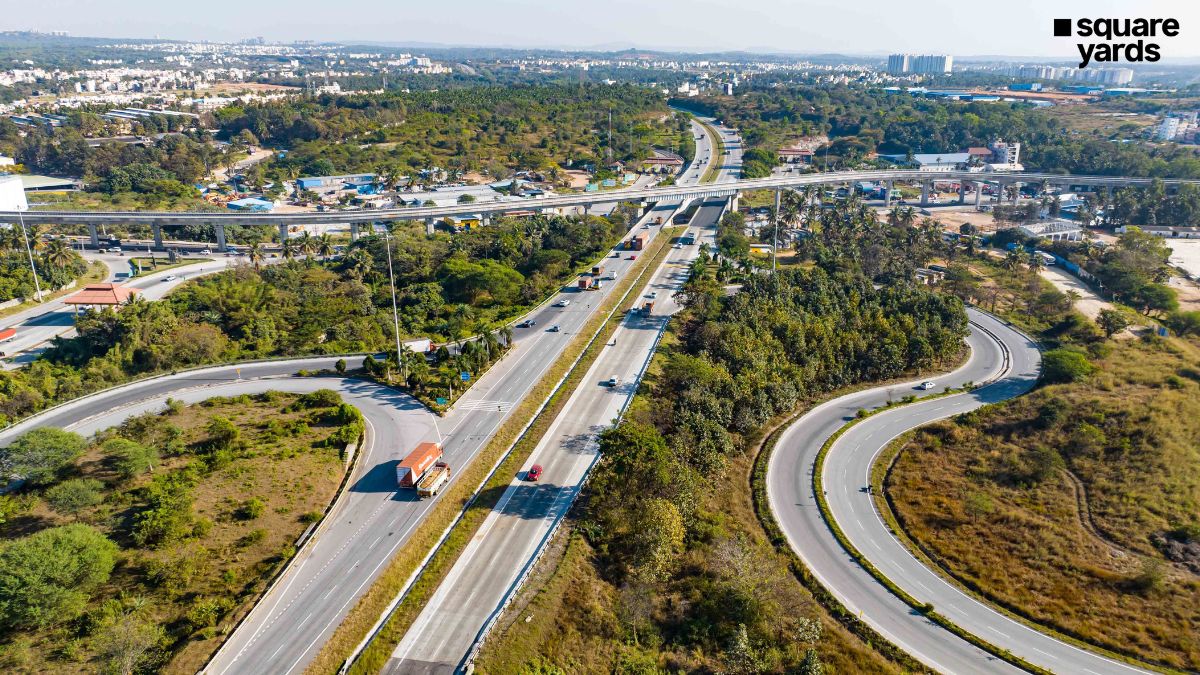
The DND-Faridabad-Sohna Access Controlled Highway is a six-lane project developed under the Bharatmala Pariyojana. Its primary objective is to provide a seamless bypass for traffic moving from North/East Delhi toward Western and Southern India, bypassing the congested inner-city arteries of the capital.
Key Highlights of the Project:
- Distance and Design: Spanning 59 kilometers, the corridor is an access-controlled highway, ensuring high-speed transit with minimal interruptions.
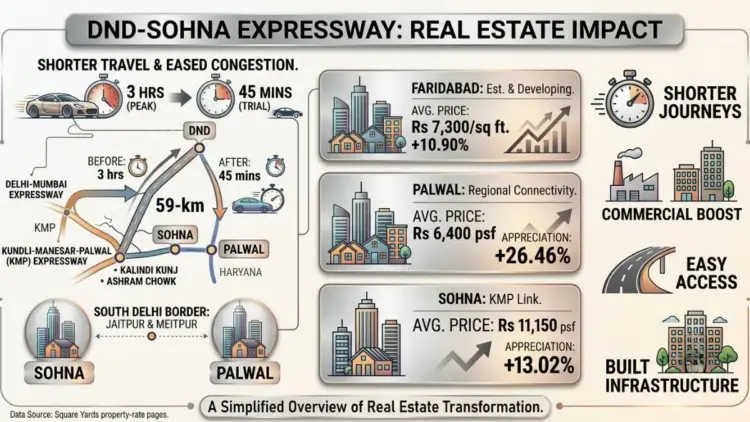
- Unprecedented Time Savings: Trial runs have demonstrated a radical reduction in travel time. The journey from Sarai Kale Khan in Delhi to Sohna and Palwal—which previously took nearly three hours during peak traffic—now clocks in at approximately 40 to 45 minutes.
- Strategic Integration: The highway serves as a feeder to the 1,350-km Delhi-Mumbai Expressway. It also intersects with the KMP Expressway near Sohna, creating a massive loop that connects all major satellite towns of the NCR.
- Decongestion of Delhi: By providing an alternative route for heavy vehicles and long-distance commuters, the corridor is expected to significantly ease the perennial traffic bottlenecks at Ashram Chowk, Kalindi Kunj, and Mathura Road.
Chronology: From Blueprint to Reality
The journey of the DND-Sohna Expressway has been one of strategic planning and phased execution, aimed at addressing the increasing vehicular load on the existing NH-19 (Delhi-Mathura Road).
Phase 1: Conceptualization and Allotment
The project was conceived by the National Highways Authority of India (NHAI) as part of a larger plan to link the DND Flyway directly to the Delhi-Mumbai Expressway. This was necessitated by the realization that without a dedicated feeder route, the massive traffic heading toward Mumbai would overwhelm Delhi’s local roads.
Phase 2: Land Acquisition and Groundbreaking
Work on the corridor was divided into multiple packages. The first package focused on the stretch from the DND Flyway to Jaitpur along the Yamuna riverbank. Subsequent packages extended the route through the urban clusters of Faridabad and into the rural-industrial belts of Palwal and Sohna.
Phase 3: Overcoming Engineering Hurdles
The construction faced significant challenges, including the relocation of high-tension power lines, the construction of elevated sections over densely populated areas like Jaitpur and Meethapur, and the integration of the route with the existing KMP cloverleaf.
Phase 4: Final Stretch Completion (2024)
The recent completion of the final stretch marks the functional unification of the corridor. With the infrastructure now largely in place, the focus has shifted toward trial runs, safety audits, and the formal opening of all entry and exit ramps, which has immediately triggered a surge in interest from the real estate sector.
Supporting Data: The Real Estate Impact
The "Expressway Effect" is already visible in the property valuation data across the corridor. As connectivity improves, the gap between "affordable" and "premium" markets is narrowing, with several micro-markets showing double-digit appreciation.
1. Faridabad: The Emerging Residential Powerhouse
Faridabad, long overshadowed by Gurugram and Noida, is seeing a renaissance. The city’s average apartment price currently stands at approximately Rs 7,300 per sq. ft., marking a 10.9% increase over the last reporting period.
- South Faridabad: This micro-market has emerged as a top performer with a staggering 27.48% year-on-year growth, bringing average prices to Rs 6,450 psf.
- Neharpar (Greater Faridabad) Phase 1: A favorite for mid-segment buyers, this area averages Rs 7,400 psf, reflecting an 11.68% growth.
2. Palwal: The Next Industrial and Logistics Hub
Once considered a distant peripheral town, Palwal is now within a 45-minute drive from the heart of Delhi. This has led to a 26.46% appreciation in property rates, with average prices hovering around Rs 6,400 psf.
- Sectors to Watch: Sector 143 (Rs 6,650 psf) and Sector 65 (Rs 6,700 psf) are witnessing increased inquiry levels for both residential plots and commercial warehousing.
3. Sohna: The "South Gurugram" Extension
Sohna has benefited the most from its proximity to the KMP-DME junction. Average apartment prices have climbed to Rs 11,150 psf, a 13.02% increase.
- Sohna Sector 33: This premium pocket now commands Rs 12,550 psf, showing a 14.43% rise, as it attracts buyers who are priced out of Gurugram’s Golf Course Extension Road.
| Market | Average Property Price (psf) | Reported Appreciation (YoY) |
|---|---|---|
| Faridabad | Rs 7,300 | 10.90% |
| Palwal | Rs 6,400 | 26.46% |
| Sohna | Rs 11,150 | 13.02% |
Source: Square Yards Property-Rate Analysis.
Official Responses and Expert Perspectives
While the NHAI has remained focused on the technical delivery of the project, urban planners and real estate analysts have been vocal about the long-term structural changes this corridor will bring to the NCR.
NHAI Officials have noted that the project is a "benchmark in multi-modal integration," highlighting that the expressway will eventually feature advanced tolling systems and green landscaping to mitigate the environmental impact on the nearby Yamuna floodplains.
Real Estate Analysts at Square Yards suggest that the corridor is redrawing the map for the "commutable NCR." According to industry experts, "The psychological barrier of distance is being replaced by the reality of time. When a commuter can reach Sohna from Delhi in 40 minutes, Sohna ceases to be a ‘suburb’ and becomes an integral part of the primary residential zone."
Urban Planning Experts caution, however, that the success of these property markets hinges on "last-mile connectivity." While the expressway handles the bulk of the journey, local state governments (Delhi and Haryana) must ensure that the internal arterial roads feeding into the expressway are widened and maintained to prevent localized bottlenecks.
Implications: Beyond Real Estate
The completion of the DND-Jaitpur-Faridabad-Palwal-Sohna corridor carries implications that extend far beyond property prices.
1. Economic and Industrial Growth
The corridor provides a high-speed link for the industrial sectors of Faridabad and Palwal to reach the Delhi-Mumbai Expressway. This is expected to trigger a boom in the logistics and warehousing sectors. Companies looking for "Grade A" warehousing space will likely flock to the Palwal-Sohna belt due to the ease of movement for heavy cargo.
2. The Shift in Commuter Behavior
With the reduction in travel time, we are likely to see a "reverse migration" of sorts. Professionals working in South Delhi or the Okhla Industrial Area may now find it more viable to purchase larger, more affordable homes in Greater Faridabad or Sohna rather than cramped apartments in South Delhi.
3. Environmental Impact and Urban Decongestion
By diverting thousands of vehicles daily from the Ashram-Mathura Road stretch, the expressway will contribute to a reduction in vehicular emissions within Delhi’s core. However, the increased development along the highway will require stringent environmental oversight to protect the groundwater levels and green cover in the Aravalli foothills near Sohna.
4. Market Stabilization
While the current data shows rapid appreciation, the influx of new inventory—particularly in the Sohna and Neharpar regions—is expected to stabilize prices in the medium term. This makes the current window an "investor’s sweet spot" before the corridor becomes fully operational and the market reaches maturity.
Conclusion: A New Era for the NCR
The DND-Faridabad-Sohna Expressway is a testament to how infrastructure can dictate the destiny of a region. By bridging the gap between the national capital and its southern satellites, the project has provided a much-needed vent for Delhi’s population pressure.
For homeowners and investors, the message is clear: the focus of the NCR’s growth has shifted south. While the immediate impact is seen in the 20-25% price hikes in pockets like Palwal and South Faridabad, the long-term value will be driven by the corridor’s role as the primary gateway to the Delhi-Mumbai Expressway. As last-mile connectivity improves and civic infrastructure catches up with the highway’s pace, these once-peripheral towns are set to become the new centers of gravity for North India’s real estate market.