

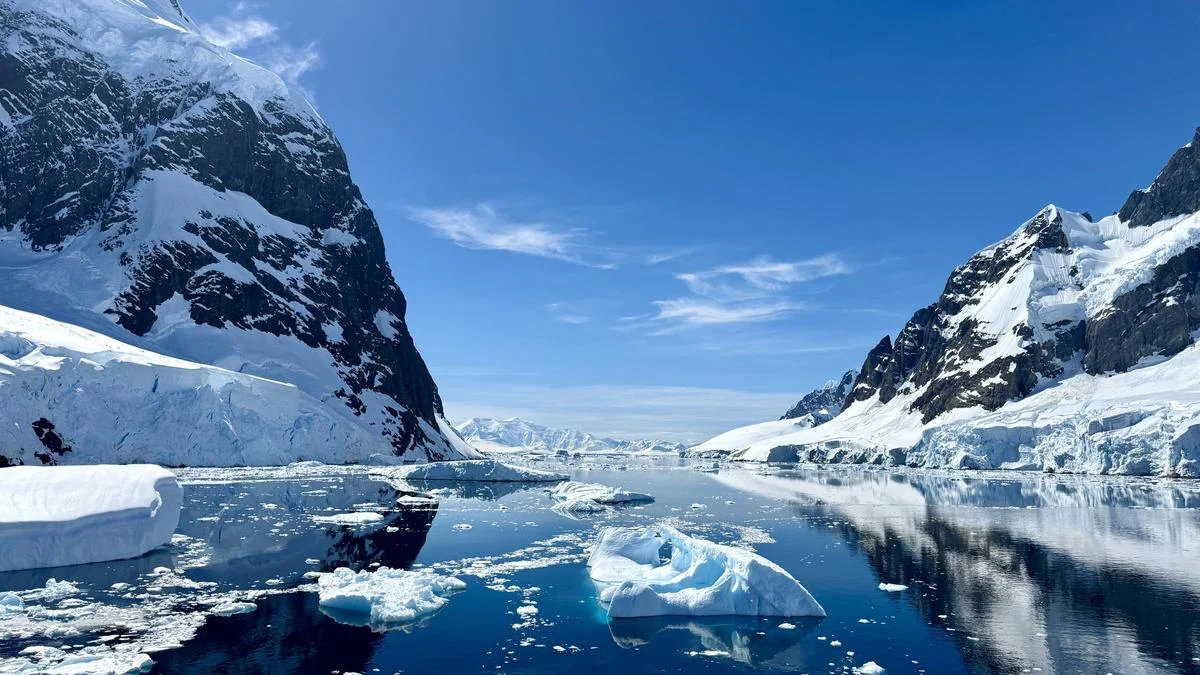
When British mountaineer George Mallory was famously asked why he wanted to scale the world’s highest peak, his reply was as succinct as it was profound: “Because it’s there.” Over a century later, that same sentiment echoes across the Southern Ocean. For the modern traveler, Antarctica—the once-impenetrable "White Continent"—is the ultimate "there."
However, as accessibility increases and the global "bucket list" culture intensifies, the very qualities that make Antarctica alluring—its pristine isolation and untouched wilderness—are being threatened by the weight of its own popularity. Experts and environmentalists are increasingly concerned that this remote sanctuary is being "loved to death."

Main Facts: The Great Polar Migration
The scale of human presence in Antarctica has undergone a radical transformation in the last few years. What was once a destination reserved for rugged explorers and specialized researchers has become a high-end tourist hotspot.
The Numbers Game
In the 2023-24 summer season, Antarctica received approximately 125,000 tourists. While this figure might seem modest compared to the millions who flock to Paris or Venice, it represents a staggering increase for a continent with no permanent residents, no infrastructure, and a hyper-fragile ecosystem. Projections suggest that if current trends continue, tourist numbers could reach half a million by 2033.

The "Last Chance" Phenomenon
A driving force behind this surge is a concept known as "last chance tourism." As climate change dominates global headlines and the melting of polar ice becomes a visible reality, well-heeled travelers are rushing to see the continent before it changes irrevocably. This creates a tragic irony: the carbon footprint required to reach this remote destination—often involving long-haul flights to South America followed by massive cruise ships—contributes to the very warming that is destroying the ice.
The Nature of the Visit
Modern Antarctic tourism is no longer a monolithic experience. It ranges from "fly-over" tourism to "cruise-only" voyages on massive ships, and "expedition" cruises that allow for shore landings. The latter are the most regulated but also the most impactful, as they bring humans into direct contact with penguin colonies, seal haul-outs, and historical sites.

Chronology: From Explorers to Influencers
The history of human interaction with Antarctica has shifted from exploitation and exploration to scientific study and, finally, to mass-market tourism.
- 1959: The Antarctic Treaty: This landmark agreement was signed by 12 nations, declaring the continent a neutral, demilitarized zone dedicated to peace and science. It remains the bedrock of Antarctic governance.
- 1966: The Birth of Commercial Tourism: American entrepreneur Lars-Eric Lindblad pioneered the first dedicated tourist cruise to Antarctica. He took 57 travelers on a mission to prove that tourism could foster environmental advocacy.
- 1991: The Formation of IAATO: As tourism began to grow, the International Association of Antarctica Tour Operators (IAATO) was established. This voluntary consortium was created to advocate for and promote the practice of safe, environmentally responsible private-sector travel.
- 1991: The Madrid Protocol: Formally known as the Protocol on Environmental Protection to the Antarctic Treaty, this agreement designated Antarctica as a “natural reserve, devoted to peace and science” and banned all mining activities indefinitely.
- 2000-2019: Steady Growth: Visitor numbers grew from fewer than 8,000 at the turn of the century to over 50,000 just before the global pandemic.
- 2020-Present: The Post-Covid Surge: After a brief hiatus due to global lockdowns, Antarctic tourism exploded. The desire for "transformational" travel and the influence of social media have turned the Southern Ocean into a theater for high-end "expedition" marketing.
Supporting Data: The Ecological Stakes
To understand why 125,000 tourists represent a crisis, one must look at the biological and geophysical data of the continent.

The World’s Water Tower
The Antarctic ice sheet is the largest body of freshwater on Earth. It contains a staggering 90% of all the ice on the planet. Scientific models indicate that if this ice sheet were to melt completely, global sea levels would rise by approximately 230 feet (70 meters). Such an event would submerge almost every major coastal city on the planet.
Biosecurity and Invasive Species
The introduction of non-native species is one of the greatest threats to Antarctic biodiversity. Data from researchers suggests that seeds, spores, and even small insects can hitchhike on the boots and clothing of tourists. In an ecosystem where life is balanced on a knife-edge, a single invasive grass or a stray avian virus could decimate local populations of penguins or mosses.

The Historical Scars
Locations like Deception Island serve as a data point for human impact. Once a bustling whaling station, the island is littered with the rusting remnants of an industry that slaughtered humpback and fin whales for oil until the late 20th century. While whale populations are slowly recovering, the presence of heavy metals and microplastics in the Southern Ocean—partially linked to increased shipping traffic—remains a concern for marine biologists.
Official Responses: Regulating the Wild
Because Antarctica belongs to no single nation, its regulation falls under a complex web of international agreements and voluntary industry standards.

The Role of IAATO
Most major cruise lines are members of IAATO, which enforces strict operational guidelines. These include:
- Ship Size Limits: Ships carrying more than 500 passengers are prohibited from making landings.
- Landing Constraints: No more than 100 passengers are allowed on shore at any single site at one time.
- Biosecurity Protocols: Passengers must undergo rigorous "decontamination" processes, including scrubbing boots and vacuuming pockets, before and after every landing.
- Wildlife Distances: Strict rules dictate how close humans can get to penguins (usually 5 meters) and seals to prevent stress and behavioral changes.
The Push for Sustainability
Juan Cristóbal Del Pedregal Bravo, Senior Commercial Director at Antarctica21, emphasizes that boutique cruise companies are moving toward more sustainable practices. Some operators now offer "fly-cruise" options, where travelers fly over the turbulent Drake Passage to reach the South Shetland Islands, reducing the time spent at sea and the associated fuel consumption of large vessels.

However, critics argue that "voluntary" guidelines are not enough. There is a growing call among some Treaty nations for a hard cap on tourist numbers and a more formal, legally binding regulatory framework for commercial activities.
Implications: The Future of the White Continent
The debate over Antarctic tourism is not a binary one of "go" or "stay away." Instead, it is a discussion about the evolution of the traveler from a consumer to an ambassador.

From Tourism to Expedition
Bhawna Rao, founder of Encompass Experiences, argues that the terminology matters. "It’s important that travelers understand this is not a typical holiday. It’s an expedition," she notes. The implication is that an expedition requires a higher level of personal responsibility, education, and engagement with the environment.
The "Ambassador" Effect
The strongest argument in favor of regulated tourism is the "Ambassador" effect. Proponents believe that when people witness the surreal, silent majesty of an iceberg or the communal struggle of a penguin colony, they return home as fierce advocates for climate action. They are no longer reading about climate change in a textbook; they have seen its frontline.

The Luxury Dilemma
As the market grows, there is a risk that the "expedition" element will be eclipsed by "luxury." If Antarctica becomes merely a backdrop for five-star dining and heated swimming pools on ships, the educational and transformational value of the trip is lost, leaving only the environmental cost.
Conclusion: A Fragile Balance
Antarctica remains one of the last truly untouched wildernesses on Earth, a place where the scale of nature makes human endeavors seem infinitesimally small. Yet, our collective footprint is growing. The future of the continent depends on a shift in perspective: seeing Antarctica not as a trophy to be collected or a checkbox on a list, but as a global commons that requires our silence more than our presence.

The question for the next decade is whether we can restrain our desire to see it "because it’s there" in order to ensure that it remains there for the centuries to come. The "transformational" experience many seek may ultimately lie in the realization that some places are best left to the wind, the ice, and the silence.
