

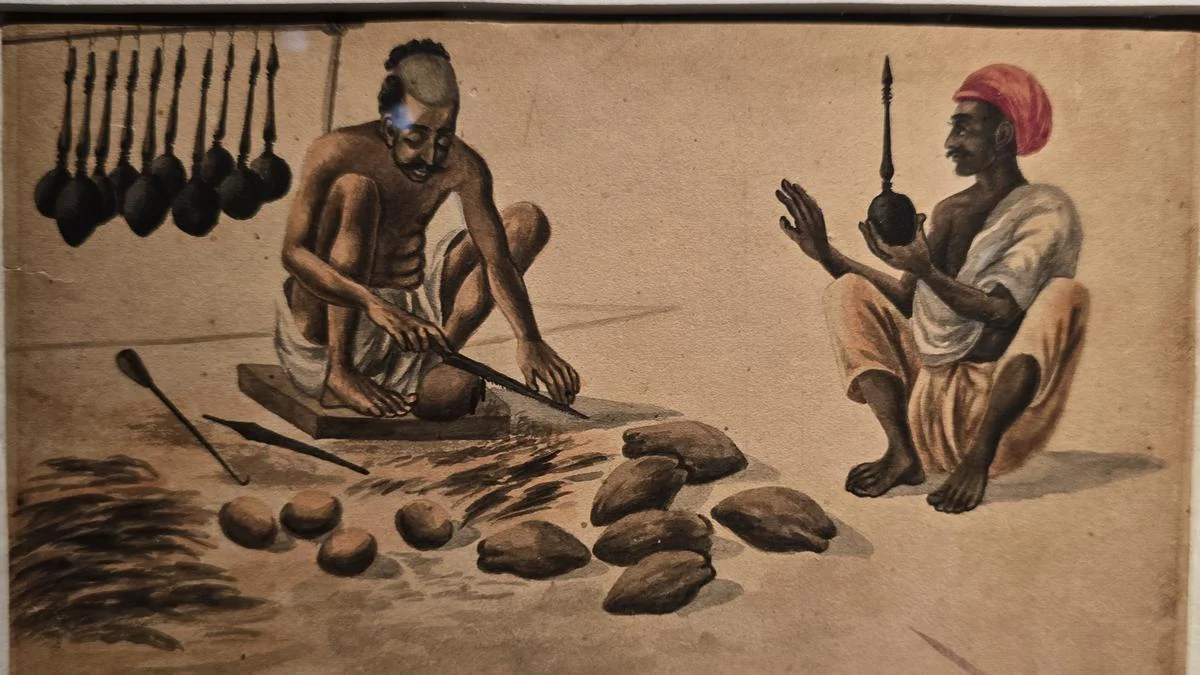
In the quiet, climate-controlled corridors of the Bihar Museum, a delicate watercolor depicts two men in simple cotton dhotis focused on their labor within a rustic distillery. Nearby, another frame captures a woman in a vibrant blue-and-yellow ghaghra, her dupatta fluttering as she dances in a palace hall, accompanied by musicians lost in their melody. These are not just paintings; they are the visual echoes of an 18th-century India, rendered through a unique tradition known as Patna Kalam.
Once the primary mode of visual documentation in a pre-photographic era, Patna Kalam captured the mundane beauty of the ordinary—vegetable sellers, blacksmiths, and servants. After decades of languishing in dusty archives and private trunks, this art form is witnessing a modern-day renaissance. Following a landmark exhibition at the Bihar Museum Biennale 2025 and a series of intensive workshops, the "People’s Art" of Patna is finally stepping out from behind the glass of obscurity.

Main Facts: The Essence of Patna Kalam
Patna Kalam, often referred to as the "Patna School of Painting," is a distinctive offshoot of the larger Company School of Art. It emerged as a hybrid style, blending the intricate detailing of Mughal miniatures with the naturalism and perspective of European art. Unlike the grand, stylized portraits of emperors that defined the Mughal courts, Patna Kalam was stubbornly terrestrial. It focused on the firka—sets of snapshots depicting the daily lives, trades, and festivals of the common man.
The technical hallmarks of the style include:

- Minimalist Backgrounds: Unlike Mughal art, which featured lush landscapes or ornate architecture, Patna Kalam often utilized pale, bare backgrounds to keep the focus entirely on the human subject.
- Delicate Brushwork: The artists used the Kajli Syahi technique, where the image is painted directly with a brush without a pencil sketch.
- Unique Mediums: While many works were done on imported European paper, others were rendered as gouache on mica (locally known as abrak), providing a luminous, translucent quality.
- Authentic Color Palettes: Pigments were often derived from natural sources—plants, minerals, and even precious stones—giving the works a muted yet enduring vibrancy.
Despite its historical significance, the art form nearly vanished after Indian independence, surviving only in the vaults of the British Museum, the Victoria & Albert Museum in London, and a few select private collections in Bihar.
Chronology: The Rise, Fall, and Rebirth of a Tradition
1750–1760: The Migration
The roots of Patna Kalam lie in the decline of the Mughal Empire. As the imperial court in Delhi lost its luster and patronage dried up, artists migrated to regional centers. Initially, they settled in Murshidabad under the Nawabs of Bengal. However, following the British victory at the Battle of Plassey in 1757, political instability forced these artists to move again. By 1760, a significant community of painters had established themselves in the bustling trade hub of Patna city.

1790–1850: The Golden Age
This period saw the flourishing of the "Patna School." Artists like Sewak Ram and Hulas Lal pioneered the firka sets. By the mid-19th century, cousins Shiva Lal and Shiva Dayal Lal led a thriving workshop tradition. Patna became a center where European travelers and British East India Company officials commissioned works to document the "exotic" life of India, leading to the "Company School" designation.
1860–1940: The Decline
The advent of photography in the mid-19th century dealt a near-fatal blow to Patna Kalam. The demand for hand-painted documentation plummeted as cameras provided faster and more accurate captures. Simultaneously, the rise of cheap lithographs—mass-produced prints—by artists like Charles D’Oyly further eroded the market for labor-intensive hand-painted works. By the early 20th century, the tradition was sustained by only a few families, such as that of Ishwari Prasad Verma.

2023–Present: The Revival
Interest was reignited through the Patna Kalam: Ek Virasat exhibition held at the Patna Museum (December 2025 – February 2026). This was bolstered by the Bihar Museum Biennale 2025, which introduced the art to a global audience. Organizations like the Indian National Trust for Art and Cultural Heritage (INTACH) have since conducted nine specialized workshops to train a new generation of artists.
Supporting Data: Institutional and Private Guardianship
The survival of Patna Kalam is largely credited to a few dedicated collectors and institutions.

The Jalan Collection:
The century-old Quila House (Jalan House) remains a cornerstone of this heritage. Aditya Jalan, the great-grandson of the legendary art connoisseur Dewan Bahadur Radha Krishna Jalan, recently opened "Planet Patna," a private museum. While the family home remains a private landmark, Planet Patna offers public access to a vast collection of Company Paintings for a nominal fee of ₹100. This collection is so significant that even British historian Mildred Archer acknowledged it as a primary source for her 1948 book, Patna Painting.
The Global Footprint:
Paradoxically, much of Bihar’s heritage resides abroad. Significant volumes of Patna Kalam are housed in:

- The British Museum, London.
- The Victoria & Albert Museum, London.
- The Metropolitan Museum of Art, New York (featuring works from the family of contemporary descendant Sanjay Kumar).
Comparative Survival:
While Patna Kalam struggled, another local tradition—Tikuli art—survived by adapting. Tikuli, which uses enamel paint on hard surfaces and was revived in the mid-20th century, is now a staple of home decor. Modern revivalists of Patna Kalam are looking at the "Tikuli model" to see if the 18th-century style can be adapted for contemporary commercial use without losing its soul.
Official Responses: A State-Led Renaissance
Government and institutional leaders have expressed a newfound urgency in preserving the art form.

Anjani Kumar Singh, Director General of the Bihar Museum, noted the surprising enthusiasm from young artists. "We were pleasantly surprised by the interest in our workshops. Our goal now is to find high-level art trainers who can impart the technical skills necessary to create contemporary Patna Kalam," Singh stated. He also revealed plans for a permanent gallery dedicated solely to this tradition.
Bhairav Lal Das, Convenor of INTACH’s Patna Chapter, emphasized the cultural specificity of the art. "Patna Kalam employed the technique of the Company School but with characteristics intrinsic to Patna—its people and its culture. INTACH is committed to providing incentives for budding artists to ensure this isn’t just a historical curiosity but a living profession."

Ashok Kumar Sinha, Deputy Director of the Bihar Museum, likened the art to Bihar’s "Vaidehi Sita" exhibition, which traveled internationally. "We plan to take Patna Kalam exhibitions to other Indian states and abroad. Many people are simply unaware that this sophisticated documentation of Indian life exists."
Implications: Can the Past Flourish in a Chaotic Present?
The revival of Patna Kalam faces significant modern challenges. The 18th-century Patna was a place where artists could sit in quiet corners of the city to observe a blacksmith or a grocer. Today’s Patna is a sprawling, chaotic metropolis.

The Space for Art:
Architect and artist Aditya Kumar Singh points out a logistical hurdle: "Sketching a contemporary building takes thirty minutes, but a true Patna Kalam painting, with its nuanced brushwork and natural pigments, takes at least three days of dedicated focus. In a fast-paced world, finding that patience is difficult."
Contemporary Adaptation:
However, there is hope in adaptation. Textile designer Sunita Prakash has successfully integrated Patna Kalam motifs into block-printing and fabric painting through her company, Bandhani. By moving the art from mica and paper onto wearable textiles, she has created a new market that ensures the survival of the aesthetic, if not the original medium.

The Next Generation:
Perhaps the most significant implication is the shift in the artist demographic. Professor Jitendra Mohan observed that "fresh artists"—young students with no prior bias—are often better at mastering the precise human measurements required for Patna Kalam than established folk artists from other traditions. Students like Anurag Kumar Verma represent a new vanguard, blending traditional techniques with contemporary themes.
Conclusion
Patna Kalam is more than just a style of painting; it is a historical mirror. It reminds us that before the lens of the camera, there was the eye of the artist, capturing the dignity of the laborer and the grace of the everyday. While the challenge of sustaining such a meticulous art form in the 21st century is formidable, the combined efforts of the Bihar government, private collectors like the Jalans, and organizations like INTACH suggest that Patna Kalam is finally moving toward a permanent place in the sun—not as a relic of the past, but as a vibrant part of India’s future.
