

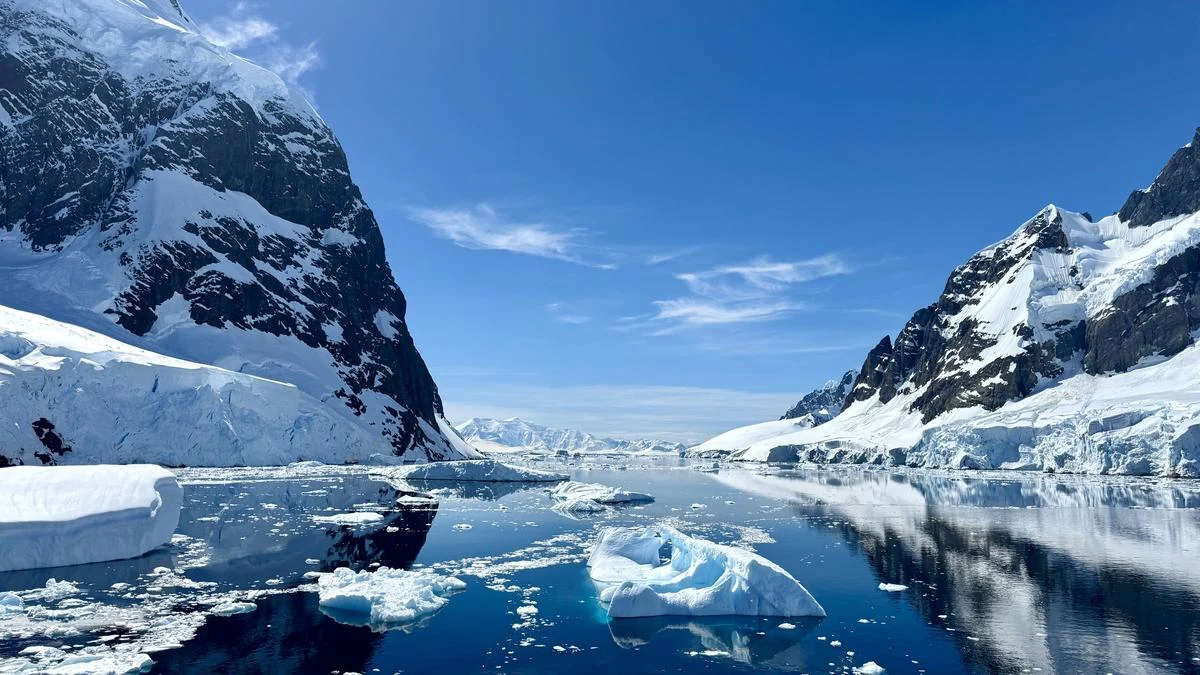
When the legendary British mountaineer George Mallory was famously asked why he felt compelled to climb Mount Everest, his response was as laconic as it was profound: "Because it’s there." For over a century, this sentiment has served as the ultimate justification for human exploration. Today, however, that same drive is fueling a massive surge in travel to the world’s final frontier: Antarctica.
Once the exclusive domain of hardened explorers and specialized researchers, the Seventh Continent is now more accessible than ever. With the advent of "fly-cruise" options and ice-strengthened luxury vessels, the remote wilderness is being integrated into the global tourism circuit. Yet, much like Everest—which now grapples with "traffic jams" in the death zone—Antarctica faces the looming threat of being "loved to death."
Main Facts: The Transition from Exploration to Mass Tourism
Antarctica is a land of extremes. It is the coldest, driest, and windiest continent on Earth, holding approximately 90% of the world’s ice and 70% of its freshwater. Until recently, its geographical isolation and the treacherous waters of the Drake Passage acted as natural barriers to human presence.

In the modern era, those barriers have been dismantled by technology and a shifting global travel culture. The 2023-24 season marked a historic turning point, with approximately 125,000 tourists visiting the continent. To put this in perspective, just two decades ago, annual visitor numbers hovered below 8,000.
The current landscape of Antarctic tourism is defined by several key realities:
- Accessibility: Travelers can now bypass the two-day sea crossing from South America by flying directly to King George Island to board their ships.
- Demographics: The "well-heeled" traveler is no longer looking for traditional luxury; they are seeking "transformational" experiences and "last-chance tourism."
- Environmental Sensitivity: The Antarctic ecosystem is incredibly fragile. A single invasive seed or a minor oil spill can have catastrophic, multi-generational consequences for local flora and fauna.
- Legal Status: Antarctica belongs to no one. It is governed by an international treaty, which makes the regulation of commercial activities a complex, cooperative effort rather than a matter of sovereign law.
Chronology: The Evolution of the Antarctic Visitor
The human relationship with Antarctica has evolved through three distinct phases: the Heroic Age, the Scientific Age, and the Commercial Age.

The Heroic and Scientific Eras (1890s – 1960s)
For decades, the only humans to set foot on the ice were those driven by national prestige or scientific discovery. Figures like Roald Amundsen, Robert Falcon Scott, and Ernest Shackleton defined the "Heroic Age of Antarctic Exploration." Following World War II, the focus shifted to science, culminating in the 1959 Antarctic Treaty, which set the continent aside as a demilitarized zone for peaceful research.
The Birth of Commercial Tourism (1966)
The paradigm shifted in 1966 when American entrepreneur Lars-Eric Lindblad pioneered the first commercial cruise specifically for "citizen explorers." He took 57 passengers to the Antarctic Peninsula, arguing that by seeing the continent, these travelers would become its most ardent protectors. This "Lindblad Model" focused on education and environmental stewardship.
The Turn of the Century Expansion (1990s – 2010s)
By the 1991-92 season, tourism had grown enough to necessitate the formation of the International Association of Antarctica Tour Operators (IAATO). At this stage, visitor numbers were still manageable, generally remaining under 10,000 per year. However, the introduction of larger cruise ships began to change the footprint of tourism.

The Modern Boom (2020 – Present)
The post-COVID-19 era has seen an unprecedented spike in interest. The "bucket list" phenomenon, amplified by social media influencers, has turned Antarctica into a status symbol. Between 2022 and 2024, numbers surged to the current record of 125,000. Projections by environmental analysts suggest that if current trends continue, the continent could see 500,000 annual visitors by 2033.
Supporting Data: The Cost of the "Bucket List"
The rapid growth of Antarctic tourism is not merely a logistical challenge; it is an ecological one. Supporting data highlights the tension between economic demand and environmental limits.
The Carbon Footprint of "Last Chance Tourism"
A significant driver of the current boom is "last chance tourism"—the urge to see the ice before it melts due to climate change. Ironically, the carbon emissions required to get there contribute to the very melting travelers wish to witness. A round-trip journey to Antarctica from Europe or North America can emit more CO2 than the average person produces in an entire year.

Ecological Fragility
The Antarctic ice sheet is the largest body of freshwater on Earth. Scientists estimate that if the entire ice sheet were to melt, global sea levels would rise by approximately 60 meters (nearly 200 feet). While tourism is not the primary driver of this melt (global industrial emissions are), the localized impact of ships—including black carbon (soot) from engine exhaust settling on snow—accelerates local melting by reducing the snow’s reflectivity (albedo).
Biosecurity Risks
With 125,000 people landing on various islands, the risk of introducing invasive species is at an all-time high. Seeds, microbes, or insects clinging to Velcro, camera bags, or boot treads can outcompete native mosses and lichens. In recent years, researchers have found traces of non-native grasses and even avian flu, which poses a dire threat to penguin colonies.
Official Responses and Regulatory Frameworks
Because Antarctica is a global common, it lacks a central government to pass tourism laws. Instead, regulation relies on a "gentleman’s agreement" framework.

The Antarctic Treaty System (ATS)
The 1959 treaty, now signed by 56 nations, remains the primary legal framework. However, the treaty was designed to manage scientific research and territorial claims, not a multi-billion-dollar tourism industry. Official responses within the ATS have been slow, as any new mandatory regulation requires consensus from all consultative parties.
The Role of IAATO
Most of the day-to-day regulation is handled by the International Association of Antarctica Tour Operators (IAATO). This is a voluntary, member-funded organization that sets industry standards. Their current guidelines include:
- Ship Size Limits: Ships carrying more than 500 passengers are prohibited from making landings.
- Site Coordination: Only one ship is allowed at a landing site at any given time.
- Passenger-to-Guide Ratios: A strict 20:1 ratio must be maintained during shore excursions.
- Biosecurity: Mandatory boot-washing and gear-scrubbing protocols before and after every landing.
Boutique Operators and Sustainable Practices
Industry leaders like Juan Cristóbal Del Pedregal Bravo of the Chile-based Antarctica21 argue that the solution is not a total ban, but a shift toward boutique, high-standard operations. "Allowing travelers to witness the continent’s beauty first-hand fosters a deeper appreciation," Bravo notes. His company utilizes a "fly-cruise" model to reduce the time ships spend at sea, though critics argue this simply trades maritime emissions for aviation emissions.

Implications: The Future of the Seventh Continent
The surge in tourism presents a profound philosophical and practical dilemma: Can we protect a place by visiting it?
The "Ambassador" Effect
The primary argument in favor of tourism is the creation of "Antarctic Ambassadors." Travelers like Bhawna Rao, founder of Encompass Experiences, emphasize the transformational nature of the trip. "It is a stark reminder that even the most remote corners of our planet have felt the impact of human activity," Rao says. The hope is that visitors return home and lobby for stronger climate policies.
The Need for Hard Caps
Environmental advocates are increasingly calling for hard caps on visitor numbers. Unlike IAATO’s voluntary guidelines, these would be legally binding limits on the number of berths available per season. There is also a push for "no-go zones"—pristine areas that would be permanently off-limits to commercial vessels to serve as ecological baselines.

Practical Advice for the Responsible Traveler
For those still determined to visit, experts suggest a rigorous vetting process for operators. A truly responsible expedition should include:
- Small Vessel Size: Opt for ships with fewer than 100 passengers to maximize educational time and minimize site impact.
- Citizen Science: Choose operators that allow passengers to assist in actual research, such as whale tracking or phytoplankton sampling.
- Educational Focus: The trip should feel less like a luxury cruise and more like an expedition, with daily lectures from glaciologists, historians, and biologists.
Conclusion
Antarctica remains a place of surreal beauty—a landscape of silent icebergs and ancient glaciers that makes the human observer feel infinitesimally small. However, as the "Mallory mindset" drives more people to its shores simply because it is there, the continent’s isolation is evaporating.
The future of Antarctica depends on a global shift from seeing the continent as a "bucket list" trophy to viewing it as a vital organ of the Earth’s climate system. Whether tourism remains a force for conservation or becomes the final blow to a fragile ecosystem depends entirely on the regulations we implement today and the personal responsibility of those who choose to venture south. In the end, the best way to love Antarctica may be to ensure that our presence there remains as massive as an iceberg in impact, but as silent as the snow in its footprint.
