

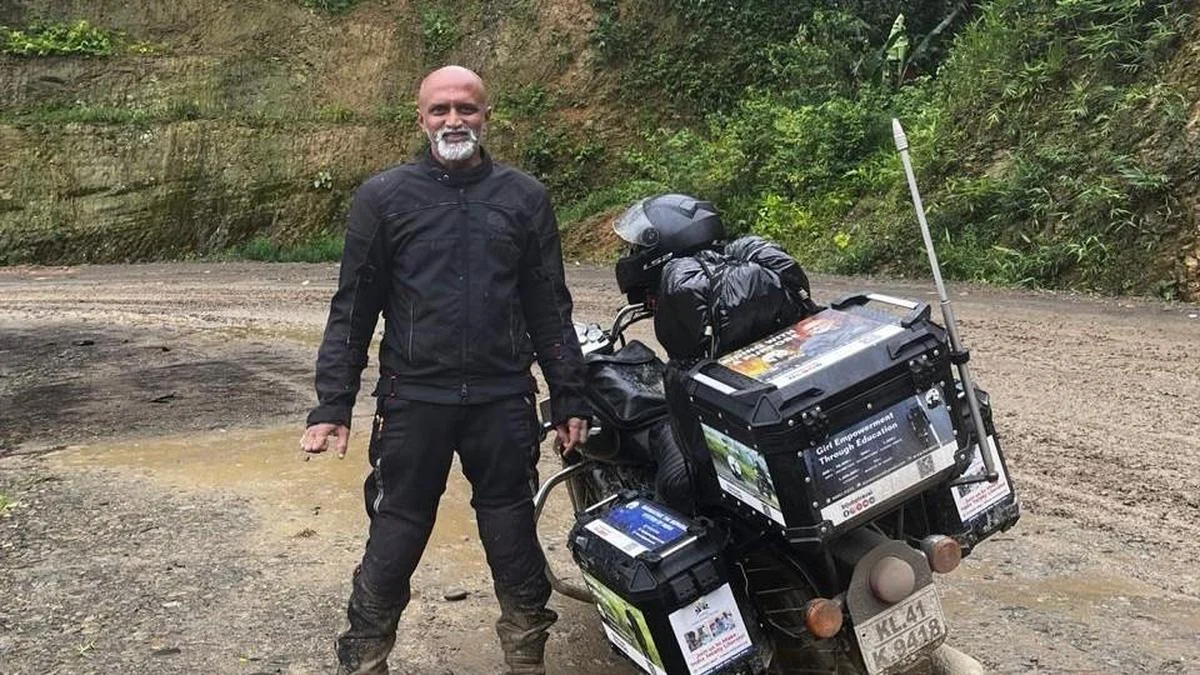
THIRUVANANTHAPURAM — In an era where "traveling for the soul" has become a common mantra, Biju BP, a 53-year-old former banker, has elevated the concept of the solo journey into a monumental crusade for social change. Completing an arduous 666-day odyssey across the length and breadth of India, Biju has not only traversed the diverse topographical tapestry of the subcontinent but has also etched his name into the annals of the World Records Union.
His feat, officially recognized this May as the "longest solo motorcycle ride across Indian states and Union Territories promoting girl empowerment through education," stands as a testament to the power of individual agency. What began as a personal quest for liberation from a corporate desk evolved into a grassroots movement that touched the lives of students at over 500 institutions.
The Genesis: From Balance Sheets to Backroads
The transition from a stable, 25-year career in banking to the unpredictable life of a long-distance motorcyclist was not an overnight impulse. For Biju, the seeds of this journey were sown during his mandatory annual leaves.
"I was a bank employee for two and a half decades," Biju recounts. "The long-distance itch started after I turned 40. I would use my leave to push the boundaries of my comfort zone." One of his most significant precursors to the all-India trip was a 15-day ride from Kochi to the desert landscapes of Rajasthan. However, these trips, while exhilarating, highlighted a growing internal conflict.
Biju noted that while the "onward journey was always exciting," the return leg was often clouded by the impending "post-vacation blues"—the looming pressure of targets, balance sheets, and the sterile environment of the banking sector. He realized that a standard vacation was insufficient to satisfy his burgeoning wanderlust. To truly see India, he needed time—a luxury his job could not afford him. At the age of 50, Biju opted for voluntary retirement, trading his professional security for a two-wheeled pursuit of the unknown.
Chronology of a 666-Day Odyssey
Biju’s journey was a marathon, not a sprint. Spanning nearly two years, the ride was meticulously planned yet remained open to the serendipity of the road.

The Departure and the Daily Grind
Setting off with a modest setup, Biju’s itinerary was designed to cover every state and Union Territory in India. This was not merely a coastal loop or a Himalayan circuit; it was a comprehensive grid-map of the Indian experience. From the humid tropics of Kerala to the biting cold of Ladakh, and from the salt marshes of Kutch to the lush rainforests of the Northeast, Biju maintained a grueling yet rewarding pace.
The October Conclusion and the Verification Process
The physical journey concluded in October of last year. However, the path to official recognition was another hurdle. "I didn’t undertake the journey keeping this record in mind," Biju explains. It was only at the urging of friends and well-wishers that he submitted his documentation to the World Records Union.
The verification process lasted several months. To prove the validity of a 666-day solo ride, Biju had to provide an exhaustive digital and physical trail:
- GPS Logs and Recordings: Continuous tracking of his route.
- Photographic Evidence: Geo-tagged images at state borders and landmarks.
- Media Documentation: Newspaper cuttings from regional dailies that covered his visits to local schools.
- Institutional Verifications: Letters and logs from the hundreds of schools and NGOs he visited.
In May, the World Records Union finally confirmed the achievement, validating a journey that spanned tens of thousands of kilometers.
The Core Mission: Empowerment Through Education
While the ride itself was a feat of endurance, the "soul" of the trip was its social objective. Biju chose to focus on girl empowerment through education, a choice driven by his observations of the systemic vulnerabilities girls face across different Indian demographics.
Addressing Social Evils
During his interactions, Biju confronted the grim realities of child marriage, child labour, and the trafficking of minors. He observed that in many rural pockets, girls are the first to be pulled out of school when financial or social pressures mount.

"There are also deeply personal issues, like menstrual health, that act as barriers," Biju notes. "Many girls are hesitant to discuss these topics, fearing ridicule or adhering to age-old taboos. Empowerment begins with the ability to speak about these issues without shame."
The Institutional Network
Biju’s impact was amplified by his membership in the Rotary Club. Leveraging the vast network of Rotary chapters across India, he was able to gain access to schools and colleges that might otherwise have been inaccessible to a solo traveler.
He held interactive sessions at approximately 500 institutions. His message was centered on a universal definition of empowerment: the autonomy to make one’s own life decisions. Crucially, these sessions were often co-educational. Biju believes that for girls to be truly empowered, boys must be educated on how to respect and interact with empowered women.
Supporting Data and Field Observations
Biju’s journey provided him with a unique, ground-level dataset on the state of the nation. His observations often contradicted popular narratives found in mainstream media.
| Aspect | Observation/Data Point |
|---|---|
| Institutional Reach | 500+ schools, colleges, and NGOs visited. |
| Geographic Scope | All 28 States and 8 Union Territories covered. |
| Primary Social Barriers | Child marriage (TN/Bihar), Menstrual Taboos (Rural belts), Dropout rates (Post-Class VIII). |
| Safety Perception | Contrary to fears, found immense hospitality in Bihar and Nagaland. |
| Collaborative Partners | Rotary International, various regional NGOs, and local Law Enforcement. |
Shattering Stereotypes
One of the most profound takeaways from Biju’s ride was the dismantling of regional prejudices. "I entered Bihar with a negative impression, fueled by stereotypes of lawlessness," he admits. "Instead, I received the warmest welcome of my entire trip." Similarly, his time in Nagaland revealed a culture of profound hospitality and safety that challenged his preconceived notions.
Official Responses and Grassroots Impact
The impact of Biju’s journey is perhaps best illustrated by a specific intervention in Tamil Nadu. During a period of heavy flooding, Biju was working with a local Rotary Club on relief efforts. He discovered a community where girls were routinely married off after Class VIII.

"I saw a 16-year-old girl already carrying her own child," Biju recalls. The encounter led to immediate action. Biju, alongside a lawyer from the relief group, formed an "Action Awareness Group" to educate the community on the legal and health implications of child marriage. Reports from the ground suggest that since their intervention, the community has seen a significant halt in underage marriages.
Recognition from the World Records Union
The World Records Union, in their citation, praised not just the distance covered but the "purposeful nature" of the travel. Their verification team noted that Biju’s journey serves as a blueprint for "advocacy travel," where the traveler acts as a bridge between different social strata.
Implications: The Road Ahead
Biju BP’s 666-day journey carries several implications for the future of solo travel and social activism in India.
1. The "Second Act" of Professional Life
Biju’s story is a powerful narrative for the "middle-aged" demographic in India. It suggests that the half-century mark is not a time for winding down, but an opportunity for a "second act" that can be more impactful than the first. His transition from banking to biking serves as an inspiration for those seeking to align their personal passions with social utility.
2. Solo Travel Safety
By completing this journey without major security incidents, Biju contributes to a more nuanced conversation about safety in India. While acknowledging that risks exist, his experience highlights that India is far more welcoming and safer for travelers than is often portrayed, provided one engages with local communities with respect and an open mind.
3. Grassroots Advocacy
The success of his school visits demonstrates that one does not need a massive budget or a large organization to effect change. A single individual on a motorcycle, backed by established networks like the Rotary Club, can facilitate significant shifts in local perspectives on education and gender rights.

Conclusion
Currently working as a consultant, Biju BP remains humble about his world-record feat. For him, the certificate is secondary to the memories and the lives he may have nudged toward a better path.
"A lifetime is not enough to travel across India," he muses. "You cannot imagine the diversity that is out there." His journey serves as a reminder that the road is not just a path between two points, but a classroom, a platform, and a catalyst for change. As Biju himself puts it, "If I was able to do this, anybody can. It can start with a small issue in your own neighborhood."
The 666 days on the road may have ended, but the ripple effects of Biju’s mission—much like the dust on his boots—will linger long after the engine has cooled.
