

By [Journalist Name]
In the quiet corridors of the Bihar Museum, far from the honking rickshaws and bustling markets of modern-day Patna, a silent revolution is taking place. It is a revolution of the brush—one that seeks to reclaim a lost visual language that once captured the heartbeat of 18th-century India.
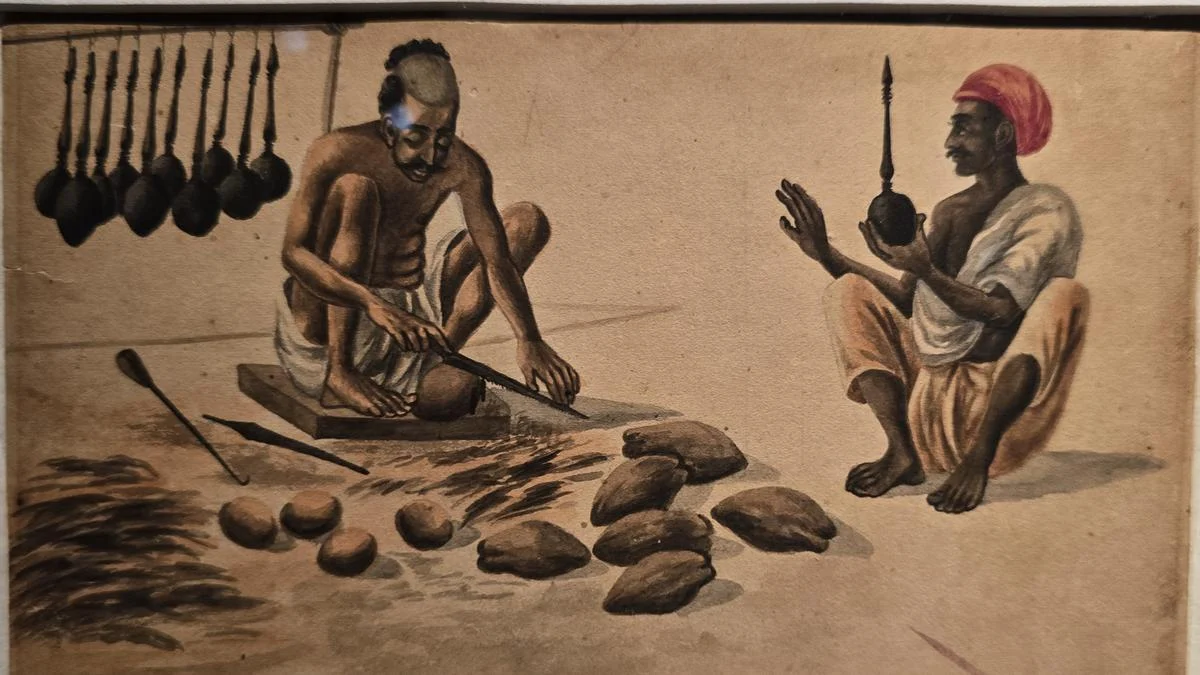
Watercolours on imported paper, rendered with a precision that rivals modern high-definition photography, depict the stark reality of two men in dhotis working within the humid confines of a distillery. Nearby, a woman in a vibrant blue-and-yellow ghaghra dances with abandon in a palace hall, her movements frozen in time by delicate brushwork on a pale, minimalist background. These are not merely paintings; they are the artifacts of the Patna Kalam tradition, a unique school of art that served as a pre-photographic visual documentation of the daily lives of ordinary people.

For decades, this art form—the "common man’s school"—languished in the shadows, confined to dusty trunks in art colleges or the climate-controlled archives of the British Museum and the Victoria & Albert Museum in London. However, following a series of high-profile exhibitions, including the Bihar Museum Biennale 2025, Patna Kalam is experiencing a renewed surge of interest. This resurgence brings with it a poignant question: why did an art form built to celebrate the vibrancy of daily life end up surviving only behind glass, and can it once again find a place in the contemporary world?
Main Facts: The "Common Man’s School" of Art
Patna Kalam, also known as the Patna School of Painting, occupies a singular niche in the history of Indian art. Unlike the grand Mughal miniatures that preceded it—which focused primarily on the lives of emperors, courtly intrigues, and mythological epics—Patna Kalam turned its gaze toward the street.
A Hybrid Aesthetic
The style is fundamentally a hybrid. As Bhairav Lal Das, the Patna chapter convenor of the Indian National Trust for Art and Cultural Heritage (INTACH), explains, the regional style "employed the technique of the Company School of Painting, with distinct characteristics intrinsic to Patna city—its people, culture, and day-to-day life."

It represents a sophisticated marriage between the meticulous detail of Mughal miniature traditions and the naturalism of European art. This "Anglo-Indian" style emerged as artists adapted to the tastes of the British East India Company officials while retaining their indigenous technical prowess.
Technical Characteristics
Dinesh Kumar, a veteran art teacher, notes that Patna Kalam is distinguished by what it lacks as much as by what it contains. Unlike other schools of Indian painting, it is remarkably bereft of ornamentation. There is often no play of light and shadow, and backgrounds are frequently left bare or pale to ensure the viewer’s focus remains entirely on the subject.
The subjects themselves are the "everyman" of the 18th and 19th centuries:

- Vegetable sellers weighing their produce.
- Blacksmiths at the forge.
- Servants fetching groceries.
- Purdah-nasheen women peeking from the red curtains of a palanquin.
The materials used were as diverse as the subjects. While watercolours on imported paper were standard, artists also painted on mica (known locally as abrak or sunmica) and even ivory, using a technique that required immense patience and a steady hand.
Chronology: The Rise, Fall, and Rebirth of a Tradition
The history of Patna Kalam is a story of migration, patronage, and technological obsolescence.
1720–1760: The Seeds of Migration
While British art historian Mildred Archer, in her seminal 1948 book Patna Painting, traced the evolution to the collapse of the Mughal Empire in the mid-18th century, some local experts like Ashok Kumar Sinha of the Bihar Museum suggest the style may have existed in Patna as early as 1720.

The widely accepted narrative, however, begins with the decline of the Delhi court. As Mughal patronage withered, artists migrated to Murshidabad in West Bengal. After the Battle of Plassey in 1757, which saw the British East India Company solidify its grip on India, these artists fled once more, arriving in Patna in waves starting around 1750. By 1760, the seeds of Patna Kalam had firmly taken root.
1790–1840: The Golden Age
The early 19th century saw the emergence of masters like Sewak Ram and Hulas Lal. They pioneered the firka sets—series of paintings that acted like "snapshots" of the city, capturing various trades and social classes. Later, cousins Shiva Lal and Shiva Dayal Lal led the Patna workshop tradition, producing prolific works between 1815 and 1840. During this period, Patna was a major commercial hub, and the demand for these paintings among both local elites and British officials was high.
Late 19th Century: The Advent of the Lens
The decline of Patna Kalam was swift and coincided with two major factors:

- Photography: The arrival of the camera offered a faster and more "accurate" way to document life.
- Lithography: The mass production of cheap lithographs, such as those by Charles D’Oyly, flooded the European market, making hand-painted works seem expensive and antiquated.
By the time India gained independence, the art form had nearly faded into oblivion, surviving only in the private collections of connoisseurs and the basements of museums.
2023–2026: The Modern Revival
The current revival began in earnest with a series of workshops organized by INTACH and the Bihar Museum. The exhibition Patna Kalam: Ek Virasat, held between December 2025 and February 2026, marked a turning point, bringing the art back into the public consciousness.
Supporting Data: Preservation and Documentation
The survival of Patna Kalam is largely due to the efforts of a few dedicated collectors and historians.

The Jalan Collection and "Planet Patna"
A significant portion of the surviving corpus belongs to the Jalan family. Aditya Jalan, the great-grandson of the legendary art connoisseur Dewan Bahadur Radha Krishna Jalan, recently opened Planet Patna, a private museum.
"My great-grandfather was passionate about objects of historical significance," Aditya says. The family’s commitment to the art is legendary; his father, Bal Manohar, once exchanged valuable colonial-era stamps just to acquire Patna Kalam paintings. While the family’s historic "Quila House" remains a private landmark, Planet Patna offers the public access to these "Company Paintings" for a modest entry fee, ensuring the art is no longer "locked away."
Academic Records
The first major academic reference to the school appeared in 1943, when British barrister P.C. Manuk published a monograph in the Journal of the Bihar Research Society. Later, Mildred Archer’s 1948 work provided the historical framework that researchers use today. In 2011, Padma Shri awardee Shyam Sharma furthered this documentation with his book Patna Kalam, published by the Lalit Kala Academy.

Comparison with Tikuli Art
To understand Patna Kalam’s struggle, one must look at Tikuli art, an 800-year-old tradition also native to Patna. Unlike Patna Kalam, Tikuli survived and thrived by adapting to modern commerce—appearing on coasters, trays, and home decor.
Padma Shri Ashok Kumar Biswas, a Tikuli artist, notes that while Tikuli is influenced by Patna Kalam, its use of bright enamel paints and hard surfaces made it more durable and commercially viable. Patna Kalam’s reliance on delicate watercolours and paper made it a "high art" that was harder to sustain in a mass-market economy.
Official Responses: The State’s Role in Restoration
The Bihar government and cultural institutions have recognized that if they do not act now, the last vestiges of this heritage will be lost to time.

The Bihar Museum’s Strategy
Anjani Kumar Singh, Director General of the Bihar Museum, expressed pleasant surprise at the public interest in recent workshops. "We now hope to find good art trainers to impart technical skills and help create contemporary Patna Kalam," he stated.
The museum plans to dedicate a permanent gallery to the school. Ashok Kumar Sinha, Deputy Director, hinted at a global push: "Just as we took the Vaidehi Sita exhibition to several states and abroad in 2024, we may do something similar for Patna Kalam."
Educational Initiatives
The College of Arts and Crafts at Patna University has become a hub for this revival. While it was once criticized for keeping original paintings "locked in trunks," it is now hosting workshops where students study reference photobooks to learn the technique. Jitendra Mohan, a Fine Arts professor, observes that young students—unburdened by the stylistic constraints of other folk arts like Madhubani—are often better at capturing the precise human proportions required for Patna Kalam.

Implications: Can the Past Have a Future?
The revival of Patna Kalam is not merely an exercise in nostalgia; it is a test of whether a slow, deliberate art form can survive in a "fast" world.
The Challenge of Modernity
Patna today is a chaotic, bustling metropolis. Aditya Kumar Singh, an architect and urban sketcher, highlights the practical hurdles: "Sketching a contemporary building takes me half an hour, while a Patna Kalam painting takes three days of full dedication." In an era of instant gratification, finding artists willing to commit to such a labor-intensive process is difficult.
Contemporary Evolution
However, there is hope in adaptation. Some artists are moving beyond mere copying and are beginning to incorporate contemporary elements. Rachana Priyadarshini, an arts enthusiast, believes the path forward involves "observing modern architecture and people" through the lens of the traditional technique.

Furthermore, commercial applications are emerging. Textile designer Sunita Prakash, through her company Bandhani, has successfully trained women to apply Patna Kalam motifs to fabric, proving that the aesthetic can work outside of a museum frame.
Cultural Identity
For Bihar, the revival of Patna Kalam is about reclaiming a narrative. For too long, the state’s artistic identity has been dominated by Mithila (Madhubani) painting. Patna Kalam offers a different perspective—one that is urban, secular, and deeply rooted in the gritty reality of the working class.
As INTACH prepares to provide incentives and build a "bank" of new paintings to promote and sell, the goal is clear: to move Patna Kalam from "behind the glass" and back into the hands of the people. If successful, this 18th-century "visual chronicle" may yet find a way to document the 21st century, one delicate brushstroke at a time.
