

Main Facts: A Nation Rebuilding Its Biological Heritage
New Zealand, known in the Māori language as Aotearoa, stands as a global laboratory for ecological restoration. After 85 million years of evolutionary isolation following the breakup of the supercontinent Gondwana, the archipelago developed a unique biological profile defined by the absence of land mammals. In this vacuum, birds, insects, and reptiles evolved to fill niches held elsewhere by predators and grazers. However, the arrival of humans—first Polynesians and later European settlers—introduced mammalian predators and habitat destruction that triggered some of the fastest extinction events in recorded history.

Today, New Zealand is engaged in a high-stakes national effort to reverse these trends. Through a combination of high-tech "mainland islands," indigenous guardianship (kaitiakitanga), and community-led conservation, the country is attempting to save species that exist nowhere else on Earth. From the 3,400-hectare predator-free sanctuary of Mountain Maungatautari to the rugged coastlines of the Otago Peninsula, the struggle to preserve the "living fossils" of the South Pacific has become a defining characteristic of New Zealand’s national identity and its burgeoning tourism industry.

Chronology: From Evolutionary Fortress to Ecological Rupture
The history of New Zealand’s wildlife is a timeline of isolation followed by sudden, violent change.

The Era of Isolation (85 Million Years Ago – 1300 AD)
Following the separation from Gondwana, New Zealand’s flora and fauna evolved in a world without teeth or claws. Birds like the moa grew to heights of three meters, and the Haast’s eagle became the world’s largest avian predator. Reptiles like the tuatara remained virtually unchanged for over 200 million years, predating the rise of dinosaurs.

The First Rupture (c. 1300 AD)
The arrival of Māori ancestors from Polynesia introduced the first human pressures and the first mammalian predators (the kiore or Polynesian rat and the kurī or dog). Within a century, the moa was hunted to extinction. This loss triggered a trophic cascade, leading to the disappearance of the Haast’s eagle, which relied on the moa as its primary food source.

The Colonial Transformation (1840 – Late 20th Century)
The signing of the Treaty of Waitangi in 1840 accelerated the arrival of European settlers. This era introduced stoats, weasels, possums, and feral cats, alongside massive deforestation for agriculture. Native bird populations, defenseless against these new threats, collapsed. Species like the takahē and the kākāpō were driven to the brink of oblivion, surviving only in the most remote pockets of the islands.

The Modern Restoration (21st Century)
In recent decades, the strategy has shifted from passive protection to active intervention. The "Predator Free 2050" initiative represents an ambitious government goal to eradicate the most damaging introduced predators. Fenced sanctuaries like Maungatautari and coastal reserves like The OPERA now serve as "lifeboats" for species being reintroduced to their ancestral ranges.

Supporting Data: The Statistics of Survival
The scale of New Zealand’s conservation challenge is reflected in the stark contrast between historical and current population data.

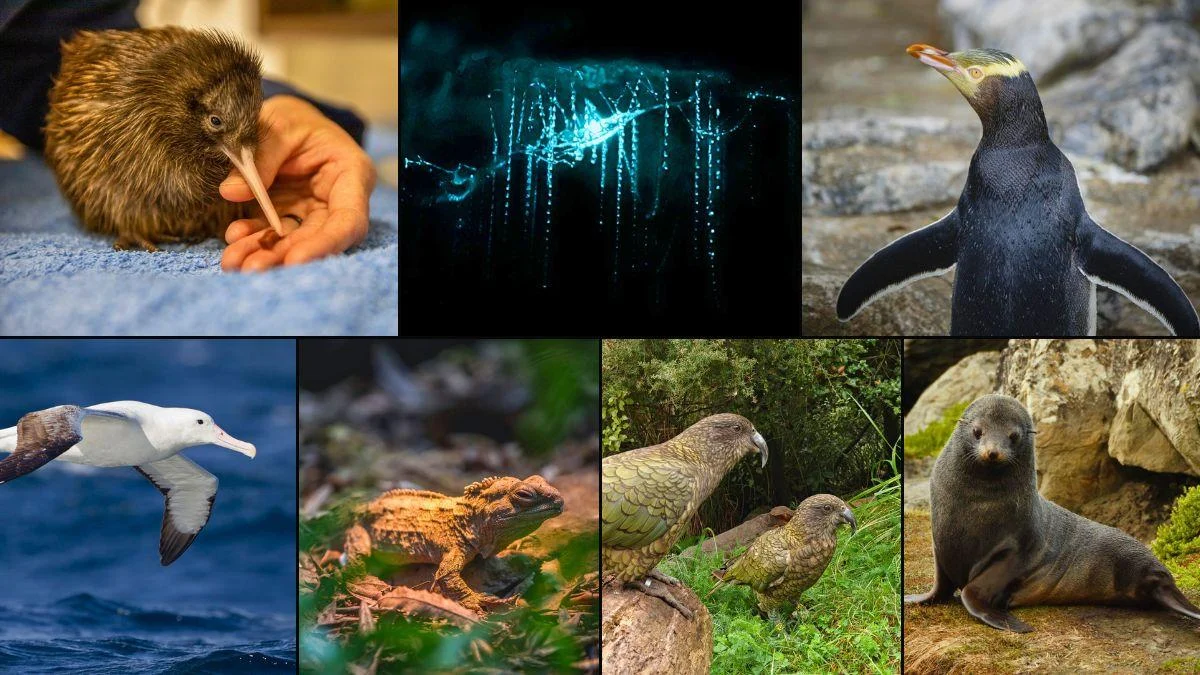
- The Kiwi: Once numbering over 12 million, the national icon’s population plummeted to roughly 70,000. Through intensive management, such as "Operation Nest Egg," some species are now seeing a 2% annual growth rate in protected zones.
- Sanctuary Mountain Maungatautari: This site represents one of the world’s largest pest-proof projects. A 47-kilometer high-tech fence surrounds 3,400 hectares of forest, allowing the reintroduction of over 3,000 kiwi and the establishment of a stable population of takahē, a bird once thought to be extinct.
- The Royal Albatross: The colony at Taiaroa Head is the only mainland breeding site for the Northern Royal Albatross in the world. These birds, with wingspans of up to 3 meters, travel an estimated 190,000 kilometers annually, yet they remain vulnerable to plastic pollution and long-line fishing bycatch.
- The Yellow-Eyed Penguin (Hoiho): Recognized as one of the rarest penguins on Earth, the hoiho faces a crisis. In the South Island, breeding numbers have fluctuated dangerously due to avian malaria, rising sea temperatures, and human disturbance, necessitating the specialized rehabilitation clinics operated by groups like The OPERA.
Official Responses: Conservation as Cultural Reclamation
The modern conservation movement in New Zealand is increasingly defined by the concept of "partnership." This involves a shift away from state-centric management toward a model that integrates Māori traditional knowledge with Western science.

Bodie Tihoi Taylor, a cultural educator and iwi representative at Sanctuary Mountain Maungatautari, emphasizes that conservation is an act of historical consequence. "For Māori communities, the country’s wildlife is inseparable from the memory of what was already lost," Taylor explains. He points to the concept of kaitiakitanga, or guardianship, as a duty inherited across generations. "There needs to be a balancing between conservation of our modern day and conservation of our ancestral days."

Taylor rejects the notion that ecosystems should be under the exclusive control of any one group, arguing instead for the "eye of the needle"—a traditional proverb about unification. This partnership is visible in the governance of sanctuaries, where iwi groups, government agencies, and private trusts co-manage the land. For many Māori, restoring native species like the tīeke (saddleback) or hihi (stitchbird) is a form of cultural reclamation, reasserting authority over forests and waterways that were historically confiscated during colonial settlement.

In the tourism sector, operators are also taking on the role of educators. At the Spellbound Glowworm Caves in Waitomo, guides emphasize the fragility of the Arachnocampa luminosa, a species found only in New Zealand. The tourism industry here is not just a commercial venture but a funding mechanism for habitat protection. "People are known to fall asleep or cry [inside the caves]," says the operator of Spellbound. "Both are acceptable." This emotional connection is viewed by officials as a critical tool for building global support for New Zealand’s ecological goals.

Implications: The Future of a "Biologically Improbable" Nation
The success or failure of New Zealand’s conservation efforts has implications that reach far beyond its shores. As a global leader in island restoration, the techniques developed here—such as aerial baiting, predator-proof fencing, and community-based species monitoring—are being exported to conservation projects worldwide.

The Economic Integration of Nature
The intersection of conservation and the "Screen Tourism" industry represents a new frontier. With major productions like The Legend of Zelda and Andy Serkis’s The Hunt for Gollum filming in New Zealand’s landscapes, the country’s natural beauty is its greatest economic asset. However, this creates a paradox: the more popular a site becomes, the higher the risk of human disturbance to sensitive species like the hoiho or the Royal Albatross.

Climate Change: The New Predator
While New Zealand has made significant strides in managing terrestrial predators, climate change is emerging as a threat that cannot be fenced out. Rising ocean temperatures are altering the distribution of fish, forcing penguins and albatrosses to travel further for food. Austin Hamilton, a ranger at The OPERA, notes that "pressures from every direction" are pushing breeding numbers downward. The future of New Zealand’s marine wildlife will depend on international cooperation regarding carbon emissions and maritime policy, rather than just local land management.

The Philosophical Shift
Perhaps the most profound implication of New Zealand’s journey is the shift in how a society views its environment. In Aotearoa, the "absence" of extinct species like the moa is as palpable as the "presence" of the surviving kiwi. This collective memory of loss serves as a powerful motivator. The goal is no longer just to prevent the next extinction but to rebuild "unnervingly alive" forests where the sound of the kākā and the korimako (bellbird) is the norm rather than the exception.

As the country moves toward its 2050 goal, the lesson of New Zealand remains clear: evolutionary isolation created a biological treasure, but it also created a vulnerability that requires eternal vigilance. The fight to keep Aotearoa alive is not just about saving birds; it is about honoring a history of isolation and ensuring that the next generation does not inherit a world where native wildlife exists only as bones in a museum.
