

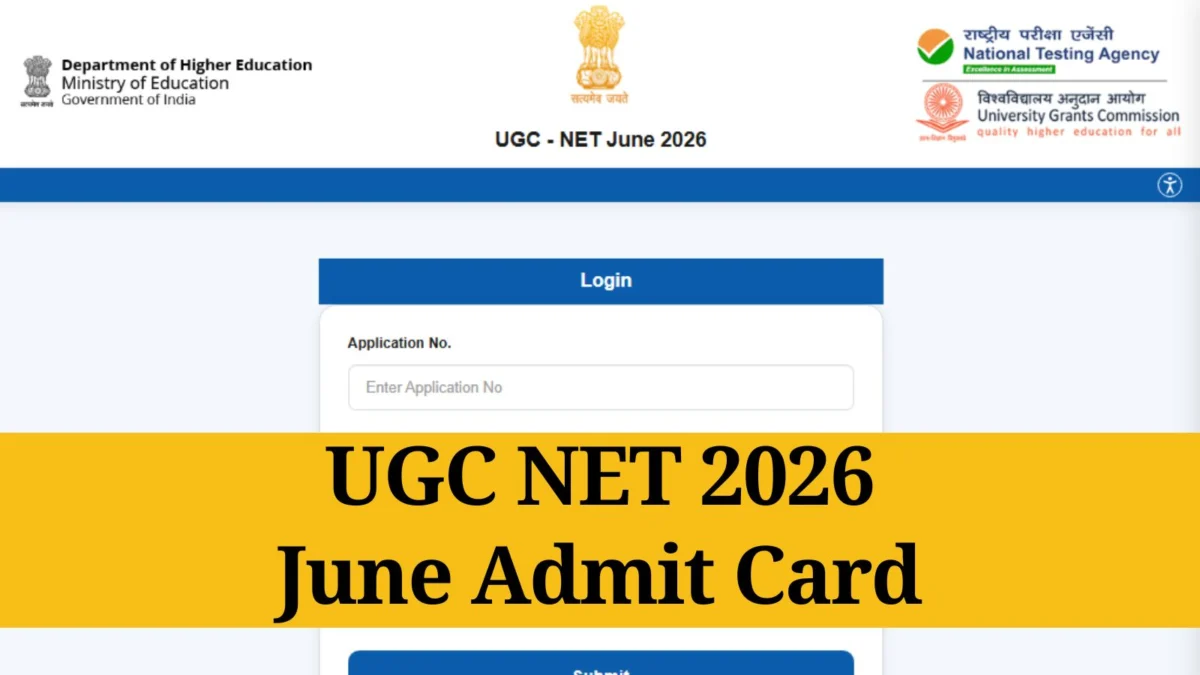
New Delhi: The anticipation is palpable among thousands of aspiring candidates as the National Testing Agency (NTA) is poised to release the much-awaited admit cards for the University Grants Commission – National Eligibility Test (UGC-NET) June 2026 session. The official release is expected by the end of next week, marking a significant milestone in the examination process. This crucial document will grant eligible candidates access to their respective examination centers for the national-level test, a prerequisite for aspiring university lecturers and Junior Research Fellows (JRF) across India.
The UGC NET 2026 examination is scheduled to commence on June 22, 2026, and will continue until June 30, 2026. This multi-day examination schedule underscores the sheer scale of the undertaking, with the NTA meticulously managing the logistics for a vast pool of candidates. Once released, candidates can download their hall tickets from the official NTA UGC NET website, accessible at ugcnet.nta.nic.in.
Prior to the release of the admit cards, the NTA had thoughtfully issued a city intimation slip. This preliminary step was designed to provide candidates with advance notification of their allocated examination city, thereby facilitating timely travel and accommodation arrangements. This proactive measure aims to alleviate last-minute logistical challenges and ensure a smoother experience for all participants. The city slip, like the admit card, is available for download on the official NTA UGC NET portal.
Decoding the Admit Card: A Gateway to Examination Success
The UGC NET admit card is far more than just an entry pass; it is a comprehensive document containing vital information critical for the examination day. Each admit card will bear the candidate’s full name, unique roll number, the specific shift in which their examination is scheduled, the precise date and time of the test, and the designated examination city. Furthermore, it will clearly state the discipline or subject for which the candidate has applied, along with essential exam day guidelines and instructions.
Candidates are strongly advised to meticulously review all details printed on their admit cards. Any discrepancies or errors should be reported to the NTA immediately through the designated channels. It is also highly recommended that candidates familiarize themselves with the location of their examination center. Visiting the center a day prior to the examination, if feasible, can significantly reduce pre-exam anxiety and ensure punctuality on the crucial day.
The NTA has reiterated that entry into the examination center will be strictly prohibited without a duly completed admit card and a valid photo identification proof. This measure is in place to maintain the integrity and security of the examination process. Acceptable forms of photo ID typically include Aadhaar card, Voter ID, Passport, Driving License, or any other government-issued identification that bears the candidate’s photograph and date of birth.
The UGC NET Examination: Format, Structure, and Scoring
The UGC NET is conducted annually in a Computer-Based Test (CBT) format, a testament to the NTA’s commitment to modernizing examination procedures. The examination is designed to assess the teaching and research aptitude of candidates, as well as their subject-specific knowledge. It comprises two papers, both administered in a single session with no breaks in between.
Paper 1: The General Aptitude Test
Paper 1 serves as the General Paper and is designed to evaluate a candidate’s teaching and research aptitude. This paper consists of 50 multiple-choice questions (MCQs), each carrying two marks, totaling 100 marks. The syllabus for Paper 1 typically covers areas such as Teaching Aptitude, Research Aptitude, Comprehension, Communication, Reasoning (Mathematical and Logical), Data Interpretation, Information and Communication Technology (ICT), People, Development and Environment, and Higher Education System. The aim is to assess a candidate’s foundational understanding of pedagogy, research methodologies, and general awareness relevant to academia.
Paper 2: The Subject-Specific Test
Paper 2 is domain-specific and directly tests the candidate’s mastery of the subject they have opted for. This paper features 100 MCQs, with each question carrying two marks, culminating in a total of 200 marks. The syllabus for Paper 2 varies widely, covering a diverse range of subjects from Humanities and Social Sciences to Sciences and Commerce. This paper is crucial for identifying candidates with in-depth knowledge and expertise in their chosen field, a key requirement for university-level teaching and research.
Key Examination Parameters:
- Mode of Examination: Computer-Based Test (CBT)
- Duration: Three hours (180 minutes)
- Number of Papers: Two (Paper 1 and Paper 2)
- Medium of Examination: English and Hindi (except for language-specific papers where the medium will be the language itself).
- Total Marks: 300 (100 marks for Paper 1 and 200 marks for Paper 2)
- Marking Scheme: Each correct answer carries 2 marks.
- Negative Marking: There is no negative marking for incorrect answers in the UGC NET examination. This encourages candidates to attempt all questions, as there is no penalty for guessing.
The absence of negative marking is a significant aspect of the UGC NET, allowing candidates to maximize their potential score by attempting every question. This strategy can be particularly beneficial for candidates who are borderline on certain topics, as a well-reasoned guess might still lead to marks.
Chronology of the UGC NET June 2026 Process
The UGC NET 2026 June session has followed a structured timeline, designed for transparency and efficiency:
- Application Period: The application window for the UGC NET June 2026 session typically opens several months prior to the examination. Candidates had ample time to register and submit their applications online.
- Application Correction Window: Following the application submission, a correction window is usually provided for candidates to rectify any errors in their application forms.
- Release of City Intimation Slip: This is a recent addition to the NTA’s examination process, aimed at helping candidates plan their travel and accommodation well in advance. The city intimation slip for the June 2026 session has already been released.
- Release of Admit Cards: The admit cards, containing the final examination center details and other critical information, are expected to be released by the end of next week.
- Examination Dates: The UGC NET 2026 examination is scheduled to be conducted from June 22 to June 30, 2026.
- Answer Key and Result Declaration: Post-examination, the NTA will release a provisional answer key, followed by a window for candidates to raise objections. After considering the objections, the final answer key and the results will be declared.
This phased approach ensures that candidates are kept informed at every stage of the examination process, allowing them to prepare adequately and manage their logistics effectively.
Supporting Data and Significance of UGC NET
The UGC NET is a cornerstone of the Indian higher education system. It serves as the benchmark for determining the eligibility of candidates for Assistant Professor positions in Indian universities and colleges, as well as for the award of Junior Research Fellowships (JRF). The JRF is a prestigious fellowship that provides financial support to doctoral candidates pursuing research in their chosen fields.
Each year, lakhs of candidates appear for the UGC NET, aspiring to secure a position in academia or pursue advanced research. The competition is intense, reflecting the high demand for qualified educators and researchers in the country. The examination’s rigor ensures that only the most competent individuals are recognized, thereby upholding the quality of higher education in India.
The data from previous UGC NET examinations consistently shows a high volume of registrations, underscoring the test’s importance. For instance, in recent years, the number of applicants has often crossed the ten lakh mark, highlighting the aspirations of a vast segment of Indian youth towards academic careers. This massive participation also presents a significant logistical challenge for the NTA, requiring robust infrastructure and meticulous planning.
The subjects covered in UGC NET are extensive, encompassing virtually all disciplines offered in higher education. This breadth ensures that the examination caters to a wide spectrum of academic pursuits and prepares a diverse pool of talent for the nation’s educational institutions.
Official Responses and Candidate Support
The National Testing Agency (NTA) has consistently emphasized its commitment to conducting fair, transparent, and efficient examinations. The release of the city intimation slip prior to the admit card is a direct reflection of this commitment, aiming to enhance the candidate experience.
In case of any queries or issues related to the admit card, application process, or examination, candidates are advised to refer to the official website of the NTA UGC NET. The website usually features a comprehensive FAQ section and contact details for the NTA help desk. Timely communication and prompt resolution of candidate grievances are crucial for maintaining trust and ensuring a smooth examination process.
The NTA has also been leveraging digital platforms to disseminate information and provide updates. Social media channels and official press releases are often used to inform candidates about important dates, schedule changes, and other relevant announcements. This multi-channel communication strategy ensures that information reaches a wider audience effectively.
Implications for Future Academics and Research
The successful completion of the UGC NET 2026 examination will have profound implications for the future of Indian higher education. Candidates who qualify will be equipped to take on roles that are vital for shaping young minds and advancing knowledge.
For those aspiring to become Assistant Professors, qualifying the UGC NET is the first major step towards a fulfilling academic career. They will contribute to teaching, research, and the overall intellectual development of students in universities and colleges across the country. Their expertise and dedication will be instrumental in nurturing the next generation of scholars and professionals.
For Junior Research Fellowship (JRF) awardees, the UGC NET opens doors to pursue doctoral research, a critical component of academic advancement and innovation. The financial support provided by the JRF fellowship allows these individuals to dedicate their time and energy to groundbreaking research, contributing to the body of knowledge in their respective fields and addressing societal challenges through academic inquiry.
The UGC NET, therefore, plays a pivotal role in maintaining and elevating the standards of higher education and research in India. The successful conduct of the June 2026 session, marked by the timely release of admit cards and a well-structured examination process, is crucial for the continued growth and development of the academic landscape in the nation. As the examination date draws closer, candidates are urged to stay vigilant, meticulously prepare, and ensure they have all necessary documents and information ready for the upcoming tests.
