

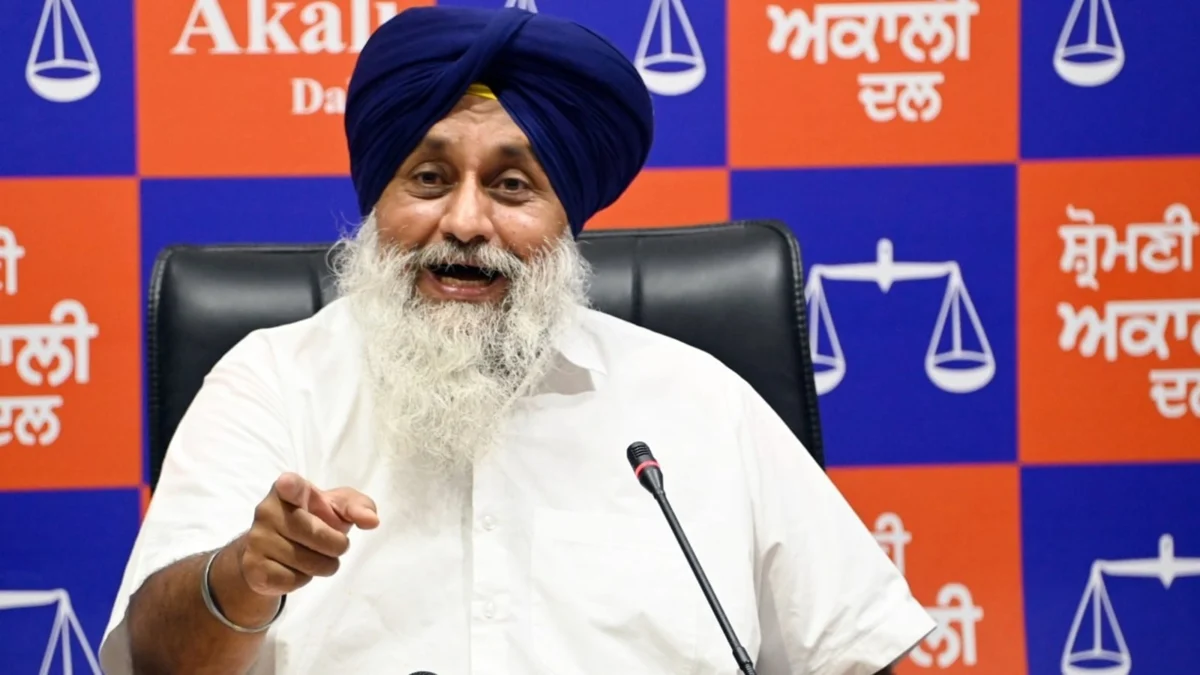
Chandigarh, Punjab – More than a decade after the traumatic events of 2015, the sacrilege controversy and the subsequent police firing at Behbal Kalan in Faridkot district have once again seized the political imagination of Punjab. A recent statement by Giani Raghbir Singh, former Jathedar of the Akal Takht, to a Special Investigation Team (SIT) has plunged the state into a fresh vortex of political accusations, religious debates, and renewed calls for justice, setting the stage for what promises to be a turbulent run-up to the 2027 Assembly elections.
The statement, recorded on June 10, has brought to the fore claims that Shiromani Akali Dal (SAD) chief Sukhbir Singh Badal had, during past Akal Takht proceedings, accepted responsibility for the sacrilege incidents and the police firing that occurred under the SAD-BJP government’s tenure. This alleged admission, which Giani Raghbir Singh reportedly stated was made publicly and recorded, formed the basis for the Akal Takht – the highest temporal seat of the Sikhs – to impose religious punishment on Badal and other senior Akali leaders, declaring them unfit to lead the Sikh community.
The development has not only reopened old wounds that profoundly shaped Punjab’s electoral landscape in 2017 and resonated deeply in 2022 but has also ignited a fierce debate within Sikh circles regarding the sanctity of religious proceedings and the ethical implications of using such admissions in temporal legal investigations. As the dust settles from the recent Lok Sabha elections, the sacrilege issue has re-emerged with potent force, further complicated by swirling rumours of a potential SAD-BJP alliance renewal, despite public denials from both parties.
Main Facts: A Resurgent Controversy
The core of the renewed controversy lies in the statement made by Giani Raghbir Singh, a former custodian of the Akal Takht, before the Special Investigation Team (SIT) probing the 2015 Behbal Kalan police firing case. On June 10, Giani Raghbir Singh reportedly informed investigators that during the Akal Takht’s own proceedings, Sukhbir Singh Badal had taken ownership of the sacrilege incidents and the subsequent police action during his party’s rule. This admission, according to Giani Raghbir Singh, was not only public, witnessed by the ‘sangat’ (congregation) and media, but also captured on video. It reportedly served as a crucial factor in the Akal Takht’s decision to impose religious punishment on Badal and other senior Akali leaders, branding them as unsuitable to lead the Sikh community.
The timing and content of this statement have had an immediate and electrifying effect across Punjab. Politically, it has provided fresh ammunition to the ruling Aam Aadmi Party (AAP), which has consistently leveraged the sacrilege issue against the Akalis. Religiously, it has sparked a heated discussion on ‘maryada’ (the code of conduct followed by Sikhs) and the independence of the Akal Takht, with several prominent Sikh leaders questioning the propriety of using religious proceedings as evidence in secular legal investigations.
The Behbal Kalan incident, where two anti-sacrilege protesters were killed in police firing on October 14, 2015, following the alleged desecration of the Sri Guru Granth Sahib in Bargari, remains one of the most politically charged episodes in Punjab’s recent history. Its revival through Giani Raghbir Singh’s statement ensures that the quest for justice and accountability for the 2015 events will continue to dominate public discourse, influencing political alliances, electoral strategies, and the very fabric of Sikh institutional authority in the state.
Chronology: A Decade of Unresolved Trauma
The Behbal Kalan sacrilege and firing case is not an isolated incident but a complex narrative spanning over a decade, marked by profound religious hurt, political upheaval, and a lingering demand for justice.
The Genesis of a Crisis: October 2015
The tragic chain of events began with the theft of a ‘bir’ (copy) of the holy Sri Guru Granth Sahib from a gurdwara in Burj Jawahar Singh Wala village in Faridkot district in June 2015. This was followed by the discovery of torn pages of the holy scripture strewn across Bargari village in October 2015. These acts of sacrilege ignited widespread outrage across Punjab, leading to massive protests. On October 14, 2015, during one such demonstration against the desecration, police opened fire on peaceful protesters at Behbal Kalan village, resulting in the deaths of two Sikh men, Krishan Bhagwan Singh and Gurjeet Singh. Several others were injured. This incident, occurring under the SAD-BJP government, cemented itself as a deep wound in the collective Sikh consciousness.
Initial Political Fallout: The 2017 Assembly Elections
The sacrilege and subsequent police firing became the defining political narrative leading up to the 2017 Punjab Assembly elections. The SAD-BJP alliance, which had been in power for a decade, faced a massive wave of anti-incumbency fueled by public anger over the Behbal Kalan events and the perceived failure to deliver justice. The issue contributed significantly to the alliance’s resounding defeat, paving the way for the Congress party to form the government under Captain Amarinder Singh. The promise of justice in the sacrilege cases was a key electoral pledge for the incoming government.
The Akal Takht’s Intervention: Past Proceedings
Amidst the public outcry and political turmoil, the Akal Takht, the supreme temporal authority of the Sikhs, initiated its own proceedings. While the original article mentions "December 2024," this is clearly a future date and is presumed to be a typographical error. It is understood that these significant proceedings, where Sukhbir Singh Badal allegedly made his admission, would have taken place in late 2015 or early 2016, following the sacrilege incidents. During these proceedings, the Akal Takht imposed ‘tankhah’ (religious punishment) on Badal and other senior Akali leaders, citing their perceived failure to protect the sanctity of the Sri Guru Granth Sahib and prevent the police firing. This religious decree was a powerful indictment from within the Sikh faith, questioning their moral authority to lead the community.
Ongoing Investigations and Political Promises: 2022 and Beyond
Despite promises from successive governments, the investigations into the sacrilege and firing cases have been protracted and controversial. Multiple SITs were formed, but progress was often seen as slow or politically influenced, further fueling public frustration. The issue remained a prominent factor in the 2022 Assembly elections, with the Aam Aadmi Party (AAP) making a strong commitment to bringing the culprits to justice. The AAP’s landslide victory was, in part, attributed to its ability to tap into the public’s deep-seated desire for closure on these cases.
Legislative Action: The Jagat Jot Sri Guru Granth Sahib Satkar Amendment Act (April 2024)
Earlier this year, in a significant legislative move, the Punjab Assembly unanimously passed the Jagat Jot Sri Guru Granth Sahib Satkar Amendment Act on April 13, 2024. This legislation proposes stricter punishment for sacrilege-related offences, reflecting the government’s stated commitment to protecting the sanctity of the holy scripture. The Act, signed by the Governor and implemented in April, was projected by the AAP government as a major step towards ensuring justice and preventing future incidents.
The Latest Development: Giani Raghbir Singh’s June 2024 Statement
The decade-long narrative culminated in the recent statement by Giani Raghbir Singh to the SIT on June 10, 2024. His testimony, claiming Sukhbir Badal’s past admission of responsibility before the Akal Takht, has injected new life into the investigation and reignited the political and religious debate, ensuring that the sacrilege issue remains at the forefront of Punjab’s consciousness.
Supporting Data: The Enduring Weight of History and Faith
The enduring relevance of the Behbal Kalan controversy stems from a confluence of historical, religious, and political factors unique to Punjab. Understanding these underlying currents is crucial to grasping the magnitude of the current developments.
The Sanctity of Sri Guru Granth Sahib
At the heart of the issue is the profound reverence Sikhs hold for the Sri Guru Granth Sahib, considered a living Guru. Any act of sacrilege (known as ‘beadbi’) is viewed not merely as a criminal offense but as an egregious assault on the faith itself, causing deep emotional and spiritual anguish among the community. This reverence elevates the issue far beyond typical political discourse, embedding it within the collective Sikh identity and sense of honour.
The Authority of Akal Takht
The Akal Takht in Amritsar is not just a spiritual seat but the highest temporal authority for Sikhs worldwide. Its pronouncements, or ‘hukamnamas’, carry immense weight and are binding on the Sikh community. The Akal Takht’s decision to impose religious punishment on Sukhbir Singh Badal and other Akali leaders for their perceived failings in the sacrilege cases was an unprecedented move, significantly diminishing their standing within the Sikh faith and, by extension, their political legitimacy. The current debate over whether Akal Takht proceedings can be used as evidence in secular courts touches upon the very independence and sanctity of this revered institution.
Political Ramifications: A Decisive Electoral Factor
The sacrilege issue has demonstrably altered the political landscape of Punjab.
- 2017 Assembly Elections: The issue was a primary catalyst for the SAD-BJP alliance’s historic defeat. The traditional Sikh vote bank, long loyal to the Akalis, fractured significantly due to widespread disillusionment over the handling of the sacrilege and firing incidents.
- 2022 Assembly Elections: The issue continued to be a potent electoral weapon. The Aam Aadmi Party (AAP) successfully capitalized on public frustration over the delayed justice, promising swift action. This promise resonated deeply with voters and was a key factor in their overwhelming victory.
- 2027 Outlook: With Giani Raghbir Singh’s statement, the issue is poised to remain a dominant force in the upcoming 2027 Assembly elections, ensuring that any party perceived as having failed to deliver justice will face severe electoral consequences.
The Role of the Special Investigation Team (SIT)
The SIT probing the Behbal Kalan police firing case is tasked with investigating the circumstances leading to the deaths of the two protesters and identifying those responsible. Giani Raghbir Singh’s statement, particularly the claim of a public and video-recorded admission by Sukhbir Badal, adds a new, potentially crucial, dimension to the SIT’s evidence gathering. The outcome of this investigation is keenly awaited by the victims’ families and the wider Sikh community, who seek definitive legal accountability.
Speculation on SAD-BJP Alliance
The resurgence of the sacrilege controversy comes amidst unconfirmed reports of "backdoor talks" between the Sukhbir Badal-led SAD and the BJP to renew their alliance, which broke down in 2020 over the now-repealed farm laws. While both parties have publicly denied these talks, the timing of Giani Raghbir Singh’s statement serves as a stark reminder of the baggage the SAD carries. Any renewed alliance would inevitably force the BJP to contend with the Akalis’ historical liabilities, particularly an issue as emotionally charged as the sacrilege, potentially complicating their political calculations in Punjab.
Public Sentiment and the Demand for Justice
For over a decade, the demand for justice in the sacrilege and firing cases has remained a burning issue in Punjab. The memory of the desecrated holy scripture and the loss of innocent lives at Behbal Kalan has fostered a deep sense of betrayal and a yearning for accountability. This public sentiment ensures that the issue cannot be easily swept under the rug and will continue to exert significant pressure on political parties and the judicial system alike.
Official Responses: A Flurry of Accusations and Defences
The reverberations of Giani Raghbir Singh’s statement have triggered a wave of reactions from all corners of Punjab’s political and religious spectrum, leading to a complex interplay of accusations, denials, and counter-allegations.
Giani Raghbir Singh’s Stance
In his statement to the SIT, Giani Raghbir Singh reportedly asserted that Sukhbir Singh Badal’s admission of responsibility for the sacrilege incidents and the police firing was a public event, witnessed by the ‘sangat’ and media, and captured on video. He maintained that this admission was a fundamental reason behind the Akal Takht’s decision to impose religious punishment on the SAD leadership. His appearance before the SIT suggests a belief that temporal justice must complement religious pronouncements, potentially setting a precedent for future interactions between Sikh institutions and the state’s legal framework.
Sukhbir Badal and SAD’s Counter-Narrative
Sukhbir Singh Badal, the SAD chief, vehemently denied the implications of Giani Raghbir Singh’s statement. While acknowledging that he had taken "ownership" as party president for "whatever happened during the tenure of our government, whether it was done by our worker or any employee or anyone else," he framed this as a general acceptance of political responsibility, not an admission of culpability in the sacrilege or firing. He accused Giani Raghbir Singh of becoming an "active AAP worker" and part of a "fresh effort… to implicate him in a false case." Badal declared his fearlessness of legal action or imprisonment, projecting defiance in the face of what he termed political vendetta.
Senior SAD leader Daljeet Singh Cheema went further, accusing Giani Raghbir Singh of violating a sacred ‘hukamnama’ (divine edict) issued by former Jathedar Giani Joginder Singh Vedanti. This edict, Cheema claimed, explicitly prohibited the use of Akal Takht proceedings as evidence in court-related cases, demanding strict adherence from the Sikh ‘sangat’. Cheema lambasted Giani Raghbir Singh’s appearance before the SIT as "highly condemnable" and alleged that the former Jathedar had become a "stooge" of the AAP government, thereby compromising the sanctity and independence of the Akal Takht.
Sikh Clergy and Leaders’ Reactions
The controversy has also splintered opinion within the Sikh clergy, leading to a parallel debate on ‘maryada’ and institutional integrity.
- Giani Harpreet Singh: The former acting Akal Takht Jathedar, now president of the rebel Akali faction SAD (Punar Surjit), stated that Akal Takht proceedings are "a part of our religious code and principles… and cannot be a part of the evidence." As someone present during the December 2015/early 2016 proceedings, his stance highlights the traditional view that religious confessions and punishments are distinct from secular legal processes.
- Giani Ranjit Singh Gohar-e-Maskeen: The former Jathedar of Takht Sri Patna Sahib echoed similar sentiments, accusing Giani Raghbir Singh of violating Sikh maryada. He condemned the act of "incorporating the proceedings of the Akal Takht into police records," arguing that such actions fundamentally challenge the sanctity and independence of the revered institution.
Aam Aadmi Party’s Position
The ruling Aam Aadmi Party has swiftly moved to capitalize on the latest developments. Party national convener Arvind Kejriwal has consistently referred to the SAD as a "beadbi (sacrilege) party" during public meetings, reinforcing the narrative of Akali culpability. Punjab AAP media in-charge Baltej Pannu explicitly stated that the latest revelations had "exposed attempts by the Akali leadership to evade accountability." Pannu further claimed that Badal had indeed accepted responsibility for the Behbal Kalan firing and sought forgiveness before the Akal Takht, asserting that a video recording of this alleged admission was preserved with the Akal Takht. He accused SAD leaders of publicly contradicting their earlier admissions made before the highest temporal authority of the Sikhs, reiterating that "Punjab has not forgotten the firing incidents, the sacrilege cases, and the role played by the then Akali-BJP government."
BJP’s Stance
Given the ongoing speculation about a potential alliance with the SAD, the BJP has largely maintained a strategic silence on the issue. Any direct comment would be fraught with political risk, potentially alienating their potential ally or exposing them to criticism for associating with a party burdened by such a sensitive controversy. Their quiet observation underscores the delicate political tightrope walk currently underway in Punjab.
Implications: A Confluence of Political, Religious, and Legal Challenges
The latest developments in the Behbal Kalan sacrilege and police firing case carry profound and multifaceted implications for Punjab’s political landscape, religious institutions, and the broader quest for justice.
Political Ramifications
- For the Shiromani Akali Dal (SAD): The resurgence of the sacrilege issue poses an existential threat to the SAD. Already struggling to regain its traditional support base after significant electoral defeats, these fresh allegations further erode its credibility among the Sikh community. The tag of a "beadbi party" could become indelible, making any political resurgence extremely challenging. Moreover, the controversy complicates any potential alliance with the BJP, as the national party would be hesitant to align with a partner facing such severe moral and legal accusations, especially in a state where religious sentiments run deep.
- For the Aam Aadmi Party (AAP): The AAP stands to gain significantly. By consistently keeping the sacrilege issue alive and capitalizing on new revelations, the party can reinforce its image as the harbinger of justice and accountability. This narrative allows them to paint the Akalis as corrupt and religiously insensitive, consolidating their position ahead of the 2027 Assembly elections and potentially swaying undecided voters.
- For Punjab Politics: The issue ensures continued polarization along political and religious lines. It will likely dominate political discourse, diverting attention from other pressing developmental issues. Parties will be forced to take clear stances on the sacrilege, making electoral contests highly charged and emotionally driven.
Religious and Legal Dilemmas
- Clash between Temporal Justice and Religious Sanctity: Giani Raghbir Singh’s statement highlights a fundamental tension between the pursuit of justice in a secular legal system and the sanctity and independence of religious institutions like the Akal Takht. The debate over whether proceedings and admissions made within the sacred confines of the Akal Takht can be used as evidence in police investigations raises critical questions about Sikh ‘maryada’ and the potential for external interference in religious affairs.
- Precedent for Akal Takht Proceedings: The outcome of this debate could set a significant precedent for how future Akal Takht proceedings are viewed and whether they can be subjected to external scrutiny. It forces a re-evaluation of the boundaries between temporal and spiritual authority within the Sikh faith.
- Impact on SIT Investigation: Giani Raghbir Singh’s testimony, particularly the claim of a video recording, could provide a substantial boost to the SIT’s investigation. If corroborated, it could strengthen the case against those accused and potentially lead to charges against senior political figures. Conversely, if the alleged video evidence is deemed inadmissible or non-existent, it could weaken the case and further prolong the pursuit of justice.
Public Trust and Justice
- Desire for Closure: For the families of the victims and the wider Sikh community, the unresolved nature of the sacrilege and firing cases remains a source of deep pain and anger. The current developments offer a glimmer of hope for closure and accountability, reinforcing the demand for justice that has lingered for over a decade.
- Erosion of Trust: The protracted investigations and the political wrangling surrounding the issue have significantly eroded public trust in political institutions and the justice system. A decisive and fair resolution is crucial to restoring faith in governance and upholding the rule of law in Punjab.
- Long-term Societal Impact: The sacrilege controversy has left an indelible scar on Punjab’s social fabric. Its continued prominence reflects the profound impact of religious hurt and political betrayal, shaping inter-community relations and the state’s collective memory.
The Road Ahead
The coming months are expected to witness intense political maneuvering, legal battles, and religious discourse. The SIT’s progress, the admissibility of Giani Raghbir Singh’s statement, the fate of the alleged video evidence, and the responses from various political and religious stakeholders will all contribute to an evolving narrative. The Behbal Kalan issue, far from fading, is set to be a defining factor in Punjab’s political and social trajectory, leading up to the 2027 Assembly elections and beyond, as the quest for justice continues to seek its ultimate conclusion.
