

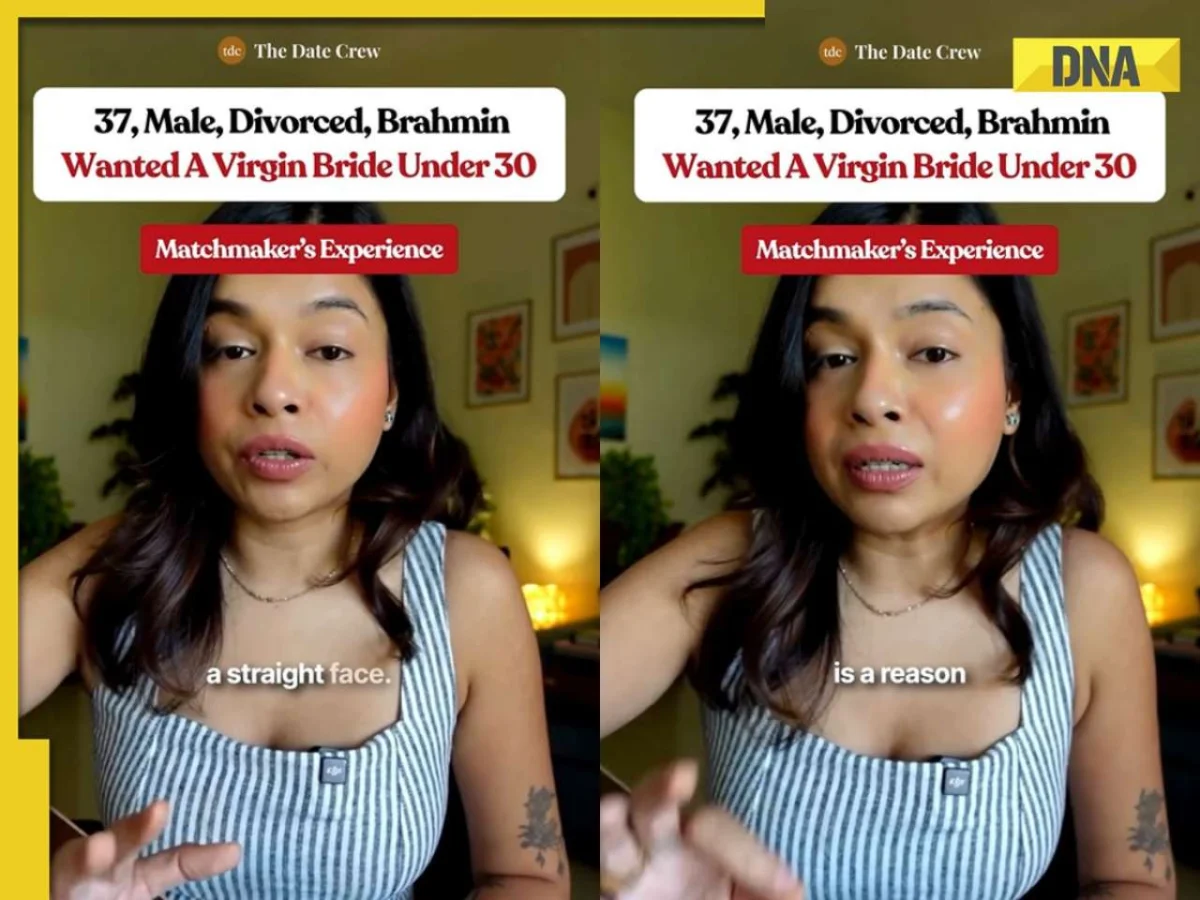
New Delhi, India – April 25, 2026 – A viral social media post by renowned matchmaker and dating coach Oendrila Kapoor has ignited a firestorm of debate, exposing deeply entrenched societal expectations and a stark double standard within the realm of modern Indian matrimony. The catalyst for this widespread discussion is the extraordinary set of demands made by a 37-year-old divorced, IIT-educated professional seeking a bride. His stringent criteria – a woman under 30, from the Brahmin community, with no prior romantic entanglements or sexual history – have been widely condemned as hypocritical, outdated, and indicative of a controlling mindset.
Kapoor, known for her insightful commentary on relationships and matchmaking, shared the details of her interaction with the client, a successful director at a billion-dollar company, on her social media platforms. The post, which quickly gained significant traction, laid bare the man’s non-negotiable stipulations, prompting a torrent of criticism and a broader conversation about fairness, gender roles, and the evolving landscape of arranged marriages in contemporary India.
)
The Unyielding Demands: A Portrait of Contradiction
The core of the controversy lies in the stark contrast between the client’s own marital status and his expectations for a potential partner. At 37, the man is a divorcee, a fact he seemingly overlooks when setting his stringent requirements for a bride. According to Kapoor’s account, he explicitly sought a woman who is:

- Under the age of 30: This places a significant age gap expectation, implying a desire for youth and perceived innocence.
- From the Brahmin community: This points to a preference rooted in traditional caste hierarchies, a factor that continues to hold sway in many arranged marriage scenarios.
- With no prior romantic relationships: This demand suggests an aversion to partners who have prior dating experience, projecting a desire for a "clean slate."
- With no past sexual history: This is perhaps the most contentious demand, reflecting a desire for a virgin bride, a notion increasingly challenged in modern society.
Kapoor, in her post, highlighted the rigidity of these expectations, noting that the client appeared unwilling to compromise on any of these points. This inflexibility, especially coming from a divorced individual, immediately raised red flags and drew sharp criticism.
)
Justifications and the "Man’s Logic": A Deep Dive into Bias
When challenged by Kapoor on the perceived hypocrisy of his demands, the client offered justifications that only served to amplify the outrage. He reportedly invoked unsubstantiated "research" to support his assertion that women with multiple past relationships are more prone to infidelity. This claim, lacking any empirical backing or specific citation, was met with skepticism and accusations of selective reasoning.
)
The pivotal moment of the exchange, as recounted by Kapoor, occurred when she posed the logical question: shouldn’t the same logic apply to him, given his own divorce? His response was dismissive and revealing. He reportedly stated that his situation was not equivalent, and when pressed further, articulated a sentiment that has become the focal point of much of the online backlash: "Because I am a man."
)
This assertion, "Because I am a man," encapsulates a deeply ingrained patriarchal mindset that allows men to be judged by a different, more lenient standard than women, particularly concerning their past relationships and marital history. It highlights a societal double standard where male experience, including divorce, is seen as a stepping stone or a learning experience, while female experience, especially in the realm of relationships, is often viewed with suspicion and as a potential detractor.
)
The Matchmaker’s Stance: Upholding Principles Over Profit
Oendrila Kapoor’s decision to refuse the client as a potential candidate speaks volumes about her professional ethics and her commitment to fostering healthy relationships. She articulated that the man’s mindset was not one of seeking compatibility but rather of control. His expectations, she argued, were not only unrealistic but also rooted in bias and a desire to dictate terms rather than build a partnership.
)
Kapoor further elaborated on the potential challenges a woman meeting his criteria might face. She suggested that a woman adhering to such stringent traditional norms would likely be from a very conservative background. It is highly improbable, she posited, that such an individual would be amenable to marrying a divorced man, especially one who exhibits such rigid and controlling expectations about her past. This highlights the inherent contradiction in the client’s search – he seeks a woman from a traditional background while himself not adhering to the traditional expectations of a bachelor.
)
The Social Media Avalanche: A Chorus of Condemnation
The aftermath of Kapoor’s post saw an immediate and overwhelming surge of public reaction across social media platforms. The narrative quickly coalesced around themes of hypocrisy, double standards, and the archaic nature of the client’s demands.
)
- Outrage over Hypocrisy: A significant portion of the comments focused on the sheer irony of a divorced man demanding a virgin bride. Users pointed out the blatant hypocrisy, questioning his right to impose such stringent criteria when he himself has experienced marital failure. Phrases like "audacity," "shameless," and "unbelievable" peppered the comment sections.
- Critique of Double Standards: The "Because I am a man" justification became a rallying cry for many, highlighting the pervasive gender inequality in societal perceptions of relationships and sexual history. Commenters argued that society often penalizes women for experiences that men are either expected to have or are excused for.
- Calls for Modernization: Many users expressed frustration with the persistence of such outdated beliefs in a rapidly modernizing India. They called for a shift in perspective, emphasizing that compatibility, mutual respect, and emotional connection should be the primary drivers of marriage, not virginity or a spotless romantic past.
- Shared Experiences: The post resonated deeply with many who have encountered similar expectations during their own matchmaking journeys or those of their acquaintances. Numerous users shared anecdotal evidence of men and their families demanding similar criteria, often from women who are themselves divorced or have had prior relationships.
- Concerns about Control and Patriarchy: The client’s demands were widely interpreted as a manifestation of a controlling and patriarchal mindset. Critics argued that such expectations reflect a desire to possess and control a partner rather than to engage in a partnership based on equality and mutual understanding.
The widespread condemnation underscores a growing societal awareness and intolerance for discriminatory practices in matchmaking. The incident has served as a potent reminder that while India is progressing rapidly in many spheres, certain regressive attitudes towards women and relationships continue to persist, particularly within the context of arranged marriages.
)
Broader Implications: Re-evaluating Societal Norms and the Future of Matchmaking
This viral incident transcends a mere matrimonial dispute; it serves as a microcosm of larger societal conversations and challenges. The demands of the divorced IIT graduate, while extreme in their specificity, are symptomatic of broader issues that need urgent attention:
)
- The Enduring Influence of Caste and Tradition: The emphasis on Brahmin community highlights the continued significance of caste in marriage decisions for a segment of the population. While modernization is chipping away at these barriers, they remain potent factors, often intertwined with notions of purity and status.
- The Evolving Definition of a "Good" Partner: The debate forces a re-evaluation of what constitutes desirable qualities in a life partner. Is it a pristine, unblemished past, or is it maturity, emotional intelligence, a willingness to learn and grow, and the capacity for a genuine partnership? The overwhelming public response suggests a lean towards the latter.
- The Role of Technology in Matrimony: With the proliferation of online matrimonial platforms, the ability to filter and specify preferences has become incredibly granular. While this offers convenience, it also risks reinforcing biases and creating echo chambers of narrow expectations, as potentially seen in this case.
- The Need for Education and Awareness: The incident underscores the ongoing need for education and dialogue around gender equality, healthy relationship dynamics, and the dismantling of patriarchal norms. Empowering individuals, particularly women, to challenge unreasonable expectations and assert their own worth is crucial.
- The Future of Arranged Marriages: While arranged marriages remain a significant institution in India, this incident, and others like it, highlight the need for them to adapt to contemporary values. The focus must shift from superficial criteria to deeper compatibility, mutual respect, and shared life goals. Matchmakers and families involved in the process have a critical role to play in guiding clients towards more realistic and equitable expectations.
The story of the divorced IIT graduate and his "Young Brahmin Virgin" bride demand has resonated far beyond the confines of a single matchmaking request. It has become a potent symbol of the ongoing struggle to reconcile traditional expectations with modern aspirations, and a powerful call for a more equitable and understanding approach to love, relationships, and marriage in India. As Oendrila Kapoor rightly pointed out, true compatibility is built on mutual respect and understanding, not on rigid, self-serving demands that perpetuate outdated biases. The conversation ignited by her post is a crucial step towards fostering such a future.
