

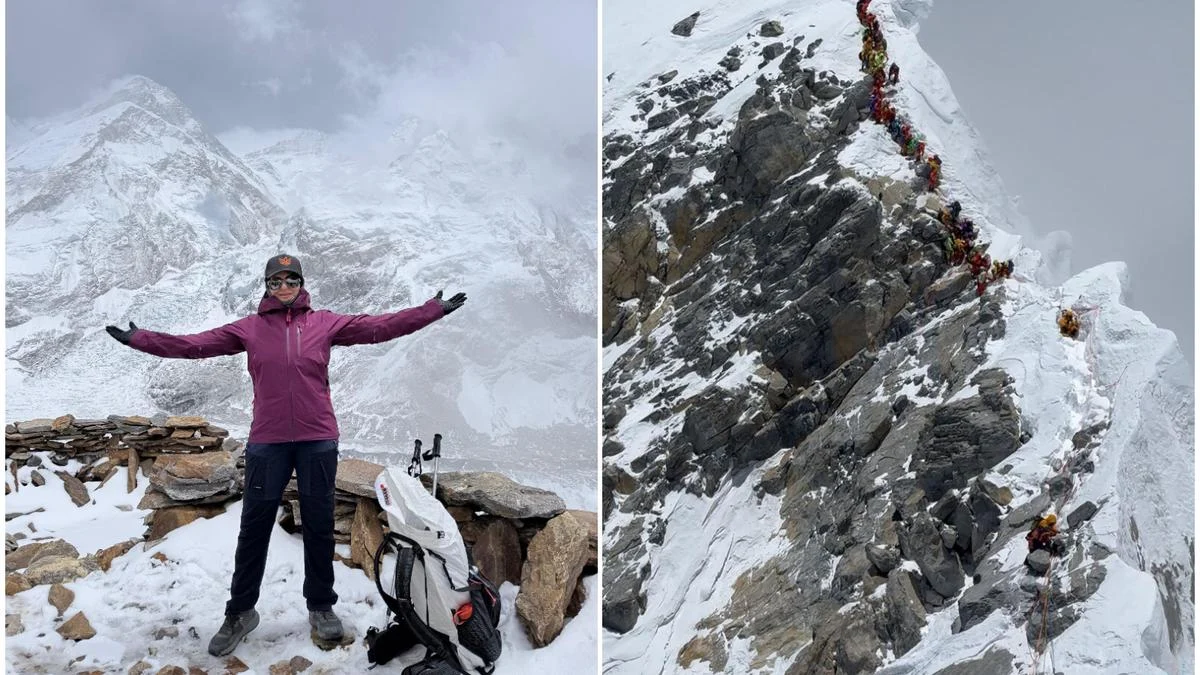
KATHMANDU / CHENNAI – In the rarefied air of the Himalayas, where oxygen is scarce and the margin for error is non-existent, Dr. Priya Selvaraj found something she hadn’t realized she was looking for: a profound sense of stillness. While most know her as a leading figure in the field of reproductive medicine and a pioneer in fertility treatments, Dr. Selvaraj has recently added a new, formidable title to her name—Everest summiteer.
Her journey to the top of the world was not the result of a lifelong obsession with high-altitude mountaineering. Instead, it was a path forged in the crucible of global tragedy and personal grief. What began as a search for a "scenic trek" to escape the claustrophobia of the COVID-19 pandemic evolved into a rigorous, multi-year odyssey that saw her conquer some of the most dangerous peaks on the planet, culminating in a successful ascent of Mount Everest (8,848.86 meters).
Main Facts: A Surgeon’s Quest for the Summit
Dr. Priya Selvaraj’s achievement is a testament to the intersection of physical endurance and mental resilience. Standing atop the world’s highest peak, she joined an elite group of Indian women who have transitioned from professional careers in medicine to high-altitude alpinism.
The core facts of her journey include:
- The Catalyst: The emotional toll of the COVID-19 pandemic and a significant personal loss prompted a search for solitude and perspective.
- The Progression: A rapid escalation from local treks to technical climbs, including Sandakphu Phalut, Kilimanjaro, and Lobuche East.
- The Qualifier: The successful summit of Mt. Manaslu (8,163m), the world’s eighth-highest peak, which served as the technical and physiological prerequisite for Everest.
- The Achievement: A successful summit of Mount Everest, navigating the treacherous Khumbu Icefall and the "Death Zone" above 8,000 meters.
Unlike many who spend decades dreaming of the Himalayas, Dr. Selvaraj’s ascent was a condensed, intense pursuit of healing through altitude. Her story highlights a growing trend of high-achieving professionals seeking "extreme" therapeutic outlets to combat the burnout and emotional fatigue of the modern era.
Chronology: The Road to 8,848 Meters
Dr. Selvaraj’s path to the summit was not a straight line, but a series of escalating challenges that tested her limits at every stage.
2020–2021: The Pandemic and the Search for Refuge
The COVID-19 years were particularly grueling for healthcare professionals. For Dr. Selvaraj, the period was marked by an "emotional upheaval" and a deep personal loss. Seeking a refuge "far from the noise" of the city and the clinical intensity of the hospital, she turned to the mountains. Her initial search was for a culturally significant and scenic trek—a way to breathe again after years of masks and mourning.
2022: The First Steps
Her journey began with the Sandakphu Phalut trek in the Singalila Ridge. While not a technical climb, it offered her a first glimpse of the "Big Four"—Everest, Lhotse, Makalu, and Kanchenjunga. This was followed by the Khopra Ridge in Nepal, which deepened her connection to the Himalayan landscape.
Later that year, she set her sights on Mount Kilimanjaro (5,895m) in Tanzania. As the highest peak in Africa, Kilimanjaro provided a crucial test of her body’s ability to handle altitude. Reaching the "Roof of Africa" served as the primary spark; the mountains were no longer just a refuge, but a challenge she felt compelled to meet.
2023: Technical Mastery and the 8,000-Meter Mark
Realizing that she possessed the physiological capacity for high altitude, Dr. Selvaraj began technical training. She completed the trek to Everest Base Camp (EBC) and successfully summited Lobuche East (6,119m). Lobuche is often used as a training peak for Everest hopefuls because it requires the use of crampons, ropes, and ice axes.
The true turning point came with her expedition to Mt. Manaslu. Known as the "Mountain of the Spirit," Manaslu is one of the world’s fourteen 8,000-meter peaks. Summitting Manaslu is a grueling feat that requires immense technical skill and the ability to survive in the "Death Zone." Her success there was the final validation needed to attempt Everest.
2024–2026: The Everest Summit
Armed with the experience of an 8,000-meter peak, Dr. Selvaraj joined an expedition to Everest. The climb involved weeks of acclimatization rotations, navigating the shifting crevasses of the Khumbu Icefall, and enduring the brutal winds of the South Col. In the final push, she navigated the Hillary Step and stood on the summit, completing a journey that had begun as a simple Google search for a quiet walk.
Supporting Data: The Physical and Logistical Toll
The scale of Dr. Selvaraj’s achievement can be better understood through the lens of the immense physical and logistical requirements of an Everest expedition.
The Physiology of Altitude
At the summit of Everest, the atmospheric pressure is about one-third of that at sea level. This means that for every breath, the body receives only 33% of the oxygen it is accustomed to. For a medical professional like Dr. Selvaraj, the risks—High Altitude Cerebral Edema (HACE) and High Altitude Pulmonary Edema (HAPE)—were not just abstract concepts but clinical realities she had to monitor in herself and her teammates.

Training and Preparation
To prepare for the 8,000-meter peaks, Dr. Selvaraj had to balance her demanding medical practice with a rigorous physical regimen:
- Cardiovascular Training: 15–20 hours of zone 2 and zone 3 heart rate training per week.
- Strength Training: Focusing on core and lower body stability to carry 15kg packs.
- Mental Conditioning: Using meditative techniques to manage the psychological stress of "objective hazards" like avalanches and rockfalls.
The Indian Mountaineering Context
According to data from the Nepal Ministry of Tourism, the number of Indian climbers attempting Everest has seen a 25% increase over the last five years. However, the percentage of these climbers who are self-funded professionals in their 40s or 50s remains small. Dr. Selvaraj’s ascent contributes to a demographic shift in the sport, where mountaineering is increasingly seen as a pursuit for mature, established professionals seeking personal transformation.
Official Responses: Recognition from the Community
The news of Dr. Selvaraj’s summit has been met with acclaim from both the medical and mountaineering fraternities.
The Medical Community:
Colleagues at GG Hospital and across the Indian medical landscape have hailed her as an inspiration. "Dr. Priya has always been a person of immense focus in the operating room," said a senior consultant in Chennai. "To see her translate that focus into the world of mountaineering is extraordinary. She has shown that life does not have to be one-dimensional, even in a demanding field like medicine."
Mountaineering Bodies:
Expedition leaders in Kathmandu noted her discipline. "Dr. Selvaraj approached the mountain with a surgeon’s precision," said a lead Sherpa from her expedition. "She was meticulous about her gear, her hydration, and her acclimatization schedule. On an 8,000-meter peak, ego is a liability; her humility and willingness to learn were her greatest assets."
Public Health Perspective:
Psychologists have pointed to her journey as a landmark case of "post-traumatic growth." By channeling the "emotional upheaval" of the COVID years into a constructive and awe-inspiring goal, she has provided a blueprint for how individuals can navigate grief through physical engagement with nature.
Implications: The Therapeutic Power of the Mountains
Dr. Priya Selvaraj’s journey from the depths of personal loss to the heights of Everest carries several broader implications for society and the individual.
1. The Redefinition of "Refuge"
Traditionally, refuge is seen as a place of safety and comfort. Dr. Selvaraj’s story suggests that for some, the ultimate refuge is found in challenge. The "noise" of modern life—notifications, professional pressure, and social expectations—can be so deafening that only the absolute silence and extreme stakes of a mountain can provide a reset.
2. Breaking the Professional "Glass Ceiling"
There is a persistent myth that high-level professional careers require the total sacrifice of outside passions. Dr. Selvaraj’s success debunks this, proving that the skills required for a high-stakes medical career—calmness under pressure, technical precision, and long-term planning—are the exact same skills required for elite mountaineering.
3. The "Second Act" of Life
Her journey emphasizes that it is never too late to begin a new chapter. Dr. Selvaraj did not start as a mountaineer; she became one in her mature years. This serves as a powerful message to a generation of professionals that the mid-career years can be a time of radical self-discovery rather than just professional maintenance.
4. High-Altitude Medicine
As a doctor on the mountain, Dr. Selvaraj’s presence adds to the growing body of knowledge regarding how the female body adapts to extreme altitude. Her first-hand experience in the "Death Zone" provides her with a unique perspective that could potentially contribute to future research in high-altitude physiology and its effects on reproductive health.
Conclusion: Beyond the Summit
As Dr. Priya Selvaraj returns to her practice in Chennai, the mountains remain a part of her. The journey that began with a Google search has ended with a transformed perspective. She went to the Himalayas to find a place far from the noise, and in doing so, she found a version of herself that was capable of standing on top of the world.
Her story is a reminder that while the summit is the goal, the true value lies in the "spiritual fulfillment" found in the climb. Whether in the sterile environment of a fertility clinic or the frozen slopes of Everest, Dr. Selvaraj continues to push the boundaries of what is possible, proving that the human spirit, much like the mountains she climbs, is truly indomitable.
