

FOR IMMEDIATE RELEASE
Introduction: The Return of the Jackdaw
In the fiercely competitive landscape of modern gaming, where titans like Grand Theft Auto 6 loom large, a challenger has emerged from the depths of gaming history, re-crafted and re-energized to stake its claim: Assassin’s Creed: Black Flag Resynced. This bold assertion, that a remastered title could stand shoulder-to-shoulder with one of the most anticipated releases in decades, might strike some as controversial. Yet, for those who first braved the treacherous yet breathtaking waters of the Caribbean in 2013 as Edward Kenway, the enigmatic pirate assassin, the appeal of the Jackdaw and its intrepid captain remains as potent as ever. Black Flag Resynced isn’t merely a graphical overhaul; it is a meticulously re-crafted experience designed to re-immerse veterans and captivate new adventurers in the golden age of piracy, now presented with unparalleled visual fidelity and modernized gameplay mechanics.
The original Assassin’s Creed IV: Black Flag carved out a unique niche within the venerable Assassin’s Creed franchise. It dared to pivot from the traditional land-based stealth and parkour to embrace the open seas, offering an expansive, vibrant world ripe for exploration, naval combat, and daring piratical exploits. Resynced takes this beloved foundation and elevates it, polishing every facet to a brilliant sheen that promises to redefine expectations for what a remaster can achieve. It’s a love letter to a classic, delivered with the power of contemporary gaming technology, ensuring that the call to plunder, pillage, and navigate the intricate political machinations of the 18th-century Caribbean resonates louder and clearer than ever before. The proposition of challenging Grand Theft Auto 6 is not just hyperbole; it speaks to the profound impact and enduring quality that Black Flag Resynced aims to deliver, betting on the strength of its revitalized core experience to draw players into its beautifully deadly embrace.
A Legacy Reimagined: The Development and Context of Resynced
The journey of Assassin’s Creed: Black Flag Resynced from a beloved classic to a contemporary masterpiece is rooted in both the original game’s enduring appeal and Ubisoft’s strategic vision for its flagship franchise. Understanding its context requires a look back at the past and forward into the future of gaming.
The Genesis of a Classic: Original Black Flag Development
When Assassin’s Creed IV: Black Flag first launched in 2013, it arrived at a pivotal moment for the Assassin’s Creed series. Following the somewhat divisive reception of Assassin’s Creed III, the franchise needed a fresh perspective. Ubisoft Montreal, known for its innovative approach, delivered precisely that by shifting the focus from the American Revolution to the Golden Age of Piracy. This bold move, spearheaded by director Ashraf Ismail, was a gamble that paid off handsomely. Black Flag was lauded for its expansive open world, revolutionary naval combat, and the charismatic anti-hero, Edward Kenway. Its critical and commercial success demonstrated that the Assassin’s Creed formula could evolve dramatically while retaining its core identity. The game’s intricate historical setting, featuring real-life pirate legends like Blackbeard and Charles Vane, blended seamlessly with the series’ overarching meta-narrative of the Assassin-Templar conflict, creating an experience that felt both fresh and familiar. It became, for many, the pinnacle of the series’ early open-world design, a testament to its daring thematic shift and robust execution.
The Call for a Return: Why Resynced Now?
The decision to develop Assassin’s Creed: Black Flag Resynced is a multifaceted one, reflecting current trends in the gaming industry, fan demand, and Ubisoft’s long-term strategy. In an era where remasters and remakes frequently dominate release schedules, bringing back a title as revered as Black Flag makes strong commercial and artistic sense. Fans have consistently ranked Black Flag as one of the best, if not the best, Assassin’s Creed game, leading to persistent calls for a modern re-release.
Technologically, the advancements in rendering, lighting, and processing power since 2013 offer an unprecedented opportunity to realize the game’s vision with far greater fidelity. Modern consoles and high-end PCs can now handle the ambitious graphical aspirations that were perhaps limited by hardware constraints a decade ago. Furthermore, Ubisoft has been exploring various formats for its Assassin’s Creed franchise, including smaller, more focused titles like Mirage and large-scale RPGs like Valhalla and the upcoming Shadows. Resynced provides an opportunity to revisit a beloved formula, catering to nostalgia while also attracting a new generation of players who may have missed the original. It serves as a bridge, connecting the franchise’s celebrated past with its evolving future, demonstrating Ubisoft’s commitment to both its legacy and innovation.
Bridging Eras: Resynced‘s Place in the Franchise Timeline
Black Flag Resynced strategically positions itself within the broader Assassin’s Creed narrative and release schedule. Coming after more recent titles that have expanded into full-fledged RPGs, Resynced offers a return to a more focused, yet still expansive, action-adventure experience. It stands in contrast to the upcoming Assassin’s Creed Shadows, which promises a feudal Japan setting and further refinements to the RPG mechanics introduced in recent entries. By releasing Resynced, Ubisoft capitalizes on the enduring popularity of its earlier, more linear, yet open-world design philosophy.
The remaster also serves to highlight the evolution of the series’ mechanics. While Resynced incorporates modernizations, it retains the core identity that distinguished Black Flag from its contemporaries. This allows players to appreciate how far the series has come while also experiencing a refined version of what made it great. It’s a deliberate effort to curate the franchise’s history, ensuring that its most impactful chapters remain accessible and visually stunning for contemporary audiences, proving that the roots of the Assassin’s Creed tree are as strong as its newest branches.
Unparalleled Immersion: Deep Dive into Resynced’s Enhancements
The true triumph of Assassin’s Creed: Black Flag Resynced lies in its meticulous enhancements across every dimension of the game, transforming an already stellar experience into a truly immersive spectacle.
Visual Grandeur: A New Benchmark for Graphical Fidelity
The most immediately striking improvement in Black Flag Resynced is its breathtaking visual overhaul. The game now sports some of the most gorgeous visuals seen in any title to date, pushing the boundaries of what a remaster can achieve. This isn’t merely a resolution bump; it’s a comprehensive re-crafting of the game’s aesthetic.
For players fortunate enough to possess a PlayStation 5 Pro or a high-end PC, the implementation of ray-traced reflections adds an unparalleled depth and realism to every scene. The shimmering surface of the Caribbean Sea, the polished decks of the Jackdaw, and the wet cobblestones of Havana now reflect their surroundings with stunning accuracy, creating a believable and dynamic world. This advanced lighting technique ensures that sunbeams glint off distant waves, and the intricate architecture of colonial towns casts realistic shadows, enhancing the sense of presence.
Beyond ray tracing, other cutting-edge graphical technologies have been integrated. The often-overlooked yet crucial detail of subsurface scattering is gorgeously implemented, particularly evident when panning the camera close to the water. The way sunlight kisses the waves, making them glow with an ethereal quality, demonstrates a level of visual fidelity that was unimaginable in 2013. This effect, which simulates how light penetrates and scatters beneath the surface of translucent objects, gives the pristine blue-green waters of the Caribbean a tangible, inviting quality.
The day and night system has been dramatically improved, transforming the world with each passing hour. Sunrises paint the sky with vibrant hues, casting long, golden reflections across the calm morning sea. Sunsets bring a dramatic play of shadows and warm light, while the night introduces a serene yet mysterious atmosphere, with distant ships’ cabin lights twinkling like stars on the dark horizon. The weather effects, from sudden tropical downpours to misty mornings, are rendered with exquisite detail, further deepening the immersion. Every island, every tiny city, town, or coastline, from Spain-controlled Havana to the bustling free port of Nassau, is now laid out with astonishing visual clarity, begging to be explored.
Modernized Combat and Stealth Mechanics
While Black Flag‘s original combat system was robust, Resynced introduces significant modernizations that bring it in line with contemporary action titles, particularly those influenced by challenging combat paradigms. The action system has been refined with a discernible "dash of Sekiro," notably in its timed parry and takedown system. This new mechanic rewards precise timing, allowing Edward Kenway to stylishly dispatch multiple enemies—often "Her Majesty’s finest"—in a flurry of well-timed blocks and counter-attacks. The dual sword fighting, already flashy, gains additional dynamism through new special kicks and sweeps, transforming skirmishes into fluid, cinematic encounters.
The stealth mechanics, a hallmark of the Assassin’s Creed series, have also received thoughtful updates. While the original game sometimes felt overpowered in stealth (the infamous "whistle from the bushes" maneuver often trivializing encounters), Resynced introduces customizable stealth difficulty. This allows players to tweak their playstyle, opting for a more challenging experience where relying solely on simple tactics is no longer sufficient. This increased difficulty forces more aggressive parkour, encouraging players to leverage the verticality of the environment for aerial assassinations and strategic repositioning. It adds a welcome layer of tactical depth, making stealth feel more earned and rewarding.
However, even with these improvements, some minor quirks persist. The camera system, particularly when free-running and needing to hold the ‘X’ or ‘A’ button, can still present challenges. Focusing the camera, especially during fast-paced sequences like chasing floating music notes over rooftops in certain mini-games, can be a source of frustration. This minor qualm, notably absent in Assassin’s Creed Shadows, highlights the delicate balance of preserving the original game’s feel while implementing modern controls. Hopefully, this can be addressed in a post-launch patch.
The Heart of the High Seas: Unrivaled Naval Warfare
Where Black Flag Resynced truly continues to shine, upholding the legacy of its predecessor, is in its unparalleled ship combat. Even after a decade and numerous attempts by other games to replicate its magic, Black Flag‘s naval warfare remains the gold standard. The meticulous design allows players to engage various armaments and cannons by simply looking around the ship, providing intuitive control over the Jackdaw‘s devastating firepower.
The deliberate pace of the Jackdaw‘s movement, a mid-sized but powerful brig, is a strategic choice, not a limitation. It allows for tactical planning amidst the chaos of battle, ensuring that engagements are not merely button-mashing affairs but tests of seamanship and foresight. Players must steer, aim, and disable enemy vessels with precision, managing wind, waves, and enemy maneuvers. The action, despite the slower ship speed, is no less frantic, culminating in the exhilarating boarding mechanics. Leaping across to an enemy ship, engaging in a frantic melee with its crew, and claiming its spoils is as satisfying and visceral as ever, cementing these moments as some of the game’s most memorable. The rhythmic chanting of sea shanties by your crew during peaceful voyages or intense battles further deepens the immersion, making the Jackdaw feel like a living entity.
A World Alive: Exploration and Narrative Depth
The open world of Black Flag Resynced is a character in itself, a sprawling canvas of opportunity and danger. Set in the 1700s during the golden age of piracy, against a backdrop of European superpowers vying for colonial dominance, the game places players in the boots of Edward Kenway. Initially a rogue driven by greed and a desire to retire to England with his love, Kenway’s journey from privateer to pivotal figure in the Assassin-Templar conflict is a compelling one.
From the moment Edward seizes the Jackdaw from the Spaniards, the entire Caribbean opens up. Every island, from the bustling streets of Havana to the infamous pirate haven of Nassau, is a meticulously crafted playground. The freedom to explore, hunt, dive for treasure, and raid plantations is unparalleled. The game brilliantly allows players to plunder and pillage the Colonial British Empire circa 1715, offering a historically charged narrative of resistance against imperial expansion, notably just before the British fully extended their colonial grasp to India. This historical context adds significant weight to Edward’s often morally ambiguous actions.
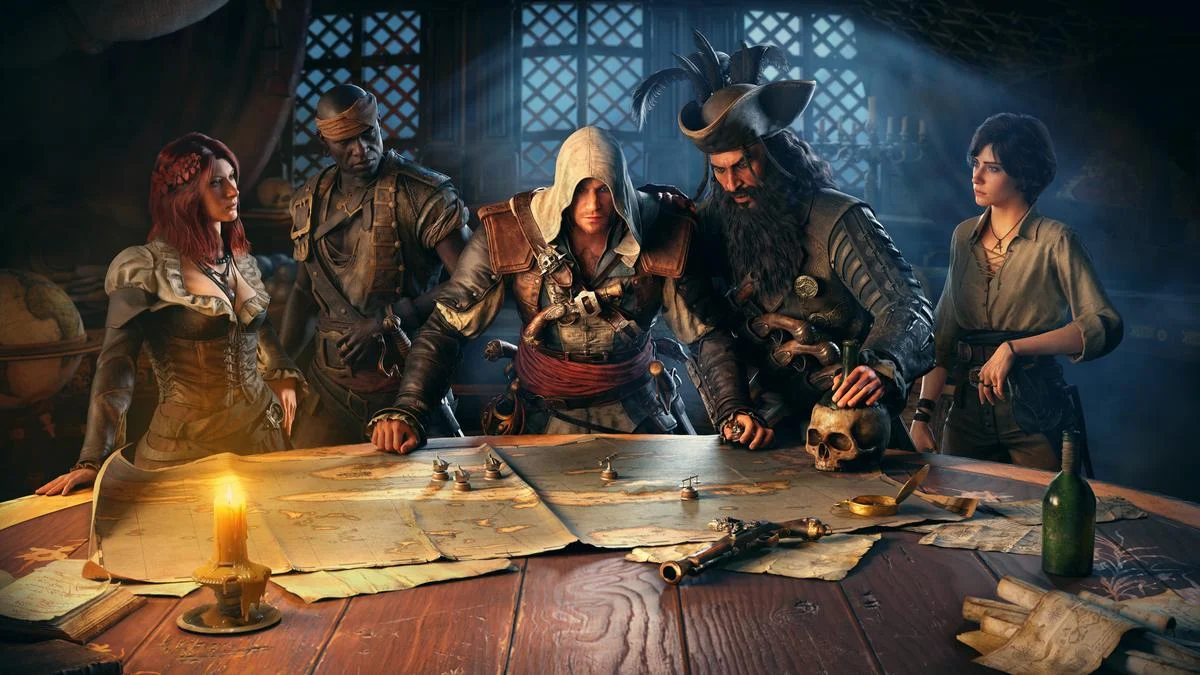
Edward’s storied journey is not solitary; his trusty quartermaster, Adéwalé, provides a moral compass and a glimpse into the broader implications of piracy and freedom. Along the way, players encounter a vibrant cast of historical figures who shaped the era: the enigmatic Captain Kidd, the fearsome Blackbeard, the cunning Bartholomew "Black Bart" Roberts, and a whole gamut of other good, bad, and ugly pirates. These interactions are not just window dressing; they are integral to the narrative, weaving a rich tapestry of camaraderie, betrayal, and the fight for independence against oppressive colonial powers.
Auditory Excellence: The Soundscape of the Golden Age
Beyond the visual splendor, Black Flag Resynced delivers an auditory experience that is nothing short of excellent. The sound design is meticulously crafted, from the subtle lapping of waves against the hull to the thunderous roar of cannons in naval battles. These ambient sounds are crucial in creating a believable world, whether it’s the chirping of crickets on a remote island at night or the cacophony of a bustling port.
The voice acting is superb, featuring a stellar cast that brings the characters to life. Matt Ryan, known for his iconic portrayal of John Constantine in television, lends his distinctive voice to Edward Kenway, capturing the pirate’s roguish charm and underlying complexity. Ralph Ineson brings his trademark gravelly, authoritative voice to Charles Vane, echoing his memorable roles such as Galactus in The Fantastic Four: First Steps. This excellent cast, combined with the superb sound effects, ensures that the Caribbean of Black Flag Resynced truly comes to life. A good pair of headphones or a surround sound system transforms the experience, making the player feel truly enveloped by the wind in the sails, the melancholic sea shanties sung by the crew (often about Edward’s love visiting him in a dream), and the crashing of waves. It is a masterclass in immersive sound design, completing the sensory feast.
Ubisoft’s Vision: Official Stance and Development Philosophy
The creation of Assassin’s Creed: Black Flag Resynced is not merely a technical exercise but a strategic move by Ubisoft, reflecting their development philosophy and their response to both fan feedback and market trends.
The Rationale Behind the Remaster
Ubisoft’s rationale for revisiting Black Flag is multi-layered. Publicly, developers have often cited overwhelming fan demand for a modern version of the game. Black Flag consistently tops polls for "most wanted Assassin’s Creed remasters," indicating a clear market appetite. This strong community endorsement provides a solid foundation for the project. Beyond sentiment, the remaster aligns with Ubisoft’s broader strategy of leveraging its extensive back catalog, similar to other major publishers. In an increasingly competitive market, remasters offer a less risky investment than entirely new IPs, while still generating significant revenue and attracting new players to existing franchises.
Furthermore, Resynced allows Ubisoft to showcase its advancements in game engine technology and art pipelines. The opportunity to push graphical boundaries with ray tracing, subsurface scattering, and higher-fidelity assets on current-generation hardware serves as a technical showcase. It demonstrates the capabilities of their internal studios and reinforces their position at the forefront of visual innovation. Developers have expressed a desire to preserve the legacy of Black Flag for a new generation, ensuring that its groundbreaking gameplay and narrative remain accessible and impactful in a modern context, while also providing a "definitive" edition for long-time fans.
Integrating Modern Gameplay with Classic Design
A key challenge for Resynced was balancing fidelity to the original design with the integration of modern gameplay sensibilities. Ubisoft’s development teams aimed to refine, not reinvent. The goal was to enhance the existing mechanics without altering the core feel that made Black Flag so beloved. This involved a careful analysis of what worked in the original and what could be improved based on a decade of player feedback and advancements in game design.
The modernized combat system, with its Sekiro-inspired parry, is a prime example of this philosophy. It updates the combat flow to be more engaging and skill-based, aligning with player expectations from contemporary action games, while still retaining the dual-wielding, swashbuckling flair of Edward Kenway. Similarly, the enhanced stealth options, particularly the adjustable difficulty, address a common criticism of earlier AC titles being too easy in stealth. These changes are designed to feel additive and organic, rather than grafted on, ensuring that the essence of Black Flag‘s gameplay loop remains intact while feeling fresh and responsive. It’s a testament to a development philosophy that respects the past while embracing the present.
Addressing Player Feedback
Ubisoft has historically been receptive to player feedback, and Resynced is no exception. The improvements in stealth difficulty directly respond to community desires for a more challenging and strategic experience. The visual upgrades, especially the ray tracing and environmental details, are a direct answer to calls for a truly next-gen presentation of the Caribbean.
However, the lingering camera issue during free-running, particularly when needing to hold a button, indicates that some legacy quirks can be difficult to fully iron out without a complete remake. While the developers have clearly invested heavily in improving core systems, certain foundational elements of the original game engine might present constraints. The acknowledgement of this issue (and the implicit comparison to Shadows, where it doesn’t occur) suggests that Ubisoft is aware and may seek to address it in future updates, underscoring their commitment to continuous improvement even post-launch. This iterative approach to development and refinement is crucial for maintaining player trust and ensuring the longevity of their titles.
The Broader Implications: Resynced’s Impact on Gaming
Assassin’s Creed: Black Flag Resynced is more than just a game; it is a significant release with far-reaching implications for the Assassin’s Creed franchise, the broader gaming industry, and the enduring appeal of certain genres.
Redefining the Remaster Standard
In a market saturated with remasters and remakes, Black Flag Resynced has the potential to redefine what players expect from such titles. Many remasters offer little more than a resolution bump and perhaps some texture updates. Resynced, however, goes significantly further, integrating cutting-edge graphical technologies like ray tracing and subsurface scattering, alongside fundamental gameplay modernizations. This comprehensive approach elevates it from a mere re-release to a genuine re-crafting. If successful, it could set a new benchmark, compelling other developers to invest more deeply in their remaster projects, thereby raising the overall quality standard across the industry. It demonstrates that a remaster can be both a tribute to the past and a vision for the future, leveraging new technology to enhance rather than just replicate the original experience.
Commercial Prospects and Franchise Longevity
The commercial prospects for Black Flag Resynced appear robust. Capitalizing on widespread nostalgia and the game’s high critical acclaim, it is poised to attract both veteran fans eager to revisit an old friend in a "swanky new house" and a new generation of players who missed the original. The high production values and extensive marketing campaign position it as a premium title, justifying its price point of ₹4,999 on PlayStation 5, PC, and Xbox.
For the Assassin’s Creed franchise, Resynced plays a crucial role in its longevity. By revitalizing one of its most popular entries, Ubisoft reinforces the brand’s strength and diversity. It shows that the franchise can successfully operate across different formats – from large RPGs to more focused stealth experiences and now, high-quality remasters. This strategy helps maintain continuous engagement with the brand, bridging gaps between major new releases and ensuring that Assassin’s Creed remains a dominant force in the action-adventure genre for years to come. It also serves as a strong entry point for new players, offering a polished version of a fan-favorite that beautifully encapsulates the series’ potential.
The Enduring Appeal of Pirate Fantasies
Black Flag Resynced‘s success also underscores the enduring appeal of pirate fantasies in popular culture and gaming. The allure of freedom, adventure, treasure, and rebellion against established authority resonates deeply with audiences. Black Flag tapped into this perfectly, offering a compelling blend of historical context and romanticized piracy. In an age where open-world games often focus on fantasy or futuristic settings, the grounded yet fantastical world of 18th-century Caribbean piracy offers a refreshing change of pace. The game’s ability to transport players to a time of swashbuckling heroes and villains, where every horizon promises a new discovery, highlights the timeless appeal of the pirate archetype. Its impact has arguably influenced other pirate-themed games, solidifying Black Flag‘s place as a definitive cultural touchstone for the genre.
A Worthy Challenger? Assessing its Position in the Gaming Landscape
Finally, revisiting the bold initial claim: can Black Flag Resynced truly challenge the might of Grand Theft Auto 6? While direct competition in terms of genre and scope is limited, the statement speaks to Resynced‘s potential to capture significant mindshare and sales in a crowded market. GTA 6 will undoubtedly dominate headlines, but Resynced offers a distinct, high-quality alternative. Its strengths lie in its refined gameplay, unparalleled naval combat, and the sheer joy of discovery within its beautifully recreated world. It appeals to a specific fantasy that GTA 6 is unlikely to touch.
For players seeking a rich, immersive open-world experience with a strong narrative, thrilling action, and breathtaking visuals, Black Flag Resynced presents a compelling argument. It is not just a nostalgia trip; it is a meticulously crafted game that stands on its own merits as a premium release in 2024/2025. Whether you are a seasoned pirate captain who remembers the original call of the Jackdaw or a newcomer eager to hoist the Jolly Roger for the first time, Assassin’s Creed: Black Flag Resynced promises an unforgettable adventure. It is a classic reborn, ready to sail into the annals of gaming history once more, a worthy challenger to any titan that dares to cross its path. So, go out and experience this vibrant, enriched classic – you are in for an absolute treat.
