

Main Facts
In an era where the traditional full-price tag no longer guarantees a complete gaming experience, many companies are increasingly relying on supplementary revenue streams to ensure profitability and sustained engagement. While some incorporate additional paid content, others weave in loot boxes, cosmetics, or battle passes. Sports simulations, with their annual release cycles and fervent fan bases, frequently become prime targets for these monetization strategies. The challenge lies in balancing commercial imperatives with maintaining the integrity of the gameplay experience.
WWE 2K26, the latest iteration in the long-running wrestling simulation series from 2K Games and Visual Concepts, stands as a compelling, albeit controversial, case study in this evolving landscape. On one hand, the game delivers an exceptionally refined and authentic wrestling simulation, lauded for its immersive presentation, deep mechanics, and extensive roster. It masterfully captures the spectacle and strategic nuances of professional wrestling, offering an unparalleled virtual ring experience. Yet, beneath this polished exterior, WWE 2K26 is also a stark example of aggressive monetization practices that have left a significant portion of its dedicated player base feeling exploited, forced to pay what many perceive as a "passion tax" on their love for the sport.
A Legacy of Evolution: The WWE 2K Franchise and the Microtransaction Age
The evolution of monetization within the gaming industry has been a gradual but significant shift, particularly within annual sports franchises. Historically, games were complete packages upon purchase, with expansions or downloadable content (DLC) released later as optional add-ons. The WWE gaming franchise, much like its counterparts in football or basketball, initially adhered to this model, offering character packs or new arenas as traditional DLC.
However, the turn of the millennium and the advent of persistent online connectivity ushered in a new era. Season Passes became common, offering a bundle of future DLC at a discounted price. This was followed by the proliferation of microtransactions, initially for cosmetic items, but gradually expanding to include experience boosts, in-game currency, and even playable characters. The "live service" model, popularized by titles like Fortnite, further cemented the idea of games as ongoing platforms, continually updated with new content, often delivered through battle passes or rotating in-game stores.
The WWE 2K series has mirrored these industry trends. Over successive iterations, the presence of in-game currencies, unlockable content, and various tiers of digital purchases has steadily increased. WWE 2K26 represents a significant acceleration of this trend, moving away from simple DLCs towards a more pervasive, almost inescapable, system of battle passes and card-based collection mechanics. This strategic pivot aims to maximize player engagement and recurring revenue, but it has also brought the game into direct conflict with player expectations of value and fairness, especially for a title that already commands a premium upfront price. The transition feels less like an evolution and more like a deliberate embrace of systems designed to extract continuous monetary and time investment from its most loyal fans.
Unrivaled Authenticity: WWE 2K26’s Gameplay Prowess
Despite the contentious monetization, the core gameplay of WWE 2K26 is undeniably a triumph for Visual Concepts. The development team has meticulously crafted a wrestling simulator that captures the essence of the sport, from its larger-than-life characters to its intricate in-ring drama.
A Roster for the Ages
One of WWE 2K26‘s most immediately striking features is its colossal and diverse roster. Spanning multiple generations of professional wrestling, the game offers an unparalleled lineup that appeals to both long-time aficionados and newer fans. From the golden age titans like the late, great Hulk Hogan, "Macho Man" Randy Savage, and Andre the Giant, to the Attitude Era legends such as Stone Cold Steve Austin, The Rock, Shawn Michaels, and The Undertaker, the game is a nostalgic trip down memory lane. Contemporary superstars and rising talents also feature prominently, ensuring that players can recreate their favorite matches and dream matchups across different eras. This extensive collection isn’t just a list of names; each wrestler is brought to life with incredible detail, fostering a deep sense of connection and nostalgia for fans.
Immersive Presentation
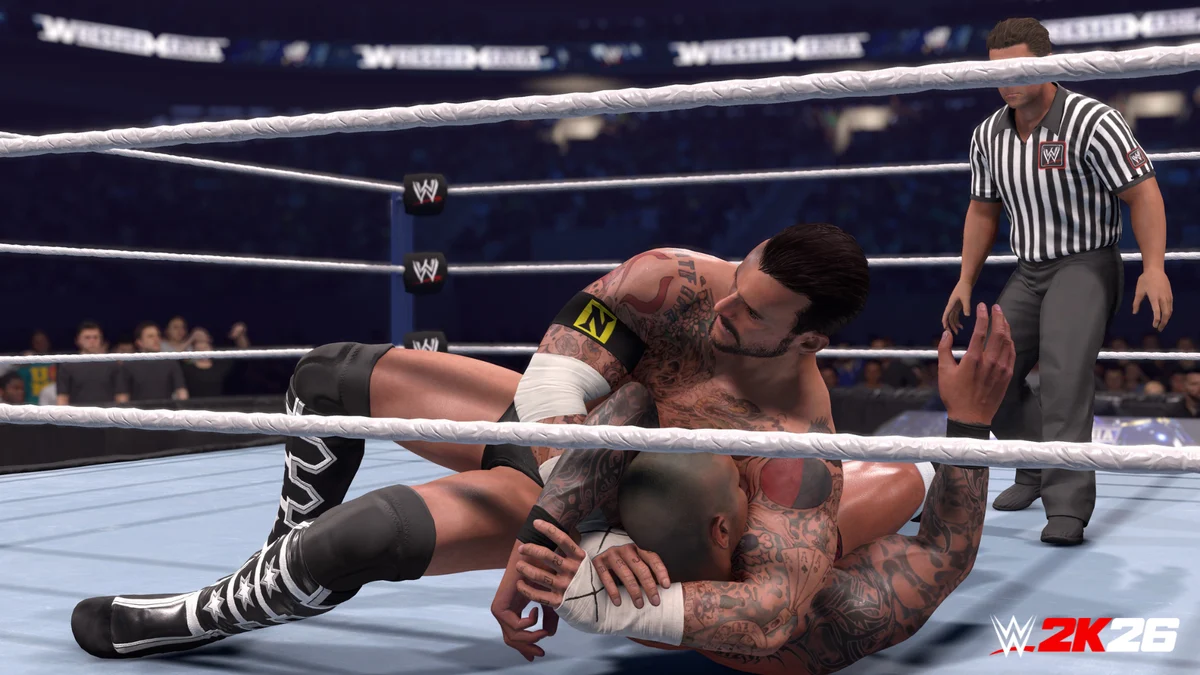
The visual fidelity and presentation in WWE 2K26 are nothing short of superb. Character models for each superstar are almost photo-realistic, meticulously capturing their likeness, musculature, and signature gear. The attention to detail extends to their animations, which are fluid, impactful, and genuinely reflective of their real-life counterparts. This realism is further enhanced by the game’s spectacular entrance sequences. From the pyro technics exploding as Shawn Michaels descends from the rafters to The Undertaker’s chilling walk to the ring, players have full control over various effects, allowing them to perfectly orchestrate the iconic spectacle that precedes every major bout. These entrances are not just cutscenes; they are integral parts of the experience, setting the stage and building anticipation just like a televised WWE event.
Redefining In-Ring Mechanics
Where past wrestling games often relied on simplified control schemes, WWE 2K26 infuses a heightened sense of "sports energy" into its mechanics, demanding more strategic thinking and nuanced execution from players.
-
Showmanship and Strategic Taunts: Beyond mere combat, the game emphasizes the theatricality of wrestling. Players can perform a variety of taunts, not just to mock opponents, but also to work up the crowd, building momentum and energy before unleashing a signature suplex or a devastating finisher. This mechanic adequately captures the showmanship that is as crucial to wrestling as the physical performance itself.
-
The Reversal Revamp System: A significant and welcome addition is the new Reversal Revamp system. This innovative mechanic ties defensive counters directly to a stamina-based system, preventing players from mindlessly spamming reversals. If a player attempts too many counters in quick succession, their wrestler becomes winded and vulnerable, unable to defend against incoming attacks. This forces players to pace themselves, strategically choosing when to absorb damage and when to explode back into action, mirroring the ebb and flow of a real televised match. It adds a layer of tactical depth that was often missing in previous iterations.
-
Enhanced Environmental Physics: The game also boasts upgraded environmental physics, offering unprecedented interactivity with the arena. No longer are players constrained by invisible walls; they can powerbomb opponents off the rampway, stack multiple tables for devastating Attitude Era-style carnage, and utilize various props and barriers in creative and destructive ways. This enhances the sense of realism and provides more dynamic, unpredictable match scenarios.
-
Sophisticated AI: The artificial intelligence in WWE 2K26 is remarkably convincing, moving beyond the binary extremes of brain-dead punching bags or unfairly omniscient counter machines. Opponents now exhibit a better sense of pacing, adapting their approach based on the match’s progression and the player’s strategy. For instance, an opponent might target specific body parts to disrupt an aerial-heavy playstyle or show realistic signs of fatigue. Crucially, the AI also leans into the theatrics, with wrestlers taking time to recover, crawling realistically to the ropes, and "selling" moves in a way that makes matches feel less like a game and more like a live performance. This responsiveness from the AI significantly elevates the immersive quality of every bout.
Boundless Creativity
Beyond the pre-set roster and match types, WWE 2K26 continues to offer a robust creation suite. Players can craft their own unique wrestlers, complete with custom entrances, move sets, and attire. The ability to share and download community-created content further expands the game’s longevity, allowing for an almost endless supply of new characters, arenas, and championships, ensuring that the fan community remains deeply invested.
The Undercard of Commerce: WWE 2K26’s Controversial Monetization Model
While the in-ring action and presentation of WWE 2K26 are stellar, the shine quickly dulls when confronted with its aggressive monetization strategies. This is where the game’s commercial ambitions clash most directly and jarringly with player expectations.
The Paywall and the Grind
A significant point of contention revolves around the game’s character roster. While impressive in its breadth, a substantial number of popular wrestlers are locked behind either direct paywalls or extraordinarily long, repetitive in-game grinds. This means that players who have already paid the full price for the game (which can be as high as ₹4999 on PC and consoles, with higher-tier editions costing even more) find themselves unable to access their favorite superstars without further investment of either time or money. Reports from online communities frequently detail player frustration, with many feeling "burnt out" by the sheer effort required to unlock content they believe should be part of the base package or easily accessible after purchase. This practice fundamentally undermines the value proposition of a full-price game, suggesting that the initial purchase is merely a down payment for the "complete" experience.
The Ringside Pass: More Than Just Cosmetics
Central to WWE 2K26‘s monetization strategy is the "Ringside Pass," a clear analogue to battle passes seen in free-to-play titles like Fortnite. However, the Ringside Pass in WWE 2K26 goes far beyond offering mere cosmetic skins or emotes. It locks away playable characters, new game modes, and even additional arenas. This means that to access significant gameplay content, players must not only purchase the pass but then actively "work" through its tiers, completing challenges and accumulating experience points.
The absurdity of this model is highlighted by the "luxury hotel" analogy: "It is akin to buying the best room at a luxury hotel, but being charged to use the elevator, and then having to climb the elevator shaft." While there is an option to "skip tiers" and instantly unlock content, this, predictably, comes at an additional real-money cost. This system forces players into a dilemma: invest significant time into a grind for content they’ve arguably already paid for, or spend even more money to bypass artificial barriers.
MyFaction: The Digital Casino
Further compounding the monetization issues is the MyFaction mode, which has been widely criticized for its loot box-like mechanics. Described by some as a "digital casino," MyFaction locks wrestlers, moves, and other valuable content behind collectible cards obtained through randomized packs. Players spend in-game currency (which can, of course, be purchased with real money) on these packs, hoping that the "Random Number Generator (RNG) gods" will bless them with the specific card they desire. This creates a predatory cycle of gambling-like behavior, where the acquisition of desired content is left to chance rather than skill or direct purchase, pushing players to spend more in pursuit of elusive rewards. In MyFaction, currency is everything, and the transparency of obtaining specific items is often obscured by the randomness of the card packs.
Widespread Fan Discontent
The aggressive nature of these monetization systems has not gone unnoticed by the dedicated WWE 2K community. Social media platforms, gaming forums, and online reviews are replete with expressions of frustration and anger. Players who have invested hundreds of dollars in the franchise over the years, often purchasing higher-tier "deluxe" or "ultimate" editions, feel particularly aggrieved. The sentiment is that their loyalty is being exploited, and that the game, despite its technical brilliance, is fundamentally disrespecting their time and money. The community backlash has been significant, signaling a clear divide between the developers’ commercial strategy and the player base’s expectations.
A Publisher’s Concession: The Response to Backlash
In response to the intense community backlash regarding the Ringside Pass, 2K Games did implement a notable change in a post-launch patch. Specifically, they moved some of the playable characters initially locked deep within the Ringside Pass tiers to Tier 1. This adjustment aimed to make these characters immediately accessible to players who purchased the pass, mitigating some of the initial grind.
While this move was a direct acknowledgement of player dissatisfaction and a step towards addressing a critical pain point, its effectiveness in fully resolving the underlying issues remains debatable. It somewhat alleviated the immediate frustration of having to grind for paid content, but it did not fundamentally alter the live-service structure or the presence of other paywalls and the MyFaction mode’s RNG mechanics. It was a partial concession, a patch on a larger systemic issue, rather than a comprehensive overhaul of the game’s aggressive monetization philosophy. This response highlights that publishers are sensitive to public outcry, but often only make changes that address the most egregious complaints, leaving the core revenue-generating systems intact.
The Price of Passion: Implications for Players and the Industry
WWE 2K26 serves as a poignant example of the ongoing tension between artistic vision, gameplay innovation, and commercial viability in the modern gaming industry. Its success in simulation is undeniable, yet its missteps in monetization carry significant implications.
Erosion of Trust
The aggressive monetization tactics employed in WWE 2K26 risk eroding the trust between developers/publishers and their player base. When fans feel that their loyalty is being exploited through artificial barriers and constant demands for additional spending, it can lead to disillusionment, decreased brand loyalty, and a reluctance to pre-order or invest in future titles. This long-term damage to player relations can outweigh any short-term revenue gains.
Industry Crossroads
The game places itself squarely within the broader industry debate: what constitutes a "full game" in an era of digital distribution and ongoing content? For a premium-priced title, the expectation is generally that the core experience, including key characters and modes, should be accessible without further mandatory investment of either time or money. WWE 2K26‘s model challenges this, suggesting that even after purchase, players are entering a prolonged transaction. This approach could normalize increasingly aggressive monetization in full-price games, setting a concerning precedent for the industry as a whole.
The "Passion Tax" Dilemma
Perhaps the most troubling implication is the concept of a "passion tax." Wrestling fans are famously dedicated and often deeply nostalgic. WWE 2K26 capitalizes on this profound connection, offering a game that taps directly into their love for the sport and its history. To then gate significant portions of that experience behind paywalls, battle passes, and randomized loot boxes feels ethically questionable. It essentially asks fans to pay extra for the privilege of fully engaging with the very passion that drew them to the game in the first place.
Navigating the Future of Gaming
For consumers, WWE 2K26 serves as a potent reminder to exercise caution. While the game’s core gameplay is exceptional and highly recommended for wrestling enthusiasts, prospective buyers should be fully aware of the extensive monetization systems in place. Understanding that the initial purchase price may not cover the "full" experience, and that additional time or money will be required to unlock all desired content, is crucial. For the industry, WWE 2K26 is a critical barometer. It highlights the fine line between sustainable revenue generation and alienating a dedicated fan base. Striking a healthier balance will be essential for the long-term health and credibility of premium gaming titles in an increasingly live-service oriented market.
In conclusion, WWE 2K26 is a phenomenal wrestling simulator that captures the spirit and spectacle of the sport with unparalleled authenticity. Its technical achievements and gameplay innovations are commendable, offering a rich and engaging experience for any long-time fan. However, this brilliance is unfortunately overshadowed by a pervasive and aggressive monetization model that demands constant investment of both time and money. While the in-ring action is five-star, the commercial strategy often feels like a cheap shot, leaving many fans feeling pinned down by a system eager to take their money. Therefore, while the game itself is a must-play for wrestling superfans, it comes with a significant caveat: proceed with caution, and be prepared to contend not just with your opponents in the ring, but also with the persistent demands of its underlying economy.
