

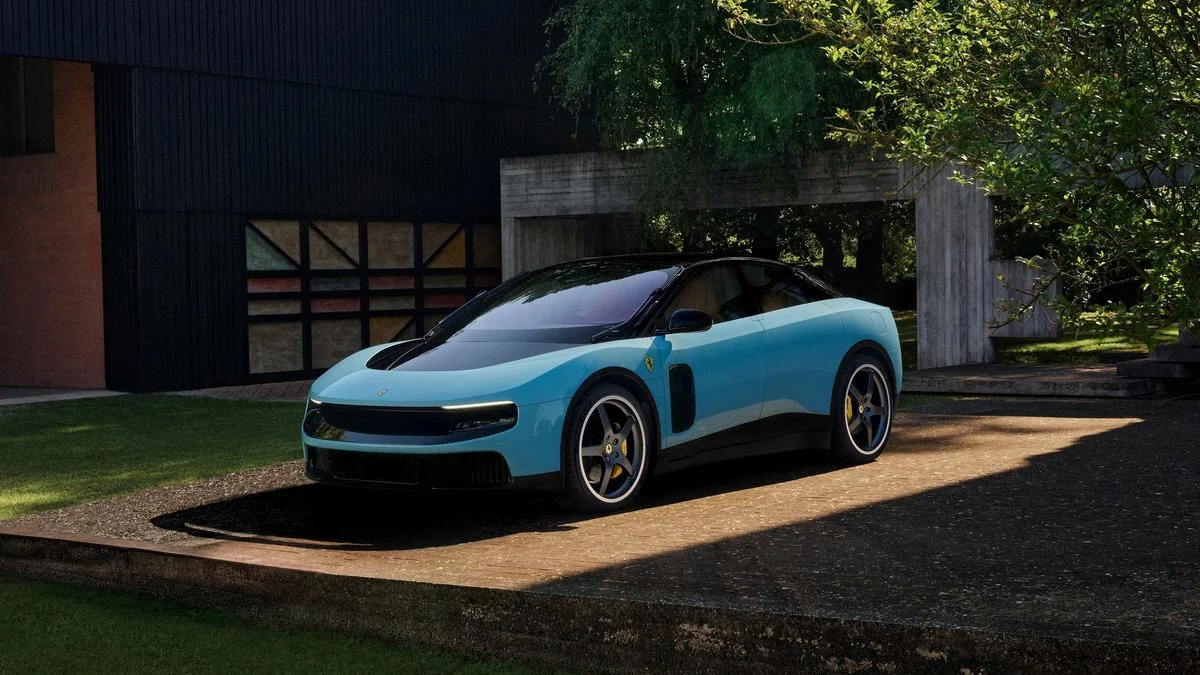
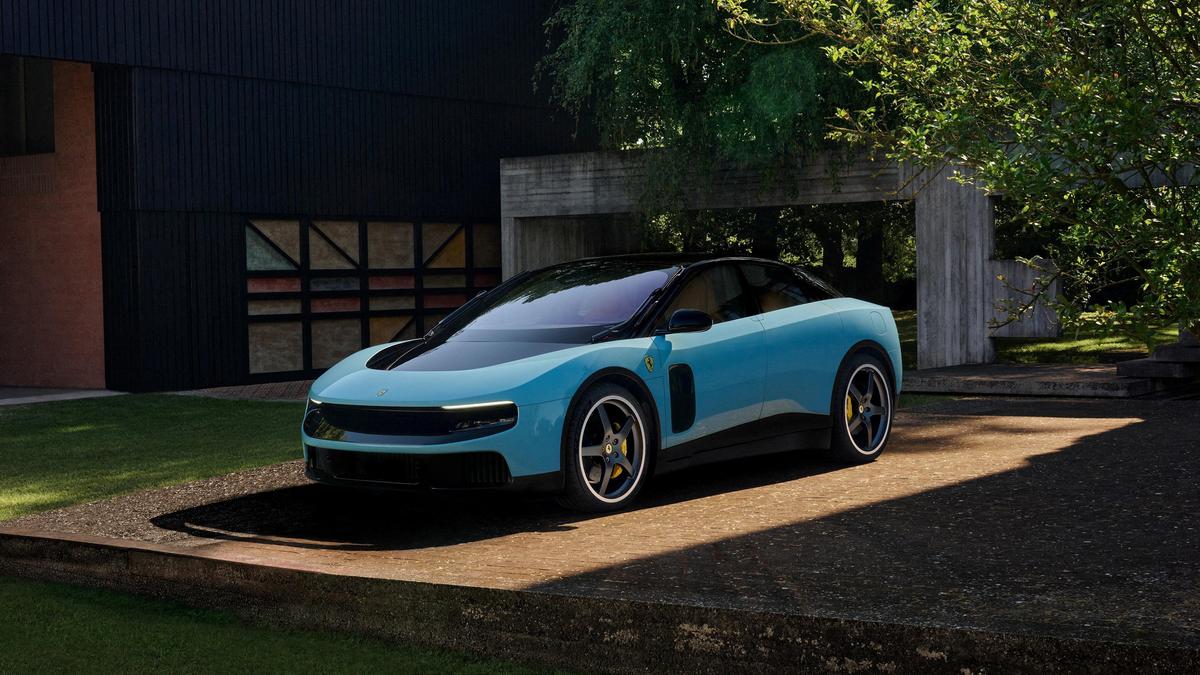
MARANELLO, ITALY — In a move that marks the most significant pivot in its 80-year history, Ferrari has officially entered the age of electrification. On Monday, the legendary Italian marque unveiled the "Luce"—its first-ever fully electric vehicle (EV). Italian for "Light," the Luce represents a radical departure from the high-decibel internal combustion engines (ICE) that defined the brand’s twentieth-century dominance.
The unveiling, held at Ferrari’s headquarters in Maranello, signals the company’s intent to redefine the "electric supercar" category. While rivals like Porsche and Rimac have already established a presence in the high-performance EV market, Ferrari’s entry is seen by industry analysts as the ultimate litmus test for whether the emotional soul of a luxury brand can survive the transition to silent, battery-powered propulsion.
I. Technical Mastery: Breaking the 300 km/h Barrier
The Ferrari Luce is not merely a statement of environmental intent; it is a showcase of Maranello’s engineering prowess. Despite the absence of a V12 engine, the Luce boasts performance metrics that place it at the apex of the current EV landscape.
Performance and Powertrain
The Luce is capable of a top speed exceeding 310 kilometres per hour (approximately 193 mph), positioning it as one of the fastest production electric vehicles on the planet. Its acceleration is equally visceral, reaching 100 kph (62 mph) from a standstill in a mere 2.5 seconds. This puts the Luce in direct competition with the Porsche Taycan Turbo GT and the Tesla Model S Plaid.
Central to this performance is a massive 122 kWh battery pack. This power unit provides the Luce with a range of over 530 kilometres (330 miles) on a single charge, addressing the "range anxiety" that has often plagued high-performance electric cars. However, this capacity comes at a physical cost: the Luce weighs in at 2.26 tonnes. This makes it the heaviest vehicle Ferrari has ever produced, presenting a unique challenge for the brand’s suspension and chassis engineers who are tasked with maintaining the "flickable" handling characteristics for which the Prancing Horse is famous.
A New Architecture: Four Doors and Five Seats
In a surprising design choice, the Luce is only the second four-door model in Ferrari’s history, following the Purosangue. Even more revolutionary is its cabin configuration: the Luce is the brand’s first-ever five-seater. By adopting a "Grand Tourer" (GT) silhouette, Ferrari is targeting a broader demographic—wealthy families and daily drivers—rather than just the weekend track enthusiast.
II. Chronology: The Road to Electrification
The path to the Luce has been a decade-long journey of incremental hybridization and strategic planning. Ferrari did not jump into the EV market overnight; instead, it used its Formula 1 expertise to bridge the gap.
- 2013 – The Hybrid Seed: Ferrari launched the LaFerrari, its first mild-hybrid hypercar. It proved that electric motors could enhance, rather than diminish, the performance of a V12 engine.
- 2019 – The Plug-in Pivot: The debut of the SF90 Stradale marked Ferrari’s first plug-in hybrid (PHEV). It allowed for short bursts of silent, electric-only driving, acclimating the Ferrari faithful to the concept of a "quiet" Prancing Horse.
- 2022 – The Strategic Blueprint: During its Capital Markets Day, Ferrari leadership announced a roadmap for carbon neutrality. They confirmed that the first fully electric model would arrive in 2025/2026.
- 2024 – The ‘E-Building’: Ferrari inaugurated its "e-building" in Maranello, a dedicated facility for the production of electric motors, battery packs, and power inverters.
- May 2026 – The Arrival of Luce: The official global premiere of the Luce marks the culmination of these efforts, moving the brand from "electric-assisted" to "electric-only."
III. Supporting Data: The Weight of Innovation
To understand the Luce, one must look at the data that differentiates it from its predecessors. The transition to electric power has forced Ferrari to recalibrate its engineering philosophy, particularly regarding weight distribution and aerodynamics.
The Weight Challenge
At 2.26 tonnes (approx. 4,982 lbs), the Luce is roughly 500 kg heavier than the Ferrari Roma and nearly 200 kg heavier than the Purosangue SUV. To counteract this mass, Ferrari has employed an advanced active suspension system and four-wheel steering. The 122 kWh battery is integrated into the floor of the car to lower the center of gravity, which Ferrari claims results in cornering speeds that rival its mid-engine combustion models.
Charging Infrastructure and Efficiency
Ferrari has confirmed that the Luce utilizes an 800-volt architecture, allowing for ultra-fast charging. Under optimal conditions, the battery can be replenished from 10% to 80% in under 18 minutes. This is crucial for a brand whose owners value time as much as speed.
Comparative Market Data
| Feature | Ferrari Luce | Porsche Taycan Turbo GT | Lamborghini Lanzador (Concept) |
|---|---|---|---|
| 0-100 kph | 2.5 Seconds | 2.2 Seconds | < 2.5 Seconds |
| Top Speed | 310+ kph | 305 kph | 300+ kph |
| Battery | 122 kWh | 97 kWh | ~100+ kWh |
| Weight | 2.26 Tonnes | 2.22 Tonnes | TBD |
IV. Official Responses: A Vision for the Future
The launch of the Luce was accompanied by statements from Ferrari’s top brass, who sought to reassure purists while inviting a new generation of tech-savvy buyers.
John Elkann, President of Ferrari, emphasized the continuity of the brand’s spirit:
"With the Luce, we are inaugurating a chapter that turns our vision into reality, strengthening Ferrari’s tradition of anticipating and shaping the future. This is not just a new car; it is a new way of experiencing the thrill of the Prancing Horse. We have remained true to our DNA while embracing the possibilities of a cleaner world."
Benedetto Vigna, CEO of Ferrari, who was hired specifically to navigate the tech transition, noted the sensory experience:
"Our engineers have worked tirelessly to ensure that the Luce ‘sounds’ like a Ferrari. We have developed a unique acoustic signature that reflects the car’s power and dynamics without resorting to artificial, synthesized engine noises. It is an authentic, emotional experience."
The company also addressed the elephant in the room: the cooling global demand for EVs. Ferrari recently revised its 2030 targets. While they previously hoped for 40% of their lineup to be fully electric by the end of the decade, they have adjusted that figure to a more conservative 20%, citing the need to maintain flexibility as global infrastructure and consumer preferences evolve.
V. Implications: The Luxury Market in Flux
The arrival of the Luce has profound implications for the automotive industry, the luxury sector, and the Italian economy.
1. The "Soul" Problem
The biggest hurdle for Ferrari is not speed—it is emotion. Ferrari’s brand equity is built on the "symphony" of its engines. By moving to electric, Ferrari risks alienating collectors who view the cars as mechanical art. The success of the Luce will depend on whether the "Luce experience"—the torque, the prestige, and the design—can compensate for the loss of the internal combustion soundtrack.
2. Industry-Wide Slowdown
Ferrari’s launch comes at a precarious time. Major manufacturers, including Mercedes-Benz and Audi, have recently scaled back their EV ambitions as high interest rates and a lack of charging infrastructure have cooled the initial "EV fever." By launching the Luce now, Ferrari is betting that the ultra-high-end consumer is insulated from these market pressures and is ready to adopt "quiet luxury."
3. Regulatory Pressure
Despite the market slowdown, the European Union’s looming ban on new sales of CO2-emitting cars by 2035 (with some exceptions for e-fuels) makes the Luce a necessity. Ferrari must prove to regulators that it can comply with environmental standards without losing its status as a symbol of Italian excellence.
4. The Competition for "New Money"
The Luce is designed to capture a younger, "green-conscious" billionaire class—Silicon Valley entrepreneurs and tech moguls who may have previously chosen a Tesla or a Lucid but now desire the heritage and exclusivity of a Ferrari. The inclusion of five seats and four doors suggests that Ferrari is no longer content with being a "second car" in the garage; they want the Luce to be the primary vehicle for the modern elite.
Conclusion
The Ferrari Luce is a gamble of historic proportions. It is a car of contradictions: the heaviest Ferrari ever, yet one of the fastest; a silent vehicle from a brand famous for its roar; and a five-seater from a company built on the intimacy of the cockpit.
As the Luce begins its production run in Maranello, the world will be watching closely. If Ferrari can prove that an electric motor can stir the soul as effectively as a V12, the Luce will not just be a new model—it will be the spark that ensures the Prancing Horse survives for another century. If not, it may remain a high-tech outlier in a brand that, for now, is still keeping its petrol-powered engines on standby.
