

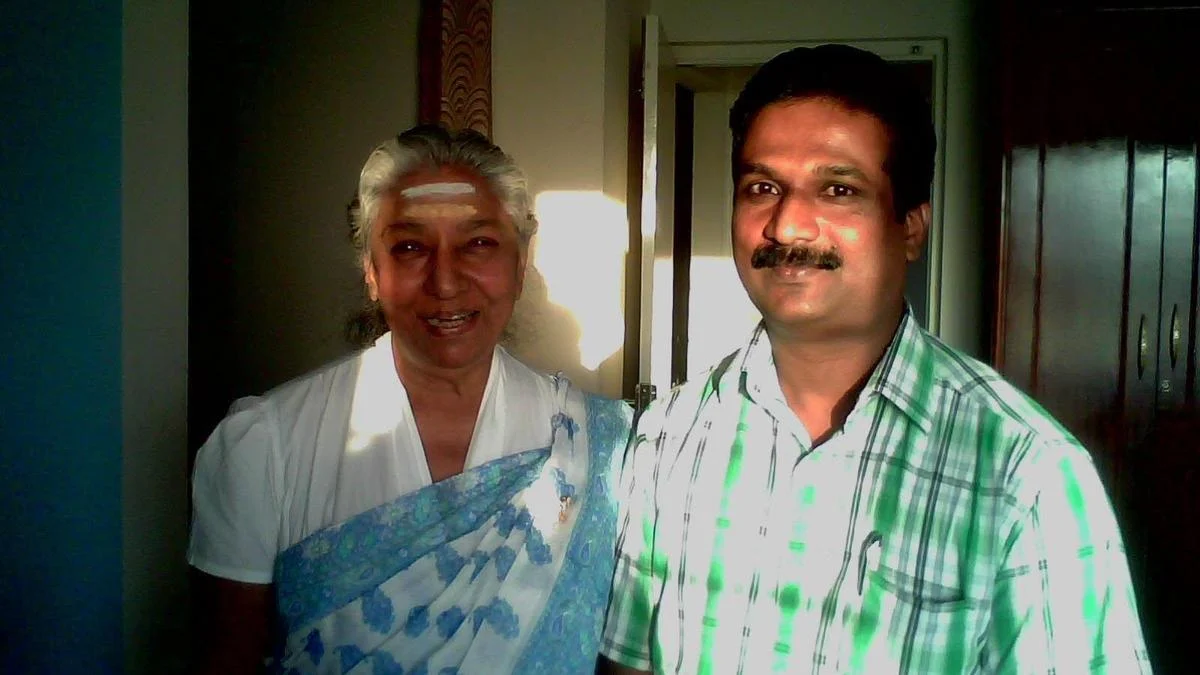
MYSURU — The world of Indian cinema and playback music was plunged into mourning on July 12, 2026, following the passing of the legendary singer Dr. S. Janaki. Known affectionately as the "Nightingale of the South," Janaki’s voice served as the soundtrack for generations of listeners across multiple languages. While the nation grieves a cultural icon, for H.S. Ravi, a 54-year-old resident of Hassan, the loss is deeply personal. Ravi, who operates a modest hotel in his hometown, is not merely a fan but the author of a definitive biography of the singer, a project born out of a lifelong obsession with her divine vocals.
As the music industry converges on Mysuru for the singer’s final rites, the story of Ravi’s journey from a schoolboy singer to a documented biographer offers a poignant look at the profound impact S. Janaki had on the common man.
Main Facts: A Devotion Beyond the Footlights
The relationship between a superstar and a fan is often one-sided, but in the case of H.S. Ravi and S. Janaki, it evolved into a mutual respect that culminated in the 2013 publication of Kannada Kampinali Gaana Kogile Dr. S. Janaki (The Nightingale in the Fragrance of Kannada).
Ravi’s biography was not the product of a professional journalist or a seasoned academic; it was a "labor of love" by a man who balanced the demands of running a small business with the rigorous research required to document a career spanning six decades and over 48,000 songs.
The news of Janaki’s demise on Sunday afternoon prompted Ravi to close his establishment and travel immediately to Mysuru. For Ravi, this was the final chapter of a story he had been writing since his childhood. His book remains one of the few comprehensive records of Janaki’s specific contributions to the Kannada film industry, where she is arguably the most beloved female playback singer in history.
Chronology: The Making of a Biographer
The seeds of Ravi’s obsession were sown in the classrooms and local competition stages of Hassan. From a young age, Ravi was drawn to the emotive power of Janaki’s voice. He became a regular fixture at school singing competitions, almost exclusively performing songs popularized by her.
The Research Phase (2000s–2012):
What began as a hobby—collecting newspaper clippings and recording radio broadcasts—transformed into a mission in the early 2000s. Ravi began traveling across South India, visiting recording studios in Chennai and Bengaluru, and seeking out retired musicians, composers, and technicians who had worked with Janaki during the "Golden Age" of Kannada cinema.
"The information was scattered," Ravi recalled during a previous interview. "I realized that while everyone loved her voice, the technical details of her journey—the struggles of her early days, the specific dates of her recordings, and her interactions with maestros like G.K. Venkatesh and Rajan-Nagendra—were fading from public memory."

The Pivotal Meeting (2012):
Before committing his findings to print, Ravi sought the ultimate validation: the singer’s own blessing. Through intermediaries in the music industry, he secured an audience with Janaki in Bengaluru. The meeting was a turning point. Janaki, known for her humility and occasionally reclusive nature, was moved by the hotelier’s dedication.
She granted him permission to write the book but imposed a singular, stern condition: "She insisted that I must not misrepresent any music director or fellow singer," Ravi said. "She told me, ‘Write the truth, but do not disrespect anyone.’ She was fiercely protective of the dignity of her colleagues."
Publication and Recognition (2013):
In 2013, the Mysuru-based publishing house Samvahana released the biography. The launch was a significant event for Janaki’s massive fan base in Karnataka. Ravi had the distinct honor of presenting the first copy to the singer herself, a moment he describes as the "pinnacle of his life."
Supporting Data: The Kannada Legacy of S. Janaki
While S. Janaki sang in over 17 languages, including Tamil, Telugu, Malayalam, and Hindi, her bond with the Kannada language was unique. Statistics cited in Ravi’s research highlight why she is often considered an honorary citizen of Karnataka despite her roots in Andhra Pradesh.
- Volume of Work: Janaki recorded more songs in Kannada than in any other language. Her career in the state began with the film Sri Krishna Garudi, where she provided vocals for a small segment, followed by her first full-length song in Rayaru Bandaru.
- Linguistic Precision: Ravi’s book delves into Janaki’s uncanny ability to master the nuances of Kannada pronunciation. Unlike many non-native singers, her diction was so flawless that she was often mistaken for a native speaker.
- The Rajan-Nagendra Era: The biography meticulously documents the 1970s and 80s, a period where the duo of Rajan-Nagendra and S. Janaki defined the "romantic duet" genre in Sandalwood, creating hits that remain staples on Kannada radio today.
- Awards: Janaki’s career was punctuated by four National Film Awards and 31 State Film Awards, a significant portion of which came from her work in the Kannada film industry.
Official Responses and Tributes
The passing of S. Janaki has triggered a wave of tributes from the highest echelons of government and the arts.
The Chief Minister of Karnataka, in a statement released Sunday evening, noted: "Dr. S. Janaki was not just a singer; she was the voice of the Kannada soul. Her contribution to our culture is immeasurable. People like H.S. Ravi, who documented her life, have done a great service to the state."
Veteran music composer M.M. Keeravani, who worked with Janaki on numerous occasions, expressed his grief: "A voice that could mimic a child, an old woman, or a divine goddess has fallen silent. She was a school of music in herself."
From his home in Hassan, Ravi’s voice was heavy with emotion as he spoke to reporters. "I did not write that book for profit. I wrote it because I wanted the future generations to know that such a phenomenon walked among us. She was the ‘Gaana Kogile’ (Singing Cuckoo), and today, the garden feels empty."
Implications: The Preservation of Cultural History
The story of H.S. Ravi and his biography of S. Janaki underscores a vital trend in Indian cultural preservation: the role of the "citizen-historian."

1. Documentation of the Oral Tradition:
In the Indian film industry, archival records are often sparse. Biographies written by dedicated fans like Ravi serve as crucial primary sources, capturing anecdotes and historical timelines that would otherwise be lost to time. Ravi’s book acts as a bridge between the era of analog recording and the digital age.
2. The Power of Vernacular Literature:
By writing in Kannada, Ravi ensured that the biography reached the heart of Janaki’s most loyal demographic. It has encouraged other local writers to document the lives of regional icons, fostering a sense of pride and historical continuity.
3. Digital Legacy:
Recognizing the shift in how music is consumed, Ravi has also transitioned into the digital space. He manages a YouTube channel dedicated to rare Kannada tracks, many of which are Janaki’s lesser-known works. This digital archive, paired with his physical book, ensures that her voice remains accessible to the "Generation Alpha" and beyond.
4. The Ethics of Biography:
The "one condition" Janaki set for Ravi—to maintain the dignity of her peers—sets a high standard for biographical writing in an era often dominated by sensationalism. It reflects the grace of the subject and the integrity of the author.
Conclusion: A Final Farewell in Mysuru
As the sun sets over Mysuru, the city prepares for the final rites of a woman who was more than just a playback singer; she was a companion to the lonely, a joy to the celebratory, and an inspiration to the aspiring.
H.S. Ravi, standing among the thousands of mourners, represents the ultimate success of Janaki’s career. He is the living embodiment of how art can transcend the screen and the speaker, transforming the life of a humble hotelier into that of a custodian of history.
While the "Gaana Kogile" may have sung her last notes, her melody will continue to echo through the pages of Ravi’s book and the hearts of millions. In Hassan, the small hotel will eventually reopen, but for its owner, the world will always sound a little different now that the Nightingale has flown away.
