

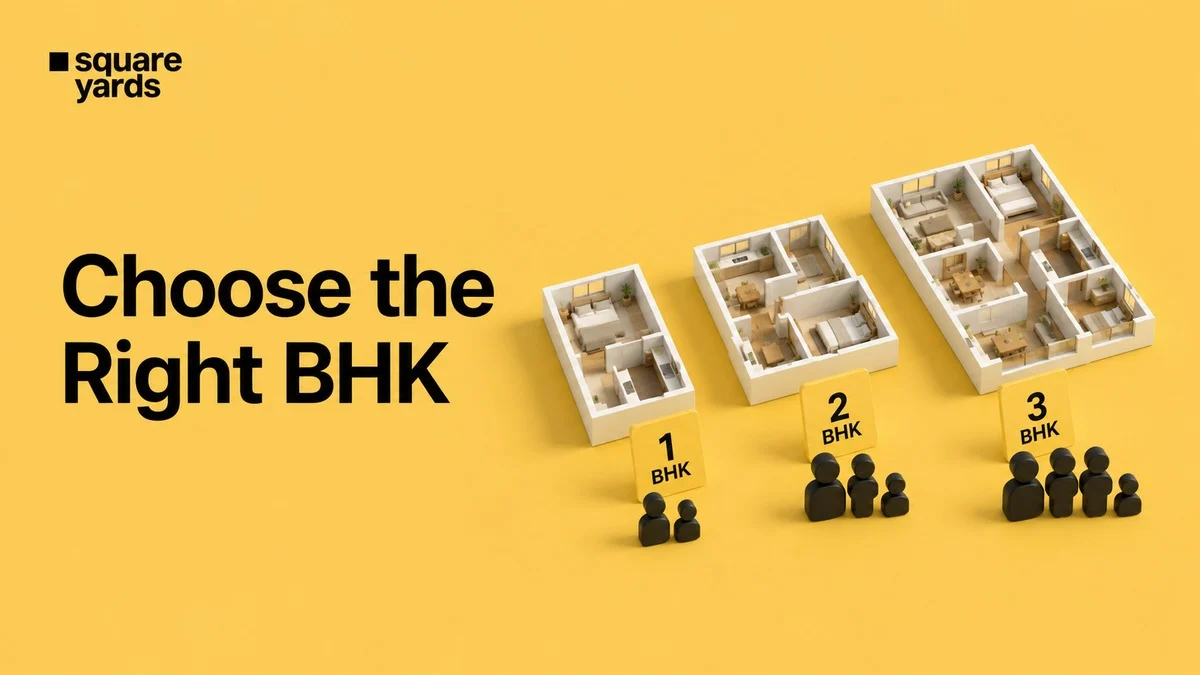
Introduction: Beyond Instinct—The Science of Residential Selection
In the high-stakes arena of Indian real estate, the decision to purchase a home is often the most significant financial commitment a household will ever undertake. Traditionally, buyers have relied on gut feeling or social aspiration when deciding between a 1BHK, 2BHK, or 3BHK configuration. However, as property prices in Tier-1 cities like Hyderabad, Mumbai, and Bengaluru continue to escalate, the margin for error has narrowed significantly.
Choosing the right BHK (Bedroom, Hall, Kitchen) size is no longer just about the number of rooms; it is a complex calculation involving family life cycles, financial liquidity, rental yields, and long-term resale potential. This report provides a structured assessment to help buyers transition from instinctive purchasing to methodical investment, ensuring that their chosen configuration matches both their current lifestyle and their five-year financial roadmap.
1. The Decision Framework: A Chronology of Choice
The selection of a BHK configuration should follow a logical sequence. Industry experts suggest that the "right" size emerges only after answering four fundamental questions in a specific order.
Phase I: The Five-Year Horizon
A common mistake among first-time buyers is purchasing for their current needs alone. Given the high costs of stamp duty, registration, and brokerage (which can total 8-10% of the property value), frequent upgrading is financially draining. Buyers must project their family composition five years into the future. Will there be a newborn? Will elderly parents move in? A home that fits perfectly today but becomes cramped in 24 months is a failed investment.
Phase II: Functional Room Mapping
Instead of counting rooms, buyers should map "usage hours." A guest room that remains empty 350 days a year is an expensive luxury. Conversely, in the post-pandemic era, a dedicated workspace has become a functional necessity. If a couple both work from home, a 2BHK is often the bare minimum to ensure professional productivity without lifestyle friction.
Phase III: The "Comfortable" EMI vs. "Eligible" EMI
Banks may declare a buyer eligible for a specific loan amount, but "technical eligibility" does not equal "lifestyle comfort." A 3BHK might be within reach according to the bank, but if the resulting Equated Monthly Installment (EMI) consumes more than 40% of the household’s take-home pay, it risks the family’s financial resilience.
Phase IV: End-Use vs. Investment Yield
The final filter is the objective. If the property is purely an investment, the buyer’s personal preferences are irrelevant. The focus shifts entirely to rental demand, maintenance costs, and capital appreciation patterns specific to that micro-market.
2. Supporting Data: Market Benchmarks and Ratios
To assist in budget planning, it is essential to understand the price dynamics between different configurations. While specific prices fluctuate by city, the ratios between 1BHK, 2BHK, and 3BHK units remain remarkably consistent across mid-market metro corridors.
The Pricing Hierarchy (Reference: 2BHK as 100%)
| Configuration | Typical Carpet Area (Sq. Ft.) | Indicative Price Ratio |
|---|---|---|
| 1BHK | 350 – 600 | 55% to 70% of 2BHK price |
| 2BHK | 650 – 1,100 | 100% (Market Reference) |
| 3BHK | 1,000 – 1,800 | 130% to 160% of 2BHK price |
Data Note: Buyers are encouraged to use Square Yards’ property price trends for real-time, corridor-specific data before finalizing budgets.
Configuration Recommendations by Family Type
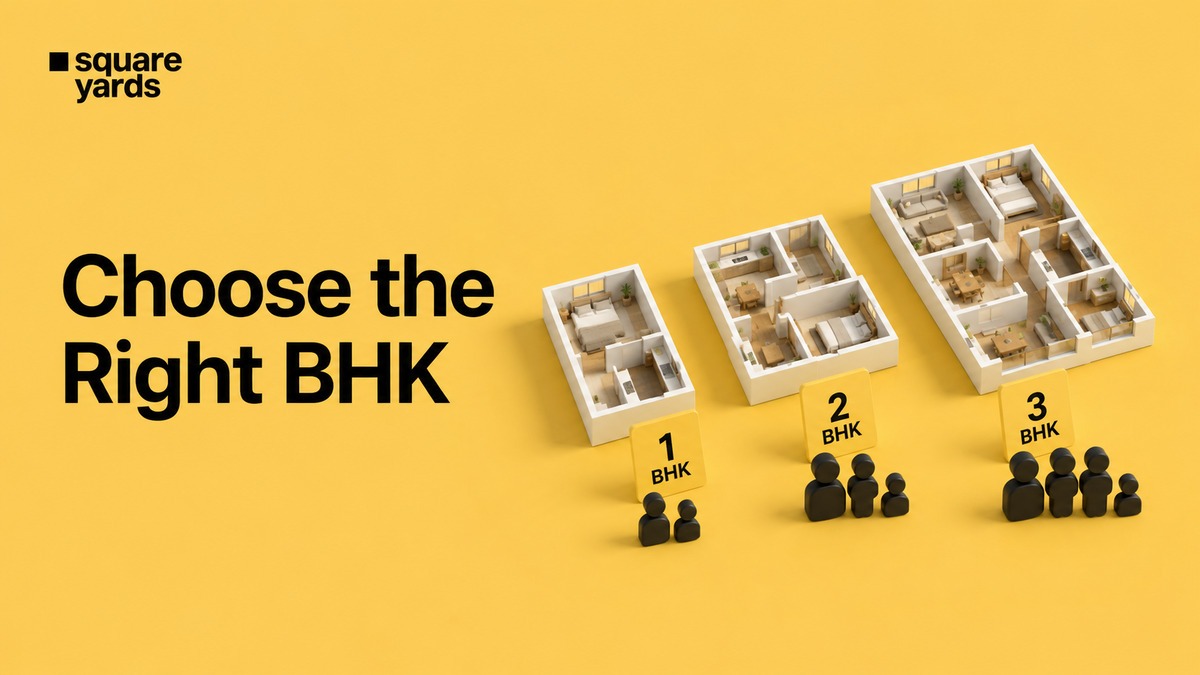
- Single Professionals/Couples (No Children): A 1BHK or 2BHK. While a 1BHK is more affordable, a 2BHK offers a dedicated workspace and higher flexibility for future life changes.
- Small Families (One Child): A 2BHK with a generous carpet area. Children under the age of seven can comfortably share space, making a 2BHK an EMI-efficient choice.
- Established Families (Two Children): A 3BHK. Once children reach school age, functional privacy becomes a priority for both study and sleep.
- Multi-Generational Households: A 3BHK or a 2BHK with an additional servant’s/utility room. Providing elderly parents with a private room is essential to avoid "lifestyle friction."
3. The Investment Perspective: Yield and Liquidity
For those purchasing with an eye on the bottom line, the 2BHK remains the "Golden Mean" of Indian real estate. However, the 1BHK holds a unique advantage in specific hubs.
The 1BHK Advantage: Yield Efficiency
In areas near major transit points or IT hubs (like Kondapur in Hyderabad or Whitefield in Bengaluru), 1BHK units often deliver the highest rental yield as a percentage of the purchase price. They serve a massive pool of single professionals and young migrant couples.
The 2BHK Dominance: Resale Liquidity
The 2BHK is the most liquid asset in the residential market. It attracts the widest range of buyers—from first-time homeowners to retirees downsizing. If a buyer needs to sell quickly, a 2BHK typically finds a taker much faster than a niche 1BHK or an expensive 3BHK.
The 3BHK Niche: Premium Stability
While 3BHKs have lower rental yields (often 2-3%), they attract more stable, long-term tenants such as corporate families or expats. These tenants are less likely to move frequently, reducing the "vacancy risk" for the landlord.
4. Official Responses and Expert Insights
The nuances of the 2026 market require a shift in perspective. Chinmay Gaur, Real Estate and Customer Experience (CX) Analyst at Square Yards, emphasizes the danger of "aspirational buying."
"The right BHK size is the one that matches the actual use case, not the aspirational one," says Gaur. "We often see buyers over-leveraging themselves for a 3BHK because they imagine hosting large family gatherings that only happen once a year. That extra bedroom ends up costing them 30% more in EMI and maintenance, which could have been better spent on a higher-quality project in a better location."
Gaur further notes that his research at Square Yards focuses on mapping "friction points" in the buyer journey. "Buyers often forget that a larger BHK isn’t just a higher purchase price; it’s higher property tax, higher society maintenance fees, and higher furnishing costs. When we analyze transaction data, the most satisfied owners are those who prioritized location and builder quality over an extra room they didn’t strictly need."
5. Real-World Application: The Hyderabad Case Study
To illustrate the financial impact of this decision, consider the case of a real investor in Hyderabad (name withheld for privacy).
The Scenario:
The investor was torn between a 1BHK priced at ₹42 lakh and a 2BHK at ₹67 lakh in the same premium project near Kondapur.
The Analysis:
- 1BHK: Rent = ₹14,000/month. Rental Yield = 4%.
- 2BHK: Rent = ₹20,000/month. Rental Yield = 3.6%.
The Outcome:
"For a first investment property where I needed the rental income to offset a significant portion of the EMI, the 1BHK’s yield efficiency was better," the investor shared. "I bought the 1BHK and four years later sold it at ₹62 lakh—a 48 percent capital appreciation. The lower entry price also meant a more comfortable EMI during the years it was tenanted."
This case highlights that for investors, the lower-priced configuration often provides a better safety net and higher percentage returns, even if the absolute rental income is lower.
6. Critical Implications: The Cost of the "Wrong" Size
Choosing the wrong BHK configuration has long-term implications that extend beyond simple comfort.
The Under-Sizing Risk:
If a buyer chooses a 1BHK and outgrows it within three years, they face the "exit cost" trap. Selling a home and buying a new one involves paying brokerage and taxes all over again. In many cases, it is cheaper to buy a 2BHK today with a slightly higher EMI than to buy a 1BHK now and "upgrade" in 36 months.
The Over-Sizing Risk:
Buying a 3BHK when a 2BHK suffices "eats" into the budget for location. A buyer might end up with an extra room in a distant suburb with poor connectivity, rather than a perfectly sized 2BHK in a prime neighborhood. This choice negatively impacts daily quality of life (commute times) and potential capital growth.
The Carpet Area Factor:
Buyers must confirm the carpet area before finalizing. In 2026, due to varying "loading factors" by builders, one developer’s 2BHK might be 750 sq. ft. while another’s is 950 sq. ft. The BHK count is a label; the carpet area is the reality.
Final Takeaways for the 2026 Buyer
- Future-Proof Your Choice: Match the BHK to your actual room usage over the next five to seven years, not just today.
- Budget for the Jump: Account for the 25% to 40% price increase when moving from one configuration to the next.
- Prioritize Liquidity: If you plan to sell within a decade, the 2BHK is your safest bet for a quick and profitable exit.
- Verify the Space: Always compare units based on usable carpet area, as BHK counts can be misleading across different projects.
- Location vs. Size: Never sacrifice a prime location or a reputable builder just to gain an extra bedroom that will mostly sit idle.
For buyers currently navigating the market, particularly in high-growth zones, consulting with a professional advisor is recommended. Platforms like Square Yards provide access to transaction data and on-ground intelligence that can help bridge the gap between a house that looks good on paper and a home that works in reality. Whether you are browsing new projects in Hyderabad or looking for resale inventory, the methodology remains the same: analyze, project, and then purchase.
