

New Delhi — In the grand tapestry of 19th-century colonial history, few figures captured the visual and social complexities of the Indian subcontinent with as much wit and precision as Emily Eden. An artist, novelist, and socialite, Eden’s residency in India during the late 1830s provided a rare, intimate window into a world on the cusp of seismic political transformation.
A major new exhibition by DAG (formerly Delhi Art Gallery), titled “Princes & People of India: Portraits by Emily Eden,” is set to open in New Delhi on July 10, 2026. Running through August 1, the exhibition serves as a definitive retrospective of Eden’s work, bringing together her celebrated 1844 lithograph series, the recently unearthed Eden Family Archives, and a rare collection of Lahore Company School paintings. This showcase offers a 21st-century audience the opportunity to reassess the "colonial gaze" through the lens of a woman who was as much a compulsive communicator as she was a keen observer of the human condition.

Main Facts: A Comprehensive Survey of the Eden Archives
The DAG exhibition is not merely a display of Victorian-era sketches; it is a scholarly assembly of primary historical documents. At the heart of the show is the published series Portraits of the Princes and People of India (1844). These lithographs, often tinted with delicate watercolours, represent the pinnacle of Eden’s artistic output during her six-year stay in India.
The exhibition is distinguished by three core components:

- The 1844 Lithographs: High-quality reproductions and originals of Eden’s most famous works, including portraits of the Sikh royalty and the attendants of the Governor-General’s camp.
- The Eden Family Archives: A recently acquired corpus of personal documents, sketches, and letters that provide context to the professional works.
- Lahore Company School Paintings: A rare set of works that highlight the intersection between European techniques and indigenous Indian artistry, particularly from the Punjab region.
Emily Eden was not a professional artist in the modern sense, yet her dedication to her craft surpassed the typical "amateur" hobbyism of the Regency era. Her work is often cited alongside other notable female figures of the period, such as Charlotte Canning, Countess Canning, and the later botanical artist Marianne North. However, Eden’s focus remained uniquely fixed on the "Princes and People"—the human faces of a subcontinent in transition.
Chronology: From the Salons of London to the Courts of Punjab
To understand the depth of the works on display, one must trace the timeline of Emily Eden’s journey through India, which was dictated by the political career of her brother, George Eden, 1st Earl of Auckland.

- 1836: Arrival in Calcutta: George Eden is appointed Governor-General of India. Emily and her sister Fanny accompany him, thrusting them into the center of British administrative and social life in India.
- 1837–1838: The Grand Progress: The Edens embark on an extensive tour of Northern India. This journey, involving a massive entourage of thousands of soldiers, servants, and camp followers, provided Emily with an endless stream of subjects.
- 1838: Meeting with Ranjit Singh: Perhaps the most significant period of her stay was the visit to the court of Maharaja Ranjit Singh, the "Lion of Punjab." It was here that she captured the likenesses of the Sikh elite, including the Maharaja himself, his son Shere Singh, and the powerful Raja Heera Singh.
- 1842: Departure: Following a period marked by the disastrous First Anglo-Afghan War (which overshadowed her brother’s tenure), the Edens return to England.
- 1844: Publication: Back in London, Emily’s sketches are transformed into lithographs. The resulting volume, Portraits of the Princes and People of India, becomes a sensation, offering the British public a vivid, albeit stylized, view of Indian majesty.
- Late 19th Century – 21st Century: While Eden’s journals (Up the Country) remained popular, many of her original sketches and watercolours were lost to private collections or forgotten in archives until their recent resurgence.
Supporting Data: The Artistic Method and Subjects
Emily Eden’s work is characterized by a blend of British portraiture traditions and an almost ethnographic interest in detail. The exhibition highlights several key pieces that demonstrate her range.
The Sikh Royalty and the Lion’s Court
The exhibition features the iconic “Maha-Raja Shere Singh,” a lithograph tinted with watercolour. In this portrait, Eden captures the opulence of the Sikh court—the intricate jewelry, the texture of the silk, and the proud bearing of the prince. Similarly, the portrait of “Raja Heera Singh” showcases the youth and elegance of the Dogra courtier who played a pivotal role in the Sikh Empire’s internal politics.

The Equine and the Ornamental
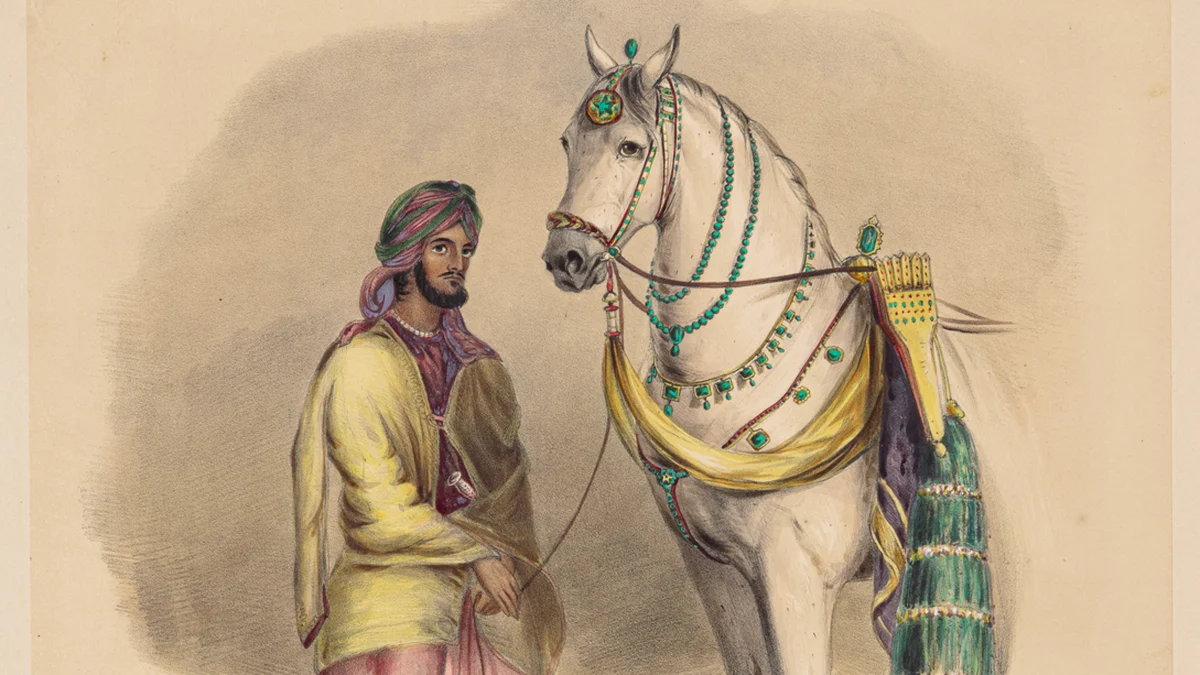
One of the most striking pieces is the “Horse of Runjeet Singh” (1844). Maharaja Ranjit Singh was famously obsessed with horses, particularly the legendary stallion ‘Laili.’ Eden’s depiction of the royal mount, adorned with emeralds and gold trappings, serves as a metaphor for the sheer wealth and power of the Lahore Darbar. This is complemented by the work “Jewels of Runjeet Singh,” which focuses entirely on the material culture of the court, documenting the Koh-i-Noor diamond and other legendary gems.
The "People" Behind the Princes
While the royalty takes center stage, Eden’s depictions of the “Shootr-Suwar” (camel courier) and other attendants offer a vital counterbalance. These sketches of camp followers, servants, and ordinary citizens provide a glimpse into the logistical scale of the British "Grand Progress" and the diverse population of 19th-century India.

Comparative Artistry
Art historians note that Eden’s work differs from that of Charlotte Canning (1817–1861). While Canning excelled in large-scale botanical studies and landscapes, Eden was a "compulsive communicator" of social dynamics. Her portraits are often accompanied by sharp, witty commentary in her journals, which the DAG exhibition integrates into the display to provide a multi-sensory understanding of her subjects.
Official Responses and Curatorial Vision
Curators at DAG emphasize that this exhibition is more than a nostalgic look at the Raj. In a statement regarding the exhibition, the gallery noted:

"Emily Eden’s works have long been viewed as charming Victorian sketches. However, by bringing the Eden Family Archives into the public eye alongside the Lahore Company School paintings, we are inviting a more rigorous academic assessment. We are looking at these works as historical evidence of a sovereign Indian state—the Sikh Empire—just years before its annexation."
Art critics have praised the inclusion of the Lahore Company School works, noting that they provide a "dialogue" between Eden’s European perspective and the local artists’ interpretations of the same subjects. This juxtaposition allows viewers to see how Indian artists were adapting to European tastes while maintaining their traditional precision in detail.

The exhibition has also drawn interest from historians specializing in the "Company School" of art. Dr. Arshiya Lokhandwala, an independent curator and art historian, remarked on the significance of the archive: "The emergence of these forgotten sketches allows us to see the ‘first drafts’ of history. Eden’s watercolours, before they were polished into lithographs for a London audience, often contain more raw, honest observations of the people she encountered."
Implications: Reassessing the Colonial Gaze
The "Princes & People of India" exhibition arrives at a time when the ethics of colonial-era art are under intense scrutiny. The implications of Eden’s work are twofold:

1. The Preservation of a Vanishing World
Eden’s residency coincided with the final years of the independent Sikh Empire. Following the death of Ranjit Singh in 1839, the region descended into a series of succession crises that eventually led to British annexation. Her portraits of Shere Singh and Heera Singh are among the last visual records of these figures as sovereign rulers rather than colonial subjects.
2. The Female Perspective in a Male Enterprise
As the sister of the Governor-General, Eden was part of the colonial machinery, yet as a woman, she occupied a peripheral space that allowed her to observe nuances that male officials might have missed. Her work challenges the monolithic view of "colonial art" by introducing a domestic and social intimacy. She captured the "society gossip" of the camps and the private dignity of her subjects, providing a narrative that is often missing from official dispatches.

3. Modern Reinterpretation
For a 21st-century audience, the exhibition prompts a reflection on how identity is constructed through the artist’s eye. While Eden’s work is undeniably rooted in the prejudices of her time, her "seriousness of purpose"—as evidenced by the sheer volume of her sketches—elevates her work from mere caricature to a vital historical archive.
As the DAG exhibition opens its doors, it offers a rare opportunity to bridge the gap between the 19th and 21st centuries. In the delicate watercolours of a "compulsive communicator" from the 1830s, modern viewers may find a surprisingly vivid, complex, and enduring portrait of India’s past.
