

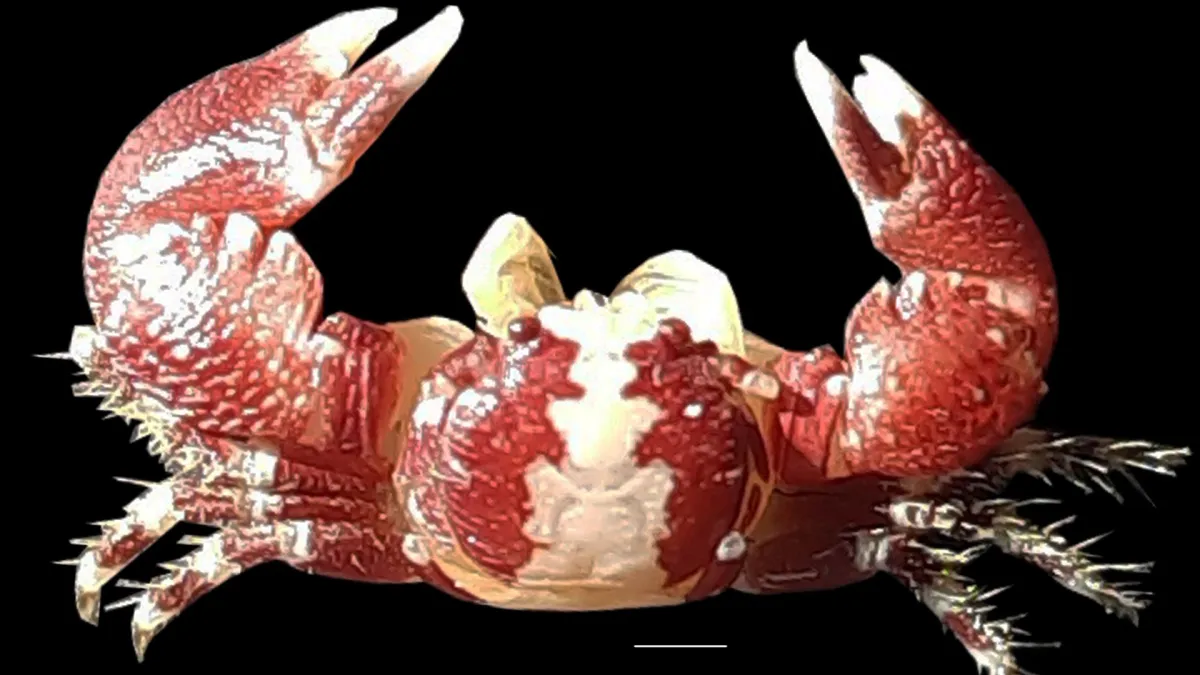
AGATTI ISLAND, LAKSHADWEEP — In the translucent, turquoise waters of the Lakshadweep archipelago, where the Arabian Sea meets the coral fringes of India’s westernmost territory, a team of marine biologists has uncovered a vibrant secret. A new species of porcelain crab, distinguished by its striking carmine-red exoskeleton and intricate white markings, has been identified living among the shallow reefs of Agatti Island.
The discovery of Pachycheles ravichandrani marks a significant milestone in Indian marine taxonomy. While the crab’s appearance is undeniably aesthetic, its discovery carries profound implications for our understanding of the biodiversity hotspots tucked away in India’s intertidal zones. This find, the result of a collaborative effort between several of India’s premier marine research institutions, underscores the fact that even in well-traveled waters, nature still holds many mysteries.
Main Facts: A Crimson Gem of the Arabian Sea
The newly identified species, Pachycheles ravichandrani, belongs to the family Porcellanidae. Despite their name and crab-like appearance, porcelain crabs are not "true crabs" (Brachyurans). Instead, they are more closely related to squat lobsters and hermit crabs, belonging to the infraorder Anomura. They are famously named "porcelain" due to their extreme fragility; like a delicate vase, they are known to shed their limbs easily when threatened by a predator—a defensive mechanism known as autotomy—only to regrow them later.
Key Characteristics of Pachycheles ravichandrani:
- Coloration: The species is characterized by a deep carmine-red shell. It features a prominent white blotch on its dorsal surface and white spots on its chelipeds (claws). Its walking legs are adorned with horizontal carmine stripes.
- Habitat: The crabs were found in the shallow intertidal zones of Agatti Island, specifically hiding beneath rock boulders covered in coralline algae.
- Size and Structure: These are tiny crustaceans, often less than a few centimeters in size, possessing a sub-circular carapace and specialized hair-like structures called setae.
- Scientific Name: Named in honor of Dr. M. Ravichandran, Secretary of the Ministry of Earth Sciences (MoES), Government of India, for his contributions to marine science and his leadership of the Deep Ocean Mission.
The discovery was spearheaded by a joint research team from the ICAR-National Bureau of Fish Genetic Resources (NBFGR), the Kerala University of Fisheries and Ocean Studies (KUFOS), and the Centre for Marine Living Resources and Ecology (CMLRE).
Chronology: From the Shores of Agatti to the Laboratory
The journey to identifying Pachycheles ravichandrani began in November 2024, during a routine but intensive biodiversity survey of the Lakshadweep Islands. The archipelago, a chain of 36 islands known for its coral reefs and rich marine life, has been a focal point for the ICAR-NBFGR’s efforts to document India’s aquatic genetic resources.

November 2024: Field Discovery
During a low-tide exploration of the rocky shores of Agatti Island, researchers noticed small, brightly colored crustaceans darting between crevices in the volcanic and coral rocks. The specimens were collected from depths of less than one meter. Initial field observations suggested that while the crabs resembled other members of the Pachycheles genus, their color patterns and specific claw structures were unusual.
December 2024 – May 2025: Taxonomic Analysis
The collected specimens were transported to the laboratory, where they underwent a rigorous two-pronged identification process known as integrative taxonomy. This method combines traditional morphological examination (studying physical traits) with modern molecular phylogenetics (DNA analysis).
Researchers utilized high-powered microscopy to map the crab’s physical architecture. They discovered unique features that separated it from its closest relatives found in the Western Pacific and Japan. Simultaneously, tissue samples were processed for DNA sequencing.
June 2025: Genetic Confirmation
By mid-2025, the genetic data provided the "smoking gun." The mitochondrial DNA analysis revealed a significant genetic divergence (ranging from 12.6% to 21.7%) from other known species within the Pachycheles genus. This level of divergence confirmed that the Agatti crab was indeed a distinct, previously undescribed species.
July 2026: Official Publication and Announcement
Following peer review and formal documentation, the discovery was officially announced to the public and the scientific community in July 2026, highlighting Lakshadweep as a critical site for marine conservation.

Supporting Data: The Science of Differentiation
The identification of Pachycheles ravichandrani was not merely based on its red color, as many marine species can exhibit color variations. The scientific team relied on specific morphological markers and genetic distance to validate the new species.
Morphological Distinctions
Under microscopic review, several key anatomical features emerged:
- The Carapace: The shell is sub-circular and covered in specialized setae (bristles) along the ridges. These structures are vital for the crab’s sensory perception in the turbulent intertidal zone.
- The Chelipeds (Claws): One of the most defining characteristics of P. ravichandrani is a distinct gap between the "fingers" of its smaller claw. Furthermore, the cutting edge of the claw is "truncate" (appearing squared off), a feature not seen in its nearest relative, Pachycheles stevensii, or other Indo-Pacific cousins.
- Sternal Plate: The shape of the thoracic sternum provided further evidence of its unique evolutionary path within the Anomura infraorder.
Molecular Evidence
The team targeted the Cytochrome c Oxidase subunit I (COI) gene, often referred to as the "DNA barcode" for animals. The genetic distance between P. ravichandrani and its sister species was found to be:
- 12.6% divergence from the most closely related species in the Western Pacific.
- Up to 21.7% divergence from other known members of the genus.
In the world of crustacean taxonomy, a divergence of over 10% is typically a strong indicator of a separate species, making the case for P. ravichandrani scientifically ironclad.
Official Responses: Honoring Leadership in Marine Science
The naming of the species—Pachycheles ravichandrani—serves as a tribute to Dr. M. Ravichandran. As the Secretary of the Ministry of Earth Sciences, Dr. Ravichandran has been a pivotal figure in advancing India’s "Blue Economy" initiatives and the "Deep Ocean Mission."

In response to the discovery, representatives from the ICAR-NBFGR stated that the find is a testament to India’s growing expertise in marine exploration. "This discovery underscores the importance of documenting our marine germplasm resources," said a lead researcher. "By naming this species after Dr. Ravichandran, we acknowledge his tireless efforts in promoting marine biodiversity and oceanographic research in India."
Dr. Ravichandran’s leadership has been instrumental in deploying advanced technology for underwater exploration, and though this specific crab was found in shallow water, the institutional framework he helped build has fostered a new era of discovery across all depths of the Indian Ocean.
Implications: Why a Tiny Crab Matters
While a small porcelain crab might seem insignificant in the grand scale of the ocean, its discovery has wide-ranging implications for ecology, conservation, and climate science.
1. Indicators of Reef Health
Porcelain crabs are filter feeders; they use specialized fan-like appendages to strain plankton and organic particles from the water. Because they rely on specific water quality and the presence of coralline algae, their presence (or absence) can serve as a biological indicator of the health of the reef ecosystem. The discovery of a thriving population on Agatti Island suggests that these specific micro-habitats currently maintain the necessary conditions to support specialized life.
2. Biodiversity and the "Blue Economy"
India’s "Blue Economy" policy emphasizes the sustainable use of ocean resources for economic growth while preserving the health of the ocean ecosystem. Discovering new species is a fundamental part of this. We cannot protect what we do not know exists. Mapping the biodiversity of the Lakshadweep archipelago allows the government to create more effective Marine Protected Areas (MPAs).

3. Evolutionary Insights
The discovery adds a new piece to the puzzle of "carcinization"—the evolutionary process where non-crab crustaceans evolve to look like true crabs. Studying P. ravichandrani helps scientists understand how these creatures adapted to the high-energy environment of the rocky intertidal zones of the Arabian Sea compared to their relatives in the Pacific.
4. The Threat of Climate Change
Lakshadweep is one of the regions most vulnerable to climate change. Rising sea temperatures and ocean acidification threaten the coral reefs that provide the very boulders and algae P. ravichandrani calls home. Scientists warn that many species in these reefs may go extinct before they are even discovered. This find serves as a call to action for increased funding and urgency in marine biological surveys.
Conclusion: The Horizon of Discovery
The discovery of Pachycheles ravichandrani is more than just a new entry in a scientific catalog. It is a reminder of the sheer vibrancy of India’s natural heritage. As the research team from ICAR-NBFGR, KUFOS, and CMLRE continues to analyze the samples from their 2024 expedition, they hint that this red crab may be the first of many new species to be announced.
In the shallow reefs of Lakshadweep, where the red shells of Pachycheles hide beneath the stones, a larger story of exploration is unfolding. It is a story that proves that even in the 21st century, the age of discovery is far from over—it is merely moving beneath the waves.
