

MUMBAI — For decades, the skyline of urban India was defined by the glass-and-steel monoliths of the Information Technology (IT) sector. From the sprawling campuses of Whitefield in Bengaluru to the high-rises of Gurugram and the financial hubs of Mumbai’s BKC, real estate value was inextricably linked to human density. Success was measured by "seats," "floor plates," and "commute times."
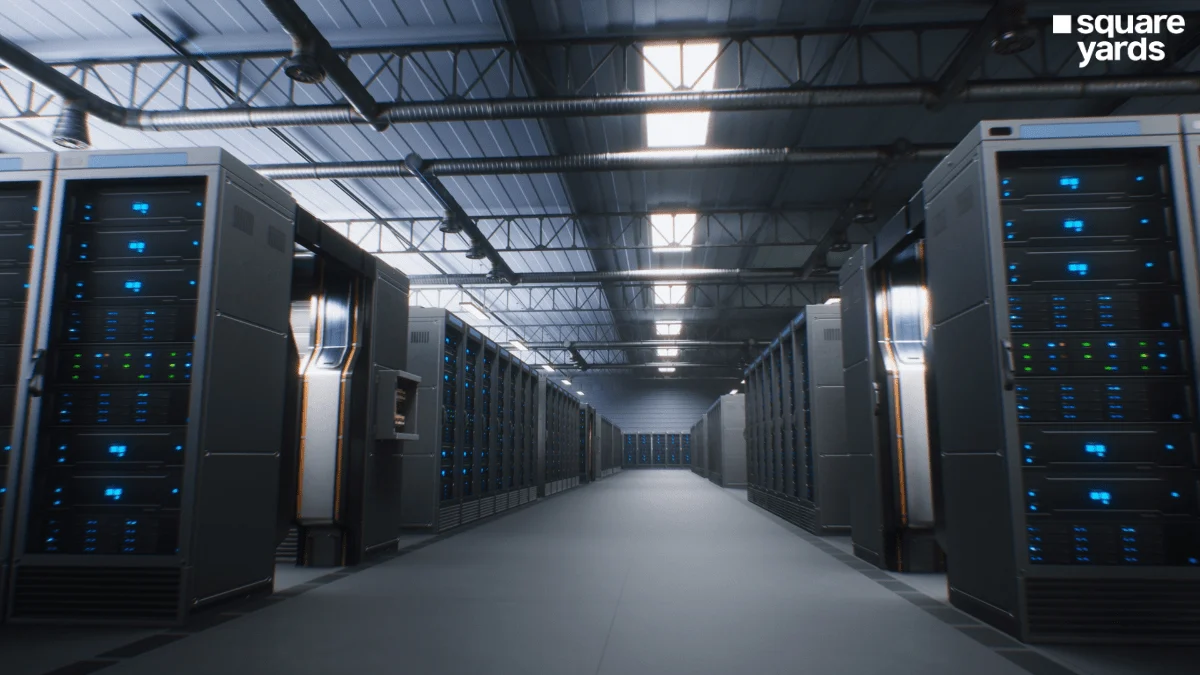
However, as we move through the second half of 2026, a fundamental shift has occurred. The most coveted tenant in the Indian property market no longer requires a cafeteria, a gym, or a parking spot. It doesn’t care about the proximity to a metro station for its commute. This tenant is the server rack—specifically, the high-density, AI-optimized server rack.
According to the latest H1 2026 report from Savills India, a historic inversion has taken place: data centers attracted 38% of all private equity inflows into Indian real estate, officially dethroning office assets (30%) and residential projects (16%). This is not merely a statistical outlier; it is the dawn of a new real estate cycle where machines, not humans, are the primary drivers of land value.
I. Main Facts: The Great Inversion of 2026
The surge in data center investment is the result of a "perfect storm" of domestic data localization laws, the massive rollout of 5G-enabled services, and, most crucially, the generative AI explosion.
By July 2026, the Indian data center landscape has transitioned from a niche infrastructure play to a mainstream institutional asset class. The "Quiet Land Grab" is characterized by three primary shifts:
- Capital Migration: Institutional investors who traditionally sought the stability of Grade-A office rentals are pivoting to data centers, drawn by longer lease terms (often 10–15 years) and the mission-critical nature of the tenant.
- Physical Transformation: The "AI-Ready" data center is a different beast entirely. While traditional facilities operated at 10 kW per rack, the new generation of AI campuses requires 100 kW or more, necessitating a total overhaul of cooling and power delivery systems.
- Policy Tailwinds: The Union Budget of 2026 introduced a landmark tax holiday for eligible foreign cloud companies, extending until 2047. This has neutralized the rising costs of land and power, keeping India’s "cost-per-megawatt" globally competitive.
II. Chronology: From Storage to Intelligence (2019–2026)
To understand the current boom, one must look at the rapid evolution of the sector over the last seven years:
- 2019–2022: The Foundation Era. India saw approximately $60 billion in investment commitments. This period was defined by "hyperscale" interest from Amazon Web Services (AWS), Google Cloud, and Microsoft Azure, primarily focusing on data storage and basic cloud services.
- 2023–2024: The AI Pivot. The global surge in Large Language Models (LLMs) changed the requirements. Developers began acquiring larger land parcels (50+ acres) to accommodate the massive power hunger of AI training clusters.
- 2025: The Capacity Milestone. By April 2025, India’s operational capacity reached 1.3 GW. However, the gap between "announced" projects and "operational" megawatts began to widen due to power grid constraints.
- 2026: The Institutional Takeover. Data centers officially became the #1 recipient of Private Equity in the real estate sector. The "Budget 2026" incentives acted as a catalyst, sparking a rush of foreign direct investment (FDI) from sovereign wealth funds and pension funds.
III. Supporting Data: The Gigawatt Race
The scale of the transformation is best illustrated by the numbers. Market intelligence from CBRE and Jefferies highlights a trajectory that is almost vertical.
Investment and Capacity
- Total Investment Forecast: Projections suggest that total investment commitments in India’s data center industry will exceed $100 billion by 2027.
- Capacity Growth: From a base of 1.3 GW in early 2025, Mordor Intelligence and Jefferies project a five-fold increase to 8 GW by 2030.
- Capex Requirements: To reach the 8 GW goal, an estimated $30 billion in capital expenditure is required for construction and hardware alone.
The Energy Consumption Paradigm
The most staggering data point involves the national power grid. Kotak Institutional Equities estimates that by the 2030 fiscal year, data centers will consume 4–5% of India’s total power capacity. In absolute terms, this equates to approximately 57 TWh annually.
For context, this energy requirement is equivalent to the total annual consumption of several smaller Indian states combined. This has forced a shift in real estate strategy: land is no longer valued for its "address," but for its proximity to high-voltage transmission lines and dedicated electrical substations.
IV. Official Responses and Industry Sentiment
The government and industry titans have responded with a mix of aggressive expansion and cautious regulation.
Government Strategy: The 2047 Vision
The Ministry of Electronics and Information Technology (MeitY) has positioned data centers as the backbone of the "Viksit Bharat" (Developed India) 2047 goal. A senior official recently noted, "Data is the new oil, but the data center is the refinery. Without the refinery, the oil is useless. Our 2026 tax incentives are designed to ensure the world’s AI models are trained on Indian soil."
Industry Leaders: Beyond Real Estate
Major players like the Adani Group (via AdaniConneX), Reliance Industries, and Yotta Data Services are no longer viewing themselves as "landlords." They are positioning themselves as integrated infrastructure providers.
"We are not just building shells; we are building energy-to-compute ecosystems," says a lead strategist at a major Mumbai-based developer. "When a hyperscaler asks for 100 MW of power, they are also asking for 100% renewable energy credits. This is forcing us to integrate solar and wind farms directly into our real estate portfolios."
The Regulatory Watchlist
However, environmental regulators are raising flags. The cooling requirements for 100 kW racks are immense. In states like Maharashtra and Telangana, new guidelines are being drafted to mandate "Zero Liquid Discharge" (ZLD) systems to prevent data centers from depleting local groundwater tables.
V. Implications: The Ripple Effect on Property Markets
The rise of the "Server Tenant" is rewriting the rules for land, housing, and commercial districts.
1. Land Re-Rating and the "Power Premium"
In micro-markets like Navi Mumbai (Airoli and Mahape) and Hyderabad (Kondapur and Gachibowli), land prices have surged by 40–60% over the last 24 months. The "Power Premium" is now a recognized valuation metric. A plot of land with an existing 100 MW power sanction is now worth significantly more than a similar-sized plot intended for a residential luxury high-rise.
2. The Residential "Anchor" Effect
While data centers employ fewer people per square foot than IT offices, they act as permanent anchors for a district. A data center campus involves a 3-to-5-year construction phase employing thousands, followed by a permanent workforce of high-earning engineers, security experts, and facility managers.
- Housing Impact: This creates a steady, "recession-proof" demand for rental housing in the mid-to-high-end segment. Unlike the volatile demand shifts seen with "Work From Home" in the IT sector, data center operations require on-site presence 24/7/365.
3. The Ancillary Industrial Boom
Data centers are catalysts for industrial "clusters." They attract:
- Logistics & Warehousing: For the storage of high-value hardware and spare parts.
- Manufacturing: Local assembly of server racks, cooling units, and backup power systems (UPS).
- Flexi-Offices: Smaller satellite offices for the vendors and service providers that support the data center ecosystem.
VI. The Caution List: Navigating the Risks
Despite the optimism, the path to 8 GW is fraught with "choke points" that investors and developers must navigate.
- The Execution Gap: There is a widening disparity between "MoUs signed" and "Megawatts commissioned." Investors betting on land near "proposed" sites may find themselves stranded if the local grid cannot support the promised power load.
- Speculative Bubbles: In corridors where data center "rumors" have driven land prices to astronomical levels, the economics are becoming precarious. If land costs rise too high, developers will simply move to the next "fiber-ready" town, leaving speculators with overpriced industrial land.
- Obsolescence Risk: AI technology moves faster than real estate construction. A building designed for 2024 standards may be obsolete by 2028 if it cannot support the next generation of liquid cooling or power-hungry chips.
VII. Conclusion: The New Invisible Hand
Infrastructure has always been the invisible hand behind Indian property wealth. In the 2000s, it was the expressway; in the 2010s, it was the Metro rail. In the 2020s, it is the data center.
The data center is a unique asset because it is simultaneously the infrastructure and the tenant. It brings its own power, its own connectivity, and its own long-term capital. For the retail investor or homebuyer, the lesson of 2026 is clear: the most valuable neighborhoods of the future will be those that can satisfy the needs of both humans and machines.
As institutional money leads the way, the traditional question—"How far is the office?"—is being replaced by a more forward-looking inquiry: "Is this neighborhood powered for the AI age?" Those who identify the corridors where power, fiber, and policy intersect will be the ones who see their value quietly compound over the next decade.
