

MUMBAI – In the sun-scorched expanses of the Kachchh Basin in western India, where the earth bleeds the secrets of millions of years, a team of researchers has unearthed a find that rewrites the evolutionary history of the world’s most iconic giants. Scientists from the Indian Institute of Technology Bombay (IIT Bombay) and the Birbal Sahni Institute of Palaeosciences (BSIP) have announced the discovery of a new species of long-necked dinosaur, Ceratocaudia antiqua, a creature that roamed the Indian subcontinent during the Middle Jurassic period, approximately 170 to 180 million years ago.
This discovery, documented following extensive excavations in the Kaladongar Formation near the village of Amrapar, introduces a "diminutive giant" to the paleontological record. While its cousins, such as the Brachiosaurus, are famed for their skyscraper-like proportions, Ceratocaudia antiqua offers a unique glimpse into a lineage that prioritized specialized defense and anatomical innovation over sheer scale.
The Discovery: Unearthing a Jurassic Relic
The journey to this discovery began in the rugged terrain of Gujarat’s Kutch district, a region long recognized by geologists for its rich fossiliferous strata. The Kaladongar Formation, characterized by its sedimentary layers deposited during a time when India was still part of the supercontinent Gondwana, served as the final resting place for this specimen.
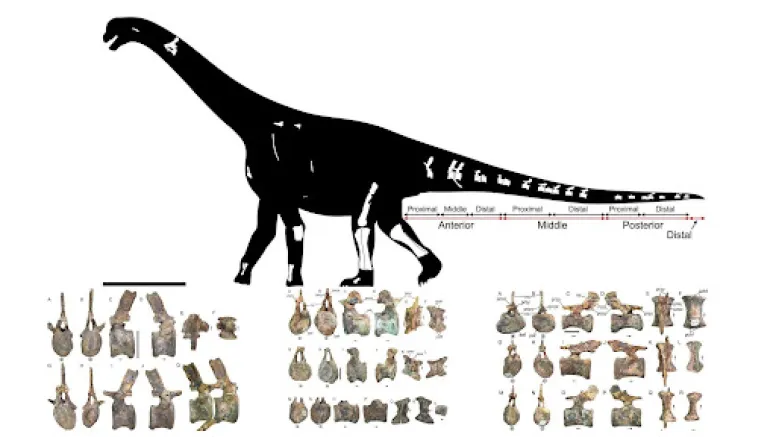
The excavation yielded a partial but highly significant skeleton. Unlike many fossil finds that consist of isolated teeth or fragments, the Amrapar specimen provided enough cranial and post-cranial material—including neck vertebrae, tail bones, and limb elements—to allow for a comprehensive reconstruction.
What the researchers found was an animal that challenged the traditional image of the "gentle giant" sauropod. Reaching an estimated length of only seven meters, Ceratocaudia was a fraction of the size of the 20-meter titans that would dominate the later Jurassic and Cretaceous periods. However, its small stature was compensated for by a suite of bizarre physical adaptations, most notably a formidable, horn-like crest situated atop its tail.

Anatomical Anomalies: The "Horned Tail" and Beyond
The name Ceratocaudia antiqua is a literal description of its most striking feature. Derived from the Greek ‘cerato’ (horn) and the Latin ‘cauda’ (tail), the genus name highlights a curved, bony spike protruding from the dorsal surface of its front tail vertebrae.
The Tail as a Deterrent
In the high-stakes environment of the Jurassic, where predators like early theropods were a constant threat, Ceratocaudia appears to have evolved a specialized defense mechanism. The "horn" on its tail was not merely an ornamental growth; biomechanical analysis suggests it served as a deterrent. By swinging its tail, the dinosaur could present a spiked surface to any predator attempting a rear-flank attack.
Furthermore, the tail vertebrae exhibit a rare evolutionary transition. Near the tip of the tail, the joints shift from flat-ended (amphiplatyan) to "ball-and-socket" (procoelous) joints. This anatomical flexibility is typically associated with much later, more "advanced" dinosaur species, making its appearance in an early Middle Jurassic specimen a point of intense scientific interest.
The "Senior Citizen" of the Mesozoic
Perhaps the most poignant aspect of the discovery is the life history of the individual excavated. Through the use of 3D laser scanning and high-resolution CT technology, the research team performed a deep dive into the bone histology of the specimen.
The results revealed that this was not a juvenile whose growth had been stunted, but rather an elderly individual. The bones showed clear signs of extensive "remodelling"—a process where old bone tissue is replaced by new tissue, which occurs throughout an animal’s life. More strikingly, the fossils exhibited evidence of ancient arthritis in the leg joints. This "senior citizen" of the dinosaur world had survived long enough to feel the wear and tear of age, providing rare data on the longevity and senescence of sauropods.

Chronology of the Lineage: A New Branch on the Family Tree
The discovery of Ceratocaudia antiqua provides a critical missing link in the chronology of the Macronaria, a major group of sauropod dinosaurs characterized by their large nostrils (hence the name "large nose") and boxy skulls.
Prior to this find, the record of Macronarian dinosaurs in India during the Jurassic was nearly non-existent. Most of our understanding of this group came from much later specimens found in North America, Europe, and Africa. Ceratocaudia pushes the presence of this lineage in India back to the early Middle Jurassic, suggesting that these dinosaurs were already diversifying and spreading across the globe far earlier than previously hypothesized.
The "antiqua" species name (Latin for ancient) serves as a placeholder for its status as one of the earliest diagnosable members of its lineage anywhere in the world. It proves that the Indian landmass was a vibrant hub of evolutionary experimentation during the breakup of Gondwana.
Supporting Data and Methodology
The identification of Ceratocaudia as a distinct species rested on several "autapomorphies"—unique traits not found in other dinosaurs.
- Cervical Notch: The neck vertebrae (cervical) feature a unique notch that likely accommodated specific ligament attachments, possibly allowing for a different range of neck motion compared to other sauropods.
- Lower Leg Morphology: The tibia and fibula (the bones of the lower leg) possess distinct shapes and muscle attachment points that indicate a sturdy, albeit smaller, gait.
- Vertebral Transition: The sudden shift in the tail’s joint structure remains one of the most significant morphological data points, indicating a high level of tail mobility.
The team utilized state-of-the-art 3D reconstruction to visualize how these bones fit together in a living animal. This digital "fleshing out" allowed researchers to estimate muscle mass and movement patterns, confirming that Ceratocaudia was a highly specialized herbivore capable of navigating the coastal plains and deltaic environments of ancient Kutch.

Official Responses and Scientific Impact
The discovery has sent ripples through the international paleontological community. Lead researchers from IIT Bombay and the Birbal Sahni Institute have emphasized the collaborative nature of the project and its implications for India’s scientific heritage.
"This discovery is a testament to the untapped potential of the Indian fossil record," noted a spokesperson for the research team. "For decades, the Jurassic of India was seen as a ‘quiet’ period for sauropod evolution. Ceratocaudia proves that the subcontinent was actually a crucible for new species and unique anatomical adaptations."
Dr. Sunil Bajpai, a prominent figure in Indian paleontology (and a key contributor to such studies), has previously highlighted how the Kachchh Basin serves as a window into the past. In official statements regarding the region’s importance, experts have noted that the unique geological history of the Kutch—alternating between marine and terrestrial environments—provides a perfect "preservation trap" for Jurassic fauna.
Academic peers have praised the use of CT scanning and histological analysis in this study. "By proving the individual was elderly and suffered from arthritis, the team has moved beyond mere taxonomy," said an independent paleontologist. "They have given us a biography of a 170-million-year-old animal."
Implications: Rewriting the "Out of India" Narrative
The discovery of Ceratocaudia antiqua has profound implications for our understanding of paleobiogeography. It supports the theory that many major dinosaur lineages may have had an early presence—or even their origins—on the Indo-Madagascar landmass before migrating to other parts of the world.

As a member of the Macronaria, Ceratocaudia suggests that the ancestors of giants like Titanosaurus and Brachiosaurus were already established in India while the continents were still closely huddled together. This find bridges the gap between the primitive sauropods of the Early Jurassic and the massive titans of the Late Jurassic.
Furthermore, the discovery underscores the importance of protecting and studying the Kaladongar Formation. As mining and industrial development expand in western India, the window to uncover more "missing links" like Ceratocaudia may be closing.
Conclusion: The Legacy of the Small Giant
Ceratocaudia antiqua stands as a reminder that evolution does not always favor the biggest or the strongest, but often the most adaptable. In the shadow of the true giants, this seven-meter-long dinosaur carved out a niche for itself, defended by a spiked tail and a resilient spirit that carried it into old age.
As the fossils are prepared for further study and eventual public display, they serve as a beacon for Indian science. The "ancient horned tail" of Amrapar is no longer a hidden secret of the Kutch clay; it is a global ambassador for a lost world, proving that India’s soil holds the keys to understanding the history of life on Earth.
The research team plans to return to the Kachchh Basin in the coming seasons, hopeful that the same layers of earth that yielded Ceratocaudia might hold the remains of its predators or the plants it once consumed, providing a full picture of a Jurassic ecosystem that has waited 175 million years to be told.
