

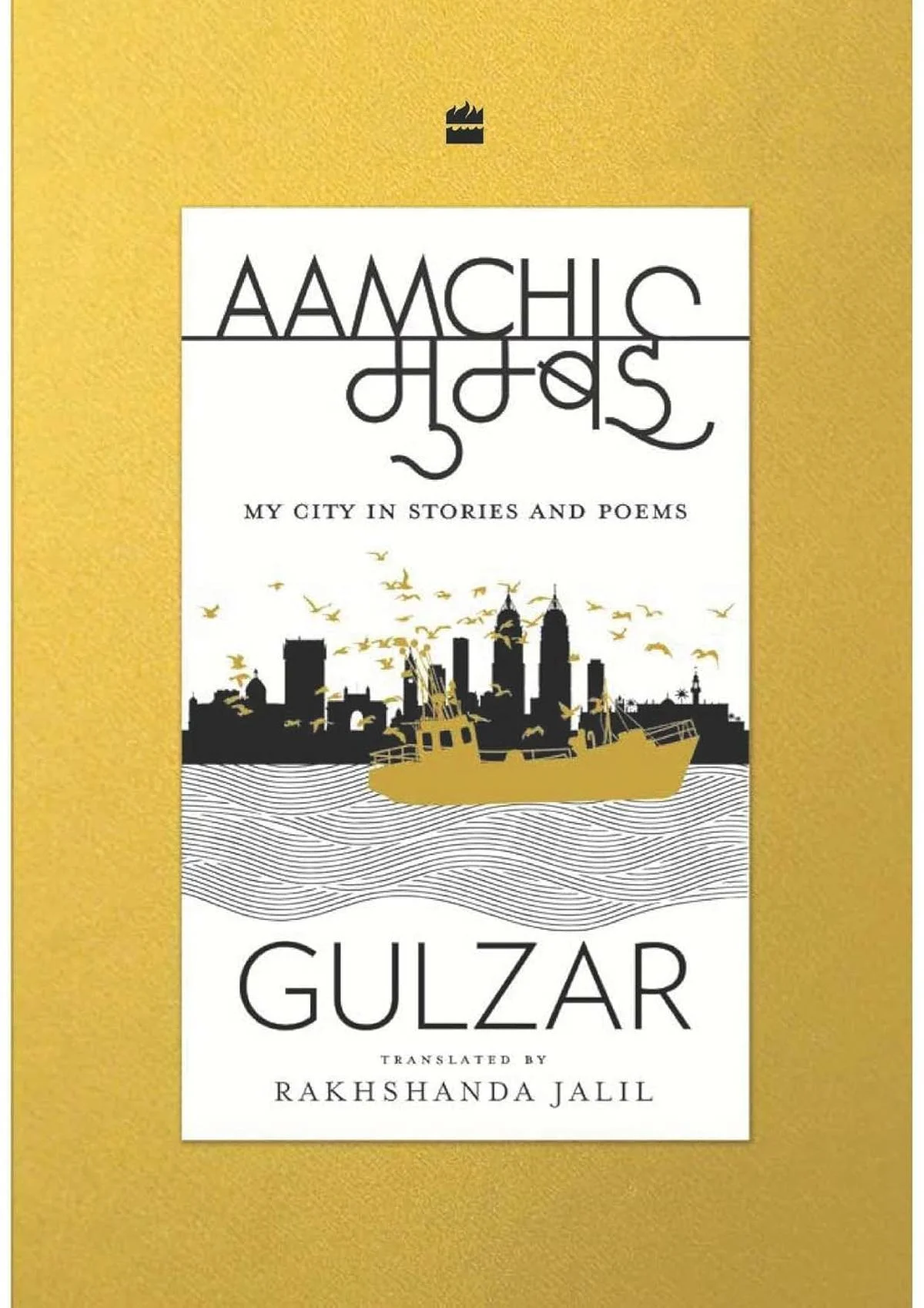
On a typical Mumbai afternoon, where the monsoon heavens have unspooled in a relentless, grey downpour, the winding roads of Bandra’s Pali Hill offer a muted backdrop to a legacy seven decades in the making. Behind the gates of an unpretentious white bungalow—a relic of an era before glass-and-chrome skyscrapers redefined the skyline—sits Sampooran Singh Kalra, known to the world by the singular, evocative pen name, Gulzar.
At 90, the legendary poet, filmmaker, and lyricist remains a vital witness to the evolution of the city that adopted him. His latest offering, Aamchi Mumbai (My Mumbai), a collection of poems and short stories originally penned in the 1980s and now translated by Rakhshanda Jalil for HarperCollins, serves as a tactile map of a city’s "capacious and chaotic heart."
This article explores the release of this anthology, the historical trajectory of Gulzar’s career, and his profound reflections on the socio-political shifts that have transformed Mumbai from a working-class bastion into a neo-liberal fantasy.

Main Facts: A Literary Map of the 1980s
Aamchi Mumbai is not merely a book; it is an archival excavation. The anthology captures the salt-flecked air and the rhythmic dissonance of the 1980s—a decade that defined the city’s modern identity. Through Gulzar’s lens, Mumbai is personified with startling originality. In the opening verses, he describes the city as a "long fish lying in the water," a nod to its island origins and its fluid, slippery nature. By night, it becomes a "black cat," predatory and silent, with claws tucked into its belly.
The collection, translated with sensitivity by Jalil, bridges the gap between the poetic and the pedestrian. It moves from the "ubiquitous marketing hype" of a city obsessed with selling itself to darker, more visceral themes. Gulzar writes of "nests falling from branches" during strong winds—a metaphor for the fragile dreams of migrants that are often shattered by the city’s indifference.
The stories are predominantly first-person narratives, a technique that allows Gulzar to inhabit the "canny outsider’s persona." Whether documenting the life of a clarinet player named Firoze or recounting the frantic, final days of filmmaker Bimal Roy, the anthology functions as a mosaic of Mumbai’s contradictions.

Chronology: From Partition Refugee to Cultural Icon
To understand Aamchi Mumbai, one must understand the journey of the man who wrote it. Gulzar’s life is a mirror of the sub-continent’s 20th-century history.
1. The Migration (1947–1950)
Born in 1934 in Dina (now in Pakistan), Gulzar was uprooted by the Partition. He arrived in Delhi as a refugee, but it was Mumbai that beckoned. At the age of 16, following a brief stint at St. Stephen’s College, he was given a one-way train ticket to Mumbai. He alighted at Dadar and moved into a sparse chawl (tenement) opposite KEM Hospital.
2. The Garage and the Lyrics (1950s–1963)
Before the fame, Gulzar worked as a mechanic in a motor garage. His nights, however, were spent at the Red Flag Hall in Khetwadi, engaging with the Progressive Writers Group. His entry into cinema was accidental. In 1962, the legendary Bimal Roy was looking for a lyricist to pen a Vaishnav song for the film Bandini. Despite his initial reluctance to join the "frivolous" world of films, Gulzar—prompted by the poet Shailendra—wrote "Mora Gora Ang Lai Le." The song’s success anchored him in the industry.

3. The Cinematic Peak (1970s–1990s)
Gulzar transitioned from lyricist to screenwriter and eventually a director of high repute. Films like Aandhi, Mausam, and Ijaazat established him as a filmmaker who understood the nuances of human relationships. However, throughout this period, he maintains that literature was his primary spouse; cinema was merely a "stability-providing" companion.
4. The Literary Return (2000–Present)
Following the creative frustrations of his last directorial venture, Hu Tu Tu (1999)—which was re-edited by producers without his consent—Gulzar pivoted back toward pure literature. This period saw a prolific output of poetry collections and his monumental work, A Poem A Day (2020), which translated 365 poems from 34 Indian languages.
Supporting Data: The Changing Texture of Urban Life
Gulzar’s recollections provide a data-rich narrative of how Mumbai’s social fabric has altered over 70 years. He identifies several key shifts in the city’s "urban soul":

- The Economy of Survival: In the 1950s, Gulzar recalls surviving on keema pav for 25 paise. Irani cafes functioned as social safety nets, providing free water and leftover biryani for the hungry—a level of community welfare that has largely vanished in the modern, transaction-heavy city.
- The Loss of Public Civility: He notes a shift in public transport etiquette. In the mid-20th century, bus conductors would actively manage crowds to prevent the "mad rush" typical of today’s Mumbai locals, asking passengers to wait for the next vehicle out of respect for space and safety.
- The Price of Poverty: One of the most poignant observations in the interview is the shift in the perception of the working class. Gulzar remarks, "Garibi mein jo garibi ki dignity thi, aaj usme sharmindgi hai" (The dignity that once existed in poverty has been replaced by shame). This reflects the transition from a socialist-leaning, union-driven city to one where wealth is the only metric of worth.
Official Responses and Perspectives: Secularism and the Arts
In a climate often defined by polarization, Gulzar’s perspective on the film industry serves as an "official" defense of the medium’s cultural role. During the interview, he recalled a conversation with the late former President of India, Pranab Mukherjee, upon receiving the Dadasaheb Phalke Award.
Gulzar told the President that the Hindi film industry remains one of the few "steadfastly secular" institutions in the country, second only to the Armed Services. This perspective highlights the industry as a melting pot where talent transcends communal identity—a sentiment he believes has remained unchanged despite shifting political winds.
Furthermore, he addresses the "outsider" perspective. Despite living in Mumbai for 76 years, Gulzar’s writing remains "uniquely alchemised" by his North Indian roots, his native Punjabi, and his deep fascination with Bengali literature (cultivated under Bimal Roy). He argues that being a "Mumbaikar" is not about shedding one’s origins but about keeping one’s "antenna open" to the city’s heterogenous rhythms.

Implications: The Legacy of a Progressive City
The publication of Aamchi Mumbai and Gulzar’s ongoing work carry significant implications for the future of Indian literature and urban identity.
The Preservation of the ‘Composite’ Culture
Gulzar’s insistence on engaging with writers across languages—from Marathi stalwarts like P.L. Deshpande to Bengali novelists—underscores the importance of a "composite" Indian identity. He suggests that Mumbai, as a progressive springboard, allows for a pan-Indian literary dialogue that is increasingly rare in more regionalistic pockets of the country.
The Warning of the ‘Neo-Liberal Fantasy’
The anthology serves as a warning against the "advertising city." By highlighting the "darker and more unsettling themes" of the 1980s, Gulzar reminds readers that the city’s glitter often masks the "sobbing and sighing" of those whose dreams have failed to take flight. His work acts as a conscience for a city that is moving too fast to look back.

The Resilience of the Creative Spirit
Ultimately, Gulzar’s journey from a garage mechanic to a Dadasaheb Phalke awardee—while remaining a "bookish young man" at heart—is a testament to Mumbai’s role as a city of possibilities. He views the city as an "elder brother" who might give you a "box on the ears" but never lets you go.
As the monsoon continues to lash the windows of his Pali Hill home, Gulzar remains a sentinel of the city’s history. Aamchi Mumbai is more than a collection of poems; it is a reminder that while the buildings may grow taller and the Irani cafes may fade, the "salt-flecked sea air" of Mumbai will always carry the stories of those who dared to call it home.
