

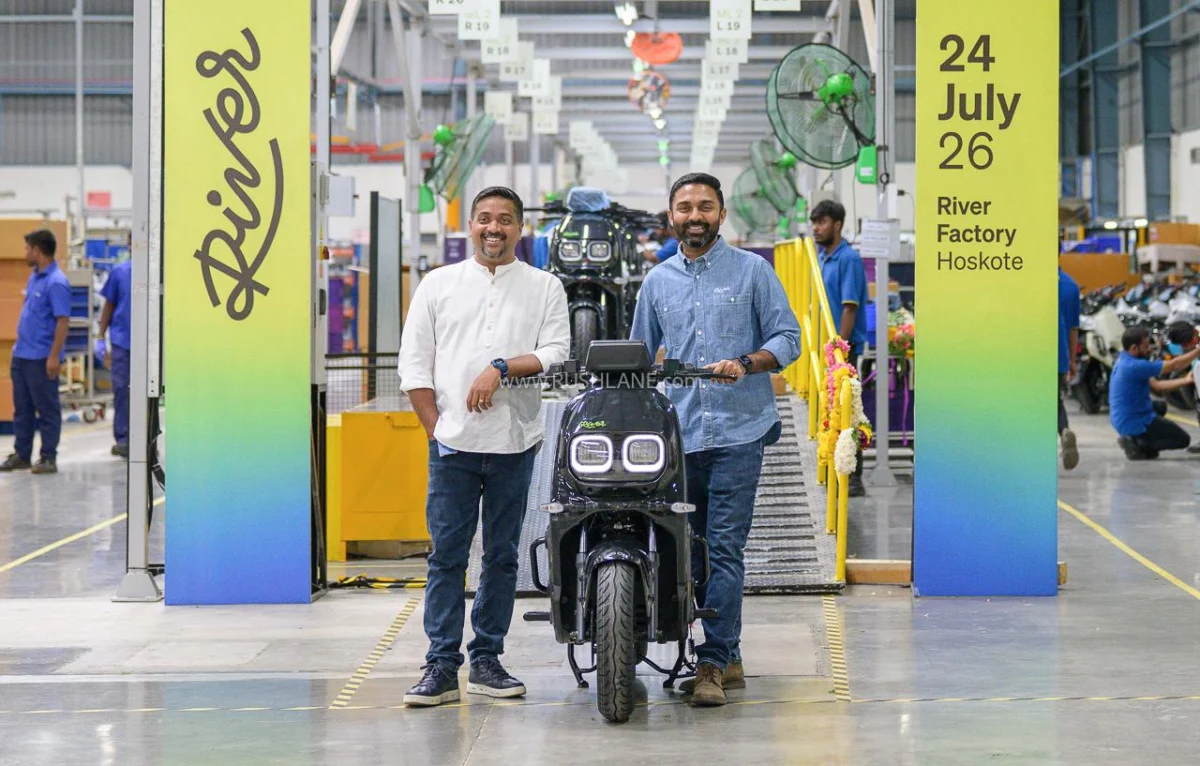
The achievement comes at a time when River is experiencing its most aggressive growth phase to date, buoyed by a robust retail expansion and a strategic manufacturing partnership with Japanese conglomerate Yamaha. As the "SUV of scooters" finds its footing, the 50,000-unit mark serves as a testament to the brand’s unique positioning and engineering pedigree.
I. The Milestone: Scaling New Heights in Hoskote
The 50,000th Indie, draped in the brand’s signature aesthetic, rolled off the assembly line amidst celebrations involving the company’s workforce and leadership. For River Mobility, the journey to 50,000 units has been defined by a focus on utility and "lifestyle-first" engineering—a departure from the performance-centric or budget-centric approaches of its peers.
The Hoskote plant, which serves as the nerve center for River’s operations, has undergone significant scaling to meet burgeoning demand. The facility is not merely an assembly point but a hub where the Indie’s unique features—such as its signature 14-inch wheels and massive storage solutions—are brought to life.
Reaching this volume in under 36 months is a feat that many EV startups have struggled to achieve, often hampered by supply chain bottlenecks or lack of consumer trust. River’s ability to scale suggests that its value proposition—offering a rugged, versatile alternative to the sleek, urban-focused designs of competitors—is resonating with a broader demographic of Indian riders.
II. A Chronology of Disruption: From Concept to Top 5
River Mobility’s ascent can be traced through several pivotal moments that transformed it from a niche startup into a top-tier market contender.
The Inception and Launch (2023-2024)
River entered the market with a clear identity: the "SUV of Scooters." While other brands focused on top speed or futuristic aesthetics, River focused on practicality. The Indie was launched with 43 liters of under-seat storage, 12 liters of front glove-box space, and unique features like pannier mounts and front footpegs. This focus on "carry-all" utility carved out a new segment in the EV space.
The Gen 3 Transformation (October 2025)
The launch of the Indie Gen 3 in October 2025 was a turning point. Priced at Rs 1.46 lakh at the time, the Gen 3 was not just a cosmetic update but a response to intensive customer feedback. It introduced:
- Hill Hold Assist: Enhancing safety on inclines.
- Revised Instrumentation: A more intuitive user interface.
- App-Based Functionality: Deepening the digital ecosystem for riders.
- Enhanced Dynamics: Grippier tires and refined suspension tuning.
The Breakout Year (2026)
By mid-2026, the cumulative effect of product refinements and retail expansion began to show in the sales charts. June 2026, in particular, will be remembered as the month River broke into the "Top 5" list of bestselling electric scooters in India, solidifying its status as a major player.

III. Supporting Data: Analyzing the Sales Surge
The numbers behind River’s recent success tell a story of exponential growth. In June 2026, River recorded sales of 5,217 units. To put this in perspective, the company sold 1,432 units in June 2025. This represents a staggering 264.32% Year-on-Year (YoY) growth.
The Competitive Landscape (June 2026 Sales)
River now finds itself in the company of India’s automotive royalty. The June 2026 sales leaderboard for electric scooters highlights the scale of the competition:
- TVS iQube: 47,331 units
- Bajaj Chetak: 40,376 units
- Ather Rizta: 24,742 units
- Hero Vida: 20,416 units
- River Indie: 5,217 units
While a gap remains between River and the "Big Four," the startup has successfully bypassed several other legacy and electric-only brands to secure the fifth spot. The fact that River is competing with the likes of TVS and Bajaj—companies with decades of manufacturing experience and thousands of touchpoints—underscores the Indie’s strong product-market fit.
Retail Footprint Expansion
The sales surge is directly correlated with River’s aggressive physical presence. In October 2025, River operated just 34 outlets. Today, that number has grown to over 75 stores across India. This rapid doubling of the retail network has allowed the brand to penetrate Tier-1 and Tier-2 cities, bringing the "SUV of Scooters" to a national audience. The company is now within striking distance of its 80-store short-term target.
IV. Technical Specifications: The Indie Gen 3 Package
The 50,000th unit reflects the current technical standard of the Indie Gen 3, a vehicle designed to balance daily commuting with heavy-duty utility.
- Battery and Range: The Indie is equipped with a 4 kWh battery pack, providing an IDC (Indian Drive Cycle) range of 161 km. This range is competitive for the premium electric scooter segment, catering to both urban commuters and small business owners.
- Performance: The peak motor output is rated at 6.7 kW. The scooter features three riding modes, with ‘Rush’ mode allowing for a top speed of 90 km/h.
- Utility Features: Beyond the storage, the Indie is known for its twin-beam steel frame, which provides superior rigidity, and 14-inch wheels—the largest in its class—which offer better stability over Indian potholes compared to the standard 10 or 12-inch wheels found on most scooters.
- Pricing: As of July 2026, the ex-showroom price stands at Rs 1,55,199. While positioned at the premium end of the market, the price reflects the higher material costs of its ruggedized components and larger battery.
V. Official Perspectives: Leadership on the Milestone
While official statements often highlight the numbers, the commentary from River’s leadership emphasizes the philosophy of "slow and steady" engineering.
Aravind Mani, Co-Founder and CEO, has frequently noted that River’s goal was never just to build a scooter, but to build a "utility platform." Upon reaching the 50,000-unit mark, the sentiment within the Hoskote facility is one of validation. The leadership views this milestone as proof that Indian consumers are willing to pay a premium for build quality and functional design over mere digital gimmicks.
Vipin George, Co-Founder and CPO, has focused on the "hard engineering" aspects. For George, the 50,000 units represent 50,000 real-world laboratories. The data gathered from these vehicles has been instrumental in iterating the Gen 3 model, ensuring that the Indie remains the most robust offering in its price bracket.
VI. The Yamaha Dimension: A Global Validation
Perhaps the most significant strategic development in River’s recent history is its partnership with Yamaha. The Japanese giant, known for its stringent quality standards, chose River Mobility as its partner for entering the Indian electric scooter market.

The Yamaha EC-06, launched earlier this year at Rs 1.67 lakh, is a rebadged and slightly restyled version of the River Indie. It is manufactured by River at the Hoskote plant using the same 4 kWh battery and 6.7 kW motor architecture.
This partnership is a massive "vote of confidence" for River. For a startup to act as the Original Equipment Manufacturer (OEM) for a legacy brand like Yamaha is almost unprecedented in the Indian EV space. It provides River with:
- Manufacturing Scale: Helping lower component costs through higher volume procurement.
- Engineering Credibility: Validating River’s platform on a global stage.
- Revenue Diversity: Providing a steady stream of B2B manufacturing revenue alongside its B2C retail sales.
VII. Implications for the Indian EV Market
The success of the River Indie and its 50,000-unit milestone carries several broader implications for the industry:
1. The Rise of the "Utility" Segment
For years, the Indian scooter market was divided between "family" scooters (like the Activa) and "sporty" scooters (like the NTORQ). River has successfully created a third category: the "Utility/Lifestyle" scooter. The success of this format is likely to prompt competitors like Ather or Ola to consider more rugged, storage-focused variants of their own products.
2. Startup Resilience
River’s growth proves that there is still room for new entrants in the EV space, provided they offer a distinct hardware differentiation. In a market increasingly dominated by software features, River’s focus on 14-inch wheels, crash guards, and panniers has proven that "hardware is still king."
3. The "Make in India" Synergy
The River-Yamaha partnership serves as a blueprint for future collaborations. It shows how Indian EV startups, which are often more agile in developing electric platforms, can collaborate with global giants who possess massive distribution networks but may be slower to develop localized EV hardware.
4. Pressure on Legacy Players
While TVS and Bajaj lead the charts, the rapid 264% growth of River suggests that brand loyalty in the EV space is fluid. Consumers are prioritizing range, utility, and build quality over legacy brand names. As River expands to 100+ stores, it will inevitably begin to eat into the market share of the "Big Four."
VIII. Conclusion: The Road to 100,000
As the 50,000th Indie departs the Hoskote facility, River Mobility is already looking toward its next horizon. With a retail network that is set to cross 80 outlets shortly and a manufacturing line that is humming with both Indie and Yamaha production, the path to 100,000 units looks significantly shorter than the journey to 50,000.
The Indie has transitioned from a "curiosity" on Indian roads to a "staple" of the premium EV segment. In a market that is rapidly electrifying, River has proven that being different is just as important as being first. For the thousands of "Indie-vists" (as the brand’s fans are called), the scooter represents a new era of Indian engineering—one where utility, durability, and electric efficiency coexist without compromise.
