

By Automotive Correspondent
The Indian automotive landscape has undergone a tectonic shift over the last decade. Once a market defined solely by "fuel efficiency" and "low acquisition cost," the modern Indian consumer now demands a sophisticated blend of safety, technology, and aspirational design, even at the entry-level. Standing at the forefront of this transition is the Tata Tiago. With its latest iteration, the Tiago range—encompassing Petrol, CNG, and Electric powertrains—is no longer just a "budget car." It has matured into a premium sub-compact offering that challenges the traditional hierarchy of the A and B segments.
Main Facts: A Triple-Threat Strategy for a Diverse Market
The new Tata Tiago arrives not as a single product, but as a comprehensive ecosystem designed to cater to three distinct buyer personas. Priced between INR 4.69 lakh and 8.55 lakh, the range leverages Tata Motors’ "New Forever" philosophy, focusing on striking aesthetics, robust build quality, and a feature list that was previously the exclusive domain of luxury sedans.
The refresh introduces several segment-firsts and "segment-best" features. Visually, the car adopts a more assertive "Lux Beam" LED headlamp setup and a "Halo Lightbar" at the rear, bridging the gap between the Tiago and its larger sibling, the Altroz. Inside, the cabin has been overhauled with "Fabricia Luxe" materials and a dual-screen setup comprising a 26.03 cm HD touchscreen and a "Digital Island" instrument cluster.
Crucially, Tata has standardized safety, offering six airbags across the entire lineup—a move that underscores the brand’s commitment to safety leadership in India. Whether it is the frugality of the twin-cylinder CNG, the refinement of the Revotron petrol, or the instantaneous torque of the Tiago.ev, the range offers a tailored solution for the urban commuter.

Chronology: From ‘Zica’ to a Segment Benchmark
To understand the significance of the current Tiago, one must look back at its evolution. Launched in 2016 (originally previewed as the ‘Zica’), the Tiago was the first product to showcase Tata’s "Impact Design" language. It was tasked with a monumental challenge: shedding the "taxi" image associated with the Indica and proving that Tata could build a world-class small car for private buyers.
- 2016–2018: The Tiago established itself as a sturdy, well-designed alternative to the Maruti Celerio and Hyundai Santro. Its 4-star Global NCAP safety rating (awarded later in its lifecycle) became a pivotal selling point.
- 2020: The first major facelift introduced BS6 compliance and a sharper "Impact 2.0" design, aligning it with the Nexon and Altroz.
- 2022: Tata disrupted the market with the Tiago iCNG, introducing "Direct Start in CNG" mode, and later the Tiago.ev, which became India’s first truly accessible electric hatchback.
- 2024–Present: The latest update focuses on "Premiumization." By adding high-definition cameras, sophisticated interior textures, and advanced connected car tech, the Tiago has moved away from being a "basic" car to a "lifestyle" choice.
Supporting Data: Technical Excellence and Performance Metrics
The Tiago’s success is rooted in its ability to offer three distinct driving personalities without compromising the underlying chassis’s integrity.
1. The Petrol Powerhouse: 1.2L Revotron
The heart of the petrol range is the 1.2-litre, 3-cylinder Revotron engine. It produces a healthy 86PS of power and 113Nm of peak torque.
- Performance: In urban environments like Bengaluru or Delhi, the engine is tuned for low-end tractability. The throttle response is crisp, making it "light-footed" for quick overtakes.
- Transmission: Available in both a 5-speed manual and a refined AMT (Automated Manual Transmission), the latter has been recalibrated to minimize the "head-nod" effect typical of AMTs.
2. The CNG Innovator: Twin-Cylinder Technology
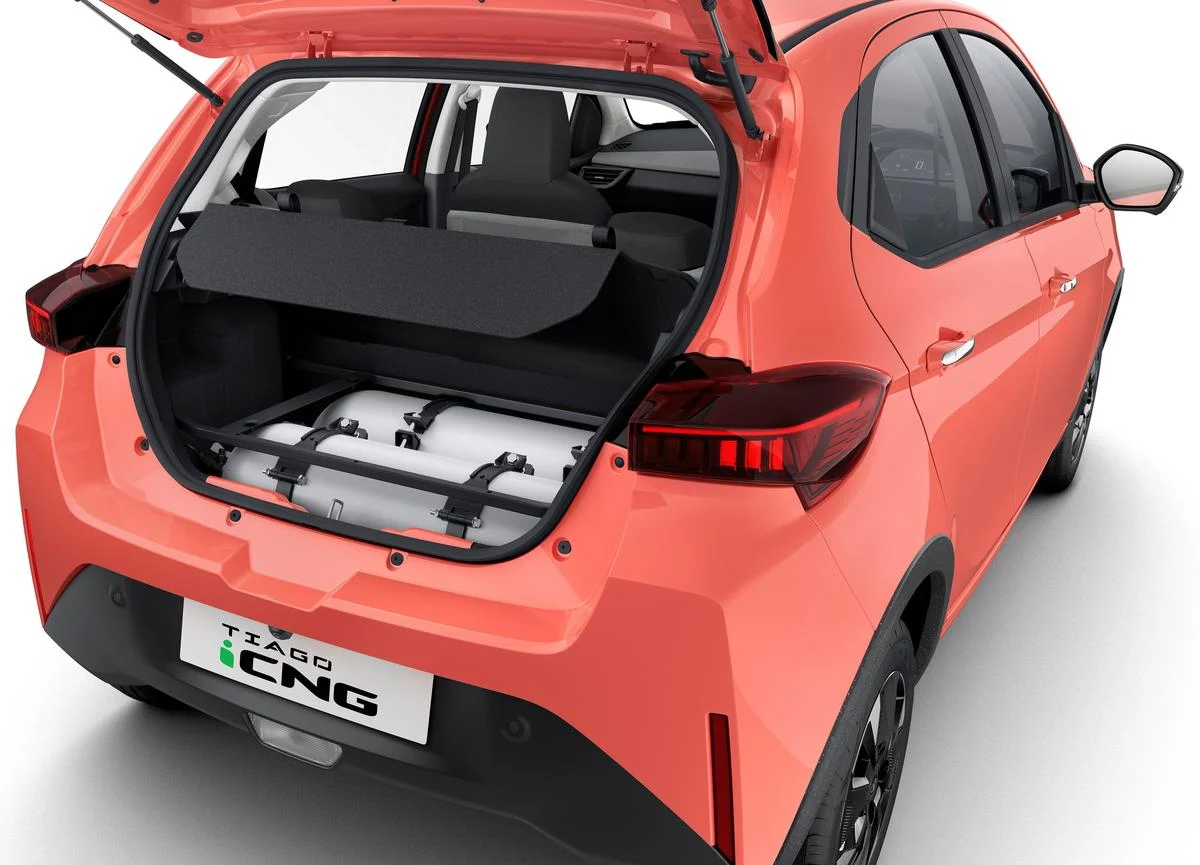
Perhaps the most significant engineering feat in the Tiago range is the twin-cylinder CNG setup. Traditionally, CNG cars sacrificed their entire boot space to accommodate a large gas cylinder.
- Space Management: Tata uses two smaller cylinders (totaling 60-litre water capacity) tucked away under the luggage floor. This preserves a usable boot, a first for the segment.
- Output: In CNG mode, it delivers 75.5PS and 96.5Nm. While there is a marginal drop in power compared to petrol, the integration is so seamless that the transition between fuels is almost imperceptible to the driver.
3. The Electric Disruptor: Tiago.ev
The Tiago.ev is offered with two Lithium-ion battery options: 19.2kWh (Medium Range) and 24kWh (Long Range).

- Acceleration: The 24kWh version produces 114Nm of instant torque, propelling the car from 0 to 60 km/h in a brisk 5.7 seconds.
- Efficiency: Real-world testing suggests a range of 205–215 km for the larger battery, making it more than sufficient for a week of average city commuting.
- Charging: With DC fast charging, the Tiago.ev can add 100 km of range in just 18 minutes, effectively mitigating range anxiety for urban users.
Official Strategy: Democratizing Technology and Safety
While specific quotes from leadership are often reserved for launch events, Tata Motors’ overarching strategy is evident in the Tiago’s equipment list. The company’s move to include a 360-degree HD Surround View Camera and a Blind View Monitor in a hatchback is a strategic statement. These are features usually reserved for SUVs costing twice as much.
The "Official Response" to market demands is seen in the "iRA.ev" connected car suite. By allowing users to pre-cool their cabins via a smartphone app or track their charging status in real-time, Tata is positioning the Tiago not as a "cheap car," but as a "smart car."
Furthermore, the standard inclusion of Six Airbags, Electronic Stability Program (ESP), and Hill Hold Control across all variants is a direct response to the Indian government’s push for higher safety standards and the growing consumer awareness regarding vehicular crashworthiness. For the EV variants, the IP67-rated battery and motor protection ensure that the vehicle remains resilient against the harsh Indian monsoons and dust conditions.
Implications: Setting a New Standard for the ‘Common Man’s Car’
The enrichment of the Tiago range has profound implications for the Indian automotive industry.
1. The Death of the ‘Basic’ Hatchback:
The Tiago proves that entry-level buyers are no longer willing to settle for "basic." By offering a "Fabricia Luxe" dashboard and a high-end Harman-sourced infotainment system, Tata is forcing competitors like Maruti Suzuki and Hyundai to reconsider their feature-to-price ratios.

2. Multi-Powertrain Synergy:
Tata’s ability to offer Petrol, CNG, and EV on the same platform—without compromising the design or interior space—provides a blueprint for manufacturing flexibility. It allows the brand to hedge against fluctuating fuel prices and varying levels of EV infrastructure across India.
3. Safety as a Standard, Not an Option:
By making six airbags standard, Tata has effectively raised the "safety floor" of the Indian market. This move will likely trigger a ripple effect, where competitors will be forced to match these safety specs to remain relevant in a market that increasingly values life over "mileage."
4. Urban Mobility and Sustainability:
The Tiago.ev, in particular, acts as a "gateway" vehicle. By pricing it competitively and ensuring it feels as premium as its petrol counterparts, Tata is accelerating the adoption of green mobility among middle-class families who were previously hesitant to switch to electric.
Verdict: A Mature Choice for a Modern India
The new Tata Tiago range is a testament to how far the Indian hatchback has come. It is no longer just a tool for transportation; it is a sophisticated piece of engineering that offers dignity, safety, and modern technology to the entry-level buyer.
Whether it is the petrol variant’s eagerness, the CNG’s practicality, or the EV’s futuristic appeal, the Tiago remains a cohesive package. It manages to feel "a segment above" because Tata Motors has focused on the "perceived quality"—the way the door thuds, the way the suspension soaks up a pothole, and the way the touchscreen responds to a light tap. In a market where small cars are often stripped of features to meet a price point, the Tiago stands out by refusing to compromise. It is a small car that has finally grown up, proving that in modern India, small cars no longer need to feel small.

Price Range: INR 4.69 lakh – 8.55 lakh (Ex-showroom)
In association with Motorscribes and The Hindu.
