

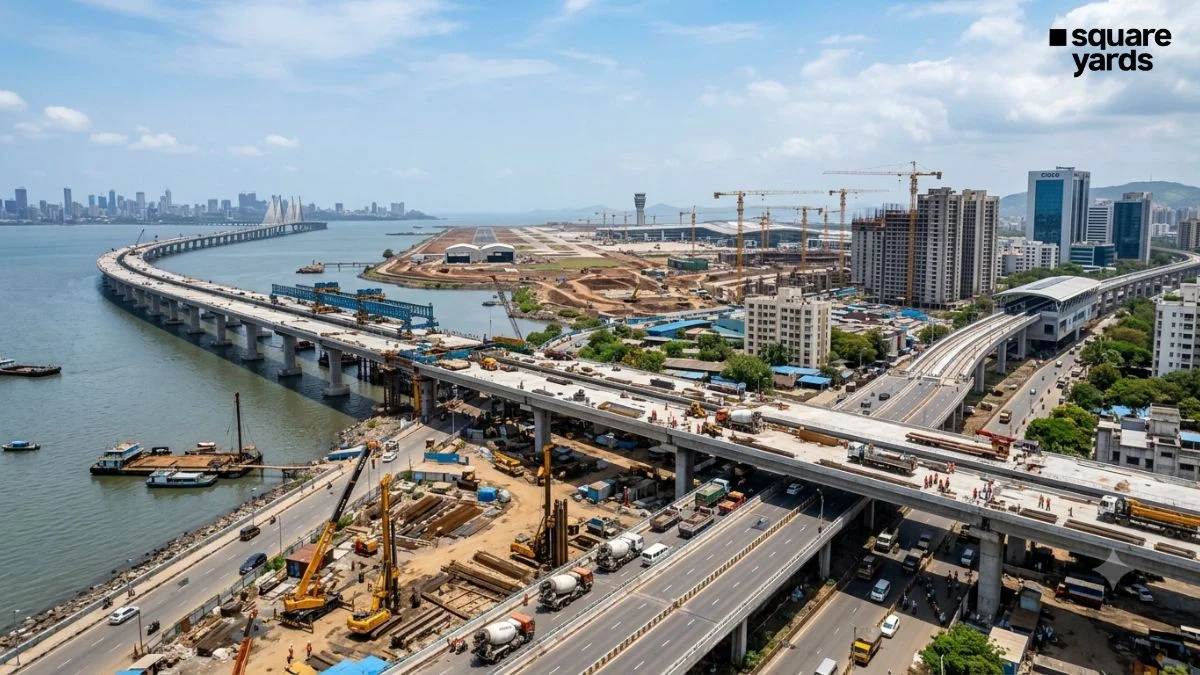
NAVI MUMBAI — For over half a century, the narrative of the Mumbai Metropolitan Region (MMR) was dictated by a rigid north-south axis. South Mumbai stood as the undisputed commercial and cultural epicenter, while Thane emerged as the preferred residential extension for the burgeoning middle class. However, as of mid-2026, a seismic shift in the region’s real estate hierarchy has reached a tipping point.
According to a comprehensive report released by Square Yards Research on July 31st, 2026, Navi Mumbai has officially transitioned from a "spillover market" to the MMR’s most dynamic growth corridor. Backed by a convergence of "mega-infrastructure" projects, a burgeoning employment ecosystem, and a strategic pricing advantage, the planned city is now outpacing its neighbors in both supply momentum and demand absorption.
Main Facts: The Statistical Ascent of a New Powerhouse
The data provided by Square Yards Research paints a clear picture of Navi Mumbai’s growing dominance. In the first half (H1) of 2026, the city accounted for 21% of all new residential launches across the entire MMR. To put this in perspective, Navi Mumbai’s share of regional launches stood at just 18% in 2014.
More significantly, the sales velocity has outstripped the supply growth. Navi Mumbai’s share of total housing sales in the MMR surged from 16% in 2014 to a staggering 22% in H1 2026. This indicates that the city is no longer merely an alternative for those priced out of Mumbai; it has become a primary destination of choice.
During H1 2026, developers launched approximately 49,000 housing units across the MMR. Navi Mumbai’s substantial contribution to this inventory was met with robust absorption levels, a rare equilibrium in a real estate market often plagued by speculative oversupply. This balance suggests a healthy, end-user-driven market rather than one fueled by short-term investor volatility.
Chronology: From Satellite Town to Independent Metropolis
The evolution of Navi Mumbai can be categorized into three distinct eras, culminating in the current 2026 boom:
- The Foundational Era (1970s – 2000s): Conceptualized by CIDCO to de-congest Mumbai, Navi Mumbai spent decades as a "bedroom community." While nodes like Vashi and Nerul developed early, the lack of high-speed connectivity to the mainland kept it secondary to the "Island City."
- The Connectivity Bridge (2010s – 2023): This period saw the conceptualization of "Game Changer" projects. The announcement of the Navi Mumbai International Airport (NMIA) and the commencement of the Mumbai Trans Harbour Link (MTHL) began to shift developer interest toward the southern nodes like Ulwe and Dronagiri.
- The Integration Era (2024 – 2026): The completion of the Atal Setu (MTHL) and the operationalization of the Navi Mumbai Metro and the International Airport have fundamentally altered the geography of the region. Travel times that once took two hours have been slashed to 30–45 minutes, effectively merging Navi Mumbai’s economy with that of South Mumbai and the BKC (Bandra Kurla Complex).
Supporting Data: The Price-Value Equation
The primary driver for the mass migration to Navi Mumbai remains the "Affordability-to-Infrastructure" ratio. Square Yards Data Intelligence reveals that as of June 2026, the average asking price in Navi Mumbai is ₹19,300 per square foot (psf). While this represents significant capital appreciation over the last decade, it remains a fraction of the prices found in Mumbai’s premium markets, even as the infrastructure gap closes.
Micro-Market Breakdown (June 2026):
- Vashi: The premium gateway node, averaging ₹33,350 psf.
- CBD Belapur: The commercial heart, averaging ₹19,950 psf.
- Ulwe: An airport-influenced growth node, averaging ₹15,600 psf.
- Panvel: The multimodal transport hub, averaging ₹15,050 psf.
The report highlights that localities such as Kharghar and Taloja continue to be magnets for first-time homebuyers. The "Ulwe-Pushpak Nagar" belt, in particular, has seen the highest surge in buyer inquiries, directly correlated to its proximity to the Navi Mumbai International Airport and the Atal Setu exit points.
Official Responses and Industry Perspective
Analysts at Square Yards Research suggest that the current boom is structurally different from previous cycles.
"Navi Mumbai is no longer a satellite; it is a self-sustaining orbit," says a senior research lead at Square Yards. "A decade ago, the market was speculative, banking on the promise of an airport. Today, the airport is operational, the bridges are built, and the metro is running. We are seeing a shift from ‘hope-buying’ to ‘utility-buying.’ People are moving here because their offices are moving here."
Urban planning experts point out that Navi Mumbai’s "planned" nature gives it a long-term edge over Thane and the Mumbai suburbs. With wider roads, designated green spaces, and a more robust sewage and drainage infrastructure, the quality of life (QoL) index in Navi Mumbai is increasingly rated higher by millennial homebuyers who prioritize wellness and air quality over a "Mumbai" pin code.
Developers operating in the region have also noted a change in buyer profiles. "We are seeing a significant influx of professionals from the IT and BFSI sectors who previously would only consider Western Suburbs or Thane," noted a spokesperson for a leading real estate firm active in the Panvel-Karjat corridor. "The Panvel-Karjat suburban rail corridor has opened up a new frontier of affordable luxury that was previously inaccessible."
The Infrastructure Catalyst: More Than Just Roads
The transformation is anchored by four "Mega Pillars" of infrastructure:
- Atal Setu (MTHL): By bringing Sewri to Chirle in under 20 minutes, this sea link has turned Navi Mumbai into an extension of South Mumbai.
- Navi Mumbai International Airport (NMIA): Beyond air travel, the airport has spurred the "Aerocity" concept, attracting logistics, hospitality, and corporate headquarters to the region.
- Navi Mumbai Metro: Internal connectivity has finally bridged the gap between the residential northern nodes and the industrial/commercial southern nodes.
- The Multi-Modal Integration: The expansion of the JNPT (Jawaharlal Nehru Port Trust) and the upcoming Delhi-Mumbai Industrial Corridor (DMIC) nodes near Navi Mumbai have solidified the city’s status as a global logistics hub.
Implications: What Lies Ahead for the MMR?
The rise of Navi Mumbai carries profound implications for the future of urban development in India:
1. The "De-Centering" of Mumbai:
The traditional "North-South" commute is being replaced by a "Polycentric" model. As Navi Mumbai develops its own commercial hubs, the pressure on Mumbai’s aging infrastructure may finally begin to ease.
2. Competitive Pressure on Thane:
For years, Thane was the default choice for mid-segment buyers. However, with Navi Mumbai offering superior planning and similar (or better) connectivity at competitive price points, Thane developers may need to recalibrate their value propositions to retain market share.
3. Shift in Investment Strategy:
Institutional investors are increasingly pivoting toward Navi Mumbai’s commercial real estate. With the residential base now firmly established, the next phase of growth is expected to be in Grade-A office spaces and data centers, further stabilizing the housing market through local job creation.
4. The Challenge of Gentrification:
As prices in nodes like Vashi and Belapur climb toward the ₹30,000 psf mark, the challenge for CIDCO and the government will be maintaining the "affordable" tag that made Navi Mumbai popular. The focus is now shifting toward the "Extended Navi Mumbai" regions like Dronagiri and the areas beyond Panvel to provide for the lower-income segments.
Conclusion
The Square Yards Research report for H1 2026 serves as a definitive marker of change. Navi Mumbai has successfully shed its image as a distant suburb to emerge as the region’s most compelling real estate growth story.
For the homebuyer, it offers a rare combination of modern infrastructure and relative affordability. For the developer, it provides a canvas of land availability and sustained demand. As the MMR continues to expand, it is increasingly clear that the region’s next chapter is being written not in the crowded corridors of the Island City, but across the harbor, in the wide, planned avenues of Navi Mumbai. The hierarchy has shifted; the "New MMR" has arrived.
