

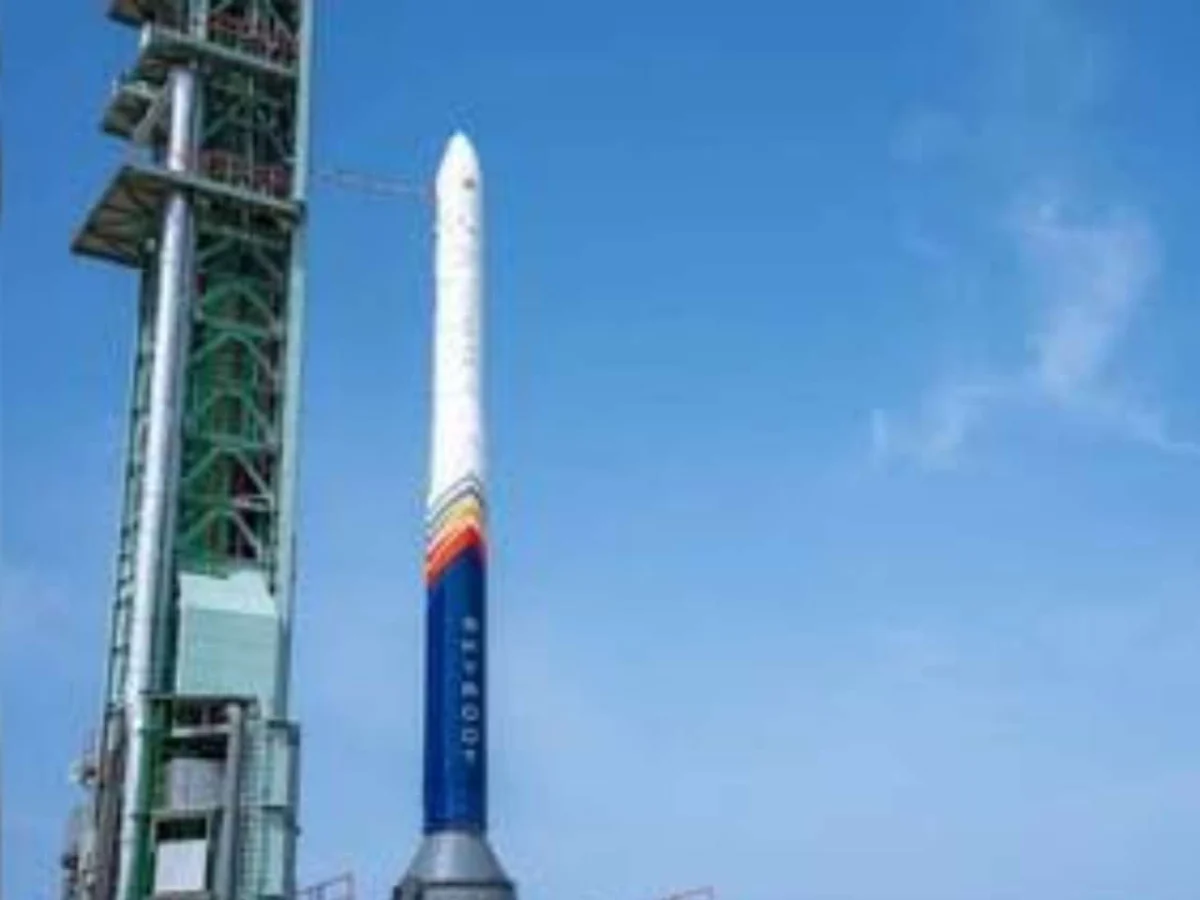
SRIHARIKOTA, India – July 16, 2026 – India stands on the cusp of a new era in space exploration and commercialization as Skyroot Aerospace, a pioneering Hyderabad-based startup, prepares for the inaugural orbital test flight of its indigenously developed rocket, Vikram-1. Scheduled for liftoff at 11:30 AM on July 18 from the First Launch Pad at the Satish Dhawan Space Centre in Sriharikota, this mission marks a monumental stride for the nation’s burgeoning private space sector, signaling its readiness to compete on the global stage.
The launch of Vikram-1 is not merely a technical demonstration; it is a profound declaration of India’s capability to foster private innovation in high-tech domains. Pawan Kumar Chandana, co-founder and CEO of Skyroot Aerospace, encapsulated the sentiment, calling the flight approval "a big moment for India." He affirmed, "After passing all tough tests, Vikram-1 is cleared to fly. This first launch is the start of our goal to open up space for everyone." This mission follows Skyroot’s successful sub-orbital test of Vikram-S in 2022, and with Vikram-1, India’s private sector is poised to establish a firm foothold in the competitive global launch services market.
Main Facts: A New Horizon for Indian Space
The Vikram-1, a sophisticated seven-storey, multi-stage launch vehicle, is designed to deploy small satellites weighing up to 350 kg into Low Earth Orbit (LEO). Its maiden flight will target an altitude of 450 km at a 60-degree orbital inclination, a crucial trajectory for validating its performance and systems. The rocket boasts an all-carbon composite body, making it remarkably lightweight yet robust, and incorporates advanced indigenous propulsion systems, including state-of-the-art 3D-printed engines and high-thrust solid-fuel boosters. These technological advancements underscore India’s prowess in cutting-edge manufacturing and rocketry.
This orbital mission is critical for gathering comprehensive performance data across all key operational parameters – propulsion, stage separation, Guidance, Navigation, and Control (GNC) systems, and the overall vehicle’s structural integrity and flight dynamics. Such data is indispensable for Skyroot’s strategic transition towards routine commercial launch operations, ensuring reliability and precision for future client missions.
)
The flight will carry a diverse manifest of four technological demonstration payloads, showcasing both national innovation and international collaboration. These include Grahaa Space’s Solaras S3 satellite from Bengaluru, incubated at IIST; Embrace, a space-debris removal robotic arm developed by Hyderabad startup Cosmoserve Space; Skyroot’s own Scope satellite for internal validation; and an orbital demonstration from the German firm DCUBED. Additionally, in a poignant tribute to India’s scientific and visionary heritage, the rocket will carry 18-carat gold micro-sculptures of Sir C.V. Raman, Dr. Vikram Sarabhai, and Dr. A.P.J. Abdul Kalam, alongside Cosmos Diamonds’ "Cosmic Bloom" artwork, symbolizing the nation’s aspirations in the cosmic realm.
Chronology: From Vision to Orbital Reality
The journey of Skyroot Aerospace and the Vikram series of rockets is a testament to perseverance and innovation, rooted in the broader narrative of India’s evolving space policy.

The Genesis of Skyroot Aerospace
Skyroot Aerospace was founded in 2018 by former ISRO scientists Pawan Kumar Chandana and Naga Bharath Daka, driven by a vision to make space access more affordable and reliable. Their ambition was to leverage India’s robust engineering talent and cost-effective manufacturing capabilities to develop a series of privately-built launch vehicles. The company’s inception coincided with a pivotal shift in India’s space policy, particularly the establishment of the Indian National Space Promotion and Authorization Centre (IN-SPACe) in 2020. This autonomous body was created to provide a level playing field for private companies, encouraging their participation in space activities and acting as a single-window agency for approvals. This governmental backing was crucial for Skyroot to secure initial funding, navigate regulatory complexities, and gain access to ISRO’s facilities and expertise.
The Vikram Series: A Tribute to a Visionary
The rockets developed by Skyroot are named "Vikram" in homage to Dr. Vikram Sarabhai, widely regarded as the father of the Indian space program. This naming signifies Skyroot’s commitment to carrying forward Sarabhai’s legacy of fostering scientific temper and technological self-reliance. The Vikram series comprises three variants: Vikram-I (for small satellites up to 350 kg), Vikram-II (for satellites up to 500 kg), and Vikram-III (for satellites up to 800 kg), aiming to cater to a broad spectrum of small satellite launch needs.
)
Vikram-S: The Pathfinder Mission
The first significant milestone for Skyroot came on November 18, 2022, with the launch of Vikram-S, a sub-orbital demonstrator. Dubbed the "Prarambh" (the beginning) mission, Vikram-S successfully lifted off from Sriharikota, making history as India’s first privately developed rocket to reach space. This mission, a crucial stepping stone, validated the core technologies and propulsion systems that would later be integrated into the orbital-class Vikram-1. The success of Vikram-S provided invaluable flight data, boosting confidence in Skyroot’s design and engineering capabilities, and proving the viability of private players in India’s space landscape. It demonstrated a vertical take-off and reached an altitude of approximately 89.5 km, validating its three-stage solid propulsion.
Vikram-1 Development and Pre-Launch Preparations
Following the triumph of Vikram-S, Skyroot accelerated the development of Vikram-1. The design and engineering phases involved extensive simulations, component testing, and static fire tests of its various engine stages. The "Kalam-100" solid rocket motor, a crucial component, underwent rigorous testing, showcasing its robust performance. The "Dhawal-1" liquid-fuel engine, featuring 3D-printed components, also underwent successful hot-fire tests, confirming its operational readiness.
)
The final assembly of Vikram-1 was a meticulous process, bringing together thousands of components from hundreds of suppliers across India. Once assembled, the rocket was transported to the Satish Dhawan Space Centre and carefully placed on the First Launch Pad. In the weeks leading up to July 18, Skyroot’s launch control centre executed a series of exhaustive final checks, including integrated systems diagnostics, communication link tests with all telemetry ground stations, and tracking radars. Crucially, concerned authorities, including the Directorate General of Civil Aviation (DGCA) and the Indian Navy, issued the necessary airspace and maritime notices. These notifications formally designate restricted zones along Vikram-1’s ascent and impact corridor for launch day, ensuring safety and compliance with international regulations. These pre-launch activities symbolize the culmination of years of dedicated effort and meticulous planning, leading up to this historic orbital attempt.
Supporting Data: The Engineering Marvel and Its Mission
Vikram-1 represents a leap in indigenous rocket technology, integrating advanced materials and manufacturing processes to achieve its ambitious goals.
)
Technical Prowess of Vikram-1
The "seven-storey" designation highlights the rocket’s multi-stage architecture, optimized for efficient payload delivery. Its all-carbon composite body is a significant engineering feat. Carbon composites offer superior strength-to-weight ratio compared to traditional metallic structures, drastically reducing the rocket’s overall mass. This mass reduction translates directly into increased payload capacity and improved fuel efficiency, making launches more economical. The use of composites also enhances structural integrity and resilience during the extreme conditions of launch and atmospheric ascent.
At the heart of Vikram-1 are its indigenous propulsion systems. The rocket utilizes a combination of solid and liquid-fuel engines. The solid-fuel boosters, designed for high thrust during the initial stages of flight, provide the necessary brute force to overcome Earth’s gravity. The upper stages feature advanced liquid-fuel engines, which are often 3D-printed. This additive manufacturing technique revolutionizes rocket engine production by allowing for complex geometries, reducing part count, cutting manufacturing time by up to 80%, and significantly lowering production costs. These engines also offer greater thrust vector control, allowing for precise steering and orbital insertion. Skyroot has pioneered the use of these technologies in India, demonstrating a commitment to innovation and self-reliance.
)
The mission’s target of a 450 km altitude at a 60-degree orbital inclination places the satellites in a Low Earth Orbit (LEO). LEO is the most commonly used orbit for small satellites due to its proximity to Earth, which allows for higher resolution imaging, lower communication latency, and reduced power requirements. A 60-degree inclination means the rocket will launch at an angle that allows it to cover a significant portion of the Earth’s surface, suitable for various applications like earth observation, remote sensing, and internet-of-things (IoT) constellations. The 350 kg payload capacity is ideal for CubeSats, micro-satellites, and small constellations, which constitute a rapidly growing segment of the global space market.
Comprehensive Mission Objectives
The primary objective of Vikram-1’s first flight is comprehensive data acquisition. This encompasses real-time telemetry on the performance of the propulsion systems during each stage’s burn, precise measurements of stage separation events, and detailed feedback on the GNC systems’ accuracy in maintaining the desired trajectory. Understanding the overall vehicle dynamics, including vibrations, structural loads, and thermal performance, is equally crucial. This wealth of data will be meticulously analyzed to validate design models, identify any deviations, and inform necessary refinements for subsequent flights. This rigorous validation process is fundamental for Skyroot’s ambition to transition into reliable commercial launch operations, where predictability and consistent performance are paramount for attracting and retaining clients.
)
Diverse Payload Manifest
The four tech-demonstration payloads on board highlight the breadth of innovation fostered by India’s private space ecosystem:
- Grahaa Space’s Solaras S3 satellite: Developed by a Bengaluru-based startup incubated at the Indian Institute of Space Science and Technology (IIST), Solaras S3 is likely an experimental satellite for Earth observation or IoT applications, testing new sensor technologies or communication protocols. Its presence underscores the academic and startup synergy within India’s space sector.
- Embrace, by Cosmoserve Space: This Hyderabad startup’s space-debris removal robotic arm addresses one of the most pressing challenges in orbital mechanics – the proliferation of space junk. Demonstrating such a capability is vital for ensuring the long-term sustainability of space operations and showcases India’s contribution to global space stewardship.
- Skyroot’s own Scope satellite: This internal payload serves as a testbed for Skyroot’s proprietary technologies, potentially validating new communication systems, sensor packages, or satellite bus designs that the company plans to offer or utilize in future missions.
- Orbital demonstration from German firm DCUBED: The inclusion of an international payload signifies global confidence in Skyroot’s capabilities and India’s growing reputation as a reliable launch provider. DCUBED specializes in deployable structures and small satellite technologies, and their payload on Vikram-1 could be testing a new component or deployment mechanism in an actual space environment.
Commemorative Elements: Honoring the Legacy
The 18-carat gold micro-sculptures of Sir C.V. Raman (Nobel laureate in Physics), Dr. Vikram Sarabhai (father of India’s space program), and Dr. A.P.J. Abdul Kalam (renowned scientist and former President of India) serve as a powerful symbolic tribute. These figures represent the scientific curiosity, visionary leadership, and technological drive that have propelled India’s scientific and space endeavors. Carrying their likenesses into orbit connects the present achievements with the foundational work of past generations. The "Cosmic Bloom" artwork by Cosmos Diamonds further adds an artistic dimension, symbolizing the flourishing of India’s space dreams and its boundless potential in the universe.
)
Official Responses: Voice of Aspiration and Resolve
The impending launch has generated immense enthusiasm, particularly from Skyroot’s leadership, who articulate a clear vision for India’s future in space.
Skyroot Leadership’s Vision
Pawan Kumar Chandana’s statement, "This first launch is the start of our goal to open up space for everyone," reflects a fundamental shift in access to space. Traditionally, space launches were the exclusive domain of government agencies. Skyroot aims to democratize this access by providing cost-effective, frequent, and reliable launch services, thereby lowering barriers for universities, private companies, and even individuals with innovative space-based ideas. His emphasis on "valuable data" being "foundational to Skyroot’s aspirations of establishing launch cadence" highlights the methodical approach the company is taking. This test flight is not just about reaching orbit; it’s about building a robust, data-driven foundation for future operational reliability and efficiency, crucial for achieving high launch frequency.
)
Naga Bharath Daka, co-founder and COO, provided a poignant perspective on the collaborative effort behind Vikram-1. "The launch represents the hopes and hard work of around 1,000 people, the contributions of over 400 suppliers, and nearly 3,000 days of resolve to build a global offering from India," he stated. This quote underscores the immense human capital and intricate supply chain involved. It highlights the "Make in India" initiative’s success in high-technology sectors, fostering a vibrant ecosystem of specialized suppliers, engineers, and technicians. Daka’s commitment to "learn, improve, and build further" post-mission reflects the agile and iterative development philosophy characteristic of successful private ventures, emphasizing continuous improvement based on real-world performance data.
Governmental and Regulatory Support
While specific new official statements from IN-SPACe or ISRO might not be immediately available, their established policies provide the framework for Skyroot’s success. IN-SPACe’s role in streamlining the authorization process, facilitating access to ISRO’s expertise and infrastructure, and ensuring regulatory compliance has been instrumental. This supportive ecosystem has transformed India from a nation with a state-monopoly in space to one actively encouraging private sector participation, aligning with global trends of space commercialization. The granting of flight approval itself is a testament to the rigorous evaluation process undertaken by these authorities, ensuring the mission’s safety and adherence to national and international space guidelines.
)
Industry Expert Perspectives
Industry analysts and experts view Vikram-1’s launch as a critical validator for India’s private space ambitions. Dr. Sivan, former Chairman of ISRO, has often emphasized the importance of private participation for India to capture a larger share of the global space market. "Such missions will not only create jobs but also spur innovation across various sectors," remarked a leading aerospace consultant, speaking anonymously to reflect general industry sentiment. "Skyroot’s ability to develop an orbital-class rocket with indigenous technology positions India strongly in the competitive small satellite launch market, offering a credible alternative to established players." This collective sentiment underscores the significance of Vikram-1 beyond just Skyroot, painting it as a bellwether for the entire Indian private space industry.
Implications: Reshaping India’s Space Future
The successful orbital launch of Vikram-1 will have far-reaching implications, solidifying India’s position as a formidable global space power and catalyzing unprecedented growth within its domestic space economy.
)
For India’s Space Sector
Commercialization and Global Competitiveness: Vikram-1’s success will catapult India into the league of nations with private orbital launch capabilities, directly challenging established players like SpaceX, Rocket Lab, and Arianespace in the small satellite launch segment. This competition is expected to drive down launch costs, making space more accessible for a wider array of clients globally. India, already known for its cost-effective government-led launches by ISRO, can now leverage its private sector to offer more frequent and agile launch options, capturing a larger share of the rapidly expanding commercial space market, projected to reach over a trillion dollars in the coming decades.
Catalyst for Innovation and Ecosystem Growth: The achievement will serve as a powerful inspiration and validation for numerous other Indian space startups in various domains – satellite manufacturing, data analytics, space debris management, and beyond. It demonstrates that with perseverance and strategic support, private entities can achieve complex feats traditionally reserved for state agencies. This will foster a vibrant ecosystem, attracting more investment, nurturing talent, and accelerating technological advancements across the entire space value chain. The "Make in India" initiative will receive a significant boost, proving India’s capability to design, develop, and manufacture cutting-edge space hardware domestically.
)
Economic Impact and Job Creation: The growth of the private space sector directly translates into economic benefits. The development of Vikram-1 involved hundreds of suppliers and a thousand-strong workforce, creating high-skill jobs in engineering, manufacturing, and R&D. A successful and regular launch cadence will further expand this workforce, generating employment opportunities and driving economic growth, particularly in advanced manufacturing and technology sectors.
For the Global Space Industry
Increased Competition and Accessibility: The entry of a new, reliable private launch provider from India will intensify global competition, which typically leads to lower prices and more flexible services for satellite operators. This enhanced accessibility to space will empower more organizations – from universities and research institutions to emerging economies and small businesses – to deploy their satellites, fostering innovation and expanding the benefits of space technology to a broader global community.
)
Trend of Privatization: Vikram-1’s mission reinforces the global trend of space privatization. As governments increasingly collaborate with or hand over certain aspects of space operations to commercial entities, India’s success will serve as another powerful example of this paradigm shift, potentially influencing other nations to liberalize their own space sectors.
Future Outlook for Skyroot Aerospace
Post-Vikram-1’s test flight, Skyroot Aerospace will enter a crucial phase of analysis and refinement. The invaluable data gathered will inform improvements to the rocket’s design, propulsion, and control systems. The company’s immediate goal will be to establish a reliable launch cadence, moving from test flights to routine commercial operations. Skyroot envisions offering dedicated and rideshare launch services for a variety of small satellite missions, potentially expanding its market reach beyond India. Future plans may also include the development of the larger Vikram-II and Vikram-III variants, allowing Skyroot to target heavier payloads and more diverse orbital requirements. The long-term vision articulated by its founders – "to open up space for everyone" – suggests a commitment to innovation that continually seeks to lower the cost and complexity of accessing space, fundamentally reshaping how humanity interacts with the final frontier.
)
The countdown to July 18 is more than just for a rocket launch; it is a countdown to a new chapter in India’s space saga, one where private enterprise takes center stage, propelling the nation’s aspirations ever higher into the cosmos.
