

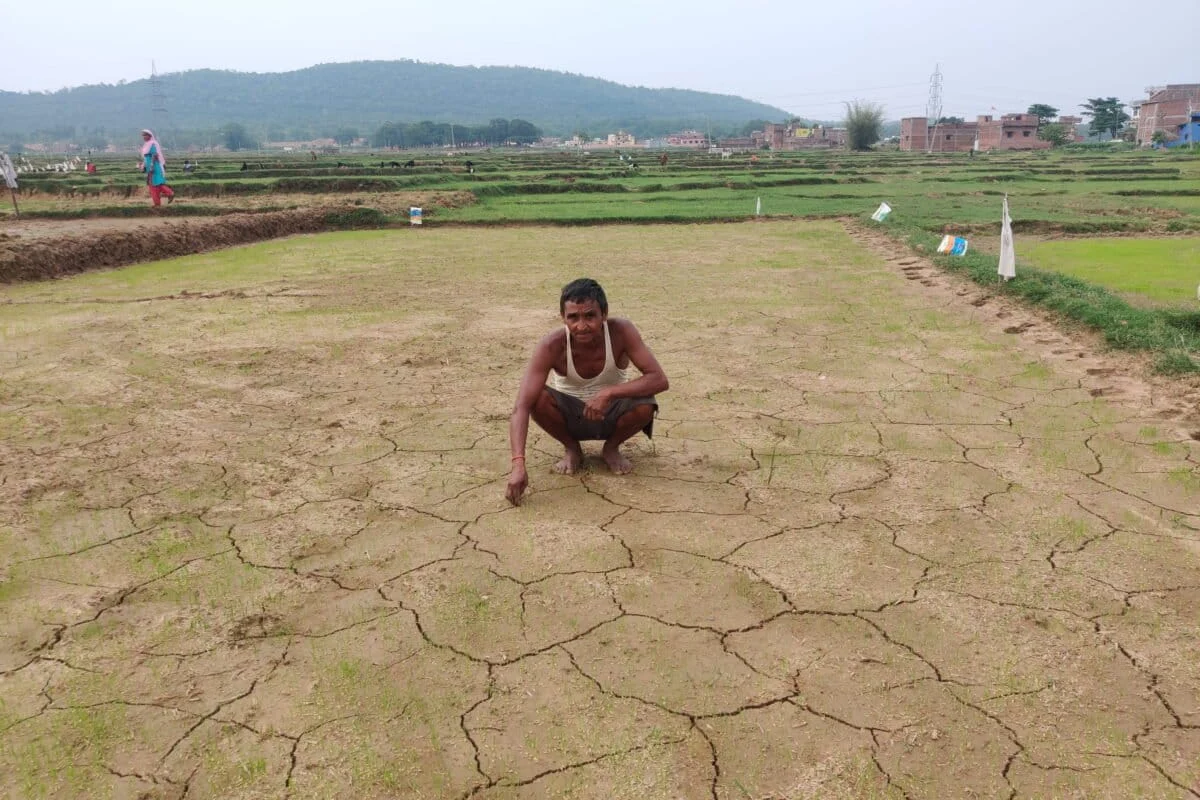
RANCHI, JHARKHAND — For Barun Kumar Yadav, a 40-year-old carpenter who spends most of the year working in the industrial city of Bhilai, Chhattisgarh, the month of June usually represents a homecoming of hope. Like millions of other migrant workers from Jharkhand, Yadav returns to his ancestral village of Pathalgada in the Chatra district specifically for the kharif (monsoon) sowing season. In a state where the economy is inextricably linked to the rhythm of the rains, the success of the paddy crop often determines whether a family will eat or fall into the clutches of debt.
This year, however, the rhythm has broken. After weeks of staring at a cloudless sky and a traditional well that has dwindled to a muddy puddle, Yadav has packed his bags and returned to Bhilai. He left without transplanting a single seedling.
"I bought four kilograms of seeds and prepared a nursery for my 12 katha field," Yadav said, his voice heavy with the resignation of a man defeated by the elements. "But the rain never came. You can see the grass growing in the field before the rice. There is no hope left for a crop that relies on the heavens."

Yadav’s story is not an isolated tragedy; it is the opening chapter of a brewing agrarian crisis across Jharkhand. As a powerful El Niño event takes hold, the state is grappling with a massive rainfall deficit that threatens to trigger a widespread drought, spark a fresh wave of distress migration, and cripple the livelihoods of the state’s most vulnerable marginal farmers.
Main Facts: A State Under Hydrological Stress
Jharkhand’s agricultural sector is currently facing a "perfect storm" of climatic and structural challenges. The state’s economy is heavily reliant on the monsoon, yet it remains one of the least irrigated regions in India. According to the 2025-26 Jharkhand Economic Survey, over 80% of the gross cropped area is unirrigated, leaving farmers almost entirely dependent on seasonal rainfall.
The current statistics are staggering:
- Rainfall Deficit: Between June 1 and July 14, Jharkhand received 41% less rainfall than the historical average. While the state typically expects 321 mm during this window, it recorded only 193.2 mm.
- District Crises: The situation is even more dire in specific pockets. Chatra district has seen a 68% deficit, while Garhwa recorded a staggering 79% shortfall. In total, 13 out of 24 districts are facing a rainfall deficit exceeding 40%.
- Sowing Delays: Paddy transplantation, the backbone of the state’s food security, is running more than 20 days behind schedule. As of early July, only 7.65% of the target 1.8 million hectares had seen completed transplantation.
- The El Niño Factor: The India Meteorological Department (IMD) and the U.S. National Weather Service have both warned of a "very strong" El Niño event. This phenomenon, characterized by the warming of surface waters in the eastern Pacific Ocean, historically correlates with deficient monsoons in South Asia.
Chronology of a Faltering Season
The crisis began to manifest in early June, the traditional start of the monsoon. While farmers like Basant Dangi in Pathalgada managed to use community wells to start paddy nurseries, the heat intensified rather than broke.

Early June: Expectations for a normal monsoon were high, but the IMD issued early warnings regarding the developing El Niño. Farmers began preparing nurseries, hopeful that the "Pre-Monsoon" showers would transition into a steady downpour.
Late June: The rainfall deficit began to widen. In districts like Chatra and Garhwa, the deficit reached 90% for the month of June. Farmers who had already sown seeds saw their nurseries begin to wither. Barun Kumar Yadav arrived from Chhattisgarh, only to find his fields bone-dry.
July 1–15: This period is traditionally the "golden window" for paddy transplantation. However, the lack of water caused the earth to crack. Basant Dangi noted that the cracks in his field were becoming so wide that even a light rain would now be insufficient, as the water would simply disappear into the fissures rather than flooding the field for transplantation.
Late July: With the 20-day delay established, many farmers have reached a breaking point. Shankar Dangi, a farmer from Chautha village, made the difficult decision to abandon paddy altogether. "It is better to sow maize than to keep waiting for the rain," he said, though he acknowledged that even the maize yield will be stunted due to the 10-day delay in its own sowing cycle.

Supporting Data: The Science of Diminishing Returns
Agricultural scientists warn that the clock is ticking against Jharkhand’s food security. Parvez Alam, an associate professor at Birsa Agricultural University (BAU) in Ranchi, highlights a critical "cliff edge" for crop yields.
"Our research shows that if transplantation is delayed until August 1, the yield drops by as much as 50%," Alam explained. "This isn’t just about water; it’s about the photoperiod. If the crop is planted too late, it does not receive adequate sunlight during its critical growth phases, leading to stunted grains and lower biomass."
The data from the state’s Agriculture Directorate paints a grim picture of the current progress compared to targets:
- Paddy: 7.65% completion (Target: 1.8 million hectares).
- Pulses: 8.82% completion.
- Oilseeds: 13.53% completion.
- Maize: 24.41% completion (the only crop showing significant activity as farmers pivot away from rice).
The long-term data is equally concerning. Abhishek Anand, head of the IMD’s Ranchi centre, points out that drought is becoming a cyclical norm rather than an anomaly for Jharkhand. "In the past 25 years, the state has experienced eight years of below-normal rainfall. This means a drought-like situation occurs, on average, every three years. We are seeing a trend where the early phase of the monsoon is consistently weak."

Official Responses: Policy vs. Reality
The Jharkhand government has attempted to project a proactive stance. In May, officials submitted a contingency plan to the central government, identifying 315 districts across India—many in Jharkhand—vulnerable to drought-like conditions.
Vidyanand Sharma Pankaj, Director of the Agriculture Directorate, maintains a cautious optimism. "Transplantation is behind, but in areas like Santhal Pargana, the window is longer. We estimate the paddy yield could still reach 80% of last year’s levels," he stated.
To mitigate the crisis, the government has launched the "Millet Mission." This initiative encourages farmers to switch from water-intensive paddy to "coarse grains" like finger millet (madua), which are drought-resistant. The government is offering:
- Financial Assistance: ₹3,000 per acre (up to ₹15,000 for five acres).
- Subsidies: Seeds provided at 50% to 100% subsidies.
- Short-duration Varieties: Encouraging paddy seeds that mature in just 60 days.
However, there is a significant "last-mile" disconnect. Farmers in villages like Belhar and Sayal report that they have seen no government awareness camps. "We haven’t been told which crops to plant or how to access these subsidies," said Prakash Rana, a master trainer with the Panchayati Raj Department. "Elected representatives are silent, and the knowledge of millet farming has skipped a generation in many of these villages."

Socio-Economic Implications: The Migration Threat
The failure of the monsoon in Jharkhand is never just an agricultural issue; it is a profound socio-economic crisis. Jharkhand is already a migration-prone state, with an estimated 4.5 million people working as migrant labor across India.
James Herenj of Jharkhand NREGA Watch warns that a drought will accelerate this exodus. "When the fields dry up, the village empties. Only the elderly, women, and children remain. This breaks the social fabric and makes families vulnerable to predatory moneylenders when the migrant workers cannot send money back immediately."
Adding to the anxiety is the transition of the primary rural safety net. The Mahatma Gandhi National Rural Employment Guarantee Scheme (MGNREGA), which traditionally provided a fallback for agricultural laborers during dry spells, is being replaced by the Viksit Bharat-Guarantee for Rozgar and Ajeevika Mission (VB-G RAM G).
"MNREGA was the sole lifeline," Herenj noted. "The new scheme’s implementation is still unclear, and work hasn’t started in many areas. If agricultural laborers don’t find work by August, we will see a mass migration unlike any in recent years."

Conclusion: A Call for Climate-Resilient Farming
As the cracked fields of Pathalgada demonstrate, the traditional "calendar-based" farming of Jharkhand is no longer viable in an era of climate volatility. The convergence of a record-breaking El Niño and a lack of irrigation infrastructure has left millions of marginal farmers—those cultivating less than one acre—at the mercy of a changing atmosphere.
The consensus among experts like Parvez Alam and Abhishek Anand is that Jharkhand must pivot toward "weather-based farming." This involves:
- Diversification: Moving away from a paddy monoculture toward millets and pulses.
- Infrastructure: Urgent investment in micro-irrigation and check dams to capture the rain that does fall.
- Real-time Data: Integrating daily weather forecasts into village-level planning.
For Barun Kumar Yadav, these policy shifts may come too late. As he boards the train back to Chhattisgarh, he leaves behind a thirsty land and a family whose food security for the coming year is now an open question. In Jharkhand, when the monsoon fails, it isn’t just the crops that wither—it is the very hope of staying home.
