

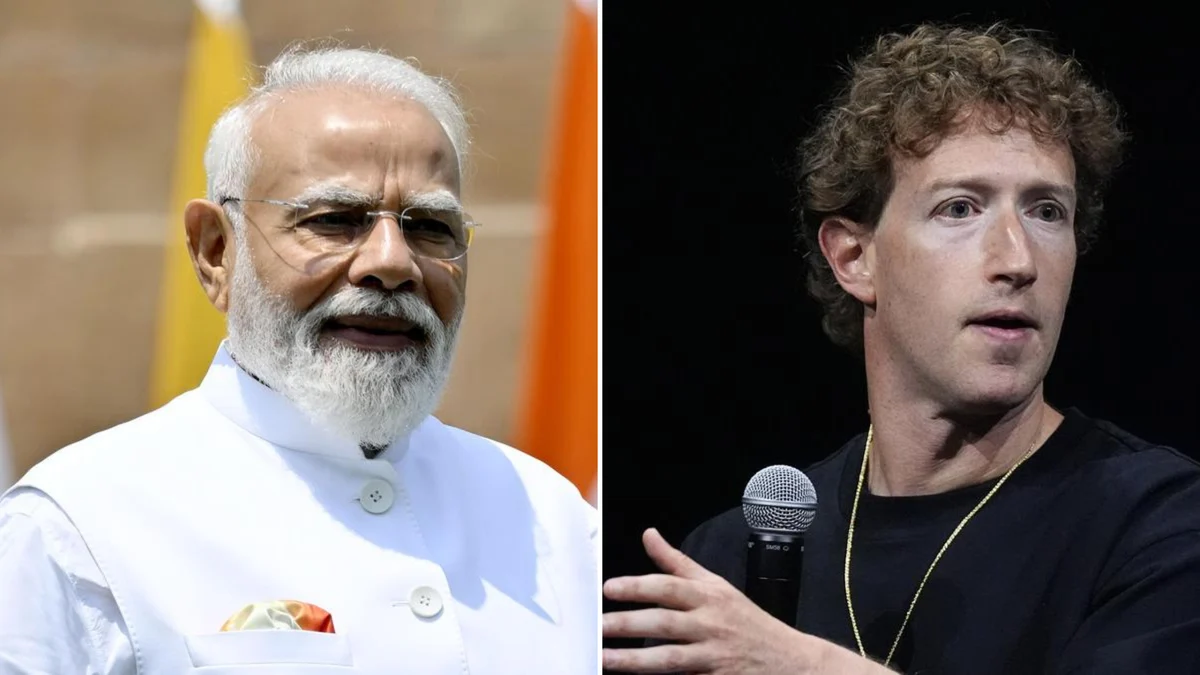
New Delhi, India – August 5, 2026 – In a significant escalation of tensions between global tech giants and the Indian government, a powerful parliamentary committee has issued a three-day ultimatum to Meta CEO Mark Zuckerberg, demanding a formal apology for Facebook’s controversial removal of a video message by Prime Minister Narendra Modi. The Parliamentary Standing Committee on Communications and Information Technology, spearheaded by the Bharatiya Janata Party’s (BJP) Nishikant Dubey, has warned that failure to comply could result in the revocation of Meta’s crucial legal immunity, known as ‘safe harbour,’ under India’s IT Act.
This unprecedented directive signals a hardening stance by New Delhi, not only against Meta but also extending to other major tech players like Google, as India increasingly asserts its digital sovereignty and demands greater accountability from platforms operating within its borders. The committee’s stern warning, conveyed through a letter from the Lok Sabha Secretariat, underscores the government’s growing impatience with what it perceives as arbitrary content moderation practices and a perceived lack of responsiveness to Indian regulatory concerns.
Main Facts: A Digital Showdown Unfolds
The core of the dispute revolves around the removal of a video message from Prime Minister Narendra Modi, addressed to students on July 23, 2026. The video’s takedown by Facebook occurred amidst a backdrop of youth protests at Jantar Mantar and other locations across the country, raising questions about the timing and rationale behind Meta’s action. The parliamentary committee, led by BJP MP Nishikant Dubey, views this as a serious transgression, demanding an "unqualified apology" from Mark Zuckerberg himself within three days of receiving the official letter.
Should Zuckerberg fail to issue this apology, the committee has explicitly stated that the protection and immunity granted to Meta under Section 79(3) of the IT Act, 2000, could be withdrawn. This would fundamentally alter Meta’s operational landscape in India, potentially exposing it to direct legal liability for third-party content hosted on its platforms, effectively treating it as a publisher rather than a mere intermediary.
Beyond the Prime Minister’s video, the committee has broadened its scope of concerns. It has also called for the withdrawal of Instagram’s safe harbour following the erroneous blocking of the same video message. Furthermore, the committee cited a recent report by the BBC concerning the prevalence of child sex abuse material (CSAM) advertisements on Instagram, demanding stringent action against intermediary platforms that facilitate such egregious content and other demeaning material against women.
The scrutiny extends beyond Meta. Google India has also been brought under the committee’s lens, with a demand for its safe harbour protection to be lifted. This follows a series of cybercrime complaints in Hyderabad, where individuals reportedly lost over ₹48 lakh due to fraudulent applications downloaded from the Google Play Store. In these cases, Google’s India country manager was reportedly named as a co-accused, signifying a significant shift in legal responsibility being placed on platform executives.
The letter, addressed to IT Secretary S. Krishnan and copied to Home Secretary Govind Mohan, underscores the gravity with which the Indian government is approaching these issues. While Meta and the IT Ministry did not provide an immediate response when contacted by The Hindu, Google declined to comment, reflecting the high stakes involved in this unfolding digital confrontation.
Chronology: From Content Takedown to Ultimatum
The sequence of events leading to this dramatic ultimatum highlights a growing friction point between Indian regulatory ambitions and the operational autonomy of global tech companies.

July 23, 2026: Prime Minister Narendra Modi’s video message, intended for students, is posted on Facebook. Simultaneously, youth protests are reportedly underway across India, including at Jantar Mantar in New Delhi. The specific content of the video and its potential connection to the protests remain subject to interpretation, but its removal by Facebook triggers immediate concern.
Shortly after July 23: Facebook removes PM Modi’s video. The exact timing and the internal mechanisms that led to its takedown are not immediately disclosed by Meta, sparking queries and accusations of arbitrary censorship.
Late July 2026: The Indian government expresses its "ire" over the video’s removal. Senior officials from the Ministry of Electronics and Information Technology (MeitY) reportedly summon Meta representatives, demanding a comprehensive explanation for the action. The initial demands include an apology from Meta’s founder, Mark Zuckerberg, signaling the government’s intent to hold the highest levels of the company accountable.
August 3, 2026 (Monday): Representatives from Meta, Google, and X (formerly Twitter) appear before the Parliamentary Standing Committee on Communications and Information Technology. During these deliberations, the issue of PM Modi’s video takedown becomes a central point of discussion. Members of Parliament from the ruling BJP reportedly press the tech companies aggressively, arguing that the content moderation practices demonstrate a bias or a lack of understanding of the Indian context. Significantly, Opposition MPs also weigh in, cautioning against political influence on content moderation, emphasizing the need for platforms to remain neutral and adhere to clear, transparent policies. Nishikant Dubey, as the committee head, publicly states his intention to seek Zuckerberg’s apology, framing the incident as an attempt to "destabilize the country."
August 5, 2026 (Wednesday): The Parliamentary Standing Committee formally issues a three-day ultimatum to Mark Zuckerberg. A letter from the Lok Sabha Secretariat is dispatched, detailing the demand for an "unqualified apology" and explicitly warning of the potential withdrawal of safe harbour protection under Section 79(3) of the IT Act if the apology is not tendered within the stipulated timeframe. This formal communication marks the peak of the current confrontation, elevating it from a ministerial grievance to a parliamentary demand with serious legal implications.
Supporting Data: The Legal and Regulatory Framework
The committee’s warning hinges on Section 79 of India’s Information Technology (IT) Act, 2000, a critical piece of legislation governing the liability of online intermediaries.
Section 79 of the IT Act, 2000: This section provides "safe harbour" protection to intermediaries, stating that "an intermediary shall not be liable for any third party information, data, or communication link made available or hosted by" them. This protection is contingent upon certain conditions. In essence, it shields platforms like Facebook, Google, and Instagram from legal responsibility for user-generated content, treating them as conduits rather than publishers. This distinction is vital, as a publisher is directly liable for all content it disseminates, while an intermediary is not, provided it adheres to due diligence requirements.
Information Technology (Intermediary Guidelines and Digital Media Ethics Code) Rules, 2021 (IT Rules, 2021): These rules, introduced by the Indian government, significantly expanded the conditions under which intermediaries can avail safe harbour. They mandate platforms to observe due diligence, establish robust grievance redressal mechanisms, appoint resident grievance officers, and remove content flagged by law enforcement agencies or designated government officers within specific timeframes. The rules also introduced specific requirements for "significant social media intermediaries," defined by their user base, to implement stricter compliance measures. The government’s ability to demand content takedowns and its expectation of platform responsiveness are largely codified within these rules. The committee’s warning implies that Meta may have violated the spirit or letter of these rules, thereby jeopardizing its safe harbour status.

The Child Sex Abuse Material (CSAM) Concern: The committee’s mention of the BBC report on CSAM advertisements on Instagram adds another layer of gravity to its demands. The issue of online child safety is a global concern, and governments worldwide are pushing platforms to take more proactive measures to detect and remove such content. India, with its vast online population, has been particularly vocal about combating online child abuse. The committee is using this highly sensitive issue to reinforce its demand for greater accountability from Meta, linking it to the broader argument for revoking safe harbour if platforms fail to maintain a safe and compliant environment.
Google India’s Predicament and Cyber Fraud: The committee’s parallel demand to lift Google India’s safe harbour due to cyber fraud complaints highlights a growing concern about financial crimes facilitated through app stores. The reported loss of ₹48 lakh in Hyderabad due to fraudulent apps downloaded from Google Play, and the naming of Google’s India country manager as a co-accused, signifies a departure from traditional approaches where platforms are rarely held directly responsible for the actions of app developers. This suggests the Indian authorities are increasingly willing to push the boundaries of intermediary liability, especially when large-scale financial harm to citizens is involved. The expectation is that platforms should exercise greater vetting and oversight over the applications they host.
Official Responses: Silence and Stern Warnings
As of the latest reports, the immediate official responses from the targeted tech giants have been minimal or non-existent, indicating the delicate and high-stakes nature of the situation.
- Meta and IT Ministry: When contacted by The Hindu, Meta and the IT Ministry did not offer an immediate response to the query regarding the letter and the ultimatum. This silence from Meta could be interpreted as a strategic pause to formulate a comprehensive response, or a reluctance to comment publicly on an ongoing parliamentary matter that carries significant legal weight. The IT Ministry’s silence, on the other hand, could signify its alignment with the parliamentary committee’s demands, allowing the committee to take the lead in this public confrontation.
- Google: Google explicitly "declined to comment" on the matter, a standard corporate response when facing legal or regulatory scrutiny.
- The Parliamentary Committee’s Firm Stance: The letter itself serves as the clearest "official response" from the Indian legislative body. The language used is unambiguous and leaves no room for misinterpretation: "During the deliberations, the Committee demanded an apology from Mr. Mark Zukerberg, Meta Chief on this issue. If he fails to tender an unqualified apology within 3 days of receipt of this letter, the protection/immunity given under Section 79(3) of IT Act may be withdrawn and action taken against him as a Publisher." This is a direct challenge, not just to Meta’s content moderation policies but to its operational model in India.
The government’s previous actions, such as summoning Meta officials and demanding explanations, also form part of the official response, demonstrating a consistent trajectory towards stricter enforcement and greater platform accountability. The fact that the IT Secretary and Home Secretary are copied on the letter underscores that this is a whole-of-government approach, signaling serious intent.
Implications: A Watershed Moment for Tech in India
The ultimatum to Mark Zuckerberg and the broader demands made by the parliamentary committee carry profound implications for the future of tech companies operating in India, the world’s largest open internet market.
Legal Precedent and Safe Harbour’s Future: The most immediate and significant implication is the potential redefinition of ‘safe harbour’ protection. As legal expert Ravi Goyal, partner at law firm Scriboard, highlights, "There is no express legal provision under the present legal framework through which the Government can directly remove or revoke the safe harbour protection provided to intermediaries under Section 79 of the IT Act." He further clarifies that safe harbour is not a "blanket or platform-wide immunity" but applies "in relation to specific content or instances," and such actions are typically "determined on a case-to-case basis by a court of law."
This legal nuance suggests that while the government cannot unilaterally "revoke" safe harbour for an entire platform, it can certainly initiate legal proceedings to argue that a platform has forfeited its safe harbour status in specific instances due to non-compliance with the IT Act and Rules. If a court were to agree, it would expose Meta (or Google) to immense liability, transforming them from neutral hosts to publishers directly responsible for user-generated content. This could lead to a deluge of lawsuits, massive financial penalties, and a complete overhaul of their content moderation strategies in India.
Content Moderation and Political Influence: The incident reignites the perennial debate over content moderation, algorithmic bias, and potential political influence. While the committee asserts its right to demand accountability for the takedown of the Prime Minister’s video, Opposition MPs have voiced concerns about this becoming a tool for political pressure, potentially stifling dissent or critical speech. This tension between government demands for "responsible" content and fears of censorship is a global challenge, but it is particularly acute in India, where the digital space is increasingly intertwined with political discourse. A precedent set here could embolden future government interventions in platform content decisions.

Digital Sovereignty and Regulatory Assertiveness: India’s actions reflect a broader global trend of nations asserting greater control over digital platforms. The government’s move is a clear signal of its commitment to digital sovereignty, aiming to ensure that global tech companies adhere strictly to Indian laws and cultural sensitivities. This is not an isolated incident but part of a larger pattern, including the stringent IT Rules, 2021, and previous bans on Chinese apps. India wants to dictate the terms of engagement for tech giants, demanding transparency, accountability, and responsiveness to its domestic concerns, rather than passively accepting global corporate policies.
Impact on Tech Investment and Operations: The potential withdrawal of safe harbour could have chilling effects on foreign direct investment in India’s digital sector. Tech companies thrive on the predictability of legal frameworks. Increased legal liability, coupled with the ambiguity of governmental power to "revoke" safe harbour, could force companies to reassess their risk profiles in India. It might lead to more cautious expansion plans, increased compliance costs, and potentially even a re-evaluation of the services they offer if the regulatory environment becomes too onerous.
User Trust and Freedom of Expression: For Indian internet users, the outcome of this standoff could redefine their experience. If platforms become overly cautious to avoid legal liability, they might resort to stricter, perhaps even pre-emptive, content removal, potentially impacting freedom of expression. Conversely, if platforms are seen to be unresponsive to legitimate concerns like CSAM or cyber fraud, user trust in the digital ecosystem could erode.
Global Ramifications: As a massive market and a rising geopolitical power, India’s actions against tech giants resonate globally. Other nations grappling with similar issues of platform accountability, content moderation, and digital sovereignty will be closely watching how this situation unfolds. A successful enforcement of these demands by India could inspire similar legislative and regulatory pressures in other jurisdictions, creating a ripple effect across the global tech landscape.
The next three days will be crucial. Mark Zuckerberg’s decision and Meta’s subsequent actions will not only determine the company’s immediate standing in India but could also set a significant precedent for how global tech powerhouses operate within the world’s most populous democracy. The digital future of India, and perhaps beyond, hangs in the balance.
