

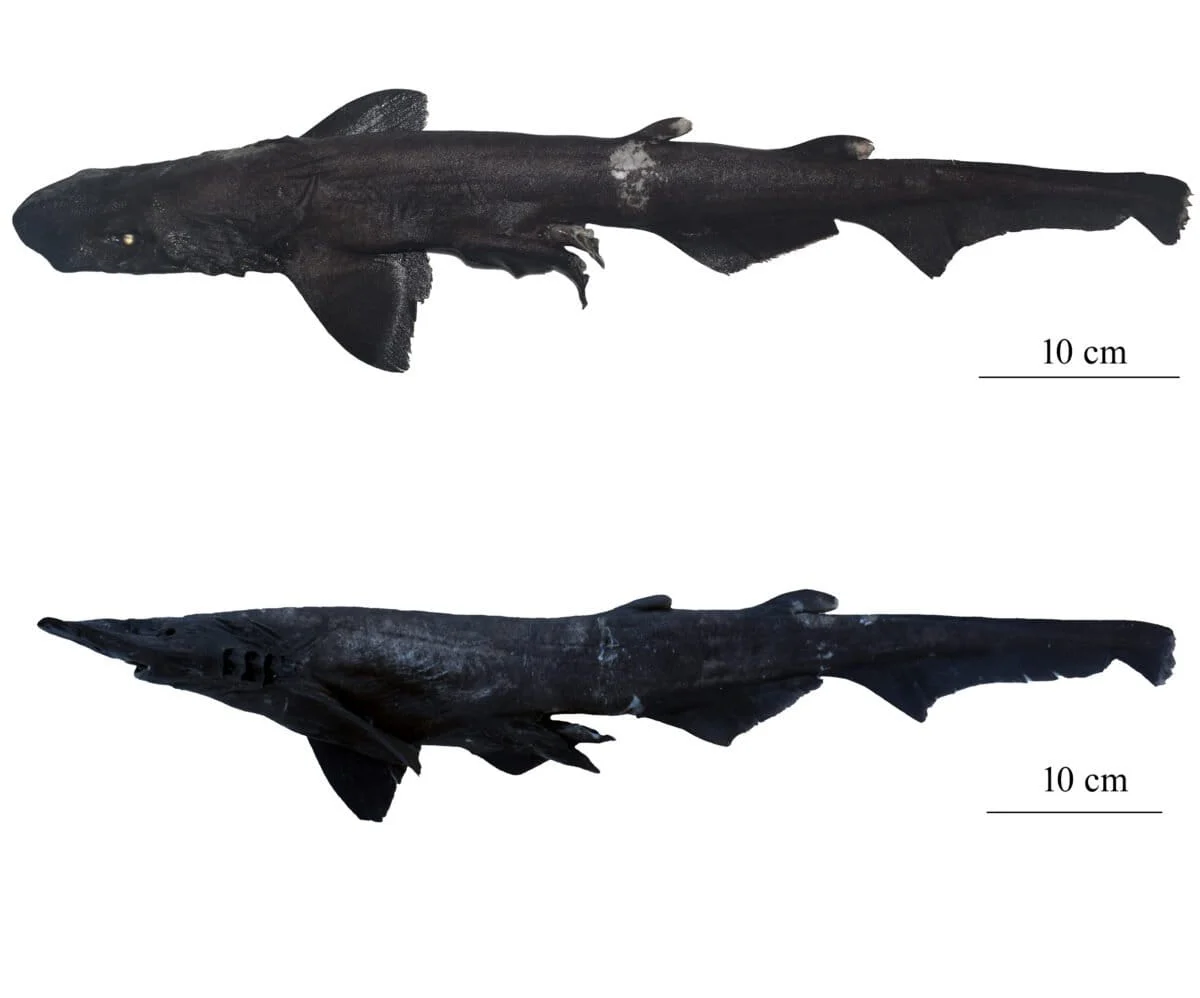
In the crushing, lightless depths of the southeastern Arabian Sea, a new predator has been officially added to the annals of marine biology. A team of Indian scientists has identified a new species of deep-sea catshark, named Apristurus drona, discovered amidst the bycatch of commercial shrimp trawlers operating off the coast of Kerala.
This discovery, part of a concerted effort to map the biodiversity of India’s Exclusive Economic Zone (EEZ), underscores the hidden complexity of deep-sea ecosystems and the urgent need for conservation strategies as industrial fishing pushes into deeper, more vulnerable waters.
Main Facts: The Emergence of Apristurus drona
The new species, Apristurus drona, belongs to the genus Apristurus, a group commonly referred to as "ghost catsharks" due to their slender, dark bodies and haunting, often pale eyes. The specimens were retrieved from the Kollam slope, a continental incline located off the coast of Kerala that has recently been designated as an Important Shark and Ray Area (ISRA).
Physical Characteristics
The Apristurus drona is distinguished by several unique morphological features:
- Coloration: A uniform, jet-black body that allows it to remain nearly invisible in the bathypelagic zone.
- Eyes: Striking white eyes that are adapted to capture the minimal bioluminescence present in the deep ocean.
- Snout: An angular, elongated, and pointed snout, characteristic of the Apristurus genus but with specific proportions that differentiate it from its closest relatives.
- Size: Like most members of its genus, it is a relatively small shark, possessing a flaccid body with high water content, which makes it of little interest to commercial food markets but of immense interest to evolutionary biologists.
The Scientific Significance
The identification of A. drona is a milestone for Indian ichthyology. While the genus Apristurus is one of the most species-rich shark groups globally, with 42 recognized species, its presence in Indian waters has long been a subject of taxonomic ambiguity. Before this discovery, only Apristurus investigatoris, found in the Andaman Sea, was confirmed to inhabit Indian territory. The description of A. drona provides the first confirmed record of a specific Apristurus species on India’s southwest coast, resolving years of "taxonomic confusion" regarding the biodiversity of the Arabian Sea’s continental slopes.

Chronology: From Bycatch to Binomial Nomenclature
The journey of Apristurus drona from the depths of the ocean to a peer-reviewed publication in the journal Zootaxa spanned several years of meticulous field and laboratory work.
2022: The Initial Encounter
The first specimen was discovered in 2022. A research team, led by scientists from the Marine Biology Regional Centre (MBRC) of the Zoological Survey of India (ZSI), was monitoring the bycatch of deep-sea shrimp trawlers at the Sakthikulangara Fisheries Harbour in Kollam. These trawlers, which typically target the high-value "red ring" shrimp (Aristeus alcocki), operate at depths ranging from 400 to 650 meters. Among the heaps of discarded marine life, the scientists spotted a slender, black fish with a distinctively pointed snout. Recognizing it as a potential member of the Apristurus genus, they preserved the specimen for further study.
2023–2024: Collection and Monitoring
Recognizing the potential for a new discovery, the team intensified their monitoring efforts. Over the next two years, three additional specimens were collected from the same landing center. These additional samples were crucial, as they provided the researchers with a sufficient sample size to account for individual variations and to perform destructive sampling for genetic analysis.
2024–2025: Laboratory Analysis
The team, comprising lead author Sweta Beura, corresponding author Bineesh K.K., and ZSI Director Dhriti Banerjee, subjected the four specimens to rigorous morphological and molecular testing. By comparing the physical measurements and the DNA sequences of these sharks with existing databases of Apristurus species worldwide, the team confirmed that the Kerala specimens were genetically and physically distinct.
2026: Official Publication
The findings were finalized and published in early 2026. The species was named Apristurus drona, contributing to a record-breaking year for Indian marine biology, which saw the discovery of several new chondrichthyan species within a single calendar year.

Supporting Data: Molecular and Morphological Evidence
The classification of deep-sea sharks is notoriously difficult because many species look nearly identical to the naked eye. To overcome this, the ZSI team employed a dual-approach methodology.
Genetic Barcoding
The researchers extracted DNA from fresh tissue samples to perform DNA barcode analysis. The results showed that A. drona had a genetic divergence of 5.5% to 5.7% from its closest known relative, Apristurus nayakai, which is found in the southwestern Pacific Ocean. In the world of shark taxonomy, a genetic difference of 3% or higher is generally considered sufficient evidence to classify a group as a separate species.
Taxonomic Grouping
Based on its physical characteristics, the researchers placed A. drona within the Apristurus brunneus subgroup. The genus is traditionally divided into three groups: brunneus, spongiceps, and longicephalus. By identifying the specific subgroup, scientists can better understand the evolutionary lineage and the migratory patterns of these deep-sea dwellers across the Indo-Pacific region.
Habitat Data
The specimens were consistently found in the Kollam slope and the Wadge Bank area. These regions are characterized by steep continental inclines where nutrient-rich upwellings support a high biomass of shrimp and small fish, which in turn attract apex predators like the catshark.
Official Responses: Insights from the Scientific Community
The discovery has prompted responses from leading marine scientists, highlighting both the achievement and the gaps in current oceanographic knowledge.

Bineesh K.K. (Scientist, MBRC, ZSI):
"Our understanding of deep-sea biodiversity is currently limited by the difficulty of accessing these environments. Apristurus drona is an ecologically important species because, as an apex predator in its niche, it helps regulate the population of smaller organisms. However, we must categorize it as ‘data-deficient’ for now, as we know very little about its total population or its reproductive biology."
Sweta Beura (Lead Author, ZSI):
"Taxonomically, there has been high ambiguity regarding this genus in India. While records mentioned other species like A. microps or A. indicus, those records were scant and often lacked specimen evidence. A. drona gives us a firm footing to begin mapping the true diversity of our southwest coast."
Shoba Joe Kizhakudan (Principal Scientist, ICAR-CMFRI):
"The description of this species highlights how much remains to be discovered in our deep-sea ecosystems. In 2026 alone, we have seen the discovery of multiple new species including Filistriatus arabicus and Cyttopsis indica. This suggests that our deep waters are a hotspot of undocumented life. However, we must be cautious; the inherent life-history traits of sharks—slow growth and low fecundity—make them highly vulnerable to the very fishing pressure that led to this discovery."
Implications: Conservation and the Future of Deep-Sea Research
The discovery of Apristurus drona serves as a double-edged sword. While it celebrates the success of India’s Deep Ocean Mission, it also shines a light on the unintended consequences of industrial deep-sea fishing.
The Bycatch Crisis
Historically, fishermen in the Arabian Sea operated at depths of 200 to 400 meters. However, as near-shore resources dwindle and global demand for deep-sea shrimp increases, trawlers have extended their reach to 600 meters and beyond. A. drona had not been recorded in bycatch surveys between 2008 and 2022, suggesting that it only began appearing once fishing depth increased.

While these catsharks have no commercial value for human consumption due to their small size and "watery" flesh, they are no longer being discarded. Instead, they are increasingly being ground into fish meal for the poultry and aquaculture industries. This transition from "discard" to "industrial raw material" could lead to targeted pressure on a species whose population dynamics are entirely unknown.
Risk of Local Extinction
Scientists fear that A. drona might be a "micro-endemic" species, meaning it may only exist within a very specific geographic range, such as the Kollam slope. If this is the case, even moderate levels of sustained trawling in that specific area could lead to local extinction before the species is even fully understood.
Potential for Biotechnology
The study also suggests that deep-sea species like A. drona could be untapped resources for biotechnology. Evolutionary adaptations that allow these sharks to survive in high-pressure, low-temperature environments often involve unique physiological processes. Future research may explore whether the species hosts unique microbes or produces antimicrobial peptides with potential applications in human medicine.
The Call for a Research Consortium
In light of these findings, experts are calling for the establishment of a national research consortium. Such a body would integrate the efforts of the Zoological Survey of India (ZSI), the Central Marine Fisheries Research Institute (CMFRI), and the Ministry of Earth Sciences. By pooling resources, India can transition from accidental discoveries via bycatch to systematic, non-invasive exploration of the deep sea.
As India continues to develop its "Blue Economy," the case of Apristurus drona stands as a reminder that the ocean’s depths hold secrets that are being uncovered just as they face their greatest threats. Monitoring, funding, and international cooperation will be essential to ensure that the "Ghost Catshark" of Kerala does not vanish into the darkness from which it emerged.
