

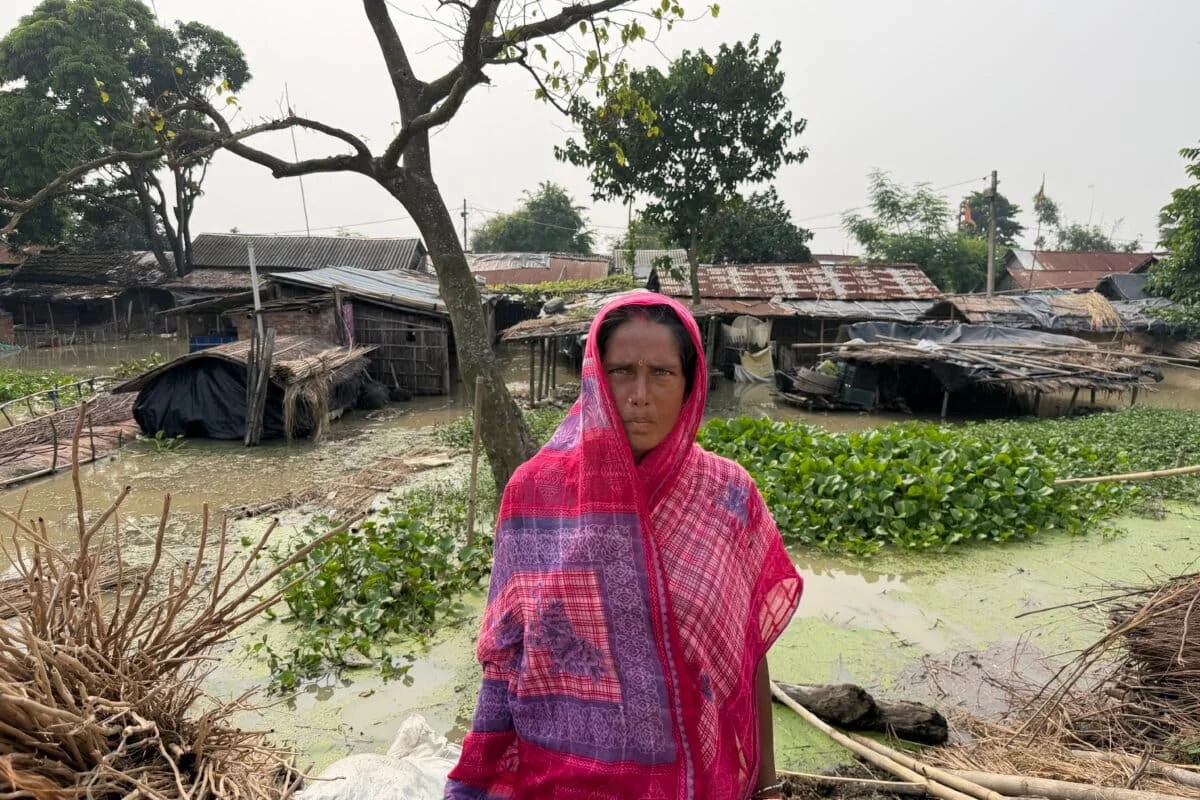
KATIHAR, BIHAR — In the village of Gandhi Tola, located in the Manihari block of Bihar’s Katihar district, Geeta Devi stands waist-deep in murky water. Her three-room mud house, a structure that represents her family’s life savings, is currently an island in a sea of silt and debris. The 35-year-old farmer performs a grueling daily ritual: she braves the rising currents to wade from a makeshift roadside shelter back to her submerged home. Her mission is simple yet desperate—to check if the water has climbed higher and if the few valuables she perched on elevated platforms remain safe.
Geeta’s struggle is a microcosm of a larger, systemic catastrophe. With her husband working as a daily-wage laborer in Delhi to send home meager remittances, she is the sole guardian of their four children, their livestock, and their ruined agricultural fields. "Now that we don’t have a house, where will we stay?" she asks, her voice reflecting a mix of exhaustion and stoicism. "How long can we stay out here with the children?"
As of mid-September 2026, Bihar finds itself in the grip of a devastating flood season that defies conventional meteorological logic. Despite an overall rainfall deficit of 35%, the state is witnessing some of its most severe flooding in recent years, exposing deep-seated vulnerabilities in infrastructure, environmental management, and disaster relief.
I. Chronology of a Crisis: From Deficit to Deluge
The 2026 monsoon season in Bihar began with concerns of drought. In June and July, the fields remained parched, and the usual monsoon rhythms were absent. However, the script flipped dramatically in late August and early September.

The September Surge
By September 14, 2026, the Bihar government’s disaster management department confirmed that 15 districts had been severely impacted. The scale of the crisis is staggering:
- Total Population Affected: Approximately 5 million (50 lakh) people.
- Geographic Spread: 88 blocks and 575 gram panchayats are currently inundated.
- River Levels: The Ganga has breached danger marks at multiple critical points, including Digha, Gandhi Ghat, Hathidah, Bhagalpur, Kahalgaon, and Munger.
- Tributary Overflow: The Kosi is flowing above danger levels at Baltara and Kursela; the Budhi Gandak is surging at Khagaria; and the Punpun, Bagmati, and Ghaghra rivers are threatening embankments at Paliganj, Benibad, and Darauli, respectively.
What makes this timeline peculiar is that the flooding did not stem from a consistent three-month monsoon. Instead, it was triggered by intense, concentrated rainfall in the later months within the catchments of Uttar Pradesh and Bihar, combined with a catastrophic flash flood event in neighboring Nepal.
II. The Hydrological Paradox: Why Bihar Floods Without Rain
The central question haunting policymakers and environmentalists is how India’s most flood-prone state—where 73% of the land is vulnerable—can face a deluge during a rain-deficit year.
1. The Saturated Soil Phenomenon
Himanshu Thakkar, coordinator of the South Asia Network on Dams, Rivers and People (SANDRP), explains that the timing of rainfall is as critical as the volume. "In the initial monsoon period, the soil is dry and acts like a sponge," Thakkar notes. "But by the later part of the monsoon, even if the total seasonal rainfall is low, the soil becomes saturated. Any additional rainfall thereafter cannot be absorbed; it converts into immediate runoff, leading to flash floods."

2. Catchment Degradation and Deforestation
The ability of the land to manage water has been severely compromised by decades of environmental neglect. Experts point to visible deforestation and the systematic destruction of local water bodies (wetlands and ponds) that once acted as natural buffers. With the catchment areas degraded, rainwater rushes into the river systems with unprecedented velocity, carrying heavy loads of silt that raise the riverbeds and reduce their carrying capacity.
3. The Farakka Factor
A recurring point of contention is the Farakka Barrage, a 2.4-kilometer-long structure on the Ganga designed to divert water into the Hooghly River. For years, Bihar’s leadership and environmentalists have blamed the barrage for creating a "backwater effect."
When the Ganga is full in the second half of the monsoon, the barrage restricts the free flow of water and sediment. This causes silt to accumulate upstream in Bihar, effectively raising the river’s floor. "Once Farakka is full, the water from the river finds it very difficult to drain out," says Thakkar. "This creates a flood situation even when rainfall is not exceptionally high."
III. Supporting Data: The Hidden Economic Toll
While the state government focuses on immediate relief statistics, independent assessments paint a far bleaker picture of the long-term economic devastation.

The Statistical Gap
Official state figures are notably silent on several key metrics:
- Total acreage of farmland destroyed.
- The number of livestock lost.
- The exact count of damaged houses and missing persons.
This lack of data contradicts the state’s own Standard Operating Procedure (SOP), which mandates a detailed initial damage assessment involving dated photographs and video evidence. Avinash Kumar, Joint Secretary in Bihar’s Disaster Management Department, maintains that "agriculture departments are still assessing the damage," and figures will only be released once the water recedes.
Household-Level Reality
Eklavya Prasad, managing trustee of Megh Pyne Abhiyan (MPA), argues that the absence of data masks a massive humanitarian crisis. MPA conducted a flood loss assessment across 2,290 households in seven districts following the 2024 floods, providing a blueprint for the current year’s expected losses.
The findings were harrowing:

- Total Loss: The surveyed households incurred a combined loss of ₹1.26 billion.
- Average Loss per Household: Approximately ₹5.51 lakh ($6,600 USD).
- The Debt Trap: With half of the households losing more than ₹2.11 lakh, many are forced into high-interest loans to survive.
For farmers like Pradeep Kumar Mandal, a 60-year-old from Hanswar village, the math of survival no longer adds up. Having lost eight acres of paddy and maize—amounting to a loss of ₹1 lakh this year alone—Mandal is at a breaking point. "I no longer have the courage to farm next year," he says, staring at the lake that used to be his livelihood.
IV. Official Responses vs. Ground Reality
The Bihar government has highlighted its massive relief operations as a sign of proactive governance. According to official releases:
- 1,260 community kitchens have been established.
- 12 million (120 lakh) meals have been served.
- 13 relief camps are housing over 11,000 people.
- 400,000 tarpaulin sheets and thousands of food packets have been distributed.
However, for those in the rural interiors, these numbers feel like fiction. Geeta Devi, living on a railway embankment, says she has received nothing. She was forced to borrow ₹1,500 just to buy the bamboo and plastic sheets for her temporary shelter.
The situation is mirrored across the river in the Sahebganj district of Jharkhand. There, resident Saiba Bano describes the government relief as "insulting."
"They gave us 5 kg of flattened rice (chura), two candles, and 200 grams of jaggery," Bano says. "Our entire house is submerged. We are living on the roof. How many days is 5 kg of rice supposed to last a family?"

Bijay Kumar, Additional Collector of Sahebganj, acknowledges that 45,000 families across 68 villages have been affected, but maintains that property and crop assessments must wait for the water to recede.
V. Implications: The Cycle of Migration and Poverty
The persistent flooding in Bihar and Jharkhand is not merely a seasonal weather event; it is a driver of systemic poverty and mass migration.
1. The "Climate Refugee" Surge
When crops fail and homes vanish, the only remaining "export" for these districts is human labor. Geeta Devi’s husband is already in Delhi; Sudesh Mahato, a 65-year-old laborer in Katihar, notes that all of his sons have migrated for work. The floods act as a catalyst, pushing young men out of the agrarian economy and into the informal urban sectors of Delhi, Mumbai, and Bengaluru.
2. The Erosion of Resilience
The "flat cash payout" often provided by the government months after the flood (usually in October or November) is rarely enough to cover even 10% of the actual household loss. As Eklavya Prasad notes, "By the time a family recovers from one flood, the next one has already arrived." This constant state of recovery prevents families from investing in education, healthcare, or improved farming techniques, keeping them trapped in a cycle of subsistence.

3. Infrastructure and Policy Needs
The 2026 floods underscore the urgent need for a shift in policy:
- De-silting Initiatives: Addressing the sedimentation in the Ganga and its tributaries is no longer optional.
- Decentralized Relief: Relief camps are often centered in towns, leaving rural villagers to fend for themselves on highways and embankments.
- Climate-Resilient Housing: The vulnerability of mud houses (kucha houses) remains a primary cause of property loss.
Conclusion
As the sun sets over the flooded plains of Manihari, Pintu Yadav stands neck-deep in water, using a sickle to cut what remains of his fodder crop. He ducks under the surface, resurfacing with a sodden bundle to hand to his family on a tractor. It is a scene of immense grit, yet it is a battle he is destined to lose.
The water will eventually recede, leaving behind a thick layer of silt and a mountain of debt. Geeta Devi will return to her mud house, scrape away the grime, and attempt to rebuild. She will do this with the haunting knowledge that the Ganga will rise again, and when it does, the statistics will likely once again fail to capture the true depth of her loss.
