

BENGALURU — In the humid, emerald expanses of India’s Western Ghats and the rapidly encroaching concrete jungles of its urban centers, a quiet revolution is taking place in the field of conservation genetics. For decades, the study of amphibians—often referred to as the "canaries in the coal mine" for planetary health—has been marred by a fundamental paradox: to save a species, scientists often had to harm the individual.
A team of researchers from the Srishti Manipal Institute of Art, Design & Technology, the Manipal Institute of Technology, and the Ashoka Trust for Research in Ecology and the Environment (ATREE) has successfully shattered this paradigm. Their latest study demonstrates that a simple cotton swab, applied with precision and care, can yield high-quality genetic data without the need for invasive surgeries or tissue removal. This breakthrough promises to align wildlife research with modern ethical standards while providing a critical tool for monitoring species on the brink of extinction.
Main Facts: A Gentle Touch for Genetic Mapping
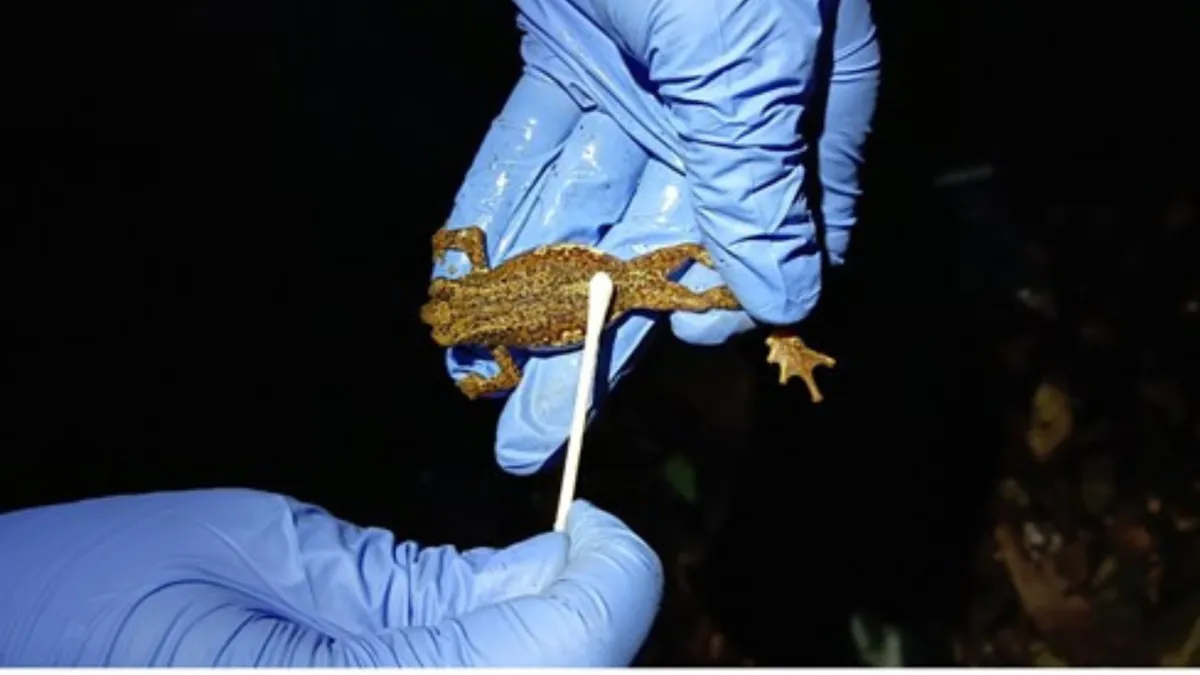
The research, recently published and validated in the field, establishes a standardized protocol for collecting amphibian DNA through skin swabbing. This method leverages the biological reality that amphibians, much like humans, constantly slough off skin cells. These cells contain the nuclear and mitochondrial DNA necessary for a variety of scientific analyses, from species identification to the tracking of deadly pathogens like the chytrid fungus.
The core of the discovery lies in its simplicity and efficacy. By applying exactly 60 gentle strokes of a sterile cotton swab across a frog’s back, belly, and limbs, researchers can gather enough genetic material to map the organism’s entire genetic code. The study tested this method on 88 individuals across seven distinct groups of frogs and toads, ranging from large, warty-skinned specimens to the minute, 13-millimeter Microhyla frogs.
The results were staggering: over 86% of the swab samples successfully produced DNA copies through Polymerase Chain Reaction (PCR), and 67% of those were of high enough quality to be read by sequencing machines. This proves that the "swab-and-release" method is not only more humane but also scientifically robust enough to replace older, more traumatic techniques.
The Chronology of Innovation: From Debate to Discovery
The journey toward this ethical breakthrough began in early 2024, born out of a moral dilemma faced by the research team. At the heart of the project was Vaibhavi G., a PhD candidate at the Srishti Manipal Institute of Art, Design & Technology, working under the supervision of Dr. Gururaja KV, a renowned batrachologist.

The traditional "gold standard" for amphibian DNA collection involved methods that many modern researchers find increasingly difficult to justify: "toe-clipping" (the removal of a digit), the clipping of tadpole tail tips, or the collection of egg masses and thigh muscle tissue. While proponents of these methods argued that the long-term impact on survival was minimal, a growing body of evidence suggested these procedures caused significant acute stress, potential infection, and behavioral changes.
"In 2024, when I joined for PhD, the topic of skin swabbing started as a discussion between Dr. Gururaja KV, my supervisor, Dr. Priti Hebbar, and I," recalls Vaibhavi G. "Dr. Gururaja was firmly against collecting thigh muscles, tadpole tail tips, or eggs. After several long conversations, we decided to try skin swabbing."
The team spent months in the field and the lab, refining the protocol. The transition from theory to practice was fraught with technical hurdles. The primary challenge was the "amplification" phase. Because a swab collects significantly less biological material than a tissue sample, the researchers had to perfect the PCR process to ensure the tiny amount of DNA could be copied millions of times without errors.
"Post field visits, sample collection, and DNA processing came one of the challenges: the Polymerase Chain Reaction step," Vaibhavi G. explains. "We finally saw a promising result after a month-long trial and error." This persistence eventually led to a standardized protocol that could be replicated by conservationists across the tropical world.
Supporting Data: Testing the Limits of the Swab
To ensure the method was viable for large-scale conservation, the researchers conducted a series of comparative tests focusing on two critical variables: extraction methods and storage conditions.
1. Extraction: Professional Kits vs. Basic Chemistry
The team compared expensive, professional laboratory extraction kits against a more basic, cost-effective "salt extraction" method. In remote field stations where funding and high-tech equipment are often scarce, the ability to use simpler methods is vital. The study found that while both methods yielded similar quantities of DNA, the professional kits produced "purer" samples, which are easier for sequencing machines to read. However, the salt extraction method remained a viable alternative for basic species identification.

2. Storage: The Wet vs. Dry Debate
One of the most significant findings involved how the swabs were stored after collection. Traditionally, biological samples are kept in vials of ethanol (alcohol) to prevent degradation. However, carrying large quantities of chemicals into the deep forests of the Western Ghats is cumbersome and poses a spill risk.
The researchers discovered that "dry swabs"—stored in sterile containers without liquid—actually provided higher purity than those kept in alcohol. This finding is a game-changer for field researchers, as it simplifies the logistics of sample transport and reduces the cost of materials.
3. Scaling Down: The 13mm Success
A common criticism of swabbing in previous international studies was its failure to work on very small species. Small frogs have less surface area, meaning fewer skin cells are collected. However, this study successfully extracted DNA from Microhyla frogs measuring just 13 millimeters in length. This success suggests that the "60-stroke" protocol provides enough friction to collect adequate cellular material even from the tiniest amphibians.
Official Responses: The Voice of the Scientific Community
The research team is vocal about the implications of this study for the future of Indian herpetology. For them, the success of the swabbing method is as much about ethics as it is about data.
Dr. Priti Hebbar, from the Manipal Institute of Technology, Bengaluru, emphasizes the conservation potential: "This minimally invasive genetic method has the potential to identify new or cryptic species, advance our understanding of genetic diversity, and contribute to amphibian conservation without killing the individuals. The study can enhance our understanding of India’s amphibian diversity without compromising animal welfare."
Prof. Gururaja KV, who has spent decades studying the frogs of the Western Ghats, reflected on the shift in methodology on social media, noting that the team had "lengthy discussions and deliberations" to find an alternative to toe-clipping. His advocacy for the "skin swab" call has now been vindicated by the study’s high success rate.

Vaibhavi G. also acknowledged the collaborative nature of the breakthrough, citing the help of fellow researchers Aravind CK, Shashank K Borkar, and Sona Maria Sebastian, as well as guidance from Pavan Kumar Thunga at ATREE. "We hope this standardized skin-swabbing protocol encourages wider adoption of minimally invasive genetic sampling," she stated.
Implications: A New Era for Bio-Indicators
The significance of this study extends far beyond the laboratory. Amphibians are considered "bio-indicators"—their permeable skin makes them highly sensitive to changes in water quality, air pollution, and climate. Their health is a mirror reflecting the health of the entire ecosystem.
With nearly 50% of amphibian species in the Western Ghats and urban India facing the threat of extinction due to habitat loss, pollution, and climate change, the need for rapid genetic monitoring has never been more urgent.
Aligning with the 3Rs Framework
The new swabbing method aligns perfectly with the global "3Rs" framework for animal research:
- Replace: Using non-sentient or less sentient materials where possible.
- Reduce: Minimizing the number of animals used in a study.
- Refine: Improving experimental procedures to minimize pain and suffering.
By "refining" the DNA collection process, the Bengaluru-based team has ensured that scientists no longer have to choose between rigorous data and the welfare of their subjects.
Future Challenges and Adaptations
Despite the success, the researchers acknowledge that a "one size fits all" approach has its limits. The texture of an amphibian’s skin—whether it is the slimy, smooth skin of a stream frog or the dry, warty skin of a Malabar tree toad—affects how many cells are sloughed off. The team recommends that future researchers conduct small pilot studies on their specific target species to determine if the number of strokes needs adjustment.

Furthermore, while swabbing is excellent for species identification and population genetics, more intensive genomic studies (such as full genome sequencing) may still require the higher DNA concentrations found in traditional tissue samples. However, for the vast majority of conservation work, the swab is now the ethical tool of choice.
Conclusion: Respecting the Life We Study
As the sun sets over the Western Ghats and the evening chorus of frogs begins, the work of Vaibhavi G. and her colleagues ensures that this music continues undisturbed. The study proves that in 2026, the pursuit of knowledge does not require the sacrifice of the living.
By proving that a simple cotton swab can unlock the secrets of an endangered species, these researchers have provided a blueprint for the future of wildlife biology—one where the tools of science are as gentle as the creatures they seek to protect. The message is clear: we can save the natural world while respecting the individual lives within it, ensuring that our quest for discovery leaves no scars behind.
