

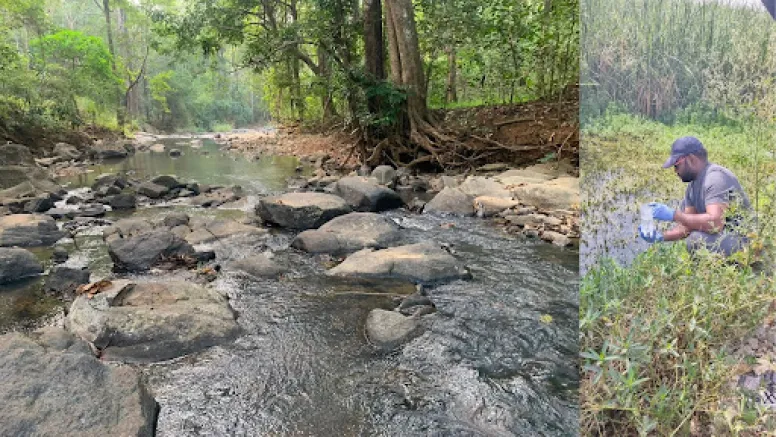
PUNE – In the intricate, microscopic world of river ecosystems, a silent revolution is taking place. For decades, the gold standard of water quality monitoring has relied on the presence and health of diatoms—single-celled algae encased in ornate, glass-like silica shells. However, new research emerging from a collaborative effort between the Agharkar Research Institute (ARI), Savitribai Phule Pune University, and the Canadian Museum of Nature suggests that our understanding of these "biological sentinels" in tropical climates has been fundamentally skewed by temperate-zone biases.
The study, conducted across the lush and biodiverse landscapes of the Western Ghats, reveals that tropical diatoms are far less selective about their physical habitats than previously thought. Whether clinging to a submerged boulder (epilithon) or the stem of an aquatic plant (epiphyton), these organisms respond primarily to the chemical composition of the water rather than the surface they inhabit. This finding promises to streamline environmental conservation efforts, making it easier, cheaper, and more efficient to monitor the health of some of the world’s most vital freshwater systems.
Main Facts: A Shift in Ecological Paradigms
The core of the discovery lies in the concept of "substrate specificity." In the rivers of Europe and North America, researchers have long operated under the assumption that diatom communities are highly specialized. A scientist looking for a true representation of water health would traditionally seek out specific types of submerged rocks, believing that the algae found on plants would offer a different, potentially misleading, ecological signal.
The new research, published by a team led by Karthick Balasubramanian, shatters this assumption for tropical ecosystems. By analyzing 40 distinct sites within the Western Ghats—a UNESCO World Heritage site and a global biodiversity hotspot—the team discovered that diatom communities on rocks and plants were nearly identical.
Key findings include:
- Chemical Dominance: Environmental water chemistry was found to be 13 times more influential in determining diatom diversity than the physical surface (substrate) they grew on.
- Phosphorus and Temperature: Factors such as phosphorus levels, water temperature, and electrical conductivity act as the primary "biological filters," dictating which species survive in a given stretch of river.
- High Endemism: Over 57% of the species identified in the study are endemic to the Western Ghats, highlighting a level of regional uniqueness far exceeding that found in temperate river systems.
- Monitoring Flexibility: The study concludes that researchers can adopt "substrate-independent monitoring," allowing for accurate water quality assessments even in rivers where rocks or plants are absent.
Chronology: From Field Observations to a New Model
The journey to these findings began with a recognition of the limitations of current monitoring manuals, many of which are adaptations of European standards. Researchers from the Agharkar Research Institute and their partners set out to determine if these "Western" rules applied to the unique conditions of the Indian tropics.

Phase 1: The Field Expedition
The team selected 40 sampling sites across the Western Ghats, spanning various altitudes, flow rates, and levels of human impact. The Western Ghats represent an ideal laboratory due to their complex topography and the varying degrees of urbanization and agricultural runoff they face. During the sampling phase, researchers meticulously collected diatoms from both submerged stones and various aquatic macrophytes (plants).
Phase 2: Laboratory Analysis and Taxonomy
Back in the laboratory, the researchers faced the mammoth task of identifying thousands of individual diatoms. Using high-resolution microscopy, they categorized the species, noting the incredible diversity of the silica shells. It was during this phase that the high rate of endemism (57%) became apparent, suggesting that the Western Ghats host a suite of species found nowhere else on Earth.
Phase 3: Statistical Modeling
The final stage involved complex multivariate statistical analysis. The team compared the diatom community structures against a suite of environmental variables. They sought to answer a specific question: "Does the type of surface (rock vs. plant) explain the variation in diatom species, or does the water chemistry explain it?" The data pointed overwhelmingly toward the latter, revealing the "species-sorting" effect driven by the tropical environment.
Supporting Data: The 13x Influence of Chemistry
The most striking data point from the study is the "13-fold" difference. In ecological terms, this refers to the "explained variance." While the physical substrate accounted for a negligible fraction of why certain diatoms lived in certain areas, the chemical parameters—specifically phosphorus, temperature, and conductivity—explained the vast majority of the distribution.
The Role of Phosphorus
In many temperate rivers, phosphorus is a "limiting nutrient," meaning its scarcity restricts growth. However, the study found that many streams in the Western Ghats are naturally rich in phosphorus due to the region’s unique geology and soil composition. When nutrients are abundant and temperatures remain relatively stable and warm throughout the year, diatoms lose their need to specialize. They become "generalists" regarding their physical home, focusing instead on optimizing their metabolism for the specific chemical "soup" of the river.

Temperature Stability
Unlike European rivers that experience dramatic seasonal shifts in temperature, tropical rivers in the Western Ghats maintain a more consistent thermal profile. This stability allows for a more continuous "sorting" of species based on chemical tolerances, as the organisms are not constantly battling extreme cold or ice cover.
Endemism Statistics
The discovery that 57% of the species are endemic is a significant jump from previous estimates. This data underscores the importance of local research; using European identification keys to monitor Indian rivers would likely result in misidentifying over half of the species present, leading to flawed conservation data.
Official Responses and Scientific Context
The research team, including contributors from Savitribai Phule Pune University and the Canadian Museum of Nature, emphasizes that these findings are a call to action for regional policy-makers.
Dr. Karthick Balasubramanian, a lead researcher on the project, noted that the flexibility of diatoms is a "gift" to conservationists. "By demonstrating that diatoms are flexible in their habitat use, this research enables the development of substrate-independent monitoring," the study suggests. This means that even in silty, muddy rivers where rocks are buried under sediment—a common occurrence in areas affected by deforestation and construction—scientists can still get an accurate reading of water health by sampling whatever is available, be it a leaf, a twig, or a plastic pipe.
International collaborators from the Canadian Museum of Nature have pointed out that this study bridges a major gap in "Global South" limnology (the study of inland waters). They argue that for too long, tropical water management has been a "copy-paste" of temperate methodologies, which often led to inefficient or inaccurate monitoring in South Asia, Africa, and South America.

Implications: A New Era for Water Conservation
The implications of this study for the Western Ghats—and tropical river management globally—are profound. As the region faces mounting pressure from rapid urbanization, industrial agriculture, and the unpredictable effects of climate change, the ability to monitor water quality accurately and cheaply is paramount.
1. Cost-Effective Monitoring
Traditional monitoring can be expensive, requiring specialized equipment and highly trained taxonomists to find specific substrates. By proving that any available surface will suffice, the study lowers the barrier to entry for water quality monitoring. Local government bodies and even "citizen scientists" can participate in gathering data, as the sampling process is significantly simplified.
2. Monitoring in Degraded Landscapes
In many parts of the Western Ghats, human activity has led to increased sedimentation. Rivers that once had rocky beds are now covered in silt. Under old methodologies, these rivers might have been deemed "un-monitorable" using diatoms. The new research proves that diatoms on the stems of invasive weeds or even submerged debris can provide a reliable picture of the river’s health, ensuring that no waterway is left behind in conservation efforts.
3. Preserving Endemic Biodiversity
With 57% of species being unique to the region, the Western Ghats are a "cradle" of diatom evolution. Understanding that these species are generalists in their habitat but specialists in their chemistry allows for better-targeted conservation. If a specific endemic species begins to disappear, scientists now know it is almost certainly due to a change in water chemistry (pollution or nutrient loading) rather than a change in the physical riverbed.
4. Climate Change Resilience
As climate change alters the rainfall patterns and temperatures of the Western Ghats, the "biological filter" of the water will shift. This study provides a baseline for understanding how these microscopic communities currently function. By monitoring how diatom communities change over the coming decades, scientists can use them as an "early warning system" for broader ecological collapse.

Conclusion
The diatoms of the Western Ghats may be microscopic, but the lessons they provide are monumental. By showing that "caves or tree houses"—rocks or plants—hardly matter to these resilient organisms, researchers have unlocked a more flexible and robust way to protect our freshwater resources. In the face of a changing world, the ability to listen to these tiny "glass" storytellers, regardless of where they choose to live, may be the key to preserving the lifeblood of the Indian tropics for generations to come.
