

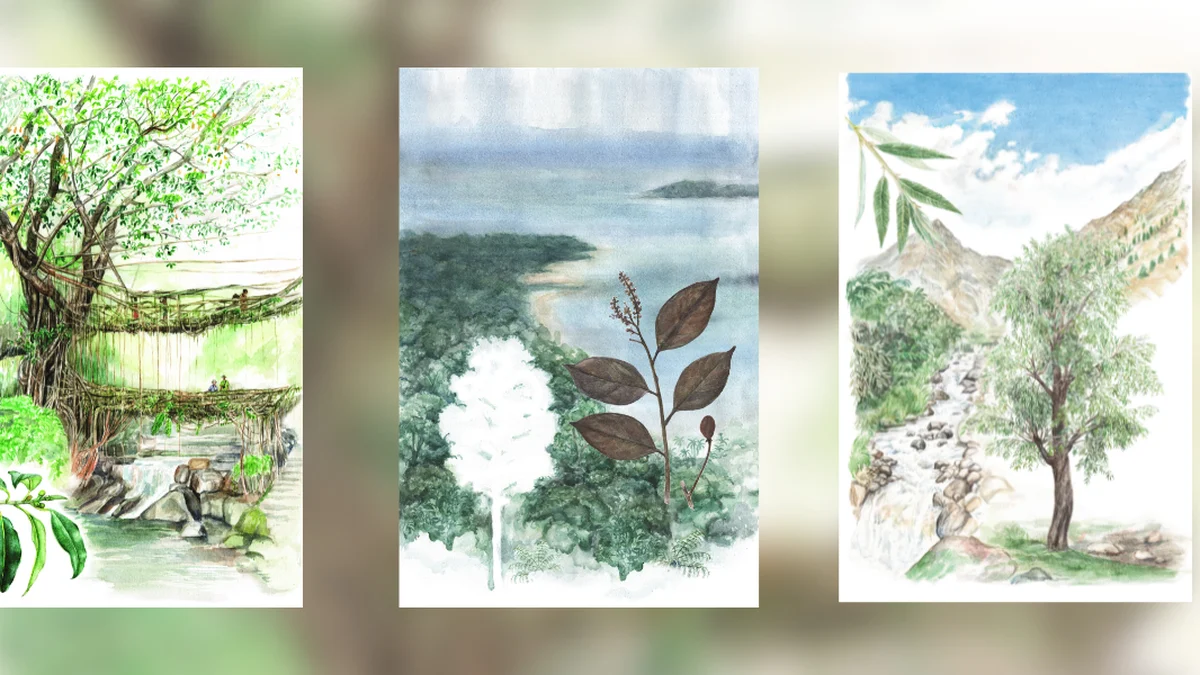
In the realm of environmental literature, few works manage to bridge the gap between cold botanical data and the warm, rhythmic pulse of human history. T.R. Shankar Raman’s latest work, The Trees of My Country: A Natural History of India in 50 Trees, published by Aleph Book Company, emerges as a vital contribution to this genre. Illustrated with evocative precision by Manali Patil, the book is more than a field guide; it is a profound meditation on the silent witnesses of the Indian subcontinent’s evolution.
At the heart of the book lies a striking visual metaphor: a conspicuous white blotch in the shape of a tree, set against a lush illustration of the Great Nicobar Island. This "missing" tree represents Nicobariodendron sleumeri, a species so elusive that even Raman, a seasoned wildlife scientist, has never seen it in the flesh. This void serves as a powerful opening gambit for a narrative that explores the fragility of India’s biodiversity and the urgent need to document what remains before it vanishes under the weight of "development."
Main Facts: A Scientific and Literary Synthesis
The Trees of My Country chronicles 50 native species, ranging from the ubiquitous to the critically endangered. T.R. Shankar Raman, a scientist with the Nature Conservation Foundation, brings a researcher’s rigor to the text, but it is his prose—infused with a deep-seated love for the landscape—that elevates the work. The book explores trees not as isolated biological units, but as "storytellers, historians, and chroniclers of place."
The selection of trees reflects the geographical and cultural diversity of India. From the rain-drenched forests of the Andaman and Nicobar Islands to the militarized valleys of Kashmir and the bustling urban centers like Bengaluru, Raman traces the lifelines that connect these species to the people who live among them. The illustrations by Manali Patil are central to the book’s identity; they were often created with scant botanical evidence, requiring a blend of scientific deduction and vivid imagination to reconstruct rare species for the reader’s eye.
Chronology of Documentation: Building an Indian Botanical Library
The publication of this book marks a significant moment in the chronology of Indian natural history writing. For decades, botanical documentation in India was largely the province of colonial-era catalogs or dry academic texts. However, the last twenty years have seen a resurgence in "literary botany"—works that combine scientific accuracy with narrative flair.
Raman’s work sits comfortably alongside a formidable lineage of contemporary Indian tree literature. It follows in the footsteps of Pradip Kishen’s seminal Trees of Delhi (2006), which revolutionized how urbanites viewed their green spaces. It also echoes the socio-ecological approach found in Harini Nagendra and Seema Mundoli’s Cities and Canopies (2019) and the historical reverence of S. Natesh’s Iconic Trees of India.
This chronological progression reflects a shifting consciousness in India. As the country urbanizes at a rapid pace, there is a growing intellectual and emotional movement to reclaim and understand the native flora that once defined the landscape. Raman’s book is the latest milestone in this journey, focusing specifically on the "native" aspect to challenge the dominance of exotic species often favored in modern landscaping.
Supporting Data: The Ecological and Economic Stakes
Raman provides compelling data and anecdotes that highlight the utilitarian and ecological value of these 50 species. Two primary examples illustrate the range of his inquiry: the Nicobariodendron sleumeri of the south and the Salix (willow) of the north.
The Mystery of the Nicobar Bittersweet
The Nicobariodendron sleumeri is a 30-meter-high giant found on the forested hilltops of the Nicobar Islands. It is characterized by white fragrant flowers, conical red fruits, and glossy green leaves. Despite its stature, it has eluded systematic botanical study. Raman notes that while the scientific community knows little of it, the indigenous Shompen and Nicobarese communities likely possess a deep, ancestral knowledge of the tree, including its names and uses. This highlights a recurring theme in the book: the gap between formal Western science and traditional ecological knowledge (TEK).
The Willow and the Economy of Conflict
In the chapter on the Salix willows of Kashmir, Raman shifts from mystery to socio-politics. The willow is not merely a tree in the Valley; it is an economic engine.

- Fodder and Craft: Native willows are used for livestock fodder and woven into intricate baskets used for carrying kangris (charcoal fire pots).
- The Cricket Bat Industry: The "alien" white willow (Salix alba), introduced to the region, has made Kashmir the global hub for cricket bat manufacturing.
- Data Point: The bat-making industry in Kashmir employs thousands and produces millions of bats annually, yet Raman points out the irony of this "nationalist" sport being fueled by a tree growing in a region defined by "unreconciled hostility" and "militarized landscapes."
Official Responses and Environmental Concerns
The book does not shy away from political critique, particularly regarding the ₹81,800-crore Great Nicobar International Transshipment Terminal project. This government-backed infrastructure plan involves the felling of nearly a million trees in one of the world’s most sensitive biodiversity hotspots.
Raman’s fear is that species like Nicobariodendron sleumeri will be eradicated before they are even fully understood by science. Environmentalists and tribal rights activists have issued numerous "official responses" and petitions against the project, citing the irreparable loss of endemic species and the displacement of the Shompen people. Raman’s narrative provides the emotional and scientific weight to these protests, framing the project as a "final death-blow" to a unique evolutionary lineage.
Furthermore, the book addresses the "irreligious" scientist’s experience at Bodh Gaya. By focusing on the Bodhi-druma (the Peepal tree or Ficus religiosa) under which the Buddha attained enlightenment, Raman bridges the gap between official religious history and botanical reality. He views the tree as a "descendant" of the original, emphasizing the continuity of life through saplings and seeds, even as human structures crumble around them.
Implications: The Future of India’s Natural Heritage
The implications of Raman’s work are manifold, touching on conservation, urban planning, and cultural identity.
1. Conservation Beyond Charismatic Megafauna
Traditionally, Indian conservation efforts have focused on "charismatic" animals like the tiger or the elephant. Raman’s book argues for a shift toward "charismatic flora." By giving trees names, stories, and histories, he makes their protection a matter of cultural survival, not just biological preservation.
2. Urban Biodiversity and Mental Health
The book recounts the experience of living with an Albizia procera (Karoi) in Bengaluru. The tree is described as a "thriving, ever-morphing world" inhabited by mynahs, owls, and rat snakes. The implication is clear: urban trees are essential for maintaining a connection to nature in increasingly concrete-heavy environments. They provide a sense of place and a "chronicle" of the seasons that is vital for human well-being.
3. Decolonizing Botany
By acknowledging that indigenous tribes likely have their own names and uses for "undiscovered" species, Raman suggests a need to decolonize Indian botany. Future research, he implies, must involve a partnership with local communities rather than a top-down approach from urban laboratories.
4. The Nationalism of Nature
The discussion of the Kashmir willow serves as a cautionary tale about how nature is co-opted into nationalistic narratives. Raman suggests that a true love for one’s country should manifest as a respect for its soil and its native species, rather than the "false nationalism" of sports or symbols that ignore the ecological cost of their production.
Conclusion: A Living Manuscript
While The Trees of My Country is a meticulously researched document, its greatest strength is its accessibility. It transforms the reader from a passive observer of the landscape into an active participant in its history. The book’s only minor flaw—the absence of a traditional index, replaced by an alphabetical enumeration—is a small price to pay for a work that reads like a collection of vivid short stories.
As India stands at a crossroads between rapid industrial expansion and environmental preservation, Raman’s 50 trees serve as 50 reasons to pause. They are reminders that once a species—be it the fragrant Nicobariodendron or the sturdy Salix—is gone, a chapter of the country’s history is closed forever. This book is an invitation to read those chapters while the leaves are still green and the stories are still being told.
