

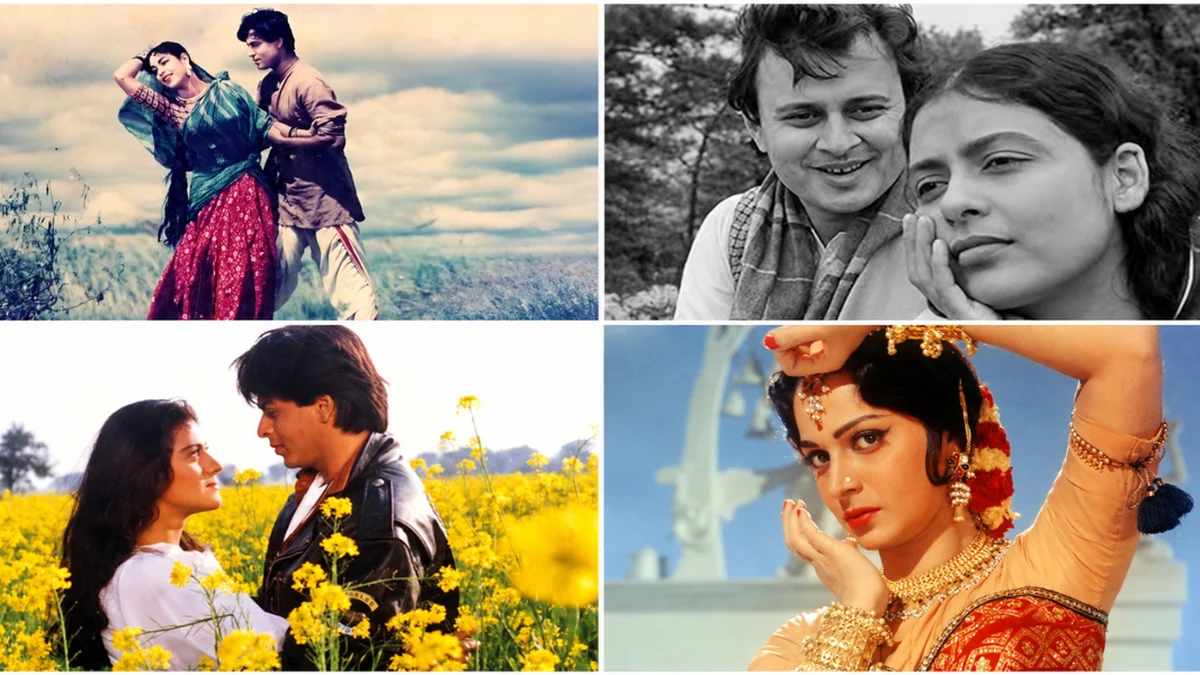
The relationship between the critic and the creator is often fraught with a fundamental tension: the tendency of the reviewer to judge a work based on what they believe it should have been, rather than what it actually is. This intellectual pitfall—fixating on omissions rather than contents—is a trap that even seasoned critics must navigate with care. However, in the case of Shoma A. Chatterji’s latest scholarly endeavor, The Male Gaze Redefined: Through Mother India and Other Classics of Indian Cinema, the omissions are not merely stylistic choices but fundamental structural issues that invite rigorous scrutiny.
Published by Hachette India, Chatterji’s book attempts a daunting task: re-evaluating the history of Indian cinema through the lens of feminist film theory, specifically focusing on how nine major male directors have depicted women over several decades. While the project is undoubtedly ambitious and essential for the canon of Indian film studies, it arrives with a curious mix of profound insight and perplexing datedness.
Main Facts: The Premise and the Framework
The Male Gaze Redefined is structured as an analytical journey through the filmographies of some of India’s most revered male auteurs. Chatterji, a National Award-winning critic and veteran scholar, uses the theoretical bedrock of "the male gaze"—a term famously coined by British film theorist Laura Mulvey in her 1975 essay, Visual Pleasure and Narrative Cinema—to dissect Indian celluloid.
The book focuses on nine directors, primarily operating within the realms of "Parallel Cinema" or "Middle Cinema." These include stalwarts such as Satyajit Ray, Mrinal Sen, Ritwik Ghatak, Shyam Benegal, and Gulzar. The narrative explores how these men, despite their progressive leanings and empathetic portrayals of women, were nonetheless products of a patriarchal society, leading to inevitable "blind spots" in their creative output.
Chatterji’s methodology involves comparing these Indian works against Western feminist pedagogy. She argues that while Mulvey’s theories regarding the objectification of women are foundational, they require a nuanced "redefinition" when applied to the Indian context, where the female figure often oscillates between being a "Goddess" and a "submissive domesticity."
Chronology: A Study Stuck in Time?
One of the most significant challenges in assessing The Male Gaze Redefined is its chronological dissonance. Though presented as a fresh publication for the mid-2020s, the text frequently reads like a manuscript preserved from a previous era.
The author specifies a primary study timeline of 1935 to 2000. While focusing on "classics" is a legitimate academic choice, the book’s claim to being a contemporary analysis is undermined by its terminology. In one chapter discussing the evolution of female voices, Chatterji cites Mahesh Manjrekar and Rituparno Ghosh as "two young directors." In reality, Manjrekar is 67 years old, and the legendary Rituparno Ghosh passed away over a decade ago.
This chronological lag extends to the selection of films. While there are passing references to more recent works like Indu Sarkar (2017) and Thalaivii (2021), the bulk of the "contemporary" analysis stops at the mid-1990s, with Dilwale Dulhania Le Jayenge (1995) serving as a rare foray into mainstream commercial cinema. For a book published in the current decade, the near-total exclusion of the transformative shifts in 21st-century Indian cinema—ranging from the gritty realism of the "New Wave" in Malayalam cinema to the polarising gender politics of Sandeep Reddy Vanga—leaves a significant void.
Supporting Data: Close Readings and Symbolic Signifiers
Where Chatterji truly shines, and where the book offers its greatest value, is in its meticulous "close readings" of specific films. When the author moves away from broad generalizations and focuses on the frame, her scholarly depth becomes evident.
The Evolution of the Mother Archetype
Chatterji provides a compelling comparison between Mehboob Khan’s Aurat (1940) and its more famous remake, Mother India (1957). She observes that while Aurat treats the protagonist Radha’s struggles as a personal, human journey, Mother India—produced in the wake of India’s independence—burdens the character with nationalistic symbolism. Radha ceases to be just a woman; she becomes the "nation-mother," a transformation that Chatterji argues actually strips the character of true individual agency.

The Power of Objects
Following the thematic thread of her earlier work, The Woman at the Window, Chatterji excels at identifying objects as powerful cultural signifiers:
- The Lipstick in Mahanagar (1963): In Satyajit Ray’s masterpiece, the simple act of a housewife applying lipstick becomes a radical symbol of modernity, economic independence, and the "Anglo-Indian" influence that both attracts and repels the traditional Bengali household.
- The Scarf in Zubeidaa (2001): Chatterji analyzes how Shyam Benegal uses costume to denote the stifling nature of royal tradition and the protagonist’s failed attempts at rebellion.
- The Bangles (Kangans) in Mother India: Despite some repetitive writing in this section, the analysis of the bangles as symbols of a woman’s "liminal" marital status—neither fully a wife nor a widow—is poignant.
The Male Lens in Mainstream Cinema
A rare but insightful foray into big-budget Bollywood occurs with the analysis of Vijay Anand’s Guide (1965). Chatterji celebrates the "snake dance" performed by Waheeda Rehman not as a moment of objectification, but as a revitalizing explosion of female pent-up energy and artistic liberation. She correctly points out the ambivalence of the male protagonist, Raju (Dev Anand), whose "support" for the heroine is often tinged with his own ego and patriarchal need for control.
Official Responses and Theoretical Debates
While the book does not feature "official responses" in the sense of government statements, it exists within a vibrant ecosystem of international film criticism. Chatterji’s work invites a comparison with how Western critics have handled similar "problematic" male directors.
In the global discourse, figures like Alfred Hitchcock and Brian De Palma have often been accused of misogyny. However, as Chatterji notes, critics like Camille Paglia and Stephanie Zacharek have offered counter-arguments, suggesting that the depiction of violence or objectification can sometimes be a nuanced exploration of male anxiety or a subversion of the gaze itself.
Chatterji’s stance is more cautious. She acknowledges that directors like Gulzar are "sensitive" to their female characters and avoid "crass objectification," yet she remains critical of their conservative views on working women. This nuanced handling of complexity—the idea that an artist can be both a feminist ally and a carrier of patriarchal conditioning—is perhaps the book’s most sophisticated contribution to the field.
Implications: The Future of Feminist Film Criticism in India
The publication of The Male Gaze Redefined highlights a critical juncture in Indian film scholarship. On one hand, it reinforces the importance of documenting and analyzing the "masters" of the 20th century. Chatterji’s work ensures that the contributions of Ray, Ghatak, and Sen are not forgotten by newer generations of scholars.
On the other hand, the book’s limitations suggest an urgent need for a "Volume II" or a new wave of criticism that addresses the modern Indian landscape. The implications of Chatterji’s findings are manifold:
- The Linguistic Divide: By focusing almost exclusively on Hindi and Bengali cinema, the book inadvertently highlights the "North-East" bias in Indian film academia. The rich, gender-complex histories of Tamil, Telugu, Malayalam, and Kannada cinema remain largely on the periphery, mentioned only as footnotes.
- The Commercial vs. Art Divide: Chatterji’s preference for "Auteur" cinema suggests that the "male gaze" is somehow more worthy of study when it is sophisticated. However, in an era where mainstream blockbusters have a massive cultural footprint, the "male lens" of the commercial potboiler requires equally rigorous feminist deconstruction.
- The Need for Updated Pedagogy: The "datedness" of the book’s contemporary sections serves as a wake-up call for Indian academia to keep pace with the rapid evolution of digital media, OTT platforms, and the changing dynamics of the female voice in the 21st century.
In conclusion, The Male Gaze Redefined is a work of significant, if uneven, scholarship. While it suffers from a certain repetitive prose and a timeline that feels frozen in the late 20th century, its individual essays offer a masterclass in close filmic analysis. Shoma A. Chatterji remains a vital voice in Indian cinema, reminding us that even the most "progressive" lens is shaped by the eye of the beholder—and that beholder is almost always a product of his time. For students of film history, it is an essential, if flawed, addition to the library; for the casual reader, it is a window into a world where a lipstick or a bangle can carry the weight of a nation.
Book Details:
- The Male Gaze Redefined
- Author: Shoma A. Chatterji
- Publisher: Hachette India
- Price: ₹499
