

Held on Tuesday, June 16, 2026, the event served as a critical nexus for urban innovators and grassroots pioneers, providing a high-profile platform to discuss the systemic barriers and burgeoning opportunities within the women-led enterprise sector. Organised by the Global Alliance for Mass Entrepreneurship (GAME) and Aspire For Her (AFH), in collaboration with the Women’s Wing of the Visakhapatnam Chamber of Commerce and Industry (VCCI), the conference underscored a collective commitment to transforming subsistence-level businesses into scalable, market-ready enterprises.
1. Main Facts: A Convergence of Policy and Practice
The conference was designed not merely as a celebration but as a strategic laboratory for economic growth. The primary objective was to bridge the gap between rural grassroots leadership and urban market ecosystems. Key participants included Member of Parliament M. Sribharat, Visakhapatnam Metropolitan Region Development Authority (VMRDA) Commissioner N. Tej Bharath, and senior executives from national developmental organizations.
The event spotlighted three core pillars essential for the evolution of women-led businesses:
- Market Access: Transitioning from local vending to national and digital marketplaces.
- Financial Inclusion: Navigating the complexities of institutional credit and venture capital.
- Digital Literacy: Leveraging technology for branding, operations, and global outreach.
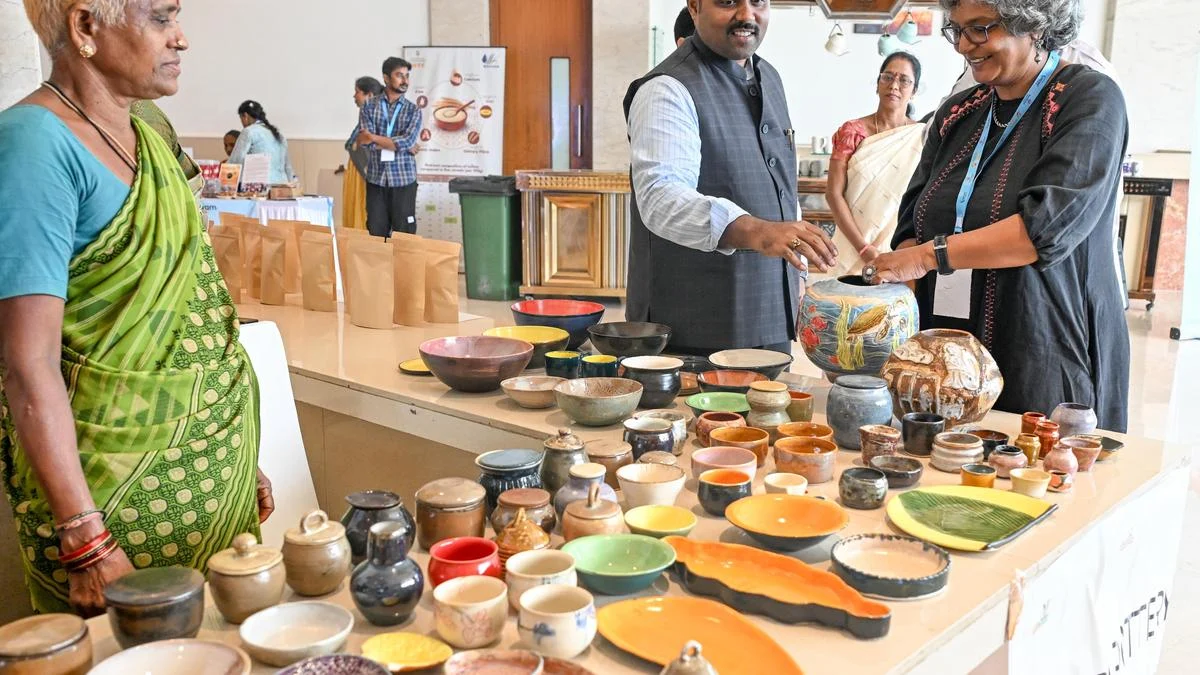
A central highlight was the Exhibition Zone, where the theoretical discussions of the conference hall met the tangible reality of the marketplace. From the sophisticated aesthetic of handcrafted ceramics to the traditional industrial output of dry fish cooperatives, the diversity of the participants illustrated the vast spectrum of the "Mass Entrepreneurship" movement in Andhra Pradesh.
2. Chronology: A Day of Deliberation and Discovery
The day’s proceedings were structured to move from high-level policy discussions to the granular realities of individual entrepreneurs.
The Morning Session: Inauguration and Vision Setting
The event commenced with the arrival of MP M. Sribharat and VMRDA Commissioner N. Tej Bharath. In their opening remarks, the dignitaries emphasized that Visakhapatnam is uniquely positioned to become a lighthouse city for women’s entrepreneurship due to its blend of industrial infrastructure and coastal heritage.
Mid-Day: The "Hamsafal" Initiative and Panel Discussions
Following the inauguration, Divya Sampath of Aspire For Her introduced the Hamsafal programme. This initiative, a collaborative effort with GAME, was presented as a roadmap for strengthening the entrepreneurial journey. The subsequent panel discussions brought together bankers, digital marketing experts, and successful entrepreneurs. They deliberated on the "missing middle"—the phenomenon where women-owned micro-enterprises struggle to scale into small and medium-sized businesses due to a lack of structured support.
Afternoon: Spotlight on Success Stories
The post-lunch sessions were dedicated to "Spotlight Stories," where entrepreneurs shared their raw experiences—detailing the hurdles of balancing domestic expectations with professional ambitions. These sessions highlighted the importance of "ecosystem enablers," such as VCCI, in providing the mentorship necessary to navigate bureaucratic and financial red tape.
The Exhibition Tour: Engaging with the Grassroots
The day concluded with a guided tour of the exhibition stalls. VMRDA Commissioner N. Tej Bharath spent significant time at the Arra Pottery stall, engaging with the artisans about the challenges of kiln logistics and urban retail. Similarly, officials visited the Visakhapatnam Town Fisherwomen Dry Fish Cooperative Society stall, a legacy institution that represents the backbone of the region’s traditional economy.
3. Supporting Data: The Landscape of Women-Led Enterprises
To understand the significance of this conference, one must look at the broader economic context of Andhra Pradesh and India.
- The Cooperative Strength: The Visakhapatnam Town Fisherwomen Dry Fish Cooperative Society stands as a testament to longevity and collective bargaining. Registered in 1987, the cooperative boasts 164 active members. For nearly four decades, these women have managed the entire value chain—from procurement and processing to marketing—proving that grassroots leadership is not a new concept, but one that requires modern "up-skilling."
- The Power of Networks: Aspire For Her (AFH) reported a staggering reach of 1.2 million women across its nationwide network. This scale is vital because data consistently shows that women-led businesses are more likely to hire other women and reinvest up to 90% of their income back into their families and communities.
- The Digital Divide: According to discussions at the event, while mobile penetration is high, only a small fraction of women entrepreneurs in the MSME (Micro, Small, and Medium Enterprises) sector utilize e-commerce platforms or digital bookkeeping. The conference aimed to address this "participation gap" by introducing tools specifically designed for non-urban business owners.
4. Official Responses: Strategic Commitments to Growth
The presence of high-ranking officials provided a sense of administrative backing to the entrepreneurial efforts on display.

M. Sribharat, Member of Parliament:
The MP emphasized the role of policy in creating a "frictionless" environment for women. He noted that the government is increasingly looking at "Mass Entrepreneurship" as the primary driver for job creation. "The goal is to ensure that a woman starting a business in a small coastal village has the same access to the global market as a tech founder in an urban hub," he remarked during the networking session.
N. Tej Bharath, VMRDA Commissioner:
Focusing on urban infrastructure, the Commissioner highlighted the need for dedicated physical spaces where women entrepreneurs can showcase their products year-round. "Visiting stalls like Arra Pottery shows the immense talent available in our city. The VMRDA is committed to integrating these entrepreneurs into the urban fabric of Visakhapatnam, ensuring they have the visibility they deserve," he stated.
Subhash Kiran, Programme Director, GAME:
Mr. Kiran provided the philosophical framework for the event. Speaking to the media, he explained, "Entrepreneurship flourishes when local ecosystems work together. We are not just looking for the next ‘unicorn’ startup; we are looking to help thousands of women move beyond subsistence livelihoods. Through our collaborations, we are building the scaffolding that allows these enterprises to scale and access larger institutional markets."
Divya Sampath, Aspire For Her:
Ms. Sampath focused on the community aspect. "With our community of 1.2 million, we have the data to know what women need: mentorship, peer support, and direct access to opportunities. The Hamsafal programme is our way of institutionalizing that support," she said.
5. Implications: From Subsistence to Scale
The "Celebrating Women Entrepreneurs" conference marks a pivotal shift in how Visakhapatnam views its economic future. The implications of this event and the ongoing Hamsafal programme are manifold:
Economic Formalization of Grassroots Groups
The inclusion of legacy groups like the Fisherwomen’s Cooperative suggests a move toward formalizing the informal economy. By providing these women with training in modern packaging, hygiene standards, and digital payments, the regional government can significantly increase the GDP contribution of the traditional sectors.
Cultural Shift in Entrepreneurship
The event successfully blurred the lines between "traditional crafts" and "modern business." By placing handcrafted ceramics (Arra Pottery) alongside dry fish processing, the conference sent a clear message: all women-led ventures are part of the same value-creation ecosystem. This helps in destigmatizing traditional trades while elevating them through modern business practices.
The Tier-2 City Advantage
Visakhapatnam’s success with this conference serves as a blueprint for other Tier-2 cities in India. As Tier-1 cities become saturated, the real growth in mass entrepreneurship is expected to come from regions that can successfully marry their local resources (like Vizag’s marine and artistic heritage) with global market standards.
Addressing the "Credit Gap"
One of the most profound implications discussed was the need to fix the credit pipeline. While micro-finance has been successful, the transition to larger commercial loans remains difficult for women. The deliberations at this conference are expected to lead to more targeted workshops between the VCCI and local banks to create gender-sensitized financial products.
Conclusion
The conference in Visakhapatnam was more than a one-day gathering; it was a call to action for a more inclusive economic architecture. As the 164 members of the Fisherwomen’s Cooperative and the artisans of Sankalpa Art Village return to their work, they do so with a renewed sense of belonging to a larger national movement. With the combined weight of the VMRDA, the MP’s office, and organizations like GAME and AFH, the journey from grassroots leadership to global market access now has a clearer, more supported path forward.
The success of the "Hamsafal" initiative in the coming months will likely determine how quickly these small-scale sparks of entrepreneurship can be fanned into a sustainable economic flame for the region of Andhra Pradesh.
